Laughing Hyena
  • Home
  • Hyena Games
  • Esports
  • NFT Gaming
  • Crypto Trends
  • Game Reviews
  • Game Updates
  • GameFi Guides
  • Shop
Tag:

trade

Tools of the trade: I upgraded my gaming PC with a 420mm Arctic Liquid Freezer 3 AiO and vertical GPU mount, and now it looks incredible
Game Reviews

Tools of the trade: I upgraded my gaming PC with a 420mm Arctic Liquid Freezer 3 AiO and vertical GPU mount, and now it looks incredible

by admin October 6, 2025


With Battlefield 6 on the horizon – plus plenty of Borderlands 4, MechWarrior 5: Mercenaries and Hades 2 to play – I wanted to upgrade my AMD Ryzen 7 9800X3D and RTX 4090 Founders Edition gaming PC to better cope with these demanding titles.

The goal here is to improve temperatures, reduce fan noise and maybe make things look a little nicer, so I’ll be swapping the (admittedly chonky) 240mm AiO liquid cooler I currently have installed for a massive 420mm unit from Arctic. With more surface area and larger fans, I should be able to run the fans at lower speeds while still achieving much better cooling performance in these and other CPU-heavy games.

I set aside Friday morning to make the swap, and the results exceeded my expectations. I’ll share what I learned, why I made the choices I did, and also discuss the titanic Havn HS 420 VGPU case that I’ve been using for the past six months.

Part one: Arctic Liquid Freezer 3 Pro RGB install and mini review

I’ve been relatively happy with the Hyte Thicc Q60 240mm AiO CPU cooler I’ve been using for the past few months, with its pleasant black/white colour scheme and surprisingly good thermal performance for its size, but it does have some flaws. First, the display screen attached to the CPU block made it impossible for me to vertically mount my graphics card, as it hung down too far below the CPU socket.

More critically though, despite its incredibly thick radiators, it’s still limited by its dual 120mm fans, which need to spin relatively fast to push enough air through the thick rad. By replacing this unit with a (remarkably, around $100 cheaper) 420mm Arctic Liquid Freezer 3 Pro RGB AiO with three wider 140mm fans, I ought to be able to hit similar or even lower temperatures while running the fans significantly slower, cutting down on noise.

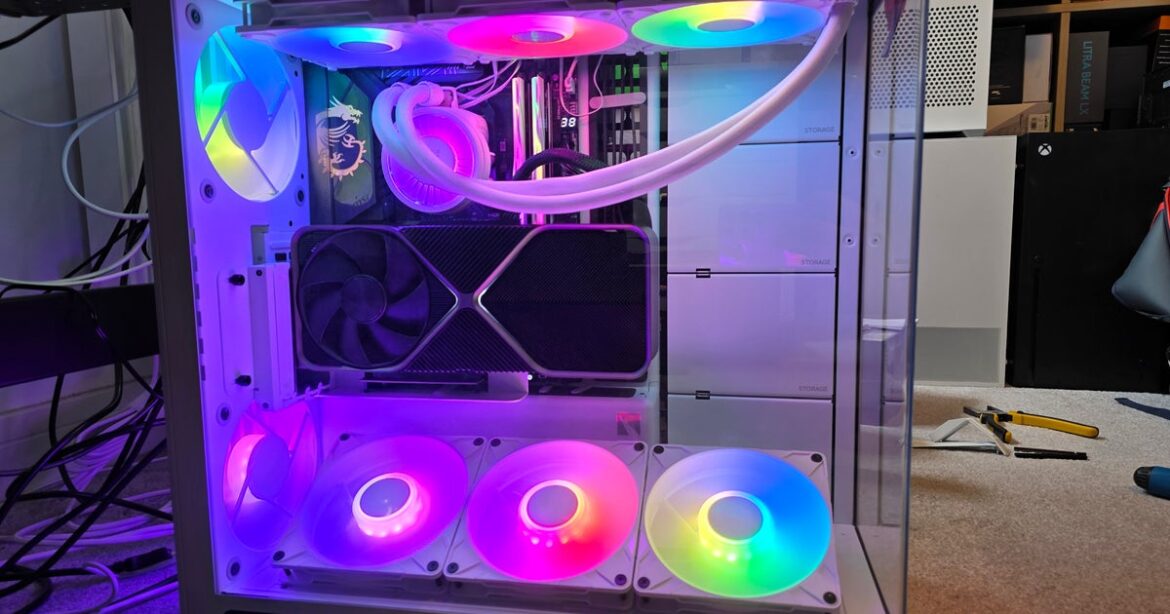
Here’s how my work PC looked before I started this project, with the Hyte Thicc Q60 240mm AiO installed. I dig the white/black colour scheme, but fan noise was relatively high. | Image credit: Eurogamer

Removing the Thicc Q60 was straightforward in the Havn HS 420 VGPU, as the case provides easy access to both sides of the computer and has clearly marked apertures for cable routing. The Arctic Liquid Freezer 3 Pro RGB (hereafter “new CPU cooler”) also has a relatively thick 38mm radiator, so rather than mounting it on the side access panel as I did with the Q60, I’ll be installing it at the top of the case and replacing the storage covers to cover the empty gap. A top placement also ensures that the pump on the CPU block is below the level of the radiator, which is generally good practice.

Installing the Arctic cooler was easy, with the fans installed on the block out of the box in the top-exhaust configuration that I wanted. The only real struggle I had with the new CPU cooler was deciding on which way up it should go. Initially, I wanted to install it with the Arctic logo on the included magnetically-attached CPU block fan the right way up, but this meant that the tubes were at the bottom and they interfered with the vertical GPU mount. In the end, I decided to sacrifice the aesthetics and live with the upside-down wordmark.

Here’s the Arctic Liquid Freezer 3 Pro A-RGB install, starting with the CPU block installed the right way up, then later upside-down to accommodate the vertical GPU mount. | Image credit: Eurogamer

With the new CPU cooler installed, I noted significantly lower CPU and GPU temperatures, with both sitting around 60 degrees celsius in Borderlands 4 (with around 50 percent load on the 9800X3D and 95 percent load on the RTX 4090), versus around 65-70 celsius CPU temperatures with the old setup. Even at maximum load – eg compiling shaders in Borderlands 4, a heavy all-core task that can last several minutes – the fans never ramped up to their maximum speed as they did before.

As well as the boost to performance, I appreciated the lack of a display on the CPU block, as it meant that the entire system only requires a single fan header and a single A-RGB header to run four fans. The last few high-end AiOs I’ve used from Hyte, Asus and NZXT have included displays, requiring a PCIe or SATA power connector and USB 2.0 connections, so going back to a simpler system was an unexpected relief.

Part two: vertical GPU swap

Moving from a traditional horizontal GPU mount to a vertical one provides a bit of an aesthetic boost, and for a large GPU like the RTX 4090 FE I’m using here, an extra sense of stability as well.

There’s plenty of space here between the RTX 4090 FE and the side of the case, which is always a worry for vertical GPU setups. | Image credit: Eurogamer

The Havn HS 420 VGPU case is designed for this, and therefore includes an extra assembly that replaces the usual PCIe slots and provides a PCIe 4.0 riser cable. The downside is a more complicated install process and blocking access to your extra PCIe ports, but given the rarity of second graphics cards or other add-in cards, that’s probably a trade most builders would be quite happy to make.

I found it easiest to install the 4090 into the vertical assembly first, then install the whole deal into the case. That makes pushing in the PCIe riser cable a tad tricky, but means that the graphics card itself doesn’t risk being damaged when you’re trying to pop it into the PCIe socket. Here, the bracket is secured with two thumb screws quite close to the glass window, so it’s easy enough to hold the assembly in place with one hand and secure it with the other.

The goal with vertical GPU placement is to make sure there’s a good amount of space between the card and the glass, so that hot air leaving the card has a chance to be directed away (in this case, by the three fans below). There’s a good two or three inches between the GPU and the side glass here, so that’s good enough for me.

I’m probably still paying a slight performance penalty for using a vertical GPU orientation, but one that I’m happy enough with given the very modest temperatures at full burn in-game.

Part three: Havn HS 420 VGPU long-term review

The £200/$230 Havn HS 420 is a fascinating high-end PC case that offers quite unusual features and a plethora of fan setups, and I’ve found it every bit as performant and sensibly arranged as the Corsair 9000D I was using before. You have more than enough space here for a full-size ATX board with a huge amount of SATA storage and a 420mm AiO, and this ought to hold it in good stead for custom water cooling as well. There’s even a bit of extra glass included in the box to virtually divide the CPU and GPU areas of the case, though I didn’t end up using it.

I particularly like the aesthetics of the case, with the rounded motif replicated across the top I/O (USB-C, two USB-A, 3.5mm) and power button, the various air inlets in the base and lid, the unusual circular rear fan mounts and so on. The white case works well with the white RAM, white Arctic P14 Pro fans and white Arctic Liquid Freezer 3 Pro A-RGB AiO cooler, and I only wish that I had a white motherboard and graphics card to complete the look.

A great-looking case, with plenty of well-designed space in the rear for accommodating cable clutter, removable frames for AiO installation and a consistent rounded aesthetic for various elements. | Image credit: Eurogamer

The curved glass used for the front and side of the case is also truly impressive, with a well-engineered system that slides it out before releasing it. I’m not such a huge fan of the small screws used to secure each side, as there’s no good place to store these if you want to leave the system in a state where it’s easy to pull apart for maintenance, upgrades or cleaning, and consequently I’ve lost them. However, at least with them removed, it’s easy enough to access each of the dust filters.

In terms of cable routing, the rear of the case provides a useful amount of space, all cable routes are clearly labelled, and there’s a surplus of tie points and so on. Installing fans and radiators is also made easier by the fact that each of the main sections (top, side, bottom) have removable frames, so you can install the rads/fans onto the frame outside of the case, then re-insert the frames.

Overall, it’s not the quietest or coolest case that I’ve ever used – I suspect that I may want to explore alternative fan arrangements, reduce fan RPMs further and/or use extra fans in the side intake to keep CPU temperatures even lower – but that’s OK. The Havn HS 420 VGPU is still comfortably the best-designed PC case I’ve tested, with great aesthetics and streamlined build experience, and I’d happily recommend it.

What I’ve learned, and what’s next

I’m happy with my redesigned gaming PC for now, but it’ll be interesting to see how it fares with next-gen graphics cards when they arrive down the line – especially if they again see an uptick in power consumption and therefore waste heat production. For the more imminent future, I’m planning to upgrade to a 9950X3D, which ought to produce a little more heat on the CPU side and therefore allow me to fully tune the fans to deal with worst-case scenarios.

I’m also curious to hear your comments and suggestions – should I turn around one of the rear fans as an exhaust, as I’ve seen elsewhere online? Add side intake fans? Get in touch with a company that will supply a white graphics card and motherboard? Clean up my cable mess? Some of these are possible, so do get in touch via the comments below or via Bluesky.


To see this content please enable targeting cookies.

Manage cookie settings


Source link

October 6, 2025 0 comments
0 FacebookTwitterPinterestEmail
SEC on Track to Allow Stocks to Trade Like Crypto
NFT Gaming

SEC on Track to Allow Stocks to Trade Like Crypto

by admin October 1, 2025


According to a recent report by The Information, the U.S. Securities and Exchange Commission (SEC) is considering allowing blockchain-based versions of popular stocks (for instance, Tesla or Nvidia) to trade on popular exchanges. 

The tokenized versions of stocks would be available for trading on approved cryptocurrency platforms. 

However, it is worth noting that the novel and innovative idea is still in the early stages, meaning that there is no guarantee that it will end up being implemented. 

Recently, SEC Commissioner Hester Peirce stated that the regulator was willing to work with tokenized initiatives. 

xStocks (with disclaimers) 

Meanwhile, several cryptocurrency exchanges already offer xStocks. Kraken launched tokenized equities on Solana earlier this year. The offering includes popular stocks (such as Tesla) as well as some ETFs. It was later expanded to BNB Chain. 

In September, Kraken brought its tokenized equities offering to the Ethereum mainnet. 

KuCoin and Bybit have also launched xStocks on their respective platforms. 

However, it is worth noting that many of these offerings are not currently available in the US. Moreover, there are some concerns about ownership and rights since token holders do not have full shareholder rights. 

Hence, the SEC’s formal approval for tokenized stocks could potentially end up being a game-changer for the budding market niche. It would essentially turn these stocks into a regulated securities product, and U.S.-regulated broker dealers would be able to offer them.


Source link

October 1, 2025 0 comments
0 FacebookTwitterPinterestEmail
ASTER VS HYPERLIQUID, XPL BULL & BEAR CASE, DAT TRADE IN TROUBLE
NFT Gaming

ASTER VS HYPERLIQUID, XPL BULL & BEAR CASE, DAT TRADE IN TROUBLE

by admin September 30, 2025


ASTER VS HYPERLIQUID, XPL BULL & BEAR CASE, DAT TRADE IN TROUBLE

Bitcoin strength continues, altcoins mixed. Various l1 etfs may be approved very soon. Sec-cftc turf war is over: pham. Sec willing to engage with token issuers: pierce. Senate committee to meet to examine crypto taxes. Wisconsin may open up licenses to crypto firms. Strategy buys $22m btc, bitmine buys $963m eth. Ibit becomes top btc options venue. Sec pauses trading of the dat qmmm. Ny crypto regulator harris steps down. Binance launches ‘crypto-as-a-service’ solution. Cronje’s flying tulip raises $200m at $1b valuation. Falconx rolls out 24×7 crypto options trading. Republic plans to tokenise animoca’s equity on sol. Kazakhstan launches crypto reserve. Bitcoin may join central bank reserves by 2030: db.


Source link

September 30, 2025 0 comments
0 FacebookTwitterPinterestEmail
Decrypt logo
NFT Gaming

Elon Musk’s xAI Sues OpenAI Again, This Time Over Alleged Trade Secret Theft

by admin September 26, 2025


In brief

  • Elon Musk’s xAI has sued OpenAI, alleging it induced former employees to steal source code and data center deployment strategies.
  • The AI company alleges OpenAI targeted employees with knowledge of its “secret sauce” data center operations, with one executive refusing to sign confidentiality documents after leaving for OpenAI.
  • One engineer allegedly admitted in a “handwritten confession” to misappropriating code after encrypted communications with an OpenAI recruiter.

Elon Musk’s artificial intelligence company xAI filed a federal lawsuit on Wednesday against OpenAI, accusing its rival of orchestrating a “coordinated, unfair, and unlawful campaign” to steal proprietary technology through targeted employee poaching.

The complaint, filed in California, alleges OpenAI “by hook or by crook” induced former xAI employees to misappropriate the company’s entire source code, training methods, and data center deployment strategies.

Musk, a co-founder of OpenAI alongside Sam Altman, Greg Brockman, Illya Sutskever, and others in 2015, stepped down from the board in 2018, citing conflicts of interest with his company, Tesla, and its self-driving cars. Since then, the tech billionaire has assumed a combative stance against OpenAI, including filing a separate lawsuit last month.


OpenAI recruiter Tifa Chen simultaneously targeted multiple xAI employees, offering multi-million dollar packages to engineers who then stole source code and uploaded it to personal devices within hours of their communications, the lawsuit alleges.

Xuechen Li, an early xAI engineer, allegedly “uploaded the entire xAI source code base to a personal cloud account” in July 2025, and later “admitted in a handwritten confession” that he misappropriated xAI’s code and presentation materials on training techniques.

The lawsuit details timestamps showing Li’s code theft occurred within hours of encrypted Signal messages with Chen, who allegedly responded “no way!” after Li copied the files, before OpenAI extended its multi-million dollar offer.

Jimmy Fraiture, another early xAI engineer, allegedly “used the AirDrop feature to transfer” confidential source code “at least five times” after signing with OpenAI, stealing “the majority of xAI’s code” he oversaw, plus experimental folders from four co-founders.

An unnamed senior finance executive who left for OpenAI allegedly called these operations xAI’s “secret sauce,” saying, “The data center team. Their speed and precision blew me away. I would NEVER want to compete against them.”

The executive then took a lesser role at OpenAI, focused on data center spending strategy even though he had no prior AI experience, and when confronted about confidentiality obligations, allegedly “responded with crude sexual expletives” and refused to sign termination documents.

Navodaya Singh Rajpurohit, legal partner at Coinque Consulting, told Decrypt  the case “leans heavily on employee poaching,” noting that whether it crosses from aggressive recruiting to unlawful misappropriation “will depend on evidence not included in the filing,” and that “hiring alone is rarely enough to prove trade-secret misuse.”

Ishita Sharma, managing partner at Fathom Legal, told Decrypt that xAI must define its “secret sauce” broadly, grouping GPU racking, vendor contracts, pricing curves, and orchestration playbooks, which, she noted, can be described “by the results they deliver — like faster deployment or cheaper scaling,  without putting the exact technical diagrams or formulas on the record.”

Sharma said “the recruiter angle is trickier,” since liability depends on whether recruiters acted as agents of OpenAI with the company’s knowledge. 

For OpenAI’s defense, she explained, the strongest approach would be to show independent creation through “time-stamped records: internal Git commits, R&D notes, supplier invoices, and emails,” with earlier documentation providing the most credibility.

xAI seeks damages, restitution, and injunctions requiring OpenAI to purge xAI material from its systems and even destroy models built with it.

The lawsuit adds to Musk’s ongoing legal battle with OpenAI, as last month, his companies filed an antitrust suit against Apple and OpenAI, claiming their exclusive iPhone integration creates unfair market dominance.

Generally Intelligent Newsletter

A weekly AI journey narrated by Gen, a generative AI model.


Source link

September 26, 2025 0 comments
0 FacebookTwitterPinterestEmail
Ethereum Trade on Hyperliquid Stands Out as Largest Amid $1B Crypto Liquidations
Crypto Trends

Ethereum Trade on Hyperliquid Stands Out as Largest Amid $1B Crypto Liquidations

by admin September 26, 2025


An ETH$3,953.08 trade on Hyperliquid turned out to be the biggest liquidation hit in the past 24 hours as crypto traders took on more than $1.19 billion in leveraged positions amid a market downturn.

Longs made up nearly 90% of the overall wipeout, per CoinGlass, leaving over 260,000 traders losing money and exposing the market’s bullish overcrowding.

Ether bore the brunt with $448 million in liquidations, followed by BTC$109,488.33 at $278 million. Solana’s SOL (SOL), XRP$2.7715, BNB Chain’s BNB (BNB) and DOGE$0.2274 all saw tens of millions flushed out.

But the single largest trade closure came on Hyperliquid — a $29.1 million ETH-USD long hit which is indicative of the growing role of decentralized perpetual exchanges in driving liquidations.

Bybit handled the most overall liquidations at $311 million, but Hyperliquid followed closely with $281 million, ahead of Binance’s $243 million.

For a relatively recent protocol that operates fully on-chain with no KYC or regulatory firewalls, Hyperliquid’s share of liquidations points to traders piling risk into perpetual decentralized exchanges (DEXs) in size. A 97% long bias further showed how aggressively users were positioned before the flush.

The wave came as sentiment remains fragile and bitcoin sees volatile price action around the $111,000 mark. Spikes in liquidations are often read as clearing events that pave the way for reversals, but with positioning stretched across majors and high-beta tokens alike, downside risks linger.

Meanwhile, some say projects with strong revenue flows could emerge attractive to traders amid an otherwise risk-off mood.

“While crypto markets are down, capital is still rotating from Bitcoin into altcoins, with perpetual decentralized exchanges (Perp DEXs) like Hyperliquid and Aster leading the charge,” said Nick Ruck, director at LVRG Research.

“We expect altcoins to slowly grind upward as investors seek projects that can decouple from macro pressures and continue to grow based on their own utility,” Ruck added.


Source link

September 26, 2025 0 comments
0 FacebookTwitterPinterestEmail
Decrypt logo
GameFi Guides

These AI Bots Will Trade Your Crypto Across Solana, BNB Chain and Base

by admin September 25, 2025


In brief

  • AIQuant launched a crypto trading platform with customizable AI agents.
  • The AI agents trade on Base, Solana, and BNB Chain, removing human emotion from trading.
  • A native AIQ token will support staking, governance, and future platform features.

AI Quant Labs, an Atlanta-based startup specializing in automated crypto trading, launched its AIQuant platform on Thursday, aiming to tap into a new crop of AI platforms that give crypto investors access to bots that never sleep.

The trading platform allows users to create and deploy autonomous agents across multiple blockchains, marking yet another step in the broader trend of automated tools moving from professional desks to retail investors.

AIQuant is leaning into that shift by promising an “end-to-end” AI trading experience that integrates everything from strategy design to execution.

“AIQuant.fun puts hedge fund-grade tools in the hands of everyday traders,” founder Marlon Williams told Decrypt. “Unlike closed bots, our platform lets anyone create and refine their own autonomous trading strategy without writing code.”


Combining automation, gamification, and community incentives, the startup is betting that traders who may have been hesitant to use trading bots will now give them a chance.

By providing traders with access to AI agents that operate 24/7, AIQuant aims to make high-frequency trading accessible beyond traditional financial institutions. For Williams, the pitch is simple: money never sleeps, and neither should trading.

Traders can develop autonomous agents that analyze real-time data and execute trades according to preset strategies. Unlike human traders, these AI agents operate around the clock, a feature the company says removes emotion from trading and allows for greater consistency.

As Williams explained, AIQuant bots are more than just another ChatGPT knockoff.

“AIQuant.fun agents are not chatbots or image generators, although you can chat to your quant,” he said. “They are trading strategies that process market data and execute logic-based trades, built entirely around performance.”

At launch, AIQuant supports decentralized exchanges on Base, Solana, and BNB Chain, and plans to expand to other blockchains. According to the company, setting up an AI Quant takes just a few clicks, lowering the barrier to entry for beginners while providing tools sophisticated enough for advanced users.

“AIQuant.fun does not run centralized bots. Each strategy operates through audited smart contracts with parameters defined by the creator, limiting exposure,” Williams explained. “Users define assets, position sizes, and risk thresholds in advance. Quants cannot move outside these guardrails, so execution always stays within the limits set by the creator.”

Instead of relying on subscription plans, AIQuant has adopted a one-time “hatching fee” model. Users pay a one-time fee—initially in Ethereum, later in the platform’s AIQ token—to activate their trading agents. Each AIQuant agent includes features such as adaptive stop-loss and take-profit settings, customizable evaluation criteria, and slippage controls.

“As adoption grows, demand for AIQ scales directly with platform usage,” Williams said. “Tokenized quants built on bonding curves will create new mechanics for ownership and liquidity, further deepening AIQ’s role at the center of the ecosystem.”

Later this year, the platform plans to roll out additional features tied to a bonding curve mechanism. That update will introduce a “Core Mode” allowing quants to be tokenized, which the company said adds “gamified experiences.”

Analysts note that while AI-driven strategies can outperform humans under certain conditions, they also raise questions about market stability and fairness. The rise of retail-focused AI-bots could lead to more competition for liquidity on decentralized exchanges, potentially squeezing margins or amplifying sudden price swings.

Despite these concerns, the launch comes amid rapid growth in algorithmic and AI-assisted trading, which is increasingly taking over crypto trading—from autonomous bots in prediction markets to retail tools that analyze data and execute trades in real time.

Generally Intelligent Newsletter

A weekly AI journey narrated by Gen, a generative AI model.


Source link

September 25, 2025 0 comments
0 FacebookTwitterPinterestEmail
DAAPrivacyRightIcon
Product Reviews

xAI accuses OpenAI of stealing its trade secrets in new lawsuit

by admin September 25, 2025


Elon Musk’s xAI is suing OpenAI, alleging that the ChatGPT maker has stolen its trade secrets. The lawsuit comes after the company recently sued a former employee, Xuechen Li, for allegedly stealing confidential information from the company before taking a job at OpenAI.

In its latest lawsuit, which was reported by Sherwood, xAI says that Li’s alleged actions are part of “a broader and deeply troubling pattern of trade secret misappropriation, unfair competition, and intentional interference with economic relationships by OpenAI.” According to xAI’s lawyers, OpenAI also hired two other xAI employees who stole proprietary information from Musk’s company.

“Another early xAI engineer—Jimmy Fraiture—was also harvesting xAI’s source code and airdropping it to his personal devices to take to OpenAI, where he now works,” the lawsuit states. “Meanwhile, a senior finance executive brought another piece of the puzzle to OpenAI—xAI’s ‘secret sauce’ of rapid data center deployment—with no intention to abide by his legal obligations to xAI.”

OpenAI didn’t immediately respond to a request for comment on the lawsuit. Musk, of course, has a complicated history with the ChatGPT maker, and this isn’t the first time his rival AI company has sued OpenAI. Last month, xAI filed lawsuits against OpenAI and Apple over Grok’s placement on App Store charts. Musk alleged that ChatGPT rank in the top spot represented an “unequivocal antitrust violation.” Musk has also filed numerous lawsuits against OpenAI over its relationship with Microsoft and its move to become a for-profit company.


Source link

September 25, 2025 0 comments
0 FacebookTwitterPinterestEmail
Decrypt logo
Crypto Trends

Crypto Asset Manager CoinShares to Trade on Nasdaq in $1.2 Billion SPAC Deal

by admin September 8, 2025


In brief

  • European crypto asset manager CoinShares has announced plans to go public in the U.S. on the Nasdaq.
  • The deal sees CoinShares enter an agreement with Vine Hill Capital Investment Corp.
  • A number of crypto firms have gone public this year or have signaled plans to do so.

European digital asset fund manager CoinShares on Monday announced plans to go public on the Nasdaq in the United States.

St Helier, Jersey-based CoinShares, which manages around $10 billion in assets, said it had entered into an agreement with blank-check company Vine Hill Capital Investment Corp. in a transaction valuing CoinShares at $1.2 billion pre-money on a pro-forma basis. 

CoinShares stock—which currently trades on the Nasdaq Stockholm—was trading about 1% higher on Monday after surging to a 52-week high earlier in the day. CoinShares will no longer trade on the Swedish exchange once it goes public in the U.S.


“This transaction represents far more than a change of listing venue from Sweden to the United States,” CoinShares CEO and co-founder Jean-Marie Mognetti said in a statement. “It signals a strategic transition for CoinShares, accelerating our ambition for global leadership, supported by favorable regulatory tailwinds.”

CoinShares, which mostly manages crypto exchange-traded funds, last year bought Valkyrie Funds, giving it control over a number of top Bitcoin and Ethereum ETFs by the asset manager.

The move to the U.S. market comes amid a wave of firms in the crypto space going public following a more favorable environment under President Trump’s administration.

The Peter Thiel-backed crypto exchange Bullish debuted on the New York Stock Exchange last month, while San Francisco-based Circle, which issues the USDC stablecoin, had a roaring June NYSE debut. Other firms such as Gemini and Figure Technologies are preparing to go public in the near future.

BIG NEWS: CoinShares → NASDAQ US
We’re going public in the U.S. via business combination with Vine Hill ($VCIC).

$1.2B pre-money valuation.
Expected to be one of the largest publicly traded digital asset managers globally.

Transaction subject to customary closing conditions &… pic.twitter.com/5DJb0rrpQr

— CoinShares (@CoinSharesCo) September 8, 2025

President Donald Trump campaigned on a ticket to help the industry, and the U.S. commander in chief has a number of personal digital asset ventures—including his own official Solana-based meme coin, and the World Liberty Financial crypto platform.

A Bitcoin miner partially owned by two of his sons, American Bitcoin, debuted on the Nasdaq last week, soaring over 80% in its Nasdaq debut before quickly losing its gains. ABTC was trading for nearly $5 per share—up close to 5%—on Monday after hitting a high of $13.93 last week.

Daily Debrief Newsletter

Start every day with the top news stories right now, plus original features, a podcast, videos and more.


Source link

September 8, 2025 0 comments
0 FacebookTwitterPinterestEmail
HBAR/USD (TradingView)
GameFi Guides

HBAR Sees Steady Gains as Institutions Step In During Trade Tensions

by admin September 8, 2025


HBAR Maintains Steady Gains Amid Institutional Support
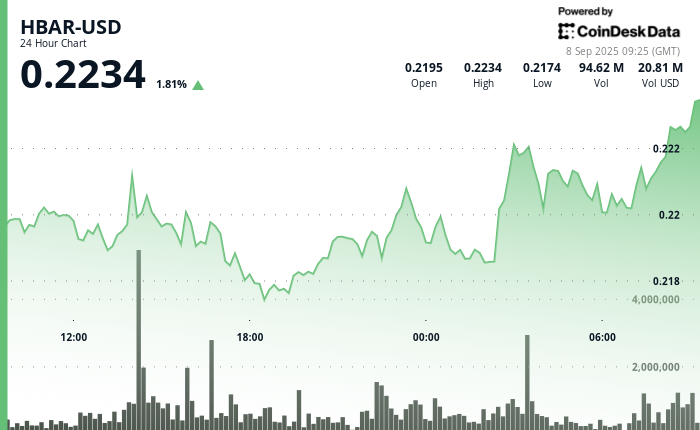
Hedera’s HBAR token posted steady gains in a 23-hour trading stretch from September 7 at 09:00 through September 8 at 08:00, trading within a tight $0.0042 band. Price action reflected just 2% volatility between key $0.22 support and resistance levels, underscoring a period of relative stability for the enterprise-focused digital asset.

Institutional Liquidity Surge Anchors Price
Market data showed a notable uptick in institutional participation during the September 7 afternoon session. Trading volumes spiked to 67.40 million units at 14:00—well above the 24-hour average of 27.33 million—as buyers stepped in to provide liquidity at the $0.22 level. That intervention helped anchor the token’s price after a brief dip during the 18:00 hour.

Corporate Interest Drives Renewed Momentum
Fresh corporate activity emerged in the early hours of September 8, with renewed demand evident from 02:00 onward. HBAR closed the period at $0.22, marking a modest 1% advance. Analysts suggest the pattern highlights growing confidence among enterprise adopters of distributed ledger technology, with Hedera positioning itself as a leading solution for corporate blockchain applications.

HBAR/USD (TradingView)

Trading Pattern Analysis
  • HBAR established technical support at $0.22 following an initial advance to the same level at 07:28, with subsequent price consolidation forming an upward trending channel.
  • The token maintained consistent institutional buying interest above 600,000 units across multiple trading intervals during the one-hour analysis window.
  • A breakout above $0.22 resistance occurred in the final trading minutes, suggesting continued institutional accumulation and potential for further price appreciation.
  • Peak volume activity reached 3.23 million units at 07:35, reflecting heightened institutional participation and market liquidity.
  • The $0.0042 trading range represented 2% intraday volatility, demonstrating relatively stable price action despite broader market uncertainties.

Disclaimer: Parts of this article were generated with the assistance from AI tools and reviewed by our editorial team to ensure accuracy and adherence to our standards. For more information, see CoinDesk’s full AI Policy.


Source link

September 8, 2025 0 comments
0 FacebookTwitterPinterestEmail
Google Pixel 10 on blue background with big savings text overlay
Gaming Gear

This Pixel 10 deal at Visible Wireless gets you $480 off without the annoying trade

by admin September 6, 2025


Tempted by the latest Google Pixel 10 series of devices, but don’t want to trade-in or sign up for a hefty postpaid plan? Visible Wireless’ latest deal might just fit the bill.

The carrier his currently offering an excellent $480 rebate on all three devices when you pair one up with a Visible Plus Pro plan – an excellent saving that doesn’t require the usual trade-in criteria.

This particular deal is currently only available with new lines, so existing customers will have to sit this one out, unfortunately. It’s also worth noting that this discount comes in the form of a $20/mo rebate over the duration of a two-year period, so it’s definitely one that’s aimed at those in it for the long haul.

If you are interested, however, then Visible Wireless is definitely one of the better options available for prepaid plans. The Visible Plus Pro plan comes with completely unlimited data on the super-speedy Verizon 5G Wideband network, HD video streaming, and unlimited mobile hotspot allowance, so it’s a great alternative to the bigger carriers. At $45/mo ($25 with this deal), it’s also much easier on the pocket.

Google Pixel 10 deal at Visible Wirless

Other great Pixel 10 deals to consider


Source link

September 6, 2025 0 comments
0 FacebookTwitterPinterestEmail
  • 1
  • 2
  • 3

Categories

  • Crypto Trends (1,098)
  • Esports (800)
  • Game Reviews (772)
  • Game Updates (906)
  • GameFi Guides (1,058)
  • Gaming Gear (960)
  • NFT Gaming (1,079)
  • Product Reviews (960)

Recent Posts

  • This 5-Star Dell Laptop Bundle (64GB RAM, 2TB SSD) Sees 72% Cut, From Above MacBook Pricing to Practically a Steal
  • Blue Protocol: Star Resonance is finally out in the west and off to a strong start on Steam, but was the MMORPG worth the wait?
  • How to Unblock OpenAI’s Sora 2 If You’re Outside the US and Canada
  • Final Fantasy 7 Remake and Rebirth finally available as physical double pack on PS5
  • The 10 Most Valuable Cards

Recent Posts

  • This 5-Star Dell Laptop Bundle (64GB RAM, 2TB SSD) Sees 72% Cut, From Above MacBook Pricing to Practically a Steal

    October 10, 2025
  • Blue Protocol: Star Resonance is finally out in the west and off to a strong start on Steam, but was the MMORPG worth the wait?

    October 10, 2025
  • How to Unblock OpenAI’s Sora 2 If You’re Outside the US and Canada

    October 10, 2025
  • Final Fantasy 7 Remake and Rebirth finally available as physical double pack on PS5

    October 10, 2025
  • The 10 Most Valuable Cards

    October 10, 2025

Newsletter

About me

Welcome to Laughinghyena.io, your ultimate destination for the latest in blockchain gaming and gaming products. We’re passionate about the future of gaming, where decentralized technology empowers players to own, trade, and thrive in virtual worlds.

Recent Posts

  • This 5-Star Dell Laptop Bundle (64GB RAM, 2TB SSD) Sees 72% Cut, From Above MacBook Pricing to Practically a Steal

    October 10, 2025
  • Blue Protocol: Star Resonance is finally out in the west and off to a strong start on Steam, but was the MMORPG worth the wait?

    October 10, 2025

Newsletter

@2025 laughinghyena- All Right Reserved. Designed and Developed by Pro


Back To Top
Laughing Hyena
  • Home
  • Hyena Games
  • Esports
  • NFT Gaming
  • Crypto Trends
  • Game Reviews
  • Game Updates
  • GameFi Guides
  • Shop

Shopping Cart

Close

No products in the cart.

Close