
Laughing Hyena
  • Home
  • Hyena Games
  • Esports
  • NFT Gaming
  • Crypto Trends
  • Game Reviews
  • Game Updates
  • GameFi Guides
  • Shop
Tag:

Test

Decrypt logo
NFT Gaming

Hyperliquid Validators to Decide USDH Ticker in First Governance Test Following Pushback

by admin September 8, 2025


In brief

  • Validators will decide the USDH ticker in an on-chain vote scheduled for September 14.
  • Hyperliquid claims the ticker carries no special privileges, while analysts see it as a push to reduce reliance on USDC.
  • Analyst estimates suggest USDH could divert $5.5 billion from USDC and generate $220 million annually for HYPE holders.

Hyperliquid, a decentralized exchange and Layer-1 chain, is slated to place the USDH ticker through a validator vote this month, testing the role of onchain governance in shaping its stablecoin strategy.

In an update posted Sunday to clarify guidelines, the team behind Hyperliquid said the vote concerns only the ticker and does not grant USDH “any special privileges by nature of its ticker name,” adding that USDH “will be only one of many such stablecoins” for its chain.

USDH is the project’s proposed native U.S. dollar stablecoin, intended to serve as an alternative to bridged assets like USDC.


The proposal deadline is September 10 at 10:00 UTC, with validators expected to declare by September 11 before voting takes place on September 14 between 10:00 and 11:00 UTC.

Hyperliquid also said that quote assets, the base currencies used to denominate trading pairs, will become permissionless after upcoming technical upgrades, allowing anyone to create new pairs without approval.

It’s worth noting that the Foundation’s validators will abstain from the vote by aligning with whichever team secures the most non-Foundation support, a mechanism meant to reduce perceptions of centralized influence while keeping the process stake-based.

Still, the vote comes amid unease from some existing stablecoin teams on Hyperliquid, who argue that reopening the USDH ticker risks disadvantaging protocols that were previously forced to build under different names.

Testing opposition

Observers told Decrypt the USDH vote could be a test of Hyperliquid’s effort to use governance to reduce stablecoin dependence.

By putting the ticker to a vote, Hyperliquid is showing that it is “consciously positioning itself in opposition to the centralized control characteristic of many exchanges,” Jaehyun Ha, research analyst at quantitative trading firm Presto, told Decrypt. Such a move elevates “community oversight and transparency as central pillars of its strategy,” he added.

The governance model also “reinforces Hyperliquid’s narrative that it is building a “Hyperliquid-aligned, compliant USD stablecoin” supporting its ecosystem, instead of “relying on external issuers,” Ha said.

The economic design of USDH is also central to its intended role within the Hyperliquid ecosystem.

Hyperliquid’s planned stablecoin aims to cut reliance on USDC and recycle reserve income, with estimates suggesting a 15% liquidity share could divert $5.5 billion and yield $220 million annually for HYPE holders, Ha said.

At this scale of capture, USDH could transform from a stablecoin to become a “powerful economic lever” within Hyperliquid’s ecosystem, Ha added.

Daily Debrief Newsletter

Start every day with the top news stories right now, plus original features, a podcast, videos and more.




Source link

September 8, 2025 0 comments
0 FacebookTwitterPinterestEmail
Chainlink CEO and co-founder Sergey Nazarov
NFT Gaming

How Stripe’s Tempo and Circle’s Arc Fail the Decentralization Test, Explains Libra Co-Creator

by admin September 7, 2025


Christian Catalini, co-creator of Facebook’s Libra project, warned on Friday that Stripe’s Tempo and Circle’s Arc could succeed commercially but at the cost of crypto’s decentralization ideal.

Launched in 2019, Libra was Meta’s bold bid to create a global digital currency backed by a basket of stable assets. The project promised to make payments as seamless as messaging, but it triggered immediate backlash from regulators concerned about financial sovereignty, systemic risk, and user privacy. By 2022, Libra — renamed Diem in a bid to reset its image — was shuttered and its assets sold off.

Catalini, who served as Libra’s chief economist, used his Sept. 5 thread on X to revisit the project’s early compromises and explain why they matter now. He said the original open design, developed with Harvard economist Scott Kominers, was reduced to a short appendix after months of regulatory negotiations.

The first major retreat, he wrote, was abandoning non-custodial wallets. Regulators insisted on a “clear perimeter,” meaning a responsible intermediary they could contact — and penalize — if problems arose.

For supervisors used to intermediated finance, a world where users truly held their own money was unmanageable. “For them, killing self-custody wasn’t a choice, it was an obvious necessity,” he recalled.

Catalini noted the irony: today, open networks are developing compliance tools native to blockchain that could have addressed these concerns more effectively than traditional frameworks. But back then, Libra was forced to strip away decentralization, a change he described as an early signal of where corporate-led projects were heading.

His broader lesson was stark: “As long as there is a single throat to choke — or a committee of them — you can’t truly rewire the system. Worse, any network with an architect is living on borrowed time.”

Arc and Tempo in the Spotlight

Catalini placed Stripe’s Tempo and Circle’s Arc in that context. Both are new blockchains designed explicitly for payments, promoted as stablecoin-first infrastructure for enterprises and fintechs.

Circle launched Arc on Aug. 12, presenting it as a Layer-1 network purpose-built for stablecoin finance. Unlike public chains that rely on volatile gas tokens, Arc uses USDC for fees, offering predictable, dollar-denominated costs.

It integrates a built-in foreign exchange engine, promises sub-second finality, and includes opt-in privacy features. Circle said Arc will support cross-border payments, onchain credit systems, tokenized capital markets and programmable, automated payments.

Just weeks later, Stripe and Paradigm unveiled Tempo on Sept. 4, describing it as a payments-first blockchain capable of handling over 100,000 transactions per second.

The network is EVM-compatible, features a dedicated payments lane with support for memos and access lists, and allows users to pay both transactions and gas in any stablecoin. Stripe said early design partners include Visa, Deutsche Bank, Revolut, Nubank, Shopify, OpenAI, Anthropic and DoorDash.

Both projects were marketed as steps toward mainstreaming stablecoin payments. But for Catalini, they raised a deeper concern.

A Revolution or a Failed Coup?

Catalini argued that corporate-led chains like Arc and Tempo risk simply rebuilding the old financial system with new players in charge. Instead of displacing card networks and banks, he warned, they could elevate fintech giants to the same position of dominance. “The throne will have new occupants, but it will be the same throne,” he wrote.

He also predicted such networks would fracture geopolitically, with Western and Eastern blocs unlikely to share a single corporate-led infrastructure. The result, he said, would be competing financial empires rather than the borderless system crypto’s early advocates envisioned.

Ultimately, Catalini described Stripe’s Tempo as a “referendum on the ghost of Libra.” If it thrives, he suggested, it may prove Libra failed because of timing, not design — and show that the dream of open, permissionless money has been overtaken by more pragmatic, centralized solutions.


Source link

September 7, 2025 0 comments
0 FacebookTwitterPinterestEmail
A fairer test of what makes good money
NFT Gaming

Stripe, Paradigm test new rails for stablecoin payments with Tempo

by admin September 4, 2025


Stripe and Paradigm’s new blockchain project, Tempo, shifts the focus from DeFi to core business functions. Its architecture is optimized for payroll, B2B invoices, and remittances, seeking to give stablecoins a tangible utility beyond trading pairs.

Summary

  • Stripe and Paradigm unveiled Tempo, a blockchain designed for stablecoin payments at enterprise scale.
  • The project targets payroll, invoices, and remittances, with partners including Deutsche Bank, Visa, and OpenAI.

On September 4, Stripe CEO Patrick Collison announced Tempo, a payments-focused blockchain incubated in partnership with venture firm Paradigm. Positioned as an independent company, Tempo is designed to process stablecoin transactions at a scale that rivals traditional financial networks.

Stripe and Paradigm are Tempo’s first investors, while early design partners range from Deutsche Bank and Visa to OpenAI and DoorDash. The initiative reflects Stripe’s ongoing expansion into digital assets, following its $1.1 billion acquisition of stablecoin infrastructure firm Bridge last year and wallet provider Privy in June.

How Tempo’s design choices set it apart

Tempo’s architecture represents a fundamental departure from existing blockchains by prioritizing the specific demands of corporate finance over general-purpose computation. Where networks like Ethereum or Solana are designed as global computers for everything from NFTs to decentralized apps, Tempo functions more like a dedicated financial utility.

Per the announcement, the blockchain’s core innovation lies in solving the practical frictions that have prevented businesses from adopting crypto rails at scale. For instance, while a trader might tolerate fee volatility in ETH or SOL, a company processing payroll needs absolute cost certainty. Tempo allows fees to be paid in any stablecoin, effectively denominating transaction costs in a predictable fiat currency.

According to its official website, Tempo includes native support for batch transfers, a critical tool for companies paying thousands of employees or vendors at once. Its memo fields are compatible with ISO 20022, the global standard for financial messaging, which allows for seamless reconciliation with existing banking systems.

Additionally, built-in compliance features like “allowlists” and “blocklist” provide the guardrails necessary for regulated entities to participate, with the design philosophy being one of neutrality.

“We will start with an independent and diverse validator set, and plan to move towards permissionless validation. Tempo will have a built-in stablecoin AMM to enable platform neutrality with respect to different stablecoins, and Stripe itself will of course continue to work with many chains as first-class partners,” Collison said.

Collison noted that the project is currently being spearheaded by a compact, fifteen-person team operating under the leadership of Paradigm co-founder Matt Huang. A broader launch timeline remains undefined, reflecting an enterprise-focused, iterative approach to development.


Source link

September 4, 2025 0 comments
0 FacebookTwitterPinterestEmail
Honkai: Nexus Anima Revealed, Here's How To Sign Up For Its Beta Test
Game Updates

Honkai: Nexus Anima Revealed, Here’s How To Sign Up For Its Beta Test

by admin August 31, 2025


HoYoverse will soon enough be adding yet another genre to its growing list of gacha games, this time in the form of a new game called Honkai: Nexus Anima. This one might interest Pokemon fans as it is a creator collector, though it looks like it’ll differ from the Nintendo series in a few key ways. And, if it takes your fancy, you can even sign up to take part in its first Nexus Bond Test.

First up are some of the big differences. For starters, the combat system is completely different. Where Pokemon sees you pitting your pocket monsters generally 1v1, each of them with four moves to choose, Honkai: Nexus Anima’s main combat system looks closer to an auto battler like Auto Chess or Teamfight Tactics.

You also seemingly get to play as Anima–this game’s titular equivalent to Pokemon–in varying ways. That includes a racing minigame, a minigame where you shoot at beach balls, and another where you … destroy an office building! There appears to be a range of customization options for your player character, but you can also seemingly play as different characters too. And like in more recent Pokemon games, you can ride different Anima to get around the game’s world.

To take part in the beta test for the game, all you need to do is head to its official website, click the Join Test button, and log in to your HoYoverse account. You’ll then be asked to fill in a questionnaire, which will ask you about the kind of device you’re playing on, other games you play, and how much you typically spend on games in general.

It’s worth noting that the test is only on iOS and PC, and will have Simplified Chinese, Traditional Chinese, English, Japanese, and Korean as language options–more languages are planned to be added in the future.

The test is live now and is running until September 12. A release date for the full game hasn’t been revealed just yet.


Source link

August 31, 2025 0 comments
0 FacebookTwitterPinterestEmail
Arthas, the Lich King, raises his unholy blade Frostmourne in Challenge. In the corner, a PC GAMER QUIZ stamp has been placed.
Product Reviews

How well do you know your MMORPGs? Test your memory for talents, spells, and classes with our new quiz

by admin August 31, 2025


More quizzes!

(Image credit: Larian Studios, PC Gamer)

Want to keep testing your knowledge of gaming trivia? We’ve got loads more PC Gamer quizzes, on everything from healthbars to weird currencies to absurd patch notes.

MMORPGs are, next to live-service games, some of the most time-intensive wagons to hitch yourself to. Filled with endless grinds, dozens of spells, oodles of talents, skill points, archetypes, and other proper nouns. Getting a broad knowledge of them is borderline impossible, but that doesn’t mean I won’t make you try!

I’ll warn thee, brave adventurer: I have not been nice. This quiz will test you, trick you, and likely upset you—but you’re an MMO player. Take a jaunt over to any online forum or subreddit of your choosing, and you’ll understand. Be honest with yourself. You live to be a little upset, it’s part of who we are.

We’ll see if you’ve got the stuff. Don your four strength, four stam leather belt, get all your Jenkins Leeroy’d, and make sure your world buffs are up: It’s time to grind.


Related articles

Let us know in the comments how you scored or which answers surprised you—or you could just rue my name. That too.

Keep up to date with the most important stories and the best deals, as picked by the PC Gamer team.


Source link

August 31, 2025 0 comments
0 FacebookTwitterPinterestEmail
What Tech Jobs Don't Drug Test? That Might Depend
Product Reviews

What Tech Jobs Don’t Drug Test? That Might Depend

by admin August 31, 2025


Workers who live in states where cannabis is legal often face a conundrum.

Can they continue using a substance deemed by lawmakers to be fit for public consumption, even if they may have an employer who might drug test? Or do they avoid it all together, because they don’t know what their employer’s drug policy is? And does that policy include only “hard” drugs like cocaine, opioids or methamphetamines, or does it test for cannabis too?

These days, the answer is a lot more flexible than it was even a decade ago. An increasing number of employers are easing their drug testing policies for cannabis, reflecting shifting attitudes toward legalization and workplace inclusion.

According to a comprehensive guide by DDMCannabis, several industries now offer positions where cannabis use is either tolerated or explicitly not tested for.

Jobs in sectors such as hospitality, entertainment, and certain tech roles tend to be more lenient, especially in states where cannabis has been legalized or decriminalized.

One of the most tolerant industries for cannabis has been tech, which is usually focused more on what an employee is doing at work with their brain than what they are doing at home with their free time.

Some tech companies have even adopted “don’t drug test” policies to attract talent, emphasize a focus on job performance over substance use, or accommodate existing employee use.

“Jobs in technology, marketing, and creative work tend to focus on talent over testing,” the guide says. “Whether you’re a software developer, graphic designer, copywriter, or video editor, most employers in these fields don’t bother with pre-employment drug testing or random drug testing.”

However, experts caution that even in these environments, employers may still have strict policies against impaired work performance or safety-sensitive roles where testing remains mandatory. Workers should understand specific company policies and local laws, as regulations continue to evolve nationwide.

So where are the safest places to work if you use legal drugs?

As cannabis becomes more mainstream, the landscape of employment policies is likely to continue shifting, providing more opportunities for workers in cannabis-friendly jobs without the concern of workplace drug tests.

A growing number of large employers have adopted policies that either exclude or downplay drug testing for employees, reflecting shifts in workplace norms and legal landscapes. Among the most prominent are hospitality, tech, and retail giants, with some publicly emphasizing a focus on performance and safety rather than punitive drug screening.

For example, companies like Microsoft, Netflix, and Amazon do not conduct routine drug tests on their workers, citing their mission to foster inclusive environments and adapt to changing regulations. Likewise, Starbucks, McDonald’s, and Target have publicly stated they do not require drug testing, emphasizing their commitment to workplace safety and employee well-being.

Drug testing changes by location

In sectors such as retail and service industries, policies are often shaped by local laws; for instance, in certain states, regulations restrict or prohibit random drug testing unless justified by safety concerns. Meanwhile, some companies reserve the right to drug test in response to suspicions of impairment following accidents or misconduct.

The shift is driven by several factors: increased legalization, broader acceptance of medicinal and recreational cannabis, and the recognition that drug testing may not correlate directly with job performance.

Industry observers note that, in many cases, unless an employee is visibly impaired or involved in safety-sensitive roles, these policies focus more on trust and flexibility than on punitive measures.

Will drug testing for cannabis eventually be a thing of the past?

As workplace norms evolve, the trend toward relaxed drug testing policies continues to reshape hiring practices, challenging long-held assumptions about substance use and employment standards.

Or, as Maryland Democrat Jamie Raskin more concisely puts it, employment laws need to reflect the times in which we live.

“We don’t want to be disqualifying half of the population, tens of millions of people, for having done something that most of our recent presidents have done,” he said. “You’re taking huge numbers of people off the field.”


Source link

August 31, 2025 0 comments
0 FacebookTwitterPinterestEmail
A fairer test of what makes good money
Crypto Trends

A fairer test of what makes good money

by admin August 30, 2025


Disclosure: The views and opinions expressed here belong solely to the author and do not represent the views and opinions of crypto.news’ editorial.

Stablecoins have quickly grown into a prominent market, but that doesn’t mean their staying power has stopped being questioned. The Bank for International Settlements recently brought this matter up once again, with its new report claiming stablecoins fail at three crucial criteria that any good money must satisfy: singleness, elasticity, and integrity. But personally, I can’t quite agree with that assessment. 

Summary

  • BIS critique vs. reality: The Bank for International Settlements claims stablecoins fail at singleness, elasticity, and integrity — but the argument overlooks how these apply in practice.
  • Singleness isn’t absolute: Like bank deposits during crises (e.g., SVB), stablecoins can temporarily deviate, but USDC/USDT still redeem 1:1 and function when banks are closed.
  • Elasticity is different, not absent: Banks rely on settlement delays to create liquidity, while stablecoins settle instantly. Mechanisms like flash loans show that elasticity can be coded in.
  • Integrity cuts both ways: Banks stop less than 1% of illicit flows, while blockchain transparency enables better tracing and even recovery of stolen funds.
  • Work in progress, not failure: Stablecoins don’t need to mimic banks — they just need to preserve value, move efficiently, and maintain trust, often doing so in ways banks can’t.

Admittedly, stablecoins aren’t perfect. Despite achieving considerable growth, the market is still small compared to traditional banking, and predictions about its future advancement have already been dialed back lately. JPMorgan, for example, now sees the stablecoin market reaching $500 billion by 2028 — down by half compared to the trillion-dollar projections that some were betting on just last year. 

Moreover, stablecoins have yet to see widespread adoption beyond crypto-native platforms. In other words, they still have a long way to go before they can become mainstream financial tools or rival banks in scale. 

But that doesn’t mean they fail the three tests BIS used to dismiss them. In fact, I would argue that they might pass them better than banks do. It’s all about how we look at it.

Singleness: A practical perspective

The BIS report argues that stablecoins lack “singleness” — the idea that every unit of money should be worth the same as any other unit. On paper, this sounds reasonable. In practice, however, singleness is never perfect. Even bank deposits can lose value or become illiquid in stressful times.

Take USDC (USDC) and Tether (USDT), the two biggest and most well-known stablecoins. They’re no less “single” than traditional bank deposits. Holders can redeem them for U.S. dollars at face value. Sometimes the market price deviates slightly, but the same can be said for bank deposits. Just look back at the Silicon Valley Bank collapse — some depositors sold their claims at a discount so they could get out faster. That’s not so different from USDC temporarily trading below its peg during the same crisis because people were skittish about where the reserves were held.

Stablecoins, however, offer something banks don’t: the ability to absorb immediate demand. On weekends or holidays, when the banking system is closed, you can still trade USDT or USDC. Tokenized bank deposits — if they ever gain traction — would likely behave the same way. So if we’re fair, stablecoins aren’t failing singleness; they’re just showing how the concept itself faces obstacles in real-world conditions.

Elasticity: Faster doesn’t mean weaker

Next up: elasticity — the idea that a money system should expand or contract to meet real economy demands. The BIS claims stablecoins lack elasticity because they require cash in advance. You can’t spend what hasn’t been minted yet, and additional issuance requires upfront payment by holders.

But here’s the catch: stablecoin transactions settle very differently from traditional banking. With banks, when you transfer funds, it often takes at least one full business day for the money to settle. During that time, banks can effectively “print” temporary money because the same funds might appear in two places at once: the sender’s account still shows the balance while the recipient’s bank processes the incoming payment. This gap is one of the ways banks maintain liquidity and keep payments flowing, even when the actual cash hasn’t moved yet.

Stablecoin transactions work differently because settlement happens instantly on the blockchain. The moment a transaction is confirmed, the funds are transferred — there’s no “money in transit” like there is with banks. That said, it is possible to build crypto mechanisms that mimic bank-like liquidity.

One way of doing that is through flash loans, where essentially “unbacked” stablecoins are borrowed and repaid within the same blockchain transaction. This means liquidity is provided instantly, without the risk of the system being left with bad debt. 

It’s a different model, but it shows stablecoins don’t have to copy banks exactly — they can build elasticity right into the code, settling transactions fast while still expanding when needed for the functioning of the system.

Integrity: Is the banking system really safer?

Finally, the BIS report raises the issue of integrity: how well a money system prevents illicit activity and ensures compliance. Banks have decades of anti-money laundering measures in place. Crypto, by design, is more open — and that worries regulators.

But traditional banking AML is hardly foolproof. UN estimates suggest that less than 1% of financial crime is actually stopped by today’s systems. In crypto, hacks do happen — and they’re incredibly frustrating — but the transparency of blockchains makes tracing stolen funds possible in ways banks can’t match. 

As a result, a significant portion of stolen crypto funds can eventually be recovered. Maybe not all of it, but it’s still far better than the tiny fraction of illicit funds intercepted in the traditional banking system.

Stablecoins are a work in progress — but that doesn’t mean banks win

In short, dismissing stablecoins because they operate differently from banking completely misses the point. Stablecoins don’t need to be banks to succeed — they just need to do what money is supposed to do: hold its value, move when needed, and maintain trust.

On all three fronts — singleness, elasticity, and integrity — the comparison is far more nuanced than the BIS report suggests. If anything, the test should push banks to evolve as well. After all, the future of money isn’t about defending legacy models; it’s about building systems that actually work for the people using them.

Michael Egorov

Michael Egorov is a physicist, entrepreneur, and crypto maximalist who stood at the origins of DeFi creation. He is a founder of Curve Finance, a decentralized exchange designed for efficient and low-slippage trading of stablecoins. Since the inception of Curve Finance in 2020, Michael has developed all his solutions and products independently. His extensive scientific experience in physics, software engineering, and cryptography aids him in product creation. Today, Curve Finance is one of the top three DeFi exchanges regarding the total volume of funds locked in smart contracts.


Source link

August 30, 2025 0 comments
0 FacebookTwitterPinterestEmail
HBAR/USD (TradingView)
GameFi Guides

HBAR Faces Heavy Selling as Traders Test Key Support Levels

by admin August 29, 2025


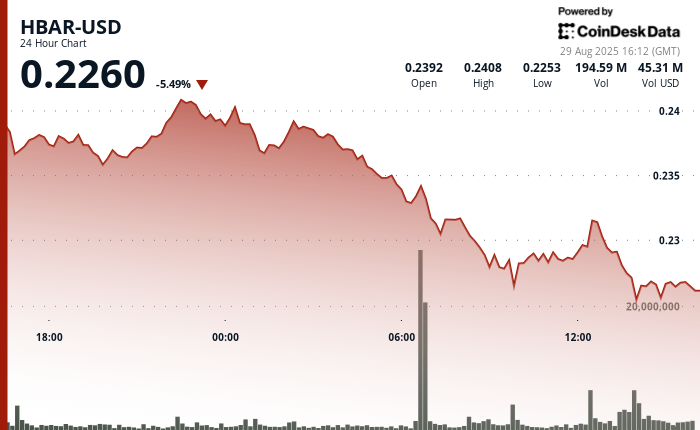
Hedera’s HBAR token endured a sharp selloff over the past 24 hours, falling 5% from $0.24 to $0.23 as traders unloaded positions in heavy volumes. The steepest decline came early Wednesday, when more than 277 million tokens changed hands between 06:00 and 09:00 UTC, forcing prices through the $0.235 support level and briefly dragging the token to lows near $0.226. Buyers stepped in at those levels, helping HBAR stabilize, though attempts to retake $0.235–$0.241 met firm resistance.

The pressure intensified again later in the session, with a one-hour drop from $0.229 to $0.226 marked by concentrated selling. Trading activity spiked at 13:30 and again just after 14:00 UTC, pushing the token as low as $0.2245 before a modest rebound. That bounce stalled at $0.227–$0.229, leaving HBAR pinned just above newly established support at $0.225.

The turbulence comes amid a significant regulatory development in the U.S. The Commodity Futures Trading Commission (CFTC) this week issued new guidance allowing U.S. traders access to offshore crypto markets via its Foreign Board of Trade advisory. Analysts suggest the move could open fresh liquidity pipelines for digital assets, including mid-cap tokens like HBAR, at a time when institutional flows are increasingly targeting undervalued corners of decentralized finance.

For now, however, the technical picture remains fragile. HBAR is holding above the $0.226 support area but faces stiff resistance on any rally attempts. With prices sitting near $0.23, traders are watching whether the CFTC’s regulatory shift can outweigh near-term bearish pressure and spark renewed demand for the token.

HBAR/USD (TradingView)

Technical Indicators Reveal Key Levels

  • Volume explosions reached 277.89 million during peak selling carnage, confirming impenetrable resistance around $0.235.
  • Support fortresses established at $0.226-$0.228 where buying interest provided desperate stabilization.
  • Resistance fortifications remain bulletproof at $0.235-$0.241 where previous rallies were systematically destroyed.
  • Make-or-break support zone forged at $0.2245-$0.225 following apocalyptic selloff periods.
  • Evaporating volume during recovery attempts signals potential consolidation battleground.

Disclaimer: Parts of this article were generated with the assistance from AI tools and reviewed by our editorial team to ensure accuracy and adherence to our standards. For more information, see CoinDesk’s full AI Policy.


Source link

August 29, 2025 0 comments
0 FacebookTwitterPinterestEmail
Battlefield 6's next Labs test will feature two of its largest maps, and a first look at the server browser
Game Reviews

Battlefield 6’s next Labs test will feature two of its largest maps, and a first look at the server browser

by admin August 29, 2025


Battlefield Studios has shared a few key details about what to expect from the next Battlefield Labs test. Unfortunately, Labs remains closed to most of the public, meaning it’s technically not a second Battlefield 6 beta.

The focus of the test, however, is very much informed by a lot of the feedback players shared during the beta’s two weekends.


To see this content please enable targeting cookies.

Manage cookie settings

First off, the next Battlefield Labs test begins today. You can still sign up if you never have, but know that spots are limited and there’s no guarantee you’ll be given access. Battlefield Studios revealed in a blog post that future sessions will also follow a more varied schedule at different intervals.

The most interesting part of this next session is that it features the first iteration of the in-game server browser. This has been one of the most requested features by many veteran players, and though I’m glad to see its return, it’s only limited to Portal.

The goal is to test the basic functionality of the server browser, especially when it comes to UI and stability. The browser lets players host matches, including the ability to make them persistent.

While you’ll be able to see some features of Portal’s Community Experiences, you won’t be able to create your own. Expect a lot of filters and tags, and a library of verified experiences that should resemble what everyone will have access to at launch.

Watch on YouTube

The other exciting feature of this upcoming test is that it’s going to be players’ first hands-on with two of the largest maps in Battlefield 6. Myself and many others felt that the beta’s maps were simply too small, and played quite similarly to each other. While Battlefield Studios addressed several points of feedback following the beta, the developer maintained that it only featured a small selection of maps, and that larger spaces will be shown off in the next Labs test.

We’re here now, and as promised, Labs testers will be able to play the Operation Firestorm remake, as well as Mirak Valley during this test. Battlefield Studios is also looking for feedback around vehicular combat, gadget interactions and gameplay, and how things flow in large-scale environments.

Finally, the developer is going to perform early testing of Hardcore mode to determine the official set of settings (HP, damage etc.).

It’s real! | Image credit: Battlefield Studios, EA.

Though we’re closer than ever to the game’s launch, some of the content in Labs will continue to be in an unfinished state. This will make it easier for developers to alter and tweak as each session progresses.

The blog post confirms that there’s going to be more than one upcoming Labs session, as expected. Indeed, we know that Battlefield 6’s mysterious battle royale mode will first be playable in Labs, even if we still don’t have even a rough date for that


Source link

August 29, 2025 0 comments
0 FacebookTwitterPinterestEmail
Starship Nails 10th Test Flight, Putting SpaceX Back on Track
Gaming Gear

Starship Nails 10th Test Flight, Putting SpaceX Back on Track

by admin August 27, 2025


Following a string of unsuccessful flights, SpaceX managed to pull off its most successful test in months, with Starship fulfilling a number of key milestones.

It was a good day for SpaceX. The megarocket blasted off on time, leaving the Starbase launch mount at 7:30 p.m. ET. Stage separation went off without a hitch, with the Super Heavy booster landing in the ocean as planned nearly 7 minutes into the mission. Second engine cutoff (SECO) occurred a few minutes later, and Starship began to cruise in space, this time without the awful tumbling experienced in the most recent mission.

History was made at the 18:30 mark, when Starship opened its bay doors and ejected payloads into space for the first time.

A view of the dummy Starlink satellites as they were being dispensed into space. © SpaceX

In this case, the payloads were mock-ups of next-gen Starlink satellites. Acting like a Pez dispenser, Starship popped each dummy satellite into space one at a time and in roughly one-minute intervals (the units will fall back to Earth and burn up in the atmosphere). It marked a huge moment for SpaceX, with Starship finally functioning as a delivery vehicle.

About 38 minutes into the flight, Starship re-lit one of its vacuum-optimized Raptor engines—the second time SpaceX has ever pulled off the maneuver.

A view of Starship during reentry. © SpaceX

Reentry of Starship began at roughly the 45-minute mark, with the spacecraft hurtling towards the Indian Ocean. SpaceX ran a stress test on the vehicle, deliberately compromising its heat shield to be “mean to the spaceship” and putting it “through its paces,” as SpaceX’s Dan Huot said during the broadcast. The fins in particular were pushed to the limit, with one of them showing clear signs of scarring.

The Starship upper stage returned to Earth at 8:37 p.m. ET, ending the 67-minute mission. Despite the abuse, Starship executed its last-moment flip, performing a landing burn and splashing down softly into the Indian Ocean before exploding in a fireball. Incredibly, a camera mounted on a nearby buoy managed to catch the action.

Starship performing a vertical, controlled landing in the Indian Ocean. © Starship

This was the flight that SpaceX desperately needed. We’ll learn more about the test in the coming days and weeks, but the modifications made to the oversized launch system appeared to do the trick. But as we’ve learned, a single successful test is no guarantee of future gain. SpaceX still has a long way to go before this incredible launch system is fully operational.


Source link

August 27, 2025 0 comments
0 FacebookTwitterPinterestEmail
  • 1
  • 2
  • 3
  • 4

Categories

  • Crypto Trends (1,098)
  • Esports (800)
  • Game Reviews (772)
  • Game Updates (906)
  • GameFi Guides (1,058)
  • Gaming Gear (960)
  • NFT Gaming (1,079)
  • Product Reviews (960)

Recent Posts

  • This 5-Star Dell Laptop Bundle (64GB RAM, 2TB SSD) Sees 72% Cut, From Above MacBook Pricing to Practically a Steal
  • Blue Protocol: Star Resonance is finally out in the west and off to a strong start on Steam, but was the MMORPG worth the wait?
  • How to Unblock OpenAI’s Sora 2 If You’re Outside the US and Canada
  • Final Fantasy 7 Remake and Rebirth finally available as physical double pack on PS5
  • The 10 Most Valuable Cards

Recent Posts

  • This 5-Star Dell Laptop Bundle (64GB RAM, 2TB SSD) Sees 72% Cut, From Above MacBook Pricing to Practically a Steal

    October 10, 2025
  • Blue Protocol: Star Resonance is finally out in the west and off to a strong start on Steam, but was the MMORPG worth the wait?

    October 10, 2025
  • How to Unblock OpenAI’s Sora 2 If You’re Outside the US and Canada

    October 10, 2025
  • Final Fantasy 7 Remake and Rebirth finally available as physical double pack on PS5

    October 10, 2025
  • The 10 Most Valuable Cards

    October 10, 2025

Newsletter

About me

Welcome to Laughinghyena.io, your ultimate destination for the latest in blockchain gaming and gaming products. We’re passionate about the future of gaming, where decentralized technology empowers players to own, trade, and thrive in virtual worlds.

Recent Posts

  • This 5-Star Dell Laptop Bundle (64GB RAM, 2TB SSD) Sees 72% Cut, From Above MacBook Pricing to Practically a Steal

    October 10, 2025
  • Blue Protocol: Star Resonance is finally out in the west and off to a strong start on Steam, but was the MMORPG worth the wait?

    October 10, 2025

Newsletter

@2025 laughinghyena- All Right Reserved. Designed and Developed by Pro


Back To Top
Laughing Hyena
  • Home
  • Hyena Games
  • Esports
  • NFT Gaming
  • Crypto Trends
  • Game Reviews
  • Game Updates
  • GameFi Guides
  • Shop

Shopping Cart

Close

No products in the cart.

Close