
Laughing Hyena
  • Home
  • Hyena Games
  • Esports
  • NFT Gaming
  • Crypto Trends
  • Game Reviews
  • Game Updates
  • GameFi Guides
  • Shop
Tag:

robots

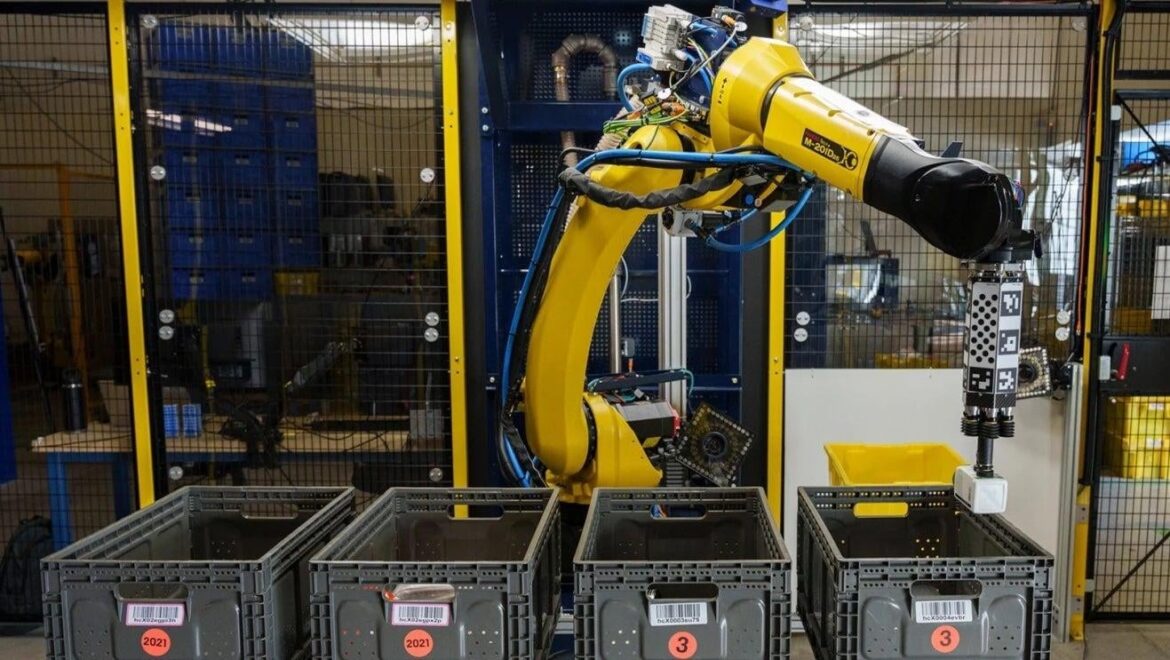
Robotic arm sorting items into four boxes
Gaming Gear

China Outpaces Rest of World in Working Robots

by admin September 28, 2025


There are an estimated 4,664,000 working industrial robots in the world, according to the International Federation of Robotics. More than two million of them are in China. And don’t count on anyone catching up soon. According to the report, the country installed nearly 300,000 new robots last year, and was responsible for 54% of all robotic deployments across the globe in 2024. For comparison’s sake, the United States managed about one-tenth that figure, adding 34,000 industrial bots during the same time frame.

China’s robot boom coincides with the country taking on the role of a global manufacturing leader. According to the New York Times, China now holds just under one-third of all global manufacturing output, up from just 6% of the pie at the turn of the 21st century. That makes China’s current output bigger than the combined manufacturing power of the United States, Germany, Japan, South Korea and Britain.

That gap seems likely to continue to widen. While China’s robotic installations increased year-over-year by about 7%, according to the International Federation of Robotics, the next-biggest robo-reliant nations all saw their total installations dip. Japan declined by 4%, the US dropped by 9%, South Korea slumped by 3%, and Germany slipped by 5%.

The IFR doesn’t see China’s automation adoption stopping any time soon, either. It projects the country will see an average of 10% growth annually through 2028, driven primarily by the introduction of industrial robotics into new markets. China’s biggest areas of growth in the last year included food and beverage, rubber and plastic, and textile production, whereas the United States continues to see robotics primarily applied to more traditional manufacturing fields like automotives.

Interestingly, while China’s robotics domination does appear driven in part by new technological developments like artificial intelligence, the country isn’t that into humanoid robots compared to other industrial forces. The New York Times attributed that to the fact that it’s difficult to build a humanoid bot entirely within the Chinese supply chain, where domestically made sensors and semiconductors can be harder to come by. Meanwhile, companies like Tesla and Boston Dynamics keep promising humanoid industrial workers that’ll likely carry a steep price tag.

Maybe the biggest enabler of China’s robot boom, though, appears to be human labor. According to the Times, the country has produced a large workforce of skilled electricians and programmers who can install and maintain robots. America is slowly catching up on that front, with the employment of electricians booming—though there remains a massive programmer shortage unlikely to be eased by the fact that the Trump administration’s new, boosted fee for H1-B visa applicants will keep skilled labor overseas.



Source link

September 28, 2025 0 comments
0 FacebookTwitterPinterestEmail
Decrypt logo
Crypto Trends

Google’s Robots Can Now Think, Search the Web and Teach Themselves New Tricks

by admin September 27, 2025


In brief

  • DeepMind’s Gemini Robotics models gave machines the ability to plan, reason, and even look up recycling rules online before acting.
  • Instead of following scripts, Google’s new AI lets robots adapt, problem-solve, and pass skills between each other.
  • From packing suitcases to sorting trash, robots powered by Gemini-ER 1.5 showed early steps toward general-purpose intelligence.

Google DeepMind rolled out two AI models this week that aim to make robots smarter than ever. Instead of focusing on following comments, the updated Gemini Robotics 1.5 and its companion Gemini Robotics-ER 1.5 make the robots think through problems, search the internet for information, and pass skills between different robot agents.

According to Google, these models mark a “foundational step that can navigate the complexities of the physical world with intelligence and dexterity”

“Gemini Robotics 1.5 marks an important milestone toward solving AGI in the physical world,” Google said in the announcement. “By introducing agentic capabilities, we’re moving beyond models that react to commands and creating systems that can truly reason, plan, actively use tools, and generalize.”

And this term “generalization” is important because models struggle with it.


The robots powered by these models can now handle tasks like sorting laundry by color, packing a suitcase based on weather forecasts they find online, or checking local recycling rules to throw away trash correctly. Now, as a human, you may say, “Duh, so what?” But to do this, machines require a skill called generalization—the ability to apply knowledge to new situations.

Robots—and algorithms in general—usually struggle with this. For example, if you teach a model to fold a pair of pants, it will not be able to fold a t-shirt unless engineers programmed every step in advance.

The new models change that. They can pick up on cues, read the environment, make reasonable assumptions, and carry out multi-step tasks that used to be out of reach—or at least extremely hard—for machines.

But better doesn’t mean perfect. For example, in one of the experiments, the team showed the robots a set of objects and asked them to send them into the correct trash. The robots used their camera to visually identify each item, pull up San Francisco’s latest recycling guidelines online, and then place them where they should ideally go, all on its own, just as a local human would.

This process combines online search, visual perception, and step-by-step planning—making context-aware decisions that go beyond what older robots could achieve. The registered success rate was between 20% to 40% of the time; not ideal, but surprising for a model that was not able to understand those nuances ever before.

How Google turn robots into super-robots

The two models split the work. Gemini Robotics-ER 1.5 acts like the brain, figuring out what needs to happen and creating a step-by-step plan. It can call up Google Search when it needs information. Once it has a plan, it passes natural language instructions to Gemini Robotics 1.5, which handles the actual physical movements.

More technically speaking, the new Gemini Robotics 1.5 is a vision-language-action (VLA) model that turns visual information and instructions into motor commands, while the new Gemini Robotics-ER 1.5 is a vision-language model (VLM) that creates multistep plans to complete a mission.

When a robot sorts laundry, for instance, it internally reasons through the task using a chain of thought: understanding that “sort by color” means whites go in one bin and colors in another, then breaking down the specific motions needed to pick up each piece of clothing. The robot can explain its reasoning in plain English, making its decisions less of a black box.

Google CEO Sundar Pichai chimed in on X, noting that the new models will enable robots to better reason, plan ahead, use digital tools like search, and transfer learning from one kind of robot to another. He called it Google’s “next big step towards general-purpose robots that are truly helpful.”

New Gemini Robotics 1.5 models will enable robots to better reason, plan ahead, use digital tools like Search, and transfer learning from one kind of robot to another. Our next big step towards general-purpose robots that are truly helpful — you can see how the robot reasons as… pic.twitter.com/kw3HtbF6Dd

— Sundar Pichai (@sundarpichai) September 25, 2025

The release puts Google in a spotlight shared with developers like Tesla, Figure AI and Boston Dynamics, though each company is taking different approaches. Tesla focuses on mass production for its factories, with Elon Musk promising thousands of units by 2026. Boston Dynamics continues pushing the boundaries of robot athleticism with its backflipping Atlas. Google, meanwhile, bets on AI that makes robots adaptable to any situation without specific programming.

The timing matters. American robotics companies are pushing for a national robotics strategy, including establishing a federal office focused on promoting the industry at a time when China is making AI and intelligent robots a national priority. China is the world’s largest market for robots that work in factories and other industrial environments, with about 1.8 million robots operating in 2023, according to the Germany-based International Federation of Robotics.

DeepMind’s approach differs from traditional robotics programming, where engineers meticulously code every movement. Instead, these models learn from demonstration and can adapt on the fly. If an object slips from a robot’s grasp or someone moves something mid-task, the robot adjusts without missing a beat.

The models build on DeepMind’s earlier work from March, when robots could only handle single tasks like unzipping a bag or folding paper. Now they’re tackling sequences that would challenge many humans—like packing appropriately for a trip after checking the weather forecast.

For developers wanting to experiment, there’s a split approach to availability. Gemini Robotics-ER 1.5 launched Thursday through the Gemini API in Google AI Studio, meaning any developer can start building with the reasoning model. The action model, Gemini Robotics 1.5, remains exclusive to “select” (meaning “rich,” probably) partners.

Generally Intelligent Newsletter

A weekly AI journey narrated by Gen, a generative AI model.


Source link

September 27, 2025 0 comments
0 FacebookTwitterPinterestEmail
Nvidia Unveils High-Tech ‘Brain’ for Humanoid Robots and Self-Driving Cars
Product Reviews

Nvidia Unveils High-Tech ‘Brain’ for Humanoid Robots and Self-Driving Cars

by admin August 26, 2025


Could humanoid robots get a lot more human? Nvidia may have made that possibility a bit realer today with a smarter robot brain that has less energy demands. 

The tech giant’s latest robotics offering is Jetson Thor, a super computer built for real-time AI computation on humanoid robots and smart machines alike, Nvidia announced in a press release on Monday.

The new module is built to handle larger amounts of information at less energy than previous model Jetson Orin. Powered by the latest Blackwell GPUs, Jetson Thor has more than seven times the AI compute power and twice the memory at more than three times speed and efficiency than its predecessor, Nvidia claims.

All this new power is supposed to unlock higher speed sensor data and visual reasoning that can help humanoid robots get better at autonomously seeing, moving, and making decisions.

“Jetson Thor solves one of the most significant challenges in robotics: enabling robots to have real-time, intelligent interactions with people and the physical world,” the company wrote.

It’s a considerable performance leap that Nvidia hopes will appeal to engineers. The company says early adopters include Amazon, Meta, Caterpillar, and Agility Robotics, a startup that makes commercially available humanoid robots for warehouses and other manufacturing facilities. The model is being considered for adoption by John Deere and OpenAI.

It’s also being adopted by research labs at Stanford, Carnegie Mellon, and the University of Zurich, to power autonomous robots in medical research settings and more, Nvidia said in a blog post on Monday.

The developer kit Jetson AGX Thor, which includes the Jetson T5000 module plus a reference carrier board, power supply, and an active heatsink with a fan, is now on sale on the company’s website starting at $3,499.

Coming soon—and available now on pre-order—is Nvidia Drive AGX Thor, a developer kit using the same technology but for autonomous vehicles instead. Deliveries for that are slated to start in September, the company said.

Nvidia’s growing bet on robotics

Although AI chips are Nvidia’s bread and butter, the tech giant is betting big on robotics and autonomous vehicles.

“This is going to be the decade of AV [autonomous vehicles], robotics, autonomous machines,” CEO Jensen Huang told CNBC in an interview in June.

Huang elaborated on his trust in just how much the robotics industry can scale at the company’s annual shareholders meeting later that month.

Along with AI, Nvidia expects robotics to provide the largest growth for the company, and combined, the two represent “a multitrillion-dollar growth opportunity,” Huang told investors.

Earlier this year, the company also released a family of AI models that can be used to train humanoid robots, called Cosmos.

Huang’s bet isn’t an empty one. Humanoid robots are advancing.

Just last week, China, one of the key players in the global robotics race, hosted its first-ever robot Olympics, World Humanoid Robot Games. At the three-day spectacle, companies showcased robots that can complete a 1,500-meter race in just a little over six seconds and achieve practical job skills like sorting medicine or taking food orders.

But still, the technology is hugely limited and far from widespread adoption. Even at the great robotics showcase in China, many of the robots suffered technical difficulties. One robot in the track and field race even ran straight into and knocked over a bystander walking off-course. 

Big week ahead for Nvidia

Nvidia made the announcement at a rather convenient time for the company. The tech giant is reporting fiscal second quarter earnings on Wednesday afternoon, and the market is buzzing already.

Nvidia dominates the AI market, so the company’s earnings always draw huge speculation, but the importance this week is boosted by volatile policy changes and questions around the economic value of wide-scale AI adoption.

The company has been on a policy rollercoaster ride in its efforts to sell AI chips in China amidst the escalating trade war between Beijing and Washington. China is a major market for Nvidia, and the uncertainty is keeping company investors at the edge of their seats.

Also keeping investors occupied is a concerning new AI report from MIT researchers. The report found that despite the bold bets on AI in the corporate world, fewer than one in 10 AI pilot programs have translated to real revenue gains.

Nvidia just hit $4 trillion market value last month, becoming the first public company to achieve the feat. Now, the stakes are high, as it’s up to the tech giant to prove that it’s valuation is not just built on AI hype.


Source link

August 26, 2025 0 comments
0 FacebookTwitterPinterestEmail
Cat laying in train car
Esports

Chinese scientists are building “pregnancy robots” to carry and deliver human babies

by admin August 19, 2025


A team in China is reportedly developing humanoid “pregnancy robots” equipped with artificial wombs capable of carrying and delivering babies.

According to Chosun Biz, Dr. Zhang Qifeng, founder of Kaiwa Technology in Guangzhou, is spearheading the project. The robot is designed with a synthetic uterus inside its abdomen, connected by a hose that delivers nutrients to a fetus much like an umbilical cord.

The machine would be able to carry a pregnancy for about 10 months before giving birth, with the company planning to debut a prototype as early as next year.

Article continues after ad

The expected price tag is around 100,000 yuan (about $14,000 USD), a fraction of the cost of surrogacy in the United States, which can range from $100,000 to $200,000.

Artificial womb inside a humanoid robot

“We want to integrate a gestation chamber into a humanoid robot and build an artificial womb so it can carry a full-term pregnancy in the normal way,” Zhang told tech outlet Kuai Ke Zhi.

Article continues after ad

He added that the artificial womb technology “is already in a mature stage” and only needs to be fully integrated into the robot to support a human fetus.

Article continues after ad

Chinese scientists are reportedly creating the world’s first pregnancy robot to carry and deliver human babies

Kaiwa plans to launch a prototype in 2026 for around $14,000 pic.twitter.com/cUdIuOb3Kj

— Dexerto (@Dexerto) August 19, 2025

The concept recalls the 2017 “biobag” experiment at the Children’s Hospital of Philadelphia, where researchers kept premature lambs alive for weeks inside a temperature-controlled fluid environment.

While still in development, Zhang says his team is addressing ethical and legal concerns by holding forums with local authorities in Guangdong Province and submitting policy proposals to regulators.

Social media has been split over the project.

“I’ve seen enough sci-fi to know exactly how this ends. Not great for humanity,” one user wrote.

Article continues after ad

Others defended the concept, arguing it could help parents struggling with IVF or surrogacy. “This isn’t for people who can and want to have pregnancy. It’s an optional choice,” one commenter said.

For now, the pregnancy robot remains a prototype. But, if it launches in 2026, it could spark one of the most disruptive debates in the history of reproductive technology.

Article continues after ad


Source link

August 19, 2025 0 comments
0 FacebookTwitterPinterestEmail

Categories

  • Crypto Trends (1,098)
  • Esports (800)
  • Game Reviews (772)
  • Game Updates (906)
  • GameFi Guides (1,058)
  • Gaming Gear (960)
  • NFT Gaming (1,079)
  • Product Reviews (960)

Recent Posts

  • This 5-Star Dell Laptop Bundle (64GB RAM, 2TB SSD) Sees 72% Cut, From Above MacBook Pricing to Practically a Steal
  • Blue Protocol: Star Resonance is finally out in the west and off to a strong start on Steam, but was the MMORPG worth the wait?
  • How to Unblock OpenAI’s Sora 2 If You’re Outside the US and Canada
  • Final Fantasy 7 Remake and Rebirth finally available as physical double pack on PS5
  • The 10 Most Valuable Cards

Recent Posts

  • This 5-Star Dell Laptop Bundle (64GB RAM, 2TB SSD) Sees 72% Cut, From Above MacBook Pricing to Practically a Steal

    October 10, 2025
  • Blue Protocol: Star Resonance is finally out in the west and off to a strong start on Steam, but was the MMORPG worth the wait?

    October 10, 2025
  • How to Unblock OpenAI’s Sora 2 If You’re Outside the US and Canada

    October 10, 2025
  • Final Fantasy 7 Remake and Rebirth finally available as physical double pack on PS5

    October 10, 2025
  • The 10 Most Valuable Cards

    October 10, 2025

Newsletter

About me

Welcome to Laughinghyena.io, your ultimate destination for the latest in blockchain gaming and gaming products. We’re passionate about the future of gaming, where decentralized technology empowers players to own, trade, and thrive in virtual worlds.

Recent Posts

  • This 5-Star Dell Laptop Bundle (64GB RAM, 2TB SSD) Sees 72% Cut, From Above MacBook Pricing to Practically a Steal

    October 10, 2025
  • Blue Protocol: Star Resonance is finally out in the west and off to a strong start on Steam, but was the MMORPG worth the wait?

    October 10, 2025

Newsletter

@2025 laughinghyena- All Right Reserved. Designed and Developed by Pro


Back To Top
Laughing Hyena
  • Home
  • Hyena Games
  • Esports
  • NFT Gaming
  • Crypto Trends
  • Game Reviews
  • Game Updates
  • GameFi Guides
  • Shop

Shopping Cart

Close

No products in the cart.

Close