
Laughing Hyena
  • Home
  • Hyena Games
  • Esports
  • NFT Gaming
  • Crypto Trends
  • Game Reviews
  • Game Updates
  • GameFi Guides
  • Shop
Tag:

review

An image of Network Solutions' landing page
Product Reviews

Network Solutions review | TechRadar

by admin August 28, 2025


Why you can trust TechRadar


We spend hours testing every product or service we review, so you can be sure you’re buying the best. Find out more about how we test.

Network Solutions was launched in 1979 as one of the first companies to provide DNS (domain name system) technology. Since then, it has developed to provide many more services, all related to web hosting. Today they provide “all you need, in one place”, that is: domain names and various hosting options with a whole variety of features and accessible applications including a page builder. The company is headquartered in the US, with its main office located in Herndon and its data center situated somewhere in North America.

In 2011, Network Solutions was acquired by Web.com Group, one of the leading web technology companies that provided services to millions of customers all over the world. Then, in 2021 web.com merged with EIG to become Newfold Digital. Later, in 2025 Newfold Digital consolidated brands and absorbed web.com into Network Solutions.

So, it’s fair to say Network Solutions has had a long and varied life changing hands and merging more than most hosts. Is this Network Solution’s final form? Who knows but one thing is certain. It’s not staying power.

You’ll have to opt for the Premium plan in order to get an SSL Certificate (Image credit: Future)

Is Network Solutions good value for money?

Network Solutions’ Starter Plan is perfect for businesses just getting started. This plan costs only $2.99 per month for the first year and includes 10 GB of disk space, 1 website, and five email boxes. You also get 25 FTP accounts, a drag and drop page builder, and unlimited bandwidth.

For $4.99 per month, the Essential Plan gives you even more features than the Starter Plan. It includes 20 GB of disk space, 3 websites, 1,000 email boxes, and a domain name included in your package (for one year). If your business needs more than the Essential Plan provides, consider Network Solutions Premium Plan. This plan covers all of the features of the Essential plan plus 40 GB disk space and supports 10 websites for $6.99 for the first year.

Is Network Solutions easy to use?

Because Network Solutions doesn’t exactly have a myriad of hosting options, picking out a preferred plan shouldn’t be a time-consuming decision. The first thing you’ll need to know is if you want a simpler cloud-based solution or a WordPress-optimized one. For the most part, together with these hosting packages, you’ll be getting email services as well. If not (and you want them), digging a bit more around the website will take you to a few email hosting solutions as well.

Network Solutions is a decent choice for anyone looking for an easy-to-use web hosting service with sufficient features. Not only does it offer a good range of benefits such as domain registration, design tools, email hosting, marketing tools, and more but its user interface is also incredibly intuitive and simple to navigate whether you’re a novice or an experienced user. 

Sign up to the TechRadar Pro newsletter to get all the top news, opinion, features and guidance your business needs to succeed!

Network Solutions offers a drag-and-drop website builder in addition to its web hosting plans (Image credit: Network Solutions)

All plans come with a proprietary control panel, which isn’t as user friendly as some industry-standard alternatives, but we managed to find our way around. From there, most of the famous apps can be yours after a click or two (WordPress, Joomla, Durpal and so on) and all developers out there will be glad to hear that a whole variety of website development features are supported as well (PHP5, Python, Ruby on Rails, Java Servlets, Zend Libraries and much more). A number of e-commerce features (and all-inclusive ecommerce solution) are available for purchase, as well as a competent drag-and-drop website builder.

We used GTmetrix to measure the uptime and response time of our Network Solutions site (Image credit: GTmetrix)

Speed and experience

When trying to convince us of the superiority of their services, Network Solutions brings up their “reliable” uptime with the guarantee of 99.9%, live tech support and flexible hosting plans, without any promises regarding the speed. Not knowing what to expect, we tested the speed performance of Network Solutions’ main website using GTmetrix as a tool. It placed the website’s speed performance above the average with the conclusive result of B (85%), which is quite good.

We decided to test the uptime of Network Solutions’ main website by using UptimeRobot and see if we’re going to take advantage of the guarantees they provided us with. After a month of constant monitoring, UptimeRobot reported a few occasions of downtime, with the longest one lasting for 19 minutes straight. However, the total of downtime was around 42 minutes. This means the total recorded uptime was 99.917% and that Network Solutions managed to deliver on their promises by a whisker.

While this isn’t a true reflection of the speeds you can expect from your site on shared hosting, it is a good indicator of how reliable and powerful Network Solutions’ infrastructure is.

Network Solutions has a searchable Help Center (Image credit: Network Solutions)

Help and support

The first help options you’ll probably notice with Network Solutions are their telephone number (which is advised to be used for urgent matters only) and “Contact us” button that will present you with a few ways to help yourself. Their knowledgebase (titled as “Help Center”) can be browsed with the help of a search box or you can pick out some of the preselected categories. There seems to be a decent number of articles which are mostly written in an easy-to-follow way (often with pictures) and rated by users with a five-star rating system. 

If you would rather rely on support agents from Network Solutions’ technical team, you can get in touch with them via support ticket, live chat and telephone, all of which ought to be available around-the-clock.

Network Solutions features a community forum, where its registered users (we assume, since trying to proceed without registration made us hit the dead end) can seek answers to their questions, answer questions from other users or leave feedback for others to see. However, when we tried to register, not a single one from dozens of display names (and some were quite original) was deemed acceptable (the only explanation we got was “Name you entered is already in use”, which doesn’t seem to be the case), so we can’t report anything more than this.

The competition

Bluehost is also one of those hosts that will provide their users with everything need but also have servers in Europe and Asia. Even so, Bluehost provides a great value for money and offers (unlike Network Solutions) VPS hosting, managed WordPress and dedicated server in addition to basics, so it is better suited for more ambitious users.

HostGator can provide you with everything Network Solutions can and go beyond that, and we are not thinking about hosting types only. The entry-level (adorably named “Hatchling”) plan with HostGator includes a domain name, website transfer, unmetered bandwidth and SSL certificate, all cost-free. In comparison, Network Solutions’ elementary plan has less bonus features to attract new users with.

Both of those brands are also owned by Newfold Digital. If you wanted to look outside of that group you could also consider Hostinger.

Is Network Solutions right for you? 

Since it was founded at the end of the disco era, Network Solutions certainly knows how to get groovy with its hosting packages, offering a great deal of helpful tools to get your website down with a boogie in no time. 

When deciding on a web hosting service, there are many factors to consider such as price point, customer service availability, and uptime guarantee. Network Solutions offers all these features in one package, making them a great option for anyone who wants reliable web hosting without breaking the bank. 

Network Solutions FAQs

Does Network Solutions support WordPress?

The short answer is yes. Network Solutions supports WordPress, which means you can create a fully functioning website with ease. The service includes auto-installers so that you don’t have to worry about installing WordPress manually or dealing with complex server configurations. You also get access to hundreds of themes so you can customize your site with ease, as well as numerous plugins that further extend the functionality of your online presence.

What is Network Solutions used for?

Network Solutions can be used for much more than just hosting websites and registering domains. The service also offers support for email services, online stores, SSL certificates, marketing, and SEO tools.



Source link

August 28, 2025 0 comments
0 FacebookTwitterPinterestEmail
An image of the text web.com and an arrow moving towards network solutions
Product Reviews

Web.com review | TechRadar

by admin August 28, 2025


Why you can trust TechRadar


We spend hours testing every product or service we review, so you can be sure you’re buying the best. Find out more about how we test.

Web.com was founded in 1999 and worked its way to become one of the leading web hosting technology companies, as well as one of the largest providers of online marketing services in the USA. It was a part of the Web.com Group which also owned a whole portfolio of brands including Network Solutions and Register.com. Their main aim was (or so they claim) to “help customers of all sizes build an online presence that delivers results”.

In 2021 web.com merged with Endurance Web Presence resulting in a new company Newfold Digital. Then, in 2025 web.com was absorbed by Network Solutions.

I’ve left this review up for posterity and for those that are not yet in the loop. This review will no longer be updated and eventually it will be redirected to Network Solutions.

Plans and pricing

    Web.com subscription options:

  • 12 month plan – $2.99 per month ($35.88 total cost)

Web.com services aim to cover all the bases when it comes to hosting, website design and the problem of security. Besides shared hosting, they provide domain registration (and transfer) services, their own website builder and WordPress-optimized hosting (managed and unmanaged).

At first, the pricing seems cheap and cheerful, but if you decide to dig a bit deeper you’ll reveal that the displayed price is valid for the first month only. From the second month onward, the price will be more than doubled and if you haven’t read everything through and through, you might feel like you’ve been played for a fool. For instance, the cheapest hosting package (labeled as “Essential Hosting”) is priced at $5.95 per month, yet this goes for the first month only and the second one is going to cost you $14.95, which is a broad daylight robbery in comparison. Well, at least you should get a “free” domain name registration with every package in addition to their beginner-friendly website builder.

As for supported payment methods, they accept all major credit/debit cards and PayPal. If you are wondering about their refund policy, they are rather rigorous about not providing any, although you can cancel their services at any time.

Swipe to scroll horizontally

Web.com gives you access to a website builder and even an online store (Image credit: Web.com)

Ease of use

To kick off your website, you’ll first have to decide which is the right hosting solution for you and whether you want to build your website by yourself (there are several ways to do so) or you would rather put it in the hands of experts (by opting for the “Build It For Me” option). If the latter is the one you want, you should schedule a call with Web.com’s team to get a consultation on the matter (at no cost).

Anyhow (sooner or later), you’ll have to pick out a plan and, since they are well presented, this should be as easy as anything. If you are new to all this, the FAQ section below might be of some help. After adding this plan to the cart, you’ll be asked (as expected) to register a new domain (all of them are free for a year, except for “.co”) or use the one you possess. However, keep in mind that after the renewal period your domain can cost you up to $38 per year, which is a handsome sum of money. There, you can apply a promotional code (if you are lucky to have one), enter your name,e-mail address and password and proceed to create your Web.com’s account.

Sign up to the TechRadar Pro newsletter to get all the top news, opinion, features and guidance your business needs to succeed!

With all shared hosting packages, Web.com provides its users with an access to cPanel, which is great news. Thanks to its intuitive and beginner friendly interface and one-click installer (for about 25 open-source applications), your website will be on fire in a heartbeat. If you haven’t had much experience with coding and yet you want to develop your website by yourself, Web.com offers a newbie-friendly drag-and-drop website builder which should do the trick.

We used GTmetrix to measure the uptime and response time of our Web.com site (Image credit: GTmetrix)

Speed and experience

Although Web.com is quite keen on presenting itself in the best possible light, it (curiously) doesn’t emphasize blazing speed performance as one of its greatest assets. Nevertheless, after putting Web.com’s main website to the test, we learned that they have nothing to worry about concerning this. After taking into account all of the vital web metrics, GTmetrix (our speed testing tool) rated speed performance of Web.com’s website with a B (95%), which is a pretty good result.

Web.com promises an industry-standard uptime of 99.9%. However, after consistent monitoring of Web.com’s main website for a month we got a less favorable outcome resulting in 99.83%. There were four instances of downtime and together they lasted for 67 minutes, the longest one persisting for 28 minutes straight. Although this is not the most dreadful performance we’ve seen, it’s needless to say that we were hoping for better results.

Web.com has an extensive Online Help Center that offers similar functionality to a knowledgebase (Image credit: Web.com)

Support

If you find yourself in need of help, proceed to Web.com‘s “Online Help Center”, which has familiar functionality of a knowledgebase. There, the articles are sorted out into eight fitting categories and each of them is rated by a system involving stars, from one to five. Most of these are beginner-oriented and offer solutions to various potential problems described in great detail, more often with pictures than without. Using the search box should get you a good deal of hits, although a number of them might be rather loosely connected to the actual problem.

As an addition, there is a FAQ section on Web.com‘s site for each product type presented and it provides some helpful insight for all the newcomers.

As a more human-centered alternative, you can reach out to Web.com’s technical team via telephone, ticket and live chat, all of which should be available day-and-night. Other than that, you can get in touch with them via text messages on Facebook and Twitter, which is a nice touch for all the users out there.

The competition

As children of the same parent company, Network Solutions and Web.com are somewhat similar. Both try to be accessible to new users and offer some affordable hosting solutions without the need for compromising the quality. That being said, Web.com gives its users an access to cPanel (probably the user-friendliest solution of its kind out there), while Network Solutions doesn’t, so the choice might be up to that.

Both Bluehost and Web.com have packages aimed at new users in particular, and pretty good ones to boot.  Nevertheless, if you’re looking to save some bucks, Bluehost is a better choice, since its entry-level plan goes for $2.95 per month, while it is $5.95 with Web.com. However, if you fail to read about the renewal rates after the promotional period, both hosts might make you jump out of your skin.

While both HostGator and Web.com are more than able to cover everything needed to launch a small business, HostGator can do the same for medium-sized businesses as well. In addition to shared hosting, it provides several options for reseller, VPS and dedicated servers, which is a must-have for a growing business.

WestHost is a fellow US-based web hosting provider with more than two decades of experience in the industry. The smallest plans with both of them are beyond budget-friendly at start (especially WestHost’s entry-level plan which is going for $0.99 at the moment), but they will raise the price after the promotional period to its fullest capacity. Even so, Web.com’s starter plan (which comes as no surprise) puts less restriction on its features and throws in a free domain registration to even the odds.  

Final verdict

At the end of the day, Web.com is pleasantly honest in not trying to be something more than it actually is. Their hosting solutions are primarily aimed at newcomers, which they try to supply with everything it takes so they can quickly kickstart their website across the virtual web highway. Hence, if you consider yourself one of them, Web.com’s hosting packages might provide you with a good value for money.

However, if you have bigger plans for your website (or are determined to save some money for the rainy days), your dream website might find a forever home with more celebrated companies like Hostgator, Bluehost or GoDaddy.


Source link

August 28, 2025 0 comments
0 FacebookTwitterPinterestEmail
Honor Magic V5 review: thinner, faster, stronger - but expensive
Game Reviews

Honor Magic V5 review: thinner, faster, stronger – but expensive

by admin August 28, 2025


Last year Honor’s Magic V3 foldable phone impressed, offering mature software, a thin and robust design and more powerful hardware. This year, thanks to the unlucky reputation of the number four in China, we’ve gone up two to the Magic V5.

The new phone follows industry trends in offering a slimmer design, a bigger battery, improved cameras, a larger internal screen and more powerful internals – including Snapdragon’s 8 Elite processor, 16GB of RAM and 512GB of storage.

But do these upgrades offer a meaningful upgrade over the 2024 model, given that the price has climbed to a massive £1699, a big ask even for this ultra-premium category? Or are you better off sticking with something a few generations older at something like half the price?


To see this content please enable targeting cookies.

Manage cookie settings

Design

The Magic V5 is a tad more reserved in its colour selection than its reddish brown or green predecessors. Instead, it’s black, ivory white and the stylish dawn gold – the pick I’d personally go with. Our sample came in black.

Putting it against my Magic V3, the new model’s camera bump protrudes a bit more due to some internal upgrades I’ll discuss later. However, the overall profile of the phone, both unfolded and folded, is even slimmer than its predecessor.

Interestingly, it’s the ivory white version that’s technically the slimmest, at just 4.1mm unfolded and 8.8mm when folded; the black and dawn gold models sit at 4.2mm and 9mm respectively. Nonetheless, that’s still 0.2-0.3mm less than the Magic V3, and virtually identical to the new Samsung Galaxy Z Fold 7’s 8.9mm total thickness. The Google Pixel 10 Pro Fold, at 10.8mm, is a positive porker by comparison.

As much as the thickness and weight (of 217g) aren’t massive departures from the V3, it feels good to know that we’ve gotten to the stage where foldable phones aren’t cumbersome to use. The Magic V5 fits into a regular-sized pocket and into adult hands without issues, whether folded or unfolded. As with its predecessor, you’ll have to keep a good grip on it when using it in tablet mode one-handed. Weirdly, this new model doesn’t have the same textured finish on the rear as the Magic V3 did, making it a bit more slippery.

The Magic V5 also runs with the typical modern design that Honor has typified these Magic foldables with, with a slender feel and super-thin bezels around the cover screen and main display to maximise screen real estate. I still think there’s some potential for dust and dirt ingress around the main screen, though I didn’t spot anything too egregious on my review unit.

There is a similar Honor “super steel” hinge involved with this phone, which has seen some upgrades to withstand even more pressure. Honor advertising includes some big claims, including the ability to suspend 30kg of stuff from the hinge – though they obviously don’t recommend it for normal use – and the durability rating sits at 500,000 cycles.

One of the biggest upgrades with the Magic V5 is to its water and dust resistance rating, as the phone now has full-fat IP58/IP59 dust and water resistance. Its predecessor was only IPX8. By comparison, the ZFold 7 has an IP48 water resistance rating, and the Pixel 10 Pro Fold is the first IP68-rated foldable.

Display

Honor has maximised screen real estate and brightness with the Magic V5 in a move that sees the main display get a slight boost to 7.95 inches in size, while the cover display remains at 6.43 inches. Both panels can get up to 5000 nits of peak brightness with HDR in supported content for an eyeball-searing experience; these screens aren’t half short of punch, and are both OLEDs for immense depth and lovely colours.

Owing to it being slightly larger, the main display has also seen a push up to 2352×2172 resolution – about the same number of pixels as a 2560×1440 (“1440p”) display – which makes it a fantastic choice for everything from general productivity to gaming and binging content on Plex, YouTube or Prime Video. The pixel density is virtually unchanged at 403ppi, while a 120Hz refresh rate keeps things responsive.

The smaller cover display impresses too, with the same 2376×1060 resolution as its predecessor, plus a 120Hz refresh rate for added zippiness. When opening the main display feels a little cumbersome, or you just want to quickly check notifications, this is a more than suitable deputy. Both screens support stylus input, though you will need to buy Honor’s stylus separately and there’s no place to store the stylus in the phone.

Certain apps and content will have a letterbox effect, not filling the screen entirely, but you can force apps and games on an individual basis to fill the screen so you can take advantage of the full 7.95 inches of real estate.

Camera

Perhaps the biggest upgrade with the Magic V5 is with what Honor has termed its new ‘AI Falcon’ camera setup, which they say gives a conventional flagship experience in a foldable form factor. It’s typically with their camera setup that foldables have made some compromises, but Honor has attempted to change that.

We’ve got a 50MP main camera, plus a boosted 64MP periscope-lens telephoto with 3x optical zoom and 100x digital zoom, and a 50MP ultrawide sensor.

General detail and colours are pleasant across the board in my testing on a few walkabouts in London, although I still think the Magic foldable cameras tend to favour over-saturated colours for as much pop as possible; the shot of the back of the Routemaster bus proves this.

Here is a selection of photos from my time with the Honor Magic V5.

Cropping into shots reveals a strong maintenance of detail from the main and ultrawide sensors, while the 3x optical zoom provides some good quality when punching in on a subject a tad. Going into the digital zoom range requires some AI help to maintain a semblance of proper quality, especially at the full 100x you’re likely to only use for a laugh.

As for low-light performance, images are smoothed out a little so they lack some detail, but there isn’t much in the way of noise to make for a generally clean image. As with its predecessor, the fuzziness is virtually gone, and there’s enough light compensation without things getting overblown.

The front cameras remain unchanged to my knowledge, with the same 20-megapixel selfie options that provide neutral colours and decent detail retained. Of course, as this is a foldable phone, it’s worth noting that you can prop the phone up and use the much more competent rear lenses for taking vain photos of yourself.

Performance

Internally, the Magic V5 gets the proper flagship treatment for 2025, as you’d expect for a phone at its high price tag, benefitting from the new Snapdragon 8 Elite processor plus 16GB of RAM and 512GB storage for good measure.

In the GFXBench gaming tests, we’re seeing a bigger boost in the Aztec Ruins High Tier test at 60fps against its predecessor’s 46fps, while Car Chase also sits at 60fps against 57fps from the Magic V3. It’s worth bearing in mind that the higher-res internal screen makes this a slightly sterner test for the V5 than last year’s V3.

The scores in Geekbench 6 aren’t demonstrably stronger than the Snapdragon 8 Gen 3 chip inside the Magic V3, although we are seeing healthy boosts in both the 3DMark Wild Life Extreme and PCMark Work 3.0 tests, proving the Magic V5 is better at both intensive gaming loads and general productivity loads.

Benchmark
Honor Magic V5
Honor Magic V3
Honor Magic V2 RSR

Geekbench 6 Single Core
2256
2214
2030

Geekbench 6 Multi Core
5237
5699
4928

3DMark Wild Life Extreme
4929
4471
3748

GFX Aztec Ruins High Tier
60fps
46fps
46fps

GFX Car Chase
60fps
57fps
56fps

PCMark Work 3.0
21201
17419
14089

In use, I found it to be a zippy customer, with no real noticeable slowdowns during daily use, whether I was streaming video content, working in Google Docs or just using the Magic V5 as I normally would.

With the benefit of the huge main display, it helps immersion in games such as COD Mobile and EA FC Mobile, the latter I hadn’t touched in some time. Under load, the phone also doesn’t get too warm, and is comfortable to hold for extended periods.

In addition, Honor seems to have managed the Magic V5’s performance drop-off in extended stress testing better than the previous two generations. Over the 20 runs during the 3DMark Wild Life Extreme test, the phone recorded a 33 percent performance drop-off, where its predecessors had seen drops of over 50 percent.

Honor is promising four years of OS updates and five years of security updates, which is perfectly acceptable if not remarkable for a phone of this class. Out of the box, it’s running MagicOS 9, Honor’s skinned version of Android 15.

I’ve had a bit of a love-hate relationship with MagicOS on Honor handsets, as I’ve never found it to be as slick or as polished as Samsung’s OneUI, for instance. The optimisations with this new variant aren’t necessarily as far-reaching as its predecessor, but there is some genuinely useful stuff pertaining to file transfer over the air and device cloning for those switching from iOS devices, as Honor says has been a common trend for their buyers.

Where this phone certainly excels is with multitasking, not least with how easy it is to create dual or triple-pane windows for when you want to write while refering to reference material or carrying on a chat, for instance. The new Multi-Flex mode allows for that triple pane, which is very handy for immense power use.

There is the usual AI gubbins baked in here too, with Google’s Gemini service acting as the backbone for systems such as Honor Notes that use the note app for summarising, formatting and grammar checking, or the Recorder app for real-time note taking. You also get some interesting AI upscaling and cutout methods in the photo app, which work with varying degrees of success in my testing.

The Game Manager app makes a return, coming with convenient access at the left hand of the screen for basic features such as a rotation lock and screen recorder, as well as more advanced ones for adding filters to change the look of a game, or a touch enhancer for more responsive inputs. There are also options for changing brightness and ‘memory cleanup’ on the fly. A lot of these options are either on or off, as opposed to having any granular control.

Despite the further optimisation that Honor has attempted with MagicOS 9, I still have the same reservations as before regarding its software. For instance, it comes with Honor’s own ‘Essentials’ folder right on the front screen, but you have to be precise on where you put your finger to open the specific app. Tapping the folder doesn’t open it into a larger one where you can see the apps inside. In addition, there is unwanted crud installed by default that you may not want, such as Facebook and Instagram. It’s easily removable, but that isn’t really the point.

Battery Life

For whatever reason, my sample of the Magic V5 didn’t ship with a power brick inside, although there is a high-wattage USB-C cable and leather case so you are at least ready to go out of the box. The phone supports up to 66W charging, the same as the Magic V3, and you can purchase the Honor-specific brick from their website, or use a third-party one.

While the maximum supported wattage might not have changed, Honor has beefed up the battery capacity to 5820mAh, from the Magic V3’s 5150mAh, to make it larger than some typical flagship phone batteries.

The cells inside the Magic V5 are also silicon-carbon, as in the Magic V3 and Magic 6 Pro handsets I’ve looked at. This has a couple of important benefits, such as being able to work in much colder environments and reportedly being better for the planet than standard lithium-ion batteries.

In my testing, I managed to comfortably get a couple of days regular use out of the Magic V5, which is excellent. The PCMark V3.0 benchmark served up a result of 11 hours and 25 minutes at 50 percent brightness, which is reasonable screen-on time for a foldable, and around two hours more than the Magic V3.

Conclusion

In-keeping with the typically incremental upgrade path I’ve come to expect from modern flagship phones, the Honor Magic V5 might not be much of an upgrade in elements against its predecessor, but it is a genuinely excellent foldable handset.

We’ve got potent performance, plus a set of two dazzling OLED screens and stronger performance in terms of camera quality and battery life, meaning Honor has hit the right notes when it comes to its targeted areas for upgrade over the Magic V3. By also being even thinner it makes it even more pocketable overall and retains serious points for a modern and stylish foldable phone. It’s just the MagicOS Android distro that holds it back a tad.

For the £1699.99 asking price, the Honor Magic V5 is an undeniably premium handset that offers some serious competition to both Samsung and Google and continues Honor’s upwards trajectory in providing genuinely compelling phones from a brand you may not have considered before.


Source link

August 28, 2025 0 comments
0 FacebookTwitterPinterestEmail
Kindle Colorsoft Kids Review (2025): Great for All Ages
Product Reviews

Kindle Colorsoft Kids Review (2025): Great for All Ages

by admin August 28, 2025


When you set up kids mode, you’ll be prompted to put in your child’s name and their birthday, which allows Amazon to recommend books appropriate for their age. You can make multiple kid profiles, but you’ll need a PIN or passcode to switch off kids mode and return to regular Kindle mode. I set up my son’s profile with his nickname and his birthday, and since he’s only 3 years old, his recommendations in the “Books You Might Like” section were colorful picture books like Polar Bear, Polar Bear, What Do You Hear? and First 100 Animals. I was able to download both immediately with the Kids+ subscription.

Photograph: Nena Farrell

You buy books on a Kindle, but the Kids interface has a Store option that allows your kid to browse books and request them, which will then alert the parent account about the desired book. It replaces the store feature in regular mode that allows you to purchase a book directly. It’s a nice way to still give kids an option to look for a new book and choose it themselves, without giving them free-for-all access to your credit card on file. (But if you were going to give your kids free rein on spending, books are a great place for it.)

An Ideal Pair

Photograph: Nena Farrell

While you can access kids mode on any Kindle, a Colorsoft certainly feels like a great fit for kids of all ages. Colorful covers and pages are a great way to entice kids to read, and it’s certainly much more fun to look at a library of books on a Colorsoft model than it is on a black-and-white-only e-reader. The full year of Kids+ content is a great bonus, too.

While upgrading to a color Kindle is a fun option, most of my adult books won’t be able to take advantage. Kids have more illustrated book options to actually take advantage of the color feature, and it’s a nice choice for developing readers who might lean on art more to understand a book.

You’ll pay quite a bit more for this Kindle than the other Kids options, but it’s an e-reader that can grow with your kid and take them through all kinds of phases of reading. Plus, it’s a Kindle you can borrow from them to get a little color for your books, even if it’s just the covers.


Source link

August 28, 2025 0 comments
0 FacebookTwitterPinterestEmail
Fortect review
Product Reviews

Fortect Antivirus Review 2025: Expert Insights into Protection, Features, and Pricing

by admin August 28, 2025


Why you can trust TechRadar


We spend hours testing every product or service we review, so you can be sure you’re buying the best. Find out more about how we test.

Fortect may not be one of the biggest names when it comes to the best antivirus and security, but this German business demands attention thanks to an ethos that prizes transparency, trust and user empowerment.

They’re all good qualities when trying to identify your next piece of security software, and it means that we’re eager to evaluate the company’s specific antivirus credentials in this review.

If you need a free antivirus product, then Fortect does have one option available – but it’s very limited. You can view and fix issues one-by-one using a manual repair system, but automatic repairs are only supported in the paid versions of the product.

Fortect’s paid antivirus module is found within a wider product called PC Suite, which also includes a slate of PC tweaking, optimization and repair tools alongside security features.

Fortect’s most affordable paid product, Essential, protects one system for one year and includes all of the app’s core features for $38.

Upgrade to the multi-device plan for $47 and you get unlimited annual usage for three devices. The Ultimate product, which costs $65, includes licenses for five devices.

Those single-device and three-device plans are priced reasonably, but the Ultimate product feels a tad expensive: Norton 360 Deluxe supports five devices for $49, for instance, and you can get Sophos Home Premium protection for ten devices for $44.99.

Sign up to the TechRadar Pro newsletter to get all the top news, opinion, features and guidance your business needs to succeed!

Fortect: Interface

Installation is easy and, once it’s complete, Fortect runs through a comprehensive system scan. Because this is a PC suite rather than just an antivirus scanner, its results outlined a host of issues, but Fortect was comprehensive when tackling security: it detected a vast array of potential privacy issues, for instance.

Get beyond that initial scan and Fortect has one of the best interfaces we’ve seen on a PC security and tweaking app.

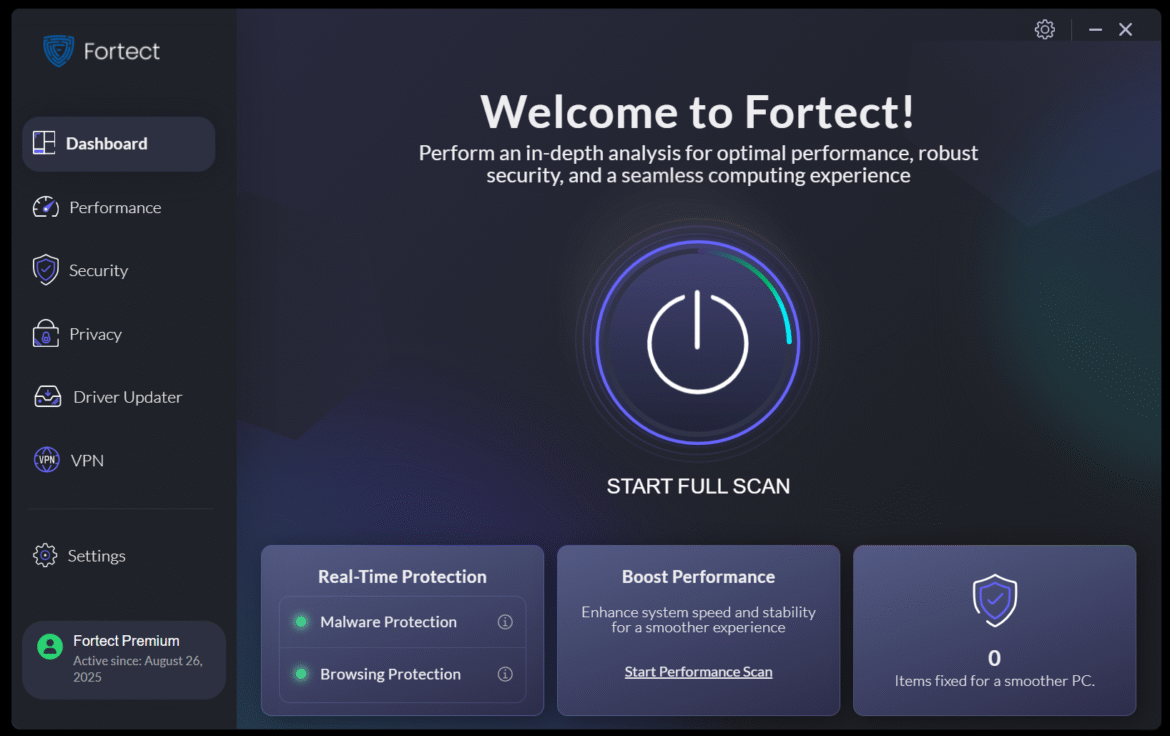
It’s modern and mature, with navy blue shades throughout, and the dashboard has a huge “On” button that starts a full system scan.

The front page has indicators so you can see if malware and real-time protection are both activated, and on the left-hand side there are links to the app’s performance, security, privacy and VPN modules.

(Image credit: Fortect)

Delve into the Security section and you can deploy quick and custom scans and toggle malware and real-time protection, and drag and drop folders and files for custom scans.

In the Security settings menu you can enable real-time protection, cloud-based analysis and the browsing shield, which blocks harmful sites. You can also customize the frequency of security reports and tweak file quarantine settings.

The app’s Privacy module includes browser cache cleanup, and a unique tool that enables users to remove traces of Office apps from their system. You’re also invited to install an effective, free Chrome browser extension that monitors your browsing activity and highlights any issues.

(Image credit: Fortect)

Fortect: Antivirus and Protection

Fortect’s Antivirus module delivers real-time malware and web browser protection, comprehensive scanning for malware and unwanted apps, and cloud-based technology that provides the app with updates of new and emerging threats.

The app automatically fixes and removes threats, repairs your system if it becomes unstable, and can be used to create system restore points. Malicious files, folders and apps can also be quarantined.

Fortect’s macOS version also includes real-time protection, cloud-based security, full system scanning, quarantine management and detailed security reports, and its Android and iOS apps include all of those abilities alongside network scanning, website blocking, data breaches alerts and a system advisor.

To access these features across multiple devices, you’ll have to pay for one of the pricier tiers that supports multi-device usage.

(Image credit: Fortect)

Most of the antivirus products we cover have been independently tested by AV-Comparatives and AV Test – or a reputable alternative like SE Labs.

Sadly, none of those organizations have evaluated Fortect, so we’re turning to Virus Bulletin and AppEsteem.

VirusBulletin is a global authority on the antivirus industry and has been testing consumer and enterprise security software for over two decades. VirusBulletin’s publications include reports by leading researchers and details about new threats, with archives going back to 1989.

VirusBulletin’s VB100 certification is awarded to apps that “meet the basic standards required to be recognized as legitimate and properly functioning anti-malware solutions.” Fortect has earned that certification with a Grade A result, with 99.19% of malware detected and only 0.007% false positives.

AppEsteem certifies apps using the Anti-Malware Testing Standards Organization’s protocols to provide consumers can see which apps offer effective antivirus performance without false positives and over-aggressive monetization tactics.

AppEsteem’s testing saw Fortect rated as a Contender, with an 88% rating for Deceptors and a 94% pass mark for certification. That’s not the best score and it means you’ll likely see some upselling attempts in this app – and we can vouch for that, given that upon installation we were presented with an offer to upgrade to a multi-device app.

Apps from Avast, AVG, Sophos and others provided a cleaner experience than Fortect, but tools from Malwarebytes, Bitdefender and Norton received poorer ratings – so Fortect is not the worst offender here, and you shouldn’t let the occasional special offer put you off.

(Image credit: Fortect)

Fortect: Other features

As Fortect Antivirus is included in a wider PC Suite, that means you get a solid range of additional features in the app.

Fortect’s Performance Scan identifies junk files and crashed apps that can slow your PC down, and the app also has a Driver Updater that will make sure your system is always up to date.

Those PC performance features are not particularly extensive, though, and there are plenty of features missing elsewhere if you compare Fortect to apps like Norton 360 and Sophos Home Premium.

(Image credit: Fortect)

Norton, for instance, included an unlimited VPN, dark web monitoring, parental controls, a password manager and a private browser. Sophos had more in-depth web filtering. None of that is available with Fortect.

Support options are underwhelming, too. If you need help with Fortect, you can complete a web form and get a response within 48 hours – below the industry standard in 2025. Norton has live chat and phone support options and paid options for more extensive help, and Sophos has chat options.

It’s worth mentioning that Fortect is a slightly different product to those two rivals: it concentrates on PC optimization and security. But given the pricing parity between all of these tools, it makes Fortect’s value proposition look a little underwhelming.

Fortect: Final verdict

The antivirus testing that we’ve found indicates that Fortect does an excellent job of protecting devices from the latest threats.

That said, its lack of testing from our favored testing sites means that we’re reluctant to give a wholehearted recommendation when compared to tools that have scored well across a wider array of testing services.

There’s no doubt that this app is a slick, easy to use tool: it’s got an excellent interface with straightforward design and sensible organization. But that does mean that Fortect lacks the in-depth tweaking and customization options that are commonplace on tools that will appeal for a more technical audience.

Go beyond its core antivirus and PC performance functionality, though, and there’s not much on offer here compared to other tools – rivals routinely include VPNs, password managers, parental controls and more, alongside better support.

Fortect may do a good job with antivirus abilities, but rivals offer more functionality and customization. Fortect is not bad, but there are better options available.

We’ve listed the best firewall software.


Source link

August 28, 2025 0 comments
0 FacebookTwitterPinterestEmail
Google Pixel 10, Pixel 10 Pro, and Pixel 10 Pro XL Review
Product Reviews

Google Pixel 10, Pixel 10 Pro, and Pixel 10 Pro XL Review

by admin August 28, 2025


Photograph: Julian Chokkattu

However, Camera Coach—which launches in a preview (sort of like a beta)—has a Get Inspired button that uses generative AI to deliver some photos it thinks you might like to try and mimic. These photos are often quite a bit different from the originally scanned image, and I found these less helpful. I think Camera Coach is a great way to teach someone about their phone’s camera capabilities, because most people barely scratch the surface, but I don’t think this generative add-on was really necessary.

Then there’s Pro Res Zoom, which is conflicting. On the Pixel 10 Pro and Pro XL, you can digitally zoom in anywhere from 30X to 100X, and the phone runs through more than 200 frames, blending images, and using generative AI to fill in the details. The results are spectacular. Take a look at the image of the Chrysler building in Manhattan, which I captured from Greenpoint, Brooklyn, across the water at 100X zoom. I’ve compared the image with real photos of the Chrysler building, and the results match up. It still leaves a weird taste in my mouth. The composition is mine, but a part of me feels like it isn’t my photo. (Note: Google says it’s not designed to work on people.)

Pro Res Zoom (100X) on Pixel 10 Pro XL.

Camera Coach on Pixel 10 Pro XL.

Lastly, there’s video capture. Google has made strides over the years in improving the video output of its phones, but it has largely started relying on Video Boost. Once enabled, this sends your footage to the cloud for processing, making the clips brighter, sharper, more colorful, and better stabilized. (It’s exclusive to the Pro models.)

The videos I’ve shot in the past week do genuinely look great once they’ve been put through the Video Boost ringer, but I still find the iPhone delivers better native footage, with better stabilization. You also have to account for the fact that some of these boosted videoclips arrived the next day for me (though you still have access to the original). It’s a smart solution, but I’d like to see Google improve the native video capture. Case in point: The Galaxy S25’s video footage was brighter, less grainy, and better stabilized than the Pixel 10’s.

The AI Assist

Photograph: Julian Chokkattu

Finally, on to the software. It’s probably not a coincidence, but both Google and Apple redesigned their operating systems this year, and I think Google’s Material 3 Expressive design language came out on top. It’s bubbly, colorful, fun, and playful. Apple’s Liquid Glass feels a bit more stale to me.


Source link

August 28, 2025 0 comments
0 FacebookTwitterPinterestEmail
Dreame AirPursue PR20 in reviewer's home
Product Reviews

Dreame AirPursue PM20 review: a high-end air purifier that follows you around a room

by admin August 28, 2025


Why you can trust TechRadar


We spend hours testing every product or service we review, so you can be sure you’re buying the best. Find out more about how we test.

Dreame AirPursue PM20: two-minute review

The Dreame AirPursue PM20 is an air purifier with a whole load of tricks up its sleeve. The USP is the ‘Follow’ mode, whereby the large, cup-shaped head will swivel to follow you wherever you go in a room, blasting purified air in your direction. In practice, it’s very impressive to watch. There’s also ‘AI Purify’ – an Auto mode by another name – whereby the AirPursue will monitor for five specific pollutants and adjust settings to clear them when they’re detected.

Aside from these and two more special modes, and a variety of manual control options, the appliance can also heat or cool the air as required. So it’s positioned to rival not only the best air purifiers on the market, but the best fans, too. Not bad for the brand’s first ever purifier.

When it comes to air purifiers, I’m often left wondering how I’m meant to know if they’re actually doing anything. Not so with the AirPursue PM20, which offers real time pollutant readings within the Dreame companion app, so you can watch at any moment as it cleans the air in your living room or bedroom. It’s able to sense and remove 14 different pollutants (although that doesn’t include CO2), and gives each one a rating so you can tell how good or bad the air quality is.

All that functionality comes at a bit of a price, and replacement filters aren’t especially cheap either (deals are appearing already, and I think it’s decent value for what you’re getting). While the design is sleek and modern, there’s no getting around the fact it’s really rather large, although Dreame has helpfully added wheels to make it easy to maneuver from one room to another,

The PM20 is geared towards use in medium or large rooms, with a CADR to match (400 m³/h). If you have a smaller space you’d be better off with the PM10 sister model, which has a has a CADR of 300 m³/h.

Keep reading to see how well the Dreame AirPursue PM20 cleaned the air in my historic home and gave me more peace of mind.

(Image credit: Future)

  • Dreame AirPursue PM20 at Amazon for $719.99

Dreame AirPursue PM20 review: price & availability

  • List price: US$999.99
  • Launch date: June 2025
  • Availability: US and Canada

The AirPursue PM20 is Dreame’s first ever air purifier, and launched in June 2025. It’s available to buy direct from Dreame or via Amazon in the US and Canada, with a list price of $999.99. (The smaller AirPursue PM10 costs $899.99 at list price.)

Sign up for breaking news, reviews, opinion, top tech deals, and more.

You can take that list price with a pinch of salt, because at time of writing this review the PM20 had only been out a month and was already attracting significant discounts on Amazon (it dropped to $769.99 during the Prime Day Sale). Even with that discount it’s still a premium purchase, though.

The only additional cost associated with this air purifier are the replacements for the carbon filter and the high efficiency composite filter, which are $59.99 and $99.99 respectively. They have to be replaced between 6 and 24 months, depending on how hard they’re put to work.

Considering that this air purifier has multiple modes, speeds, heating capabilities, app and voice integration, and AI settings, I’d say the price tag is reasonable. In fact, I’ve seen more expensive air purifiers that have fewer features. However, it’s still a decent investment, so if you’re on a tighter budget there are plenty more affordable options about.

  • Value for money score: 4 out of 5

Dreame AirPursue PM20 specs

Swipe to scroll horizontally

CADR:

400 m³/h

Size:

14.9 x 14.9 x 33.4 in

Control:

Buttons, remote, app, voice control

Filters:

HEPA-13, carbon

Modes:

1-10, AI Purify (Auto), Pet Purify, Comfort, Cooling, Heating (77-104F)

Contaminants detected:

PM1, PM2.5, PM10, HCHO, TVOC

Other readings:

Overall air quality status, temperature, humidity

Oscillation:

45, 90, 180 degrees, or ‘AI follow’

Timer:

12 hours

Heating:

78-104F

Dreame AirPursue PM20 review: design

  • Large air purifier that can also operate as a fan or heater
  • Smart capabilities, AI detection, and app integration
  • Provides specific information about pollutant levels

The Dreame AirPursue PM20 arrived assembled, allowing me to plug it in and immediately start purifying the air within my home. The only setup required of me was connecting the air purifier to the Dreame app and tap a button in the app to authorize the voice command function.

In terms of appearance, the Dreame AirPursue PM20 reminds me of a mini R2-D2, with its bulbous head, cylindrical body, and the wheels placed on the bottom. I was so glad for the wheels as I could move the air purifier around the house without having to pick it up – as I may have mentioned, it’s not small. In the air purifier world, it also bears a striking resemblance to the Dyson Big+Quiet.

(Image credit: Future)

The head has a small, square LCD screen that displays air pollution levels via colored graphs. Buttons on the head allow you to turn the purifier on and off and cycle through information on the LCD screen like air pollutant, temperature, and humidity readings, and the filter life.

Inside, the PM20 is outfitted with two filters. First, a high efficiency composite filter (HEPA-13 grade) which removes indoor pollen, dust mites, haze, bacteria, viruses, and other fine materials, and which must be replaced every 16-24 months (the app notifies you). Second, a carbon filter, which is used to remove indoor kitchen fumes, pet odor, TVOC, formaldehyde and other harmful gases. The replacement time for the carbon filter is every 6-12 months.

There more going on with this air purifier’s design that can’t be seen. It’s outfitted with dual-flow modulation technology, which means the air flows in and out of the head and the body. It can apparently project air forward up to 10 meters.

The airflow fan speed can be adjusted between 1 and 10 and the wind direction can be set on 45, 90, or 180 degrees. You can also utilize various special modes:

  • AI follow – directs pure air at whoever is in the room
  • AI purify / Auto – monitors for 5 pollutants and switches on when detected
  • Pet purify – enhanced airflow specifically geared towards pet hair and odors
  • Comfort – quiet, long-range air projection
  • Cooling
  • Heating – set between 78 and 104 degrees Fahrenheit

The most exciting of those is AI follow, where the purifier head will follow you as you move within a room. If there is more than one person in the room, the purifier will toggle between the two people’s positions.

Because I tested the AirPursue in the summer, I usually used the Cooling mode, but I was also pleased to learn it would earn its space in winter by doubling up as a heater. I found Comfort mode was a great option when sleeping at night because it lowered the fan speed so the noise wasn’t bothersome.

(Image credit: Future)

Speaking of which, noise-wise, the air purifier is not that loud. On the lowest fan speed, it has a dB rating of 54. I measured the highest speed at 67 dB.

With the remote, you can adjust the direction of the fan, change the fan speed, turn on the heating function, and choose between the different modes. I preferred managing the settings in the app or with voice commands.

Dreame AirPursue PM20 review: performance

  • Detects and clears pollutants quickly
  • Can cool or heats spaces while purifying them
  • App makes it easy to control purifier and monitor pollutants

My house was built over 100 years ago, and as a historic building it produces a lot of dust and allergens. Not to mention, it was probably updated at various times when pollutants weren’t necessarily monitored or regulated. As someone who has asthma and allergies, I’m always looking for ways to make my home – where I work, sleep, and live – healthier. After testing the Dreame AirPursue PM20, I feel a lot more confident and comfortable breathing in my own house.

To speak plainly, I love the Dreame AirPursue PM20. It was easy to move it between rooms with the wheels. Once I connected it to the app, I dove in. I was glad to discover that the air quality of my house is better than I thought. I gleaned this information from the overall air quality score. However, thanks to the Dreame sensors, I was able to see the exact levels of harmful pollutants – PM1, PM2.5, PM10, HCHO, and TVOC – present in my home.

I didn’t know what these pollutants meant, but the app provided definitions of each one. For instance, I learned that HCHO is a “common indoor pollutant, the release period of formaldehyde from furniture, paint, and adhesives lasting for years”. Not only that, but the Dreame app tracked the pollutant reading and provided a value range for each pollutant, and then labelled the reading as either excellent, good, moderate, or poor. I was able to track the pollutant readings at any moment and even by days and weeks within the app.

Click to enlarge (Image credit: Dreame / Future)

To see how well the Dreame AirPursue PM20 detects pollutants and clears them, I ran a test with dry shampoo. I began by screenshotting the readings (prior to spraying the dry shampoo) to gain an air quality baseline. Then I sprayed dry shampoo about two feet in front of the air purifier. Within the app, I saw the air purifier recognize the pollutants from the dry shampoo within about 10 seconds.

From there, I monitored the air purifier, noting the initial increase in pollutant readings. The purifier cleaned the room within about 11 minutes. The TVOC reading was the only pollutant that didn’t quite reach the original reading after 11 minutes (it was 2 points higher). In fact, the TVOC reading fluctuated over the next few hours within one to two points of the original reading. At least it remained well within the ‘excellent’ air quality range.

(Image credit: Future)

Most of the time, I set the Dreame AirPursue PM20 on a fan speed of 10, and the wind direction at 180 degrees. Sometimes, I used the AI Follow feature which means the head of the purifier followed me around the room, literally purifying the air around me. This feature was cool to see in action, and reliably well on test.

I don’t have pets, so I didn’t need the Pet Purify mode, but I know that it could be helpful for those who do share their home with four-legged friends, especially in removing odors (the purifier cleared kitchen odors within my house in minutes). The Comfort mode was great to use at night; it was quieter than my ceiling fan.

Like a few Dyson fans, the Dreame AirPursue can also be used as a fan or heater. Because I was testing in Texas in July, I mostly used the Cooling more, but the Heating option will be ultra-helpful in winter (it lets you adjust the temperature between 78 and 104 degrees Fahrenheit. The 12-hour timer was nice, but for the most part, I turned the purifier on and off at my own will.

(Image credit: Future)

I didn’t have any issues with this air purifier. The only thing to keep in mind is that when the fan speed is set to 10 (or the highest speed), you must raise your voice and move near the air purifier to use the voice command. That wasn’t a big deal to me, because I usually used the app on my phone to adjust the settings as I always forgot the voice commands and would have to look them up in the app anyways (helpfully, Dreame lists the voice commands here for reference).

Overall, I think the Dreame AirPursue PM20 does what it says it will do and brought me a lot more peace of mind. I feel better knowing that I’m breathing cleaner air in my home day or night.

  • Performance score: 4.5 out of 5

Should you buy the Dreame AirPursue PM20?

Swipe to scroll horizontally

Attribute

Notes

Rating

Value

A premium air purifier occasionally discounted but well priced considering the control and features. Filters represent and ongoing cost.

4/5

Design

Large but stylish. Can operate as a fan or heater as well as a purifier. Manual control or a selection of special modes – including one where the pure air follows you around. Easy to read, real-time pollution readings. Control via app, voice or remote.

5/5

Performance

Detects and cleans pollutants efficiently. The app makes it easy to monitor pollutants, understand how clean your air is, and adjust the settings.

4.5/5

Buy it if…

Don’t buy it if…

How I tested the Dreame AirPursue PM20

I used the Dreame AirPursue PM20 for a few weeks in July in my 105-year-old home in Texas. I used the purifier in various rooms to get a variety of readings, as well as testing each of the windspeed settings and special modes. To get a more objective view of how efficiently it cleared air, I also sprayed dry shampoo a few feet from the purifier to see how quickly the purifier detected it and cleared it from the room.

Read more about how we test

Dreame AirPursue PM20: Price Comparison


Source link

August 28, 2025 0 comments
0 FacebookTwitterPinterestEmail
Google Pixel 10 Pro review: AI, Qi2, and a spec bump too
Product Reviews

Google Pixel 10 Pro review: AI, Qi2, and a spec bump too

by admin August 27, 2025


Last year, Google proved it could make a phone that looks and feels like a true flagship, despite the software feeling like an AI jumble. This year, the Pixel 10 Pro starts to put AI features together in a way that actually makes sense — and it manages to upgrade the hardware a bit, too.

Google has finally locked in a high-end finish and feature set for this phone, and it feels more polished than ever. There’s Android’s version of MagSafe, a flagship-worthy processor, and an excellent camera. All the stuff you’d want from a phone that starts at $999.

$999

The Good

  • Qi2 with magnets!
  • Some legitimately handy AI features
  • Great camera with upgraded portrait mode

The Bad

  • Battery life is just okay
  • Some AI features still feel like gimmicks
  • For real, what is a photo?

The 10 Pro also represents a baby step from AI’s party trick era to becoming genuinely useful on a mobile device. Magic Cue, which aims to surface information from your email and calendar contextually, lives up to its name for the most part — like the time it offered to put a coffee meetup with a friend on my calendar as we were hashing out the details over text. But alongside great features like Magic Cue, you’ll still find some that feel more like they’re there to satisfy an internal mandate to put AI into every available nook and cranny.

Between the hardware upgrades and a slightly more cohesive software experience, there’s something pretty special here. The Pixel 10 Pro is a phone with solid upgrades, though it doesn’t quite feel like a must-upgrade as long as your current device is working fine. It’s a glimpse of the future, with all the messiness of now mixed in there, too.

AI gets more useful on the Pixel 10.

From the outside, the Pixel 10 Pro is very hard to tell apart from its predecessor. That’s just fine; this is a good template to keep working from. Inside is another story, and that story begins with Tensor G5.

I get the sense that Google’s fifth custom chipset is the one that the company has been waiting on. Tensor G5 is the first made by TSMC, and it seems to be the key to unlocking a lot of on-device AI. Magic Cue, for example, runs in the background on device. A camera feature we’ll get to later runs a diffusion model on device. Same with the phone call translator that mimics the sound of your voice. It’s more than just an impressive list; running these entirely on the phone means your data is much more private than if it had taken a trip to the cloud.

Running these features entirely on the phone means your data is much more private than if it had taken a trip to the cloud

Just like last year, the Pro variant of the Pixel 10 comes in two sizes. Both the Pro and Pro XL come with 16GB of RAM, and variants with 256GB or more storage use faster UFS 4.0 memory. They all have the new chip, and while I can’t say I found previous Pixels to be laggy, this one seems snappy. It stutters a bit with dense, media-heavy web pages like character builds on Icy Veins. Android Authority has a good rundown on the nuts and bolts of Tensor G5, and confirms that there’s no ray tracing support. For what it’s worth, Diablo Immortal runs just fine on the 10 Pro. The phone also doesn’t seem to heat up quite as much or as quickly as previous Tensor-powered Pixels either, which have a reputation for running hot. I used the 10 Pro as a hotspot outside on a warm morning without a problem — something I’ve had less success with on previous Pixel phones.

The 10 Pro’s battery capacity is a little bigger this time around: 4870mAh versus 4700mAh, likewise 5200mAh compared to 5060mAh on the XL. Maybe it’s all that on-device AI, but battery life seemed a little worse than usual despite the slightly upgraded capacity. I tested it with the always-on display enabled and the highest screen resolution available. On a lighter day with the 10 Pro, I found the battery running down to around 50 percent by bedtime; a heavier day with a decent chunk of hotspot use brought it down into the 30s by night. That’s fine, and within the realm of a modern flagship phone, but not exactly stellar.

The Pixel 10 Pro doubles as a clock on Google’s Qi2 charging stand with this screen saver enabled.

I’m still testing the 10 Pro XL’s battery stamina. Given all of the resource-intensive, personalized AI features on board, a week just wasn’t enough to draw solid conclusions about battery life on two different phones. I’ll be updating this review soon (with the help of my colleague Dominic Preston who’s also testing the XL model).

There’s not a lot to say about the Pixel 10’s other marquee addition, Qi2 support with built-in magnets, other than it’s great and I’m glad it’s here. On the 10, 10 Pro, and 10 Pro Fold, you get 15W wireless charging, and on the Pro XL up to 25W with the Qi2.2 standard. I throw my phone on a wireless charger at the end of the day so slower charging never bothers me, but the magnets sure are nice to have. I never put a case on my phone either, for better and worse (mostly worse), so I’m thrilled I can reap the benefits of what is essentially MagSafe on an Android phone without having to use a case like you do with Samsung’s latest flagships. Hardware is hard, and it took Google a minute to get here, but this year’s Pixel phones stand out in a way that has eluded their predecessors.

That’s just a good-looking phone.

But let’s not get too carried away; Google isn’t exactly reinventing the wheel by adding magnets and an updated processor. Some of the AI features on board the 10 Pro are new and actually useful, though — starting with Magic Cue. This is the context-aware AI that’s designed to deliver helpful information when you need it, without you having to go look for it. That might sound vague and unserious, but it’s the kind of thing we’ve been promised ever since companies started talking about AI on our phones. And it actually does work. Was it magic? Hardly, but what I’ve seen so far makes me more optimistic about AI than anything else I’ve seen it do on phones.

Magic Cue is, by its nature, just kind of floating around in the background while you do stuff on your phone. It runs completely on device — it’s not offloading anything to the cloud — and only works in a handful of Google apps. But they’re important ones, including Gmail, Messages, Calendar, and the phone app as well as last year’s addition: Screenshots. If someone messages you and asks for information about a date or reservation, Magic Cue will check your calendar or your inbox and you’ll see the details pop up above the keyboard as a suggestion. You can long press to check where Magic Cue got the information or just tap to drop it into the conversation. I tried it out in a quick staged-but-plausible test with my colleague Vee Song by having her ask about a concert I’d already put on my calendar and it was honestly cool as heck.

PreviousNext

1/2The Magic Cue suggestion pops up at the bottom of our conversation.

Magic Cue is also supposed to help you search for stuff. It does this by paying attention to what’s on your screen, detecting the kind of app you’re opening up — it knows Amazon is a shopping app, for example — and suggesting text might want to paste into the search bar, like the name of a product you were just looking at in Chrome. Not quite as exciting as saving me a trip to my calendar, but I can see it being something I’d get used to using. Is the idea that my phone is monitoring what’s on my screen a little weird? For sure. But the fact that this information doesn’t leave the device makes me feel better, or at least as good as I can feel, knowing that Google knows everything about me anyway.

I saw Magic Cue most often offer to save calendar events based on my conversations. As I was figuring out a time to meet for coffee, Magic Cue offered a link to check the appropriate day on my calendar. When we landed on a time, it let me add the event with a tap. None of this is life-changing, and “magic” seems like a strong descriptor, though I’ll allow it. Mostly, this seems like a really handy feature that will take just a little bit of the friction out of using your phone. Remember the first time you saw your phone autofill a one-time 2FA code from a text? It’s like that. Ultimately, I think that’s what AI on our phones will become. Something that just happens, saving us a little time here and there, that fades into the background once you get used to it. I guess there is a little magic to that.

I heard the translations in English — and in a voice that kind of sounded like Vee

The on-device AI extends all the way to the phone app where it provides real-time voice translations on calls — a familiar feature, this time with a twist: it mimics the voice of the speaker. I once again called on my colleague Vee Song (literally) who was also using a Pixel 10. She enabled voice translations on her side and spoke in Japanese. I heard the translations in English — and in a voice that kind of sounded like Vee. According to Vee, the feature’s translation of my English into Japanese was pretty good, though it struggled a bit with what she calls her textbook Japanese. It got the point across, and I guess it was nicer than listening to a neutral-sounding robot.

But as Vee observed, this feature would likely work best for a tourist in a foreign country trying to make a dinner reservation, not for family members trying to catch up. And if that’s the case, the personalization of the spoken voice feels kind of unnecessary. It makes for a cool party trick, though.

If voice translation is halfway between a helpful feature and a gimmick, then Daily Hub leans even further into gimmick territory. It’s a lot like the Now Brief Samsung introduced on its S25 phones, and it’s supposed to act as a quick digest for your day as well as a place to find some inspiration based on your recent activity. It does the first part of that job just fine; it’s maybe a more longwinded version of Google’s At a Glance widget, which gives you a heads up on the weather and upcoming calendar events. But it also misconstrued some of my recent Google search history in puzzling and hilarious ways. I looked up the schedule for our recycling service, provided by Waste Management, and it took that to mean that I’m interested in learning more about waste management generally. Uh, not quite.

Thanks Daily Hub, but I’m all good on embracing tech-fueled adventures.

I had a similar experience with the new Journal app, which uses on-device AI to generate prompts and reflections based on what you write. In one entry I mentioned that my kid was sad because it was his friend’s last day at school. The app reassured me that it was okay to feel sad about her passing. To be clear, she was just moving to another school.

Maybe knowing that you’re going to get some kind of feedback at the end is motivation for people to journal when they wouldn’t have otherwise? And I guess I did make a point to write an entry every night before bed, which is not a habit I’m in currently. But aside from that, I can’t say I found the prompts or bits of reflection helpful.

AI shows up in yet another place: the camera app. And not just as a tool for adding wild stuff to your photos — it’s in the actual camera. On the 10 Pro and 10 Pro XL, there’s a new feature called Pro Res Zoom that aims to make digitally zoomed photos look a little less like garbage. Once you get past 30x zoom and up to the maximum of 100x, Pro Res Zoom will kick in and use a diffusion model to try and clean up your image.

This happens after the fact; the original image is retained, and it all runs on your device. It also doesn’t attempt to enhance any people it identifies in an image, which is for the better. The results depend a lot on your subject, the conditions, and how far you’re pushing the zoom range. With enough light, a predictable subject, and moderate zoom, the results can be really good.

Before Pro Res Zoom (left) and after (right). You gotta admit that Gen AI does a pretty good job.

Pro Res Zoom has a harder time with writing. If you take a picture of a sign in the distance, you’ll see the telltale signs of generative AI — something similar to real writing that’s actually an alien language when you look closer. And all the way at 100x zoom there’s only so much even AI can do to give you a usable photo.

In a shot I took of a crane wading in a pond, it didn’t know what to do with the leaves and bits of debris on the surface of the water and turned them into little white points, like dozens of tiny sailboats. Kind of poetic but not what I had in mind. And this goes without saying, but Pro Res Zoom isn’t going to give you anything that looks as good as an optical zoom lens. Trust me. I lugged around a Nikon Coolpix P1100 with a 3000mm equivalent lens just to be sure.

1/3Taken with Pixel 10 Pro at 100x zoom before Pro Res Zoom processing

Pro Res Zoom photos are tagged with C2PA metadata that identifies them as captured with a camera and edited using generative AI. In fact, all photos taken with the Pixel 10 are tagged to reflect whether or not AI was involved, which might seem like overkill but feels increasingly necessary in a world with accessible, capable gen AI editing tools.

Does it still creep me out a little? Yeah. Is a picture I took with Pro Res Zoom still a photo, or is it something else? I’m not so sure. But I don’t think this is the last we’ll hear of diffusion models in phone cameras, so we’re all going to have to find our own levels of comfort with this kind of thing.

Elsewhere in the camera there’s some good news: portrait mode is much improved. The Pixel camera had some catching up to do here, and it’s not perfect, but subject isolation is a lot better on the Pixel 10 series than on the 9. Reynolds tells me that this revamped portrait mode pays “particular attention to hair,” which is great news for me, personally, because my kid’s hair is ungovernable. In photos taken with the 10 Pro, I can see where the camera retained individual strands of hair rather than just blurring them into the background the way the 9 Pro tends to. It goes a long way to making that photo look more convincing.

A good tool for the job.

The Pixel is in kind of a funny spot, especially in the US. Year after year its market share is comparatively small in our iPhone and Galaxy-dominated landscape. In fact, Counterpoint Research counts its percentage of the market in the single digits and lumps Google into the “others” category, far behind Apple, Samsung, and Motorola. But what Google is doing on Pixel phones matters more than its sales figures suggest. The Pixel is a showcase for the Android ecosystem, particularly in the last few years as Google has pushed it into proper flagship territory. The 10 Pro feels like that symbol of what’s possible on Android more than ever.

The Pixel 10 series represents the first phones from a major OEM to get full Qi2 support. They’re the first phones to put C2PA content credentials on photos taken with the camera. They offer a glimpse of what AI can actually do to save us some time and effort tapping around on our phones. It still feels like AI is being shoved into corners of the device where it doesn’t really need to be, but for the first time it feels like there’s a kind of connective tissue between the useful bits.

There was a time, particularly in the Tensor era, where using a Pixel phone felt a little bit like being an early adopter, and not in a good way. The prices were lower, but the hardware felt cheaper, software bugs persisted, and the chipsets ran hot. But the Pixel series has evolved into something better, something worthy of the title “flagship.” If the 10 Pro represents the best of what Android can do, then there’s a lot for Android fans to look forward to — whether it’s on a Pixel or not.

Photography by Allison Johnson / The Verge

Agree to Continue: Google Pixel 10 Pro

Every smart device now requires you to agree to a series of terms and conditions before you can use it — contracts that no one actually reads. It’s impossible for us to read and analyze every single one of these agreements. But we started counting exactly how many times you have to hit “agree” to use devices when we review them since these are agreements most people don’t read and definitely can’t negotiate.

To use a Pixel 10 series phone, you must agree to:

The following agreements are optional:

  • Provide anonymous location data for Google’s services
  • “Allow apps and services to scan for Wi-Fi networks and nearby devices at any time, even when Wi-Fi or Bluetooth is off.”
  • Send usage and diagnostic data to Google
  • Talk to Google hands-free: “If you agree, Google Assistant will wait in standby mode to detect ‘Hey Google’ and certain quick phrases.”
  • Allow Assistant on lock screen

Additionally, if you want to use Google Assistant, you must agree to let Google collect app info and contact info from your devices. Other features like Google Wallet may require additional agreements.

Final tally: five mandatory agreements and at least five optional agreements

0 CommentsFollow topics and authors from this story to see more like this in your personalized homepage feed and to receive email updates.

  • Allison JohnsonClose

    Allison Johnson

    Posts from this author will be added to your daily email digest and your homepage feed.

    PlusFollow

    See All by Allison Johnson

  • AndroidClose

    Android

    Posts from this topic will be added to your daily email digest and your homepage feed.

    PlusFollow

    See All Android

  • GoogleClose

    Google

    Posts from this topic will be added to your daily email digest and your homepage feed.

    PlusFollow

    See All Google

  • Google PixelClose

    Google Pixel

    Posts from this topic will be added to your daily email digest and your homepage feed.

    PlusFollow

    See All Google Pixel

  • MobileClose

    Mobile

    Posts from this topic will be added to your daily email digest and your homepage feed.

    PlusFollow

    See All Mobile

  • Phone ReviewsClose

    Phone Reviews

    Posts from this topic will be added to your daily email digest and your homepage feed.

    PlusFollow

    See All Phone Reviews

  • ReviewsClose

    Reviews

    Posts from this topic will be added to your daily email digest and your homepage feed.

    PlusFollow

    See All Reviews

  • TechClose

    Tech

    Posts from this topic will be added to your daily email digest and your homepage feed.

    PlusFollow

    See All Tech


Source link

August 27, 2025 0 comments
0 FacebookTwitterPinterestEmail
Matt Smith as a punk rocker and Austin Butler walk down a pier
Product Reviews

Caught Stealing review: Darren Aronofsky’s punk-rock 90s crime caper is a cat-sitting gig gone haywire

by admin August 27, 2025


Why you can trust TechRadar


We spend hours testing every product or service we review, so you can be sure you’re buying the best. Find out more about how we test.

Caught Stealing is a nostalgic slice of ’90s New York City life that comes out swinging. Set in the Lower East Side of Manhattan, Darren Aronofsky’s new movie captures the nostalgic atmosphere of the time in this cat-and-mouse crime caper chase.

Austin Butler (Elvis; Eddington) plays Henry Thompson, a former baseball player turned bartender with a drinking habit, who insists on being called Hank. Tormented by a car accident that ended his promising sports career, the San Francisco Giants fan has been lifted straight from the pages of Charlie Huston’s novels that the movie is based on.

Hank gets caught up in a case of mistaken identity when his neighbor Russ, played by Matt Smith (The Crown; Doctor Who) – who looks like a punk-rocker that just stepped out of Camden in London (mohawk, studded leather jacket, piercings – the full uniform’s here) – asks him to look after his Maine Coon cat named Bud (who you might recognize from Pet Sematary), setting in motion a chaotic chase with a growing group of eclectic goons across underpasses, subways and basements through East Village.

Caught Stealing is a chaotic crime caper crashing into the summer box office (Image credit: Columbia Pictures; Protozoa Pictures)

You wouldn’t expect that cat-care could get you killed, but that’s exactly the catalyst that drives the next 107 minutes of the white-knuckle drama. The bone-splitting violence splattered throughout does not hold back, letting you hear every crunch and snap against the backdrop of a soundtrack composed by Rob Simonsen (The Whale; Deadpool & Wolverine).

What starts with Russian mafia, played by Yuri Kolokolnikov (Tenet; The White Lotus) and Nikita Kukushkin (Attraction), beating up Hank (Kukushkin’s mobster has a signature headbutt move) quickly snowballs as more players become involved to look for a mysterious key that they all believe Hank is hiding.

This hunt has got the attention of not just the Russian mobsters but a Puerto Rican gangster, played by Benito Martínez Ocasio aka Bad Bunny (Bullet Train; Happy Gilmore 2), and two extremely ruthless Orthodox Jewish brothers.

These last two might be the most threatening characters of the movie, but who also happen to have the most comedic lines. That’s largely down to menacing performances from Liev Schreiber (Spotlight; X-Men Origins: Wolverine) and Vincent D’Onofrio (Full Metal Jacket; Men in Black) that make for a humorous contrast when you find them slurping soup or refusing to drive during Shabbat.

Sign up for breaking news, reviews, opinion, top tech deals, and more.

Liev Schreiber and Vincent D’Onofrio provide some of the best laughs in the film (Image credit: Columbia Pictures; Protozoa Pictures)

There may not be any baseball in this film (apart from the brief opening scene) but funnily enough, it’s the more violent scenes where it really comes out as we watch Hank sprinting past pedestrians like he’s on a home run and swinging a baseball bat at his assailants as if he’s a deadly batter.

The sport offers a bridge between the violence and Hank’s soft nature. After all, Hank’s not a fighter – a fact we’re reminded of throughout by police detective Roman, played by Regina King (If Beale Street Could Talk; Ray), as well as by his relationships with people (and creatures) around him, from his mother to the homeless man on the street outside of his apartment that he helps out.

Zoë Kravitz’s (The Batman; Blink Twice) Yvonne, Hank’s girlfriend, is a welcome respite from all the violence, breaking up the gut punches and shootouts with a softer charm that shares the heart of the film with the weight of a drink driving accident from when Hank was younger.

Bad Bunny joins Russian mobsters played by Yuri Kolokolnikov and Nikita Kukushkin. (Image credit: Columbia Pictures; Protozoa Pictures)

The biggest highlight of the movie is the nostalgic set created by production designer Mark Friedberg (Joker; Noah) that immerses the characters in the gritty streets of East Village in 1998 during its transformation into the trendy art scene it is today. This is complemented by a soundtrack that includes ’90s hits such as Bitch by Meredith Brooks and Wandering Star by Portishead.

However, unlike the secrets of Bud’s litter tray, Caught Stealing isn’t too mysterious, relying on action movie ideas you’ve seen many times before. From the reluctant hero to the classic revenge storyline, it goes exactly where your brain naturally expect it to go based on the familiar elements – despite it coming from an interesting an unpredictable filmmaker in Darren Aronofsky.

It also lacks the intensity that his movies are known for, and can feel disjointed at times as it transitions from scene to scene, sometimes brushing over key moments. For instance, a lingering shot of a chameleon seems like it could be a reference to Hank’s resourcefulness, but this idea isn’t hinted at again, making it feel like a stray musing rather than an interesting theme.

Caught Stealing is not a deep psychological character study like Aronofsky’s The Whale or Black Swan, it’s an action-packed adventure centered around a self-destructive protagonist that’s trying to turn the corner.

Indeed, the sunny grasses of California where Hank is originally from are in real contrast to the grimy streets of the Lower East Side, where he now finds himself, is not the subtle backstory that we’re used to seeing from the filmmaker. They say stealing third base is a high risk, low reward play in baseball; unfortunately, I think that phrase captures the end result of Aronofsky’s push into a new genre.

You might also like


Source link

August 27, 2025 0 comments
0 FacebookTwitterPinterestEmail
Lenovo Yoga Slim 9i review: just falls short of perfection
Product Reviews

Lenovo Yoga Slim 9i review: just falls short of perfection

by admin August 27, 2025


Why you can trust TechRadar


We spend hours testing every product or service we review, so you can be sure you’re buying the best. Find out more about how we test.

Lenovo Yoga Slim 9i: Two-minute review

The Lenovo Yoga Slim 9i may face some stiff competition from the usual excellent offerings from Apple, Dell, and the like, but it’s more than up to the challenge. In fact, I believe it deserves to be mentioned in the same breath as the best Ultrabooks of this generation.

It’s very slim and portable, helped by the fact that the webcam is hidden under the display in a unique and space-saving measure. And its performance is snappy and responsive, comparing well to the best laptops of this type (don’t expect it to match the power of a gaming laptop, of course). Just as important, the Lenovo Yoga Slim 9i is a gorgeous-looking laptop with an equally gorgeous-looking OLED display.

Really, there are only two drawbacks. The first is price. It’s not anywhere near a budget offering, though that’s to be expected of this type of laptop, not to mention that an OLED display always brings a price bump.

The other issue is a little more concerning. The port selection is worse than on an Apple MacBook Air, which is saying something, as that’s already very minimal. More specifically, there’s no audio jack, so hopefully, you have a good pair of Bluetooth earbuds on hand.

However, that’s a pretty short list of things to be concerned about, and one of them (price) is to be expected with a nice Ultrabook. All in all, the Lenovo Yoga Slim 9i is a wonderful laptop that will make a solid upgrade for anyone looking for an attractive, portable, and powerful Ultrabook.

  • Lenovo Yoga Slim 9i 14 (Gen 10) (14-inch Teal) at Lenovo USA for $1,601.59

Lenovo Yoga Slim 9i: Price & availability

(Image credit: Future / James Holland)

  • How much does it cost? Starting at $1,759.99 / £1,800.00 / AU$3,829.00
  • When is it available? Available now
  • Where can you get it? Available in the US, UK, and Australia

The 10th-generation model of the Yoga Slim 9i comes in two configurations, with both available in the US, UK, and Australia. And both configurations are very similar.

The more basic configuration goes for $1,759.99 / £1,800 / AU$3,849 and comes with an Intel Core Ultra 7 256V CPU and 16GB of RAM. The more robust configuration with Intel Core Ultra 7 258V and 32GB of RAM costs a nominally higher price tag of $1,899.99 / £1,900 / AU$4,199. There’s very little difference in performance between the CPUs – it’s just that the 258v supports 32GB of RAM. Essentially, the price difference comes down to whether you want 16 or 32GB of RAM. Everything else is the same, from the color options to the screen and the storage capacity.

Sign up for breaking news, reviews, opinion, top tech deals, and more.

The Apple MacBook Pro 14-inch (M4) makes for an easy comparison. Not just because they have a similar-sized screen, though the Yoga Slim 9i has better resolution, but because they have similar price points. This 14-incher from Apple starts at $1,599 / £1,599 / AU$2,499, but that gets you a 512GB SSD. If you want the same amount of storage (1TB), the price goes up to $1,799 / £1,999 / AU$3,299, which is a little more than the Lenovo Yoga Slim 9i. Of course, you’ll probably gravitate towards one over the other, mostly depending on whether you want macOS or Windows.

The Dell XPS 13 offers an interesting comparison, too. It comes in at a similar price – $1,999.99 / £2,049 / AU$3,998.50 – if you opt for a touchscreen like the Lenovo Yoga Slim 9i has, but the screen is smaller. And while the Dell XPS 13 does have an OLED display, it’s at a lower, though still pretty good, 2880 x 1800p resolution. Both laptops have limited ports, but both have plenty of power.

However, the Dell XPS 13 has an interesting design with its edgeless keyboard (meaning it stretches edge to edge) and a touchpad that just uses haptic feedback and doesn’t have a defined physical boundary. This is one of those love-it-or-hate-it design choices and will probably be a deciding factor for most.

Lenovo Yoga Slim 9i: Specs

(Image credit: Future / James Holland)

Of the two available configurations, there’s very little difference. You basically get to choose between two almost identical CPUs, the Intel Core Ultra 7 256V and the Intel Core Ultra 7 258V, which is about 0.5% better.

However, if you select the ever-so-slightly better CPU, you get 32GB of RAM instead of 16GB, since that CPU supports the higher amount of RAM.

Swipe to scroll horizontallyLenovo Yoga Slim 9i SpecsHeader Cell – Column 0

Base configuration

Review / Max configuration

Price:

$1,819.99 at Lenovo.com / £1,830 at Lenovo.com / AU$3,849 at Lenovo.com

$1,979.99 at Lenovo.com / £1,900.00 at Lenovo.com / AU$3,909.76 at Lenovo.com

CPU:

Intel Core Ultra 7 256V

Intel Core Ultra 7 258V

Graphics:

Intel graphics

Intel Arc graphics

RAM:

16GB LPDDR5X

32GB LPDDR5X

Screen:

14″ WQUXGA (3840 x 2400), OLED, Glare, Touch, HDR 600 True Black, 100%DCI-P3, 400 nits, 120Hz, Glass, Camera Under Display

14″ WQUXGA (3840 x 2400), OLED, Glare, Touch, HDR 600 True Black, 100%DCI-P3, 400 nits, 120Hz, Glass, Camera Under Display

Storage:

1TB SSD

1TB SSD

Ports:

2x USB-C Thunderbolt 4

2x USB-C Thunderbolt 4

Wireless:

Wi-Fi 7 2×2 BE 320MHz & Bluetooth 5.4

Wi-Fi 7 2×2 BE 320MHz & Bluetooth 5.4

Camera:

32MP camera-under-display with e-privacy shutter

32MP camera-under-display with e-privacy shutter

Weight:

Starting at 1.25kg / 2.76lbs

Starting at 1.25kg / 2.76lbs

Dimensions:

312.93mm x 203.5mm x as thin as 14.55mm / 12.32 x 8.01 x as thin as 0.57 inches

312.93mm x 203.5mm x as thin as 14.55mm / 12.32 x 8.01 x as thin as 0.57 inches

Outside of the internal upgrades to CPU and RAM, there are no other upgrades. Both configurations come in one color, Tidal Teal, which is admittedly beautiful.

And there’s just the one display available. Thankfully, it’s also very nice with high-resolution and responsive touchscreen capabilities.

Lenovo Yoga Slim 9i: Design

(Image credit: Future / James Holland)

  • Attractive and slim
  • Gorgeous and impressive display
  • Limited ports, including a lack of an audio jack

Available in Tidal Teal, a shimmery blue with hints of green, the Lenovo Yoga Slim 9i is a beautiful laptop even before opening it up. It’s slim and light, even for a laptop of this size, and is about as portable as it gets.

In terms of form factor, the one unusual thing I noticed is that there is a raised bar near the top of the lid. This houses the 32-megapixel webcam that’s hidden under the display and pops up near the top-middle of the screen when in use. Though there’s no physical shutter for the webcam, it does have an effective e-privacy toggle next to the right USB-C port.

Image 1 of 2

(Image credit: Future / James Holland)(Image credit: Future / James Holland)

It’s also worth noting that, despite having a touchscreen, this is not a 2-in-1, so don’t expect to be able to fold it to use as a tablet. That said, the touchscreen is very responsive and very sensitive, enough so that I’ve accidentally closed my browser multiple times when lightly touching the corner of the screen without thinking.

The screen is pretty remarkable beyond its touch capabilities. This 14-inch OLED panel has a 4K or 3840 x 2400 resolution (that’s a 16:10 aspect ratio) with a 120Hz refresh rate, along with 100% sRGB and DCI-P3 color coverage, which is ideal for photo editing. It also has a Vesa Certified DisplayHDR True Black 600 rating. It even supports Dolby Vision. You get the idea – the display is pretty spectacular.

(Image credit: Future / James Holland)

The keyboard is a bit shallow, so it’s not the most comfortable one I’ve used, but that’s to be expected with a laptop this slim. It’s otherwise accurate and responsive, and I had no trouble pounding out a couple of articles on it.

The touchpad is just as snappy and accurate. While a lot of newer laptops seem to increase the size of the touchpad, that’s not the case here. If you want a really big touchpad, you’re not going to get it here.

Finally, the port selection is very, very minimal. There are just two USB-C ports, one on each side. They’re both Thunderbolt 4, so there’s plenty of throughput if you want to use a dongle. Still, it’s very limited. What I’m most upset about is the fact that Lenovo has done away with any kind of audio jack. As ubiquitous as wireless earbuds are, some of us still use wired headphones from time to time.

Lenovo Yoga Slim 9i: Performance

(Image credit: Future / James Holland)

  • Snappy, responsive performance
  • Copilot+
  • Great audio quality with spatial audio

The Lenovo Yoga Slim 9i is quite powerful. It can handle day-to-day work easily. Opening, scrolling, clicking links, typing, photo editing: all the sorts of things most people want from an Ultrabook. For example, I was able to open 20 browser windows very quickly, just by pressing the Plus sign in Microsoft Edge.

Each window, which opens the MSN homepage filled with different news stories and information, loaded up almost immediately. Of course, I reviewed the 32GB configuration, but the CPU and RAM still do quite a bit of heavy lifting.

Even the camera behind the screen pops up promptly. Speaking of which, the webcam performs smoothly and looks good, though it does struggle with noise in low light.

Swipe to scroll horizontallyLenovo Yoga Slim 9i CPU / System Benchmarks

Benchmark

Score

Geekbench 6.4 Single Core

2,755

Geekbench 6.4 Single Core

11,186

Crossmark Overall

1,689

Crossmark Productivity

1,638

Crossmark Creativity

1,934

Crossmark Responsiveness

1,234

25GB File Copy Transfer Rate (MB/s)

1,032.87

Now, it’s not a gaming laptop, but I was able to run some less demanding or older games without any trouble, like Sable and Alan Wake. For those games, the action was crisp, clear, and smooth. That gorgeous OLED screen really helps. Still, there were some games I tried to run that wouldn’t even open.

As this is a newer laptop, it comes with Copilot+. Using the app is quick and responsive, though I still don’t find it to be a game-changer in my computing experience.

(Image credit: Future / James Holland)Swipe to scroll horizontallyLenovo Yoga Slim 9i GPU / Gaming Benchmarks

Benchmark

Score

3DMark Fire Strike

9,107

3DMark Time Spy

4,436

3DMark Speed Way

6,094

3DMark Steel Nomad

823

3DMark Night Raid

35,326

Borderlands 3 (Badass, 1080p)

27fps

Shadow of the Tomb Raider (Highest, 1080p)

46fps

Sid Meier’s Civilization VI: Gathering Storm (Max impact, 1080p)

67fps

Total War: Warhammer III (Ultra, 1080p)

37fps

I’ve rarely been impressed by the audio from a laptop. I was when I reviewed the Lenovo Yoga Book 9i, and I am here. That’s probably because there are more than two speakers in the Lenovo Yoga Slom 9i. Specifically, there are two 2-watt tweeters and two 3-watt woofers. There’s also some virtual spatial audio since the laptop supports Dolby Atmos.

Lenovo Yoga Slim 9i: Battery life

(Image credit: Future / James Holland)

  • Decent if disappointing battery life
  • Doesn’t seem to do fast charging

Laptops with OLED displays aren’t always the most efficient, so the Lenovo Yoga Slim 9i’s just under 10 hours of battery life in the PCMark 10 Battery benchmark is not surprising, though it is a bit disappointing. It did manage a better showing in our Web Surfing test, where it managed to get just over 11 hours of battery life.

While not the best results we’ve seen, this isn’t terrible battery life. However, we’re seeing a few laptops, particularly ones that this one competes with, hitting up to double those numbers. To be fair, I turned off the laptop’s battery-saver feature, which makes the laptop run more efficiently when the battery is low, so you might manage to squeeze more juice from the battery depending on the settings.

On the bright side, it was very good at maintaining battery life when the lid was closed. I’ve used and tested some laptops where the battery would continue to run down when idling, and that’s not an issue here.

Should you buy the Lenovo Yoga Slim 9i?

Swipe to scroll horizontallyLenovo Yoga Slim 9i scorecard

Category

Notes

Rating

Value

While pricey, this laptop is thin, powerful, and comes with a wonderful OLED screen.

4 / 5

Design

It’s not only thin and light, but it is gorgeous. Too bad it lacks an audio jack and only comes with two USB-C ports.

4.5 / 5

Performance

The performance (and audio quality) is excellent, especially for productivity work.

4.5 / 5

Battery Life

The battery life is decent, but compared to the competition is lower than expected.

4 / 5

Final score

It’s gorgeous, light, and comes with robust performance. Plus, it has that OLED screen.

4.25 / 5

Buy the Lenovo Yoga Slim 9i if…

Don’t buy it if…

Also consider

If my Lenovo Yoga Slim 9i review has you considering other options, here are two laptops to consider…

How I tested the Lenovo Yoga Slim 9i

  • Tested for a month
  • Used it for work, gaming, and streaming
  • Tested its various features

I used the Lenovo Yoga Slim 9i for a month, testing it for work, including this review (along with the requisite online research). I used it to stream video. I even did some light gaming. I played with the webcam, the audio, and the AI features as well.

After spending time with the Lenovo Yoga Slim 9i, it’s clear that this is perfect for those who want a premium experience (and can pay for it) in a gorgeous wrapping.

I’ve spent the last few years reviewing tech gear for gaming and otherwise, where I’ve gotten a feel for what to look for and how to put a piece of kit through its paces to see whether it’s worth the recommendation.

  • First reviewed August 2025

Lenovo Yoga Slim 9i 14 (Gen 10): Price Comparison


Source link

August 27, 2025 0 comments
0 FacebookTwitterPinterestEmail
  • 1
  • …
  • 23
  • 24
  • 25
  • 26
  • 27
  • …
  • 31

Categories

  • Crypto Trends (1,098)
  • Esports (800)
  • Game Reviews (772)
  • Game Updates (906)
  • GameFi Guides (1,058)
  • Gaming Gear (960)
  • NFT Gaming (1,079)
  • Product Reviews (960)

Recent Posts

  • This 5-Star Dell Laptop Bundle (64GB RAM, 2TB SSD) Sees 72% Cut, From Above MacBook Pricing to Practically a Steal
  • Blue Protocol: Star Resonance is finally out in the west and off to a strong start on Steam, but was the MMORPG worth the wait?
  • How to Unblock OpenAI’s Sora 2 If You’re Outside the US and Canada
  • Final Fantasy 7 Remake and Rebirth finally available as physical double pack on PS5
  • The 10 Most Valuable Cards

Recent Posts

  • This 5-Star Dell Laptop Bundle (64GB RAM, 2TB SSD) Sees 72% Cut, From Above MacBook Pricing to Practically a Steal

    October 10, 2025
  • Blue Protocol: Star Resonance is finally out in the west and off to a strong start on Steam, but was the MMORPG worth the wait?

    October 10, 2025
  • How to Unblock OpenAI’s Sora 2 If You’re Outside the US and Canada

    October 10, 2025
  • Final Fantasy 7 Remake and Rebirth finally available as physical double pack on PS5

    October 10, 2025
  • The 10 Most Valuable Cards

    October 10, 2025

Newsletter

About me

Welcome to Laughinghyena.io, your ultimate destination for the latest in blockchain gaming and gaming products. We’re passionate about the future of gaming, where decentralized technology empowers players to own, trade, and thrive in virtual worlds.

Recent Posts

  • This 5-Star Dell Laptop Bundle (64GB RAM, 2TB SSD) Sees 72% Cut, From Above MacBook Pricing to Practically a Steal

    October 10, 2025
  • Blue Protocol: Star Resonance is finally out in the west and off to a strong start on Steam, but was the MMORPG worth the wait?

    October 10, 2025

Newsletter

@2025 laughinghyena- All Right Reserved. Designed and Developed by Pro


Back To Top
Laughing Hyena
  • Home
  • Hyena Games
  • Esports
  • NFT Gaming
  • Crypto Trends
  • Game Reviews
  • Game Updates
  • GameFi Guides
  • Shop

Shopping Cart

Close

No products in the cart.

Close