Laughing Hyena
  • Home
  • Hyena Games
  • Esports
  • NFT Gaming
  • Crypto Trends
  • Game Reviews
  • Game Updates
  • GameFi Guides
  • Shop
Tag:

review

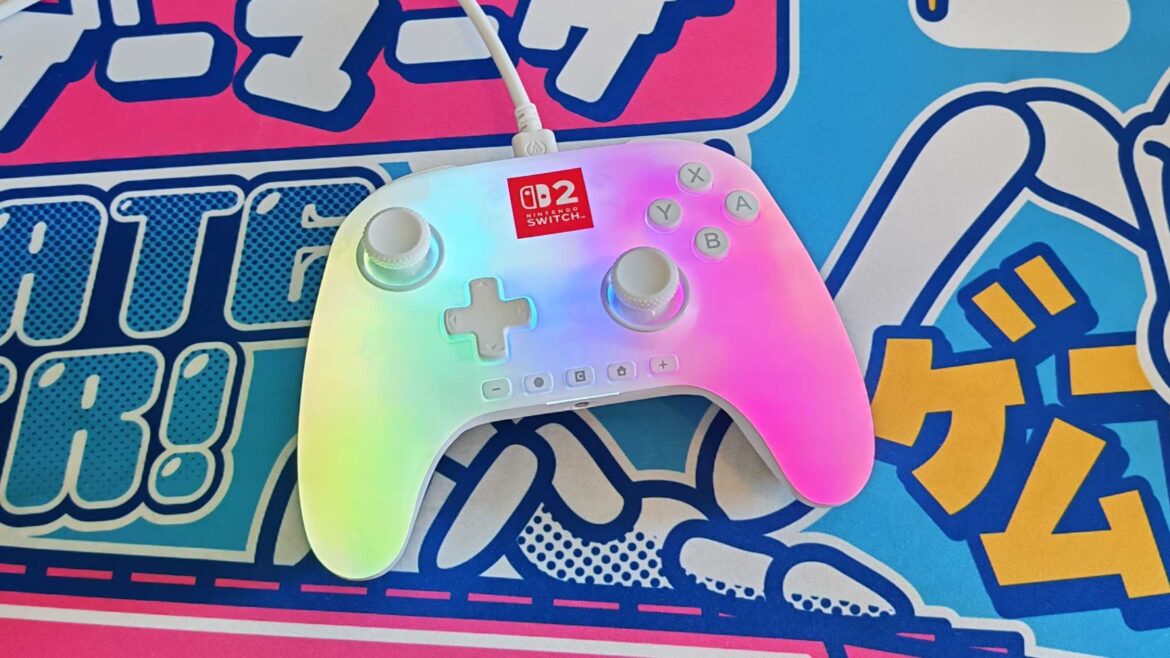
The PowerA Advantage Switch 2 Wired Controller on a bright blue mouse mat.
Product Reviews

PowerA Advantage Switch 2 Wired Controller review: just good enough

by admin September 16, 2025


Why you can trust TechRadar


We spend hours testing every product or service we review, so you can be sure you’re buying the best. Find out more about how we test.

PowerA Advantage Switch 2 Wired Controller: One-minute review

If you’re after a wired Nintendo Switch 2 pad that comes in at a relatively low price and offers a decent range of features, then the PowerA Advantage Switch 2 Wired Controller is a solid choice, though far from any of the best Nintendo Switch 2 controllers.

It features all the required Nintendo Switch 2 buttons, including the new C button for GameChat, plus two extra rear inputs that you can quickly remap without any software. It also has a 3.5mm headphone jack, compatible with many of the best gaming headsets or gaming earbuds, and offers three equalizer modes. They’re nothing groundbreaking, but a good inclusion at this price point.

I tested the ‘with Lumectra’ variant, which also boasts some pretty incredible RGB lighting that beautifully illuminates its entire faceplate. That’s aside from the giant red Nintendo Switch 2 logo that’s positioned right in the middle of the gamepad, which spoils the clean look. The lighting can be customized with a few pre-sets, or entirely personalized using four distinct lighting zones if you’re happy to spend time fiddling with the cumbersome button shortcuts.

The PowerA Advantage Switch 2 Wired Controller also boasts Hall effect thumbsticks, which is great on paper and should mean this controller lasts quite some time. Sadly, the thumbsticks themselves aren’t the best and feel very loose in comparison to alternatives. Fine control is difficult, which isn’t a huge issue when you’re playing a casual game such as Mario Kart World, but it is extremely annoying in a title like Splatoon 3, where accuracy really matters.

The top of the thumbsticks features a knobbly texture that’s rather harsh on the fingers too, leading to some soreness over prolonged periods of use. This won’t be a dealbreaker if you’re after something for player two, but for your main gamepad, consider more expensive alternatives like the Nintendo Switch 2 Pro Controller or 8BitDo Ultimate 2.

You get what you pay for with this one.

(Image credit: Future)

PowerA Advantage Switch 2 Wired Controller: Price and availability

  • Starts at $39.99 / £29.99
  • Lumectra variant is $49.99 / £34.99
  • It’s frequently on sale for much less

Buyers in the UK are getting a better deal on the PowerA Advantage Switch 2 Wired Controller, which starts at $39.99 / £29.99. That’s for the plain version. The Lumectra variant I tested goes for slightly more at $49.99 / £34.99.

Sign up for breaking news, reviews, opinion, top tech deals, and more.

This makes it a little cheaper than previous wireless options from the brand, such as the PowerA Enhanced Wireless Controller with Lumectra for the original Nintendo Switch.

These prices are frequently subject to discounts, though, especially if you’re not after a particular pattern. At the time of writing, the ‘Mario Time’ edition costs just $28.68 at Amazon in the US, while the black version is down to £24.99 at Smyths Toys in the UK.

Its wide availability means that it’s one of the cheapest Nintendo Switch 2 controllers that you can get at most retail stores, putting it firmly into impulse buy territory. If you’re shopping for a spare gamepad ahead of a multiplayer session, it’s going to be a really tempting option.

PowerA Advantage Switch 2 Wired Controller: Specs

Swipe to scroll horizontally

Price

Starts at $39.99 / £29.99

Weight

10.88oz / 300g

Dimensions

5.9 x 4.1 x 2.4in / 149 x 104 x 62mm

Compatibility

Nintendo Switch 2, Nintendo Switch

Connection type

Wired

Battery life

N/A

PowerA Advantage Switch 2 Wired Controller: Design and features

  • Lightweight
  • Lengthy 10ft USB cable
  • Doesn’t feel premium

The PowerA Advantage Switch 2 Wired Controller is extremely lightweight and doesn’t feel the most premium. It’s constructed from a basic, almost brittle plastic and seems hollow in the hands.

It doesn’t help that there are a few spots where you can actually peer at the circuitry inside the controller, around the thumbsticks and triggers, for example, which is a little strange and will surely lead to dirt and dust accumulating inside in the long run.

That lightweight feel does at least mean that it’s comfortable in the hands, though, and even young children shouldn’t struggle to hold it for extended gaming sessions.

On the front of the controller, you’ll find the two thumbsticks and all the expected inputs. This includes the face buttons, d-pad, plus and minus (which are located towards the bottom), a home button, C button, and capture button. The thumbsticks use Hall effect components, which is a good sign, though unfortunately don’t feel very high quality. They offer practically no resistance, gliding around quickly and making them difficult to control precisely.

They’re also made from a hard, plastic-like material with little abrasive bumps that left my fingers feeling sore after a few hours of play.

(Image credit: Future)

I tested the ‘With Lumectra’ version of the pad, which comes in a clean white. When plugged in, the face plate illuminates brightly thanks to loads of hidden LEDs in an impressive rainbow effect.

PowerA really knows how to make good RGB lighting without breaking the bank, and it leads to a very attractive-looking controller. Unfortunately, it’s somewhat spoiled by the giant Nintendo Switch 2 logo that’s been awkwardly slapped in a giant red square in the middle of the pad.

It clashes with the lighting effects and looks incredibly weird and out of place. Luckily, if you’re buying the cheaper regular version of the controller, you won’t need to worry about this, as the logo comes in more reasonable colors, like a dark grey on the black colorway.

On the back of the controller are the two remappable buttons, customized by holding a small program button next to them. There’s also a button to control the LED lighting, plus a dedicated audio button that cycles through EQ presets when you have headphones plugged in via the 3.5mm jack. There’s a standard preset, plus a bass boost and an ‘immersive’ option.

The only other thing of note is a small LED bar towards the bottom of the controller. It can be easy to miss with all the lighting turned on, but it’s a clean white when the controller is on and blinks blue when you’re remapping buttons.

As a wired gamepad, the controller is only usable when connected to the Nintendo Switch or Nintendo Switch 2 via a USB Type-C cable. A 10-foot-long PowerA-branded cable is included in the box, which should be long enough for most setups.

(Image credit: Future)

PowerA Advantage Switch 2 Wired Controller: Performance

  • Gets the job done
  • Ideal as a spare gamepad
  • Thumbsticks could be better

At the end of the day, the PowerA Advantage Switch 2 Wired Controller gets the job done. If you’re after a cheap controller to use when you’re playing with a friend or to give to a child, then it performs as you would expect for the price. The buttons aren’t the most tactile, but they are perfectly responsive to press, and the d-pad is a decent size and easy to use.

The plug-and-play compatibility makes the controller incredibly easy to set up, and the ability to tweak the rear button mapping or lighting effects without the need for any software is handy – though the process of doing this is cumbersome even with the instruction manual on hand.

(Image credit: Future)

The biggest area for improvement is easily the thumbsticks. As I already mentioned, they’re harsh on the finger and could really do with being made from a much softer material. They’re also quite loose, which makes them a poor fit for games that require precision.

Don’t get me wrong, they’re perfectly usable still, but they hardly compare to those offered by more expensive controllers such as the Nintendo Switch 2 Pro Controller It’s the one thing that really stops the PowerA Advantage Switch 2 Wired Controller from netting a more enthusiastic recommendation, given its modest price tag.

The addition of a 3.5mm jack is useful for voice chat, as it allows you to connect a pair of earbuds or headphones with a microphone. The three EQ settings are also nifty.

The standard and bass boost options are self-explanatory, while the ‘Immersive’ preset subtly increases both low and high-end sounds. Is it particularly immersive? Not really, but it’s still fun to play around with and might even help a cheap headset sound a little bit better.

(Image credit: Future)

Should I buy the PowerA Advantage Switch 2 Wired Controller?

Buy it if…

Don’t buy it if…

Also consider…

Swipe to scroll horizontallyRow 0 – Cell 0

PowerA Advantage Switch 2 Wired Controller

Nintendo Switch 2 Pro Controller

8BitDo Ultimate 2

Price

Starts at $39.99 / £29.99

$84.99 / £74.99 / AU$119.95

$69.99 / £59.99 / AU$90 (or $59.99 / £49.99 for PC-only model)

Weight

10.88oz / 200g

8.3oz / 235g

8.7oz / 246g

Dimensions

5.9 x 4.1 x 2.4in / 149 x 104 x 62mm

5.8 x 4.1 x 2.4in / 148 x 105 x 60mm

5.7 x 4.1 x 2.4in / 147 x 103 x 61mm

Compatibility

Nintendo Switch 2, Nintendo Switch

Nintendo Switch 2

PC, Android (Switch/Switch 2 version sold separately)

Connection type

Wired

Bluetooth, USB Type-C

2.4GHz, Bluetooth, USB Type-C

Battery life

N/A

Around 40 hours

10-15 hours

(Image credit: Future)

How I tested the PowerA Advantage Switch 2 Wired Controller

  • Tested for over two weeks
  • Tried with a wide range of games
  • Compared to other Switch and Switch 2 controllers

I tested the PowerA Advantage Switch 2 Wired Controller for over two weeks, trying it with a range of Nintendo Switch and Nintendo Switch 2 games, including the likes of Mario Kart World, Cyberpunk 2077: Ultimate Edition, Hitman World of Assassination – Signature Edition, and more.

Throughout my time with the controller, I compared it to my hands-on testing of other Nintendo gamepads, including the official Nintendo Switch 2 Pro Controller and Joy-Con 2.

Read more about how we test

First reviewed September 2025

PowerA Advantage Switch 2 Wired Controller: Price Comparison


Source link

September 16, 2025 0 comments
0 FacebookTwitterPinterestEmail
Town to City early access review
Game Reviews

Town to City early access review

by admin September 16, 2025


Town to City is the latest city builder now in early access, and it’s a must-play for fans of the genre. This new, beautifully blocky game lets your creativity run amok against an absolutely stunning landscape, and with a wide array of customization options, it sets itself apart from other entries in the genre. Since Town to City is still in early access, fans can expect developer Galaxy Grove to add more features as the game approaches its full launch—though I’m quite impressed with what we have already.

When you boot up the game, you have two options: New game (campaign) and Sandbox mode. The game’s campaign drops you in the world of Belvue, and you later gain access to a second map, Fontebrac, which introduces the game’s farming and economy features. A third map, Rocemarée, is planned to release for the campaign further down the line.

Throughout the campaign, you’ll receive quests from your townspeople, who will ask you to make improvements to the city. Sometimes, they’ll ask you to simply plant flowers or plop down a statue here and there. Other times, they want you to roll up your sleeves and design hedge mazes or marketplace plazas. Whatever their demand, though, you’ll be rewarded with new items you can place that won’t be unlockable in Sandbox mode.

Villager ask. Mayor create. Screenshot by Destructoid

In Sandbox mode, you have five different maps to choose from: the same two from the campaign, Belvau and Fontebrac, as well as three new ones. The three new levels—Creusemont, Ventelieu, and Montedeux—all come with their own characteristics that offer something new. Ventelieu is a totally flat, open field, allowing you to build your city however you’d like, whereas Montedeux features two massive mountains with a small crevasse in the middle, challenging you to build smartly around the craggy landscape. 

Though the different maps offer something new for your first playthrough on them, they’re not procedurally generated. This means each time you choose to build on Belvau or start a new campaign, you’ll load into the same Belvau map. Fontebrac always has the giant lake in the middle, Ventelieu will forever be flat, and Montedeux always comes with its two pesky peaks. The only difference between playthroughs on a particular map is where the rocks are placed. Although this can influence your early city design, you gain the ability to delete rocks fairly early into your research progression. That’s the only terrain-modifying tool you have at your disposal. Add all these factors together, and your replayability is greatly limited.

Town to City offers a plethora of items to unlock depending on your town size. Screenshot by Destructoid

The upside is the campaign took me about eight to 10 hours to “complete,” or feel as satisfied as I could across the two maps it gave me. This comes out to about four to five hours per map. Tack on playthroughs for the other three Sandbox maps, and you get about 20 to 25 hours of gameplay. Not bad for an indie game still in early access. 

When I was close to what I would consider completion of the campaign (there is no “true end”; the game allows you to keep building after reaching the largest city size), I ran into minor performance drops. My hamlet had reached the certified status of “Grandiose City,” the eighth and largest city size, with over 100 buildings. Zooming out to view my entire settlement, which only took up roughly 75 percent of the available map, caused slight stuttering and lag. It was minor enough that it didn’t disrupt my ability to enjoy the game, but it’s something still worth noting, especially for anyone who may be just at or slightly above the recommended specs. 

It’s not New York City, but it’s still much larger than it started. Screenshot by Destructoid

The selling feature for Town to City is its gridless function, and although it opens the door for your creativity to run amok, it doesn’t come without consequence. When I first began playing, I wanted my hamlet’s houses to line up on perfect parallel roads. But what originally looked like concisely angled avenues to my naked eye actually ended up slightly askew, and without a grid function to clearly show these flaws, my houses ended up resembling mangled teeth against paved pathways. I spent more time than I’d like to admit trying (and oftentimes failing) to perfect my city’s lines while its citizens watched with resignation as their houses were moved around for the umpteenth time. 

At other times, decorative items didn’t align with the buildings they were placed on. Objects like benches, which can be rotated several degrees but not freely, wouldn’t sit straight against walls. Now, let’s be clear: I’m nitpicking here, and you can judge just how upsetting the crooked bench or uneven fencing are in the screenshots below for yourself. If you’re a perfectionist like me, be aware that you may experience some eye-twitching throughout your playthrough.

Whoever lives in the red house clearly is not a perfectionist. Screenshot by Destructoid Drawing straight lines is harder than it looks. Screenshot by Destructoid

After playing through the campaign and starting a sandbox build, though, I tried letting loose a bit, and boy, did my time with Town to City only get better. I curved my paths, embraced uneven distances between buildings, and shrugged at my decorations’ lack of uniformity. And what do you know, what I thought would be chaos ended in harmony. 

You can still very much make your cookie-cutter neighborhoods if that’s what you so desire. It might be a bit more difficult than other city builders, but it is very much possible to arrange your roads, buildings, and miscellaneous decor all neat and tidy. If I, a certified neat freak, could offer some advice, it’s to learn to let go. The game is more fun when it’s played with the freedom it’s designed for.

What duly impressed me about Town to City, though, was its impressive number of customization options. Not only is there a large amount of decorations and building types to unlock with each branch of the research tree, but how those decorations can be placed varies depending on where you’re trying to place them.

Every flower and lily pad in this screenshot is from the same item. Screenshot by Destructoid

Take a flower patch, for example. This one simple item changes its shape depending on where you try to place it. Hover it over a window, and it looks like a flower box. Line it up against a wall, and it becomes a hanging flower garland. Place it in water, and it becomes lily pads. This mechanic opens up a level of exploration in design that most other city builders simply don’t offer, and it had me excitedly unlocking decor in the research tree at every chance I got. Forget unlocking a bakery or a carpenter’s station. Give me my flowers!

All in all, Town to City might not be without minor flaws, but it is an incredibly enthralling city builder. I was glued to my computer when building my villages, and I’m looking forward to tackling the other maps I haven’t gotten a chance to sink my teeth into yet. There are enough replayability options to keep me hooked for a healthy amount of time, and I’m hoping fans get even more gameplay features as the game approaches its full release.

8

Great

Impressive efforts with a few noticeable problems holding them back. Won’t astound everyone, but is worth your time and cash.

Town to City is the latest city builder now in early access, and it’s a must-play for fans of the genre. This new beautifully blocky game lets your creativity run amok against an absolutely stunning landscape, and with a wide array of customization options, it sets itself apart from other entries in the genre. It’s not without minor flaws, but aspirational players should by no means let that prevent them from giving Town to City a go.

Pros

  • Gorgeous blocky art style
  • Beautiful, relaxing music
  • Gridless feature allows you to create villages freely
  • Wide array of customization options that lead to unique town designs
  • Plenty of variety in research items and building types
  • Five different maps you can build on, with more to come

Cons

  • Lacks difficulty scaler
  • Repetitive campaign causes lack of replayability
  • Gridless gameplay can cause disorder
  • Minor performance drops once you get to the largest city stages
  • No procedural map generation

A copy of this game was provided by the publisher for review. Reviewed on PC

Review Guidelines

Destructoid is supported by our audience. When you purchase through links on our site, we may earn a small affiliate commission. Learn more about our Affiliate Policy


Source link

September 16, 2025 0 comments
0 FacebookTwitterPinterestEmail
Hornet against a gloomy underground cave backdrop
Product Reviews

Hollow Knight Silksong review: a daring, experimental, and breathtakingly beautiful sequel

by admin September 16, 2025


Why you can trust TechRadar


We spend hours testing every product or service we review, so you can be sure you’re buying the best. Find out more about how we test.

Long-awaited metroidvania game Hollow Knight: Silksong is already proving to be a victim of its own success.

The unbearable hype surrounding its storefront-destroying launch, combined with the simultaneous release into the eager hands of both critics and players, has created a uniquely voracious narrative.

There’s a sense that one must devour Silksong all at once, or else risk being left behind and out of the loop on what is surely one of the biggest gaming events of the decade so far.

The problem is, Silksong is not a game to be binged. It’s a sprawling, complicated, and brilliant sequel that demands patience above all else. Only then does it fully reveal itself as a game that’s much more than the conversations around difficulty would have you believe.

Review information

Platform reviewed: Nintendo Switch 2
Available on: PS5, PS4, Xbox Series X and Series S, Xbox One, Nintendo Switch 2, Nintendo Switch, PC
Release date: September 4, 2025

Not even two weeks into its life, developer Team Cherry’s Silksong has largely been misrepresented and mislabelled as an impossibly difficult and sadistic continuation of 2017’s brilliant Hollow Knight. Of course, Silksong is a very challenging game; I agree with that wholeheartedly. It’s so much more than that, though.

As the dust settles, and now looking back on my first completed playthrough, I believe it’s going to take years for the collective player hivemind to truly unpack exactly what Silksong does well, and where it falters.

Rough starts and Bellharts

(Image credit: Team Cherry)

I made the decision to play the first five hours of Hollow Knight alongside those of Silksong’s. This is where the two games differ most drastically. Hollow Knight is much more generous with checkpoints, resources, and clear tutorial sections than Silksong.

Sign up for breaking news, reviews, opinion, top tech deals, and more.

Enemies hit hard from the get-go in the sequel, while Hollow Knight gives you some softball encounters to practice on before its first proper boss fight. These are very different games, diverging from one another almost immediately and taking very different paths towards completely different conclusions.

The opening hours of Silksong are likely to be where players find the most friction. Enemies frequently deal two full health segments of damage, though you’ll have more freedom in how you heal thanks to main protagonist Hornet’s increased speed and aerial options. Instead of a simple down attack, Hornet dives in diagonal needle drops. This in itself requires hours to master, and it’s made very clear that bouncing between enemies without touching the ground is the strongest strategy available to you at first.

Your main special resource in Silksong is the silk meter, which is primarily filled by hitting enemies. Upon collecting enough silk, you’ll need to make a quick decision: heal, or unleash a special attack to hopefully end a fight earlier. Risk vs reward is hammered home again and again in Silksong, and it’s the first few hours where you’ll need to experiment with how you want to play. Eventually, you’ll get to the first town area, learn how to purchase items from merchants, and the currencies that you’ll have to focus on seeking out.

Rosaries are the main ones, but they’re also lost upon death, wrapped in a cocoon that must be retrieved in order to get them back. Shell Shards are somewhat supplementary, used to craft tools and open up your combat options.

My wallet is filled with moths

(Image credit: Team Cherry)

The economy between Rosaries and Shards is a tricky one to make the best use of. Silksong doesn’t give you many opportunities to get Rosaries consistently until a few hours in, while Shards aren’t particularly useful until you’ve bought tools and crafting kits from later merchants.

Tools become vital against flying enemies, bosses, and mobs of enemies, leading to one of the game’s key frustrations. To craft tools, you need Shards. To reliably purchase Shards, you must earn Rosaries, which come from exploring or, more reliably, killing enemies.

Many of the difficulty spikes I hit in Silksong completely cleared out my tools. I’d then have to travel elsewhere to farm Rosaries just to have enough tools to have another go at what was besting me. It’s reminiscent of the awful Blood Vial farming required for some bosses in Bloodborne, taking the player away from the action for repetitive bouts of repeated enemy hunting.

Unfortunately, this never really goes away in Silksong, and if anything, it becomes more common as you progress. The Shard vs Rosary reward balancing is ever so slightly off, making certain areas more and more difficult to progress through.

Shall we take a detour?

(Image credit: Team Cherry)

Silksong offers the same approach to problem-solving as seen in Elden Ring and its expansion, Shadow of the Erdtree, in that you’re supposed to go and find something else to do when a perceived skill wall presents itself. Silksong’s map is vast, and much of it is completely optional.

Best bit

(Image credit: Team Cherry)

The Needolin is an upgrade that turns Hornet’s needle into a musical instrument. You simply hold down a button, and Hornet plays along to nearby or ambient music. It’s used to unlock secret doors, interact with NPC events, and even open up new paths that are linked to the final ending of the game. It’s very ambiguous as to what the Needolin can interact with, so experimenting while exploring becomes its own intriguing side quest. I bet there’s even more the Needolin can do, and it’s going to take players years to find out all of its hidden functions.

Many times, I’d find myself throwing Hornet into the same repeated encounter, as I grew increasingly tired of losing the same fight over and over. At a certain point, however, it clicked that I simply needed to open up the map, look for new paths, and follow them forward. Every single time I did this, I happened upon something that made my build stronger – be that secret bundles of Rosaries, new move sets and upgrades, or non-player characters (NPCs) that could be brought into particular fights alongside Hornet. I developed a mantra to live by: if a section took me more than five tries, I needed to go somewhere else.

Once I opened myself up to Silksong’s non-linear progression paths, I started to meet less friction. Side quests are smart new additions that gently nudge players towards points of interest: An old town built into caves of gold, silver, and bronze bells; a decrepit medical wing filled with Lovecraftian horrors and a few allies to meet; a new encounter at the starting village that changes its topography and makes use of music to deliver sorrowful worldbuilding.

Kicking over a log in the woods

(Image credit: Team Cherry)

Playing Silksong makes me feel itchy; I’m not sure how else to describe it. Anyone else who spent their childhood wandering around rain-soaked woodland and muddy river banks will know the feeling. You find a rotten piece of wood, roll it over, and jump back at the writhing cities of grubs, bugs, and spiders you’ve unearthed.

Stepping into every new area always feels like a log turned over. You’ll hear the scritch-scratch of tiny legs from somewhere in the shadows. Tiny gnats will whine nasally as you approach. There’s a griminess to Silksong’s initial zones that’s made all the more potent by the golden gleam and religious opulence of late-game areas.

All of this is achieved in a 2D game, mind you. Somehow, Team Cherry has managed to make even the simplest passages feel thick with dirt, fog, and dust. Light is expertly used to add extra volume and scale to the standard side-scrolling formula used in other modern Metroidvanias.

In comparison, the map is one area where there’s been the least innovation. You still need to purchase them before you’ll see certain areas; there’s still a Compass that takes up a Crest slot, and pins can be used to mark key information.

Given the added variety and scale of Silksong, it’s unfortunate that the map isn’t really up to the task of leading you through the game. There frankly needs to be more information on NPCs, added options for pin types, and a reworking of the way the compass works to measure up to the changes made in this sequel.

Sting like a Hornet

(Image credit: Team Cherry)

Playing as Hornet is a wildly different experience when compared to the silent Knight of the first game. Hornet has dialogue. She’s confident, empathetic, and sternly protective of her personal space. There’s also a concerted effort to contextualize Hornet within the world of Pharloom. You get the impression that she has a personal connection to the bugs you meet, and a genuine desire to help them.

I’m impressed by how well-rounded Hornet is as a protagonist, which makes the combat and boss fights all the more impactful. Silksong is once again filled with an expansive lore and world history. Having Hornet be a part of that lore is a master stroke that elevates the sequel above the first game.

Let’s dance

(Image credit: Team Cherry)

Silksong is at its best when you’re fighting a boss. Every single one is memorable: equal parts deadly and stunning, with clear design motifs bolstered by bespoke musical accompaniment. Many of the boss battles are intricately choreographed affairs. One early game fight with a needle-wielding foe plays out like a synchronized dance routine, all death-defying dives and sparking slashes of sharpened steel.

I’m struggling to remember another game that’s so filled with best-in-class bosses as Silksong. With enough patience and a bit of time spent exploring for upgrades, none of them feel unfair. The loop of slowly learning patterns and then executing daring counters is what all great boss fights are about. Silskong delivers again and again and again in this respect. I can’t wait to jump back in and face the gauntlet of bosses with new tactics, builds, and strategies, and there isn’t a single boss I’ll be skipping in a second playthrough.

Silksong is every bit the sequel that Hollow Knight deserves. It’s the spoils of a team going the extra mile. It’s challenging, yes, but take your time and explore the vast world of Pharloom, and you’ll be rewarded with yet another masterpiece. I can’t wait to see what comes next from Team Cherry, as it’ll never be a team that settles on delivering ‘just more Hollow Knight’.

Should you play Silksong?

Play it if…

Don’t play it if…

Accessibility

Silksong offers the option to turn off camera shake and customize HUD size. There are audio sliders for individual tracks, and you can remap controls. This is a very limited offering, with no color blind, difficulty, or repeated button input options available.

How I reviewed Silksong

My first playthrough of Silksong lasted 36 hours, and I spent a while doing every side quest available before the final boss fight, not counting courier missions. I still haven’t explored the two final sections of the map, and there are plenty of secrets and locked doors I didn’t get to before the end of the credits. I played Hollow Knight back in 2018, completing the main story and some of the first DLC. I intend to go back and play Silksong a second time, focusing on a different Crest, and making use of a completely different set of tools.

I played Silksong on Nintendo Switch 2, making use of the 120Hz mode when docked. The Nintendo Switch 2 Pro Controller was perfect for this game, though d-pad users may want to go for an alternative controller (the d-pad on the Pro 2 is very subpar when compared to other options like the 8BitDo Ultimate).

I ran Silksong on my LG UltraGear 4K gaming monitor (27GR93U), making use of the extra refresh rate options. Generally, I played Silksong docked, though I did play about five hours handheld.

First reviewed September 2025

Hollow Knight: Silksong: Price Comparison


Source link

September 16, 2025 0 comments
0 FacebookTwitterPinterestEmail
Metal Eden Review - Shooting Through The Noise
Game Reviews

Metal Eden Review – Shooting Through The Noise

by admin September 15, 2025


Poland-based studio Reikon Games has only been around since 2014, but in its decade of development, it has made a name for itself creating stylish, action-forward cyberpunk games. Its debut, 2017’s Ruiner, was itself a great isometric shooter, but in hindsight, it was a look toward the studio’s future and its second game: Metal Eden. Like Ruiner, Metal Eden is a futuristic neon-lit shooter set in a cyberpunk dystopia, but this time, from a first-person perspective. It blends excellent first-person gunplay with movement tech that turns the city of Moebius into a parkour playground, and the resulting gameplay is hyper-fast, frantic, and fun. Though its narrative and level design sometimes get in the way of that, the entire package is still a setpiece-filled action romp and one of the year’s best shooters. 

In the world of Metal Eden, Hyper Units are disposable androids capable of inhuman feats thanks to a cyberpowered armor that allows them to dash, grapple, jetpack, and wall-run through just about any environment, and each unit is trained for cybernetic warfare, with a seven-gun arsenal in tow. You play as Aska, a special Hyper Unit tasked with saving the citizens of Moebius from imminent destruction. That leads her through derelict factories, deserts, mining facilities, and into the realms of Engineers, who possess Cores she desperately needs for her mission. It’s a solid foundation for the 7-hour adventure, and a voice-in-your-comms doesn’t let you forget about it, sometimes to the detriment of the game. 

While the voice acting is great, when you’re not engaged in multi-wave arena battles, there’s almost always a voice in your ear discussing their motives, their history, and their desires, all through sci-fi jargon that eventually bounced right off of me. Reikon is attempting to tell an enriched narrative, and I enjoy how much the studio focuses on walking players through Aska’s journey to save Moebius, which has been threatened with what is essentially a ticking time bomb; its finale leaves a lot to be desired, but I still found the overall story to be a commendable effort from Reikon. Its biggest flaw, though, is how often it gets in the way of the real star of Metal Eden: the action.

That said, the action was more than enough to pull me through each mission, as I constantly looked forward to the next setpiece, the next weapon, or even the next upgrade station to make my shotgun or grenade launcher more powerful. Metal Eden isn’t stingy with Dust, the currency used to upgrade weapons, found in canisters placed throughout levels or given upon defeating enemies. By the time I finished the game, only one of my seven weapons wasn’t fully upgraded, and I appreciate Reikon allowing me to unlock most of Aska’s potential in the first playthrough. Each weapon, whether it was the standard-issue submachine gun with unlimited ammo but a temperature-related cooldown, the energy weapon that melts enemy armor, or my personal favorite, an assault rifle with a secondary fire option that turns it into a powerful sniper, proved useful in combat. Firefights get so hectic that there were countless encounters where I used every single weapon at my disposal, whether it was a strategic need or because I ran out of ammo for another gun. 


Though I always enjoyed the combat, I wish it were more diegetic rather than arena-based. My favorite moments were when Metal Eden channeled another Poland-based studio’s game, Ghostrunner, to turn linear sections into parkour runthroughs where I needed to kill enemies with quick precision to advance and maintain momentum. But most of the combat happened when I entered a large arena, and a random sci-fi voice told me when I finished a wave and when another wave was beginning. These arenas are well-designed, with armor, health, and ammo pickups strategically placed about, and excellent wall-running and grapple opportunities, too, but they still grew dull. It doesn’t help that the runs between these arenas were often the type of combat encounters I actually wanted more of. 

Regardless, Aska only became more and more fun to use throughout Metal Eden as I unlocked more of my weapons’ potential and became more comfortable firing them while running on walls or grappling through the air, using my jetpack to extend my airtime. When I fully understood Aska’s set of weaponry and movement tech, and more importantly, how to take advantage of both in combat, each subsequent encounter felt like an extreme dose of adrenaline. 

Similar to the narrative’s intrusion into the excellent first-person gameplay, there were a handful of times in Metal Eden where levels went wide, allowing Aska to morph into a ball – yes, it’s very reminiscent of Metroid Prime – where you zap enemies and target them with lock-on missiles. While cool in theory, these sections are easily the worst, and rolling around as a metal ball in no way compares to the excitement of first-person shooting, wall-running, and jetpacking through this dystopia. 

Throughout my time in Metal Eden, I couldn’t help but imagine just how good a sequel I hope Reikon makes could be. This is a great start in the FPS genre for the team; its ideas are strong, and with refinement, Aska’s next mission could be as excellent as the Ghostrunner and Doom Eternal adventures it’s clearly inspired by. Though the star of the show – its first-person shooting and movement – is sometimes weighed down by an overreaching narrative and boring morph ball sections, when Metal Eden shines, it’s as bright as the sun that sheds light on Moebius’ dark underbelly.


Source link

September 15, 2025 0 comments
0 FacebookTwitterPinterestEmail
Donkey Kong looks at the camera.
Product Reviews

Donkey Kong Bananza: DK Island & Emerald Rush review: neat, but should’ve been free

by admin September 15, 2025


Why you can trust TechRadar


We spend hours testing every product or service we review, so you can be sure you’re buying the best. Find out more about how we test.

Had Donkey Kong Bananza: DK Island & Emerald Rush been released as a free update, I would be singing its praises.

Review info

Platform reviewed: Nintendo Switch 2
Available on: Nintendo Switch 2
Release date: September 12, 2025

After all, if I had one complaint with Donkey Kong Bananza in the weeks since it launched, it’s that there’s no real reason to keep coming back for more after the credits roll, and this new downloadable content (DLC) expansion remedies that somewhat by bringing back the fan-favorite Donkey Kong Island and introducing a replayable side mode to dive into.

  • Donkey Kong Bananza (Nintendo Switch) (Switch) at Amazon for $84.99

It’s an enjoyable diversion for a couple of hours and gives you a delightful excuse to rediscover some of the best locations from the main game, but for $19.99 / £16.99, the content on offer is just too slim to fully recommend.

That’s the exact same price as the recently launched Drag X Drive and most Nintendo Switch 2 Edition upgrades, not to mention indie titans like Hollow Knight: Silksong if you venture outside the first-party catalog – all of which would be better value purchases.

Switching sides

(Image credit: Nintendo)

The entirety of DK Island & Emerald Rush takes place after the main game, with the new DK Island layer appearing the next time you visit the Eelevator. Situated on the surface, a short distance from Ingot Isle, the map is a novel interpretation of how the setting appeared in the original Donkey Kong Country. It’s a joy to explore for a little bit, with memorable landmarks like Donkey Kong’s little hit and the massive Kong head-shaped volcano sure to delight long-time fans.

There’s loads of gold to hoover up, particularly in the smattering of small challenge levels hidden in its various nooks and crannies, which makes it all feel like a fitting celebration now that you’ve finished the game.

Unfortunately, there’s very little to do beyond exploration. There are a few locations clearly designed for taking screenshots in the photo mode with the likes of Diddy Kong and Cranky Kong, but it’s hard to ignore the fact that there’s no real progression like a standard Bananza stage. There aren’t even any enemies to defeat, which leaves it all feeling rather empty.

Sign up for breaking news, reviews, opinion, top tech deals, and more.

Most of your time on DK Island is clearly meant to be spent in the Emerald Rush mode, accessed by visiting Void Kong on a wrecked piledriver adjacent to the island. There’s a sliver of story content, with Donkey Kong and Pauline unwillingly drafted into joining Void Company in order to collect a new emerald substance, and then you’re thrust straight into it.

(Image credit: Nintendo)

In the mode, you run around a past level in which all of the existing gold has been turned into bright green emerald. Your task is to smash through it quickly and hoover up as much as possible within ten timed rounds, meeting a certain threshold in each in order to continue into the next.

Void Kong feeds you objectives as you go, which usually boil down to defeating some special green enemies that have spawned on the map or completing a quick task like dipping yourself in water or using a nearby barrel launcher.

Completing objectives or collecting one of the now green Fossils or Banandium gems lets you choose a perk, mainly centered around increasing your rate of Emerald collection.

There are a decent number of them, and they stack in interesting ways, leading to some satisfying rogue-like progression. On one run, for example, each enemy I defeated at full health would result in a deluge of Emerald thanks to multiple similar bonuses, and on another, I earned hundreds of times the usual reward for each completed objective.

Climbing the corporate ladder

(Image credit: Nintendo)

Finishing Emerald Rush runs awards Banandium Chips that can be spent placing statues of characters on DK Island.

There’s no real way to interact with these statues beyond bashing or throwing them, so this whole addition feels completely superfluous unless your idea of enjoyment is tossing around an inanimate idol of Squarks the Parrot.

Best bit

(Image credit: Nintendo)

The new clothing items here are really strong. My favorite new addition equips Donkey Kong with a swinging Void Co employee badge – complete with an adorable picture of him and Pauline.

Thankfully, there is a much meatier progression system tied to your current employee rating, which increases with each successful run. Working your way up the ranks gives you the chance to return to other past maps (there are a total of six), puts new perks into rotation, and unlocks some cool Void Co outfits to wear.

Beyond messing around with the option to increase the difficulty of each Emerald Rush run, which raises the required quota to progress and removes some starting abilities, there’s really not much else to this DLC, and you’re going to have had your fill after just a few hours. The perks add plenty of variety, but many of the objectives in Emerald Rush are quite samey and mean that it gets stale before you’ve even managed to max out your employee level.

What’s here certainly isn’t terrible by any means and does successfully extend the game’s overall runtime, particularly if you want to unlock everything, but it’s not unreasonable to expect something more substantial at this price.

(Image credit: Nintendo)

Should I play Donkey Kong Bananza: DK Island & Emerald Rush?

Play it if…

Don’t play it if…

Accessibility

As an expansion, Donkey Kong Bananza: DK Island & Emerald Rush has the same suite of accessibility features as the base game. This means you can access an assist mode, which makes the game easier overall, in addition to the various difficulty options for each Emerald Rush run.

Camera controls can also be inverted, and your main actions can be customized using some presets. Subtitles are enabled by default.

How I reviewed Donkey Kong Bananza

I spent over three hours in the DK Island & Emerald Rush expansion using a Nintendo Switch 2 in handheld mode using the standard Joy-Con 2 controllers and the system’s built-in speakers.

Having written our Donkey Kong Bananza review, I compared my experience to that of the base game and carefully considered the value for money offered by this DLC compared to other Nintendo releases and various Nintendo Switch 2 games.

First reviewed September 2025

Donkey Kong Bananza (Nintendo Switch): Price Comparison


Source link

September 15, 2025 0 comments
0 FacebookTwitterPinterestEmail
Strange Antiquities review | Rock Paper Shotgun
Game Reviews

Strange Antiquities review | Rock Paper Shotgun

by admin September 15, 2025


Strange Antiquities review

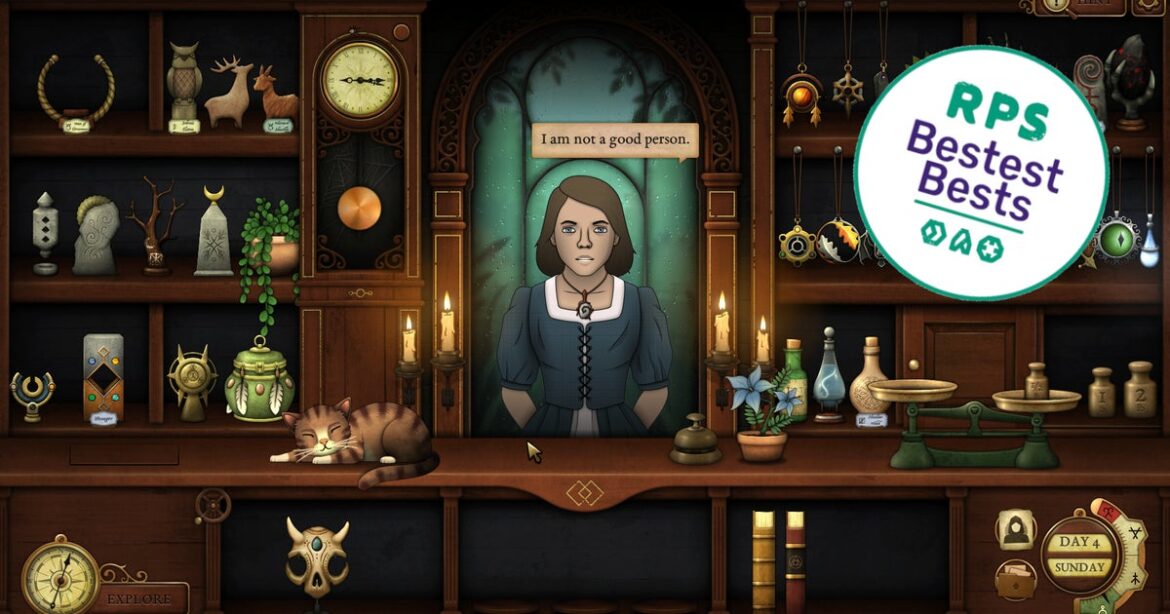
A shopkeeping puzzle game that’s even denser and more satisfying to master than its predecessor, Strange Horticulture.

  • Developer: Bad Viking
  • Publisher: Iceberg Interactive
  • Release: September 17th 2025
  • On: Windows
  • From: Steam
  • Price: £14.99/$17.99/€17.49
  • Reviewed on: Intel Core i7-12700H, 16GB RAM, Nvidia GeForce RTX 4060, Windows 11

During my first two hours serving Strange Antiquities’ customers, I tugged the bronze pendulum of an ornate clock at least a dozen times, wondering what the resulting spin and settle of its hands meant. I checked my occult encyclopaedia’s index for mentions of time and compared the clock face to shapes in a book of hermetic symbols. Each time I drew a blank I yanked the pendulum a few more times, just in case.

This follow-up to the joyous 2022 puzzler Strange Horticulture is packed with these promises of future puzzles: a locked cabinet with no key, a sliding-door cupboard with no clear purpose, three empty plinths beneath your shop counter, an engraved desk with four missing chunks. I knew they were all clues, I just couldn’t tell what for.

Until, in a series of glorious moments, I could.

When I realised how the clock fit into a multi-part puzzle that revealed a new area of my shop, I genuinely chuckled with delight, and that feeling repeated several times during my 10-hour playthrough. This is a longer and more uneven puzzle game than Strange Horticulture, but also more ambitious, and just as beguiling.

The general concept remains the same. Customers come to your shop for a specific named item. Your encyclopaedia holds clues for each one, from the concrete – like the shape or material – to the more abstract, such as the feeling it evokes when you hold it, or the fact it’s used to draw blood in an initiation ritual. You touch, listen to, and smell the objects on your shelves, and if you pick the right one you can strike it from your long list. Outside, a story of curses and cults unfolds, and some of the decisions you make, such as which of two items to give a particular customer, can change the outcome.

Image credit: Rock Paper Shotgun/Iceberg Interactive

The objects are imaginative: carved totems with unfamiliar symbols, bejewelled boxes that catch spirits, medallions designed in the image of a snake god, a blood-stained stone held by an eagle’s talons. They all look wonderful on your shelves, however you choose to arrange them. Descriptions are evocative, sometimes with double meanings that made me want to decipher them even more. Does this necklace give me goosebumps because it’s cold or because it’s creepy? Which of these wooden objects could conceivably be described as a “finger”?

At the start, simply knowing that an object is made of bronze with a single gemstone is enough to identify it, but soon the puzzles become tricky, layered challenges. Alongside your encyclopaedia you get a book on gems, a book of symbols, and a book of curses, and you’ll often need to flip between them multiple times to identify a single object. A simple example: if somebody comes in for a curse cure, you’ll first read your curse book to identify their malady, find that curse in your encyclopaedia’s index, and then read all the related entries to identify the object you need.

I was regularly stumped, but every time I split the puzzle into small chunks I could whittle down the possible answers. The hint system points you vaguely in the right direction without outright telling you the answer, which I like, but you can ask for multiple hints at once. When you solve a puzzle you’re handily told which clues were relevant – sometimes these were details I hadn’t even noticed, and that gave me new ideas for solving future puzzles.

Image credit: Rock Paper Shotgun/Iceberg Interactive

I love the feeling of mastery it builds. When you get a new encyclopaedia entry it flashes on screen. You can ignore it, but the key information often stuck in my mind. I lost count of the times I later thought “Wait, I know that name”, and it’s satisfying to use knowledge you didn’t even realise you had. The way encyclopaedia entries flow from one another encourages you to follow your trail of thought, and before you know it you’ve identified three or four objects, rather than just the one. By the end of the game I’d become a proper expert shopkeeper: I knew, without thinking, which gemstone meant death and which meant fire, which symbol meant summer, and which winter. Sometimes I could pick the right object without consulting my books, which felt fantastic.

Its best moments – like with the clock’s pendulum – are not when you’re identifying objects, but when you’re poking around your shop, discovering puzzles hidden in plain sight. To open the locked cabinet in one corner I had to manipulate an object in a way that I hadn’t initially thought was possible, and that empty cupboard I mentioned earlier proved instrumental in a way I won’t spoil, but was equally delightful. The game’s scope constantly surprised me, and it delivers on every one of the promises it teases.

Even the game’s collectible maps conceal secrets of their own. Click on a location and you get a story vignette, often ending with the discovery of a new object. The clues to find these locations – riddles, matching shapes, pattern recognition – are simpler but no less engrossing, and later, you get a device you have to place over one of your maps to find the right spots. I felt like a genius when I figured it out.

Image credit: Rock Paper Shotgun/Iceberg Interactive

In a game with so many puzzles, and so many different types of puzzle, a few duds are inevitable. I gave up identifying a particular medallion only for the hint system to tell me I had to first solve another puzzle I’d picked up (and put down) much earlier in the game, in what seemed like an arbitrary process. On another, I narrowed it down to two possible objects and simply had to guess – even when I saw the correct solution, the other object appeared to fit as well. Still, Strange Antiquities’ density and consistent generosity make it easy to forgive these small missteps.

It helped that I enjoyed simply inhabiting the shop, listening to the rain and thunder outside. I petted my cat every morning until he purred, and stuffed my papers in their drawers every night. After the first customer of every day I reshuffled my shelves to match my mood. Early on I arranged medallions by material – bronze, gold, wood, tin – with a separate section for items that looked particularly arcane. Later, I moved all my identified objects to a separate shelf and sorted medallions by the colour of their gemstone. This isn’t busywork – it’s flexibility that makes the shop feel like a deeply personal space.

I wish it was slightly easier to navigate with my mouse, though. When several objects seemed to fit the clues, I liked to stack them on the desk below my counter, a book open next to them, so I could better compare their markings and gems. To move an object from your shelves to this desk you have to grab each one, hold it at the bottom of the screen until the desk appears, and then drop it – an annoyingly fiddly procedure when it involves shifting four or five items in a row. It is, admittedly, easier if you use the keyboard too, but if ever there was a game designed for a mouse in one hand, coffee in the other, this is it. I also found it too easy to zoom in on a book (double click) when I simply meant to open it (single click).

Image credit: Rock Paper Shotgun/Iceberg Interactive

My enthusiasm for the puzzles also waned in the final hours, partly because its best challenges are all in the middle, and partly because I didn’t care about what was happening outside the shop. The town’s tale of curses, death, betrayal, and rival factions is, like all the words in Strange Antiquities, finely written, direct, and concise. Mildly poetic, even. But because you spend so much time buried in your books and staring at artefacts, it’s easy to forget what the last plot development was. And even if you keep track, the story loses its momentum about two-thirds of the way through, delaying and delaying what feels like an inevitable conclusion.

Even so, the satisfaction of a fully-ticked list kept me going to the end, and I happily lingered for a few more hours to identify objects I’d missed. The highs of Strange Antiquities – and there are many – match those of anything else I’ve played this year, and surely put it up there with Blue Prince among the best puzzle games of 2025. It is fiendish and delightful, and hopefully, one of many more Strange games to come.


Source link

September 15, 2025 0 comments
0 FacebookTwitterPinterestEmail
LEGO Voyagers Review - Studdy Buddies
Game Reviews

LEGO Voyagers Review – Studdy Buddies

by admin September 15, 2025


Every completed Lego set is a collaboration between the designers and the builder; it’s fun both because a team made a beautiful set and because you’re the one who put it together. Lego Voyagers, a co-op puzzle platformer from Light Brick Studio, made me feel the same way. Its adorable aesthetic and wordless storytelling make this brief adventure one worth sharing with family or a friend, but its distant camera angle and visual filters were frustrating obstacles on an otherwise picturesque road. At the end of the journey, though, my partner and I are the ones who completed the puzzle, and that makes it so much sweeter.

As a fan of couch co-op, I’ve been delighted to see a resurgence of two-player experiences over the past several years, and Lego Voyagers is an exciting addition to that lineup. Like Hazelight Studios’ Split Fiction and It Takes Two, Lego Voyagers is a strictly two-player experience: you cannot play it solo. Luckily, I have a fiancée at home now, and after taking one glance at the game, she was more than happy to play alongside me. If you don’t have a fiancée (which is fine, by the way), Lego Voyagers comes with a Friend’s Pass so that you can play for free with a friend online.

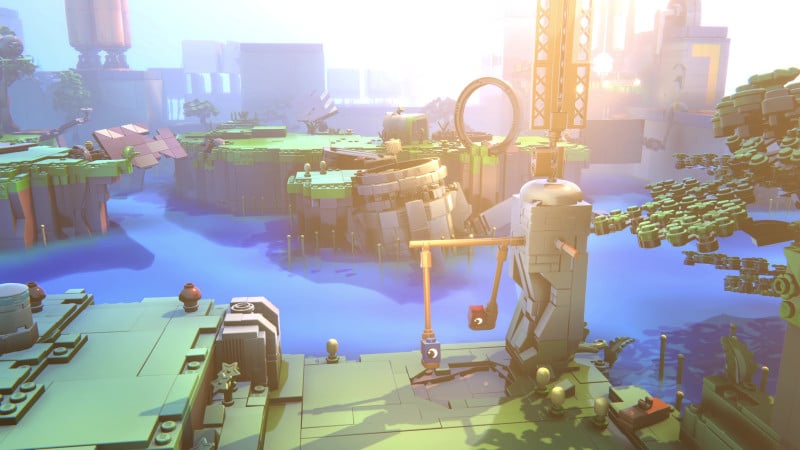
This game stars a pair of Lego pieces, one blue and one red, that goofily roll around the map, which is also gorgeously crafted from Legos. It’s visually charming, from its intricately crafted mountainsides to its minimalist animals, like butterflies represented by a tiny, flapping triangle. In addition to flopping around, one button is dedicated to “speaking,” which makes your respective Lego piece make a cute babble of gibberish. An exception to this is near a train section, where pressing the button makes the characters say “choo choo.” It’s as cute as it sounds.

While many surfaces are smooth, some have studs – those little nubs that allow Lego pieces to stick together – and the tap of a button here has your Lego guy lock onto the grid to move, allowing for more precise movement and platforming. That same button picks up loose Lego pieces, which you’ll use to build solutions to puzzles. I was slightly disappointed in this regard, solely because 80 percent of constructions are just bridges or ramps, but the last hour of the game cranks up the creativity to wonderful effect. You can also attach yourself to the other player to link up into one long Lego piece and roll around together. 

In addition to building sequences, Lego Voyagers has you solve simple puzzles, like bringing generator pieces from one area to another or operating machinery to help your partner reach distant platforms. My favorite genre of puzzle is when the game has you collaborate to pilot a vehicle, like a boat or car, with one person steering and the other controlling the acceleration. These puzzles make the most of the game’s co-op nature, and I understand why single-player isn’t an option.

Lego Voyagers is also a platformer, which I did not enjoy as much as the puzzles. You can use the build button to snap your character to studs in surfaces, allowing you to zip to platforms you need to reach, but these platforms are usually just a single stud wide and barely the full length of your jump, so some sequences take a few attempts. This only becomes frustrating because of the distant, angled camera. Lego Voyagers rightfully wants to show off its beautiful visuals, but this means making the players very small on the screen. When you combine that with a fixed camera and visual effects like bloom, depth perception is a challenge, and trying to make precise jumps feels unintentionally difficult.

Lego Voyagers doesn’t punish you for dying, but some of the platforming sequences are just messy enough that I worry whether a co-op party of two young kids would be able to make it through. Couple that with one particularly difficult rocket minigame near the end, and I’d go as far as to say that, despite its extremely kid-friendly aesthetics, I’d recommend this game for slightly older kids, maybe 10 and up, who might have an easier time getting through it.

Despite my misgivings with the platforming, however, the story more than makes up for it. Despite a vague start, you’ll know exactly what’s going on by the end, and it’s a stunning, bittersweet tale. The last hour in particular is so effective and simple that it’s become one of my favorite story moments of the year – if you start this game, you owe it to yourself to finish it.

While I wish it had an adjustable camera or the ability to tweak visual settings on console, I had a great time regardless. Ultimately, whether it’s online or local, the dedicated two-player experience is Lego Voyagers’ secret weapon. The game is intentionally abstract and open to interpretation, so you’ll fill in the gaps with your partner: you create a relationship between your Lego avatars, shorthand for game terms to get through levels, and eventually build a new, player-specific version of the game for yourself. Light Brick Studio did a great job designing Lego Voyagers, but the experience I built with my partner is what will stick with me.


Source link

September 15, 2025 0 comments
0 FacebookTwitterPinterestEmail
AirPods Pro 3 review: tripling down on a good thing
Product Reviews

AirPods Pro 3 review: tripling down on a good thing

by admin September 15, 2025


The AirPods Pro are about as ubiquitous as earbuds can get. Step outside your door, and you’re almost certain to see people wearing them. For good reason, too. Their active noise cancelling (ANC) is excellent for the price, sound quality is great, and they’re comfortable and convenient. If it ain’t broke, why fix it? After all, messing with a winning formula just for the sake of change often ends up in disappointment.

That’s not the case with the $249.99 AirPods Pro 3. Of all the shiny new gadgets Apple launched last week, this is the sole no-brainer upgrade. Everything you liked about the AirPods Pro just got better — and so did everything you didn’t.

$249

The Good

  • Improved ANC and sound
  • Longer battery
  • Standalone workout tracking
  • Live translation
  • Same price
  • IP57
  • Better fit
  • Camera remote control is handy!

The Bad

  • If you’re hoping for traditional foam ear tips, this isn’t that

The second-gen Pro was more or less about refining the software and sound; the overall design didn’t change. But while the AirPods Pro 3 look familiar at a glance, pop them in your ear and you’ll feel the difference. The new buds and tips are more angled, so they slot more naturally into your ear canal. You can twist them in for a more secure fit, whereas the last AirPods Pro would pop out unless you put them in just right.

Another plus: Apple now includes five ear tip sizes, adding an XXS size so you have a better chance of finding a comfy fit. That said, I would temper any expectations regarding the “foam-infused” tips. These aren’t your traditional foam tips, which expand to fit your ear more securely. What Apple’s done here is more of a hybrid approach. The front portion has some foam that subtly expands, but the majority of the tip is silicone for comfort and easier cleaning.

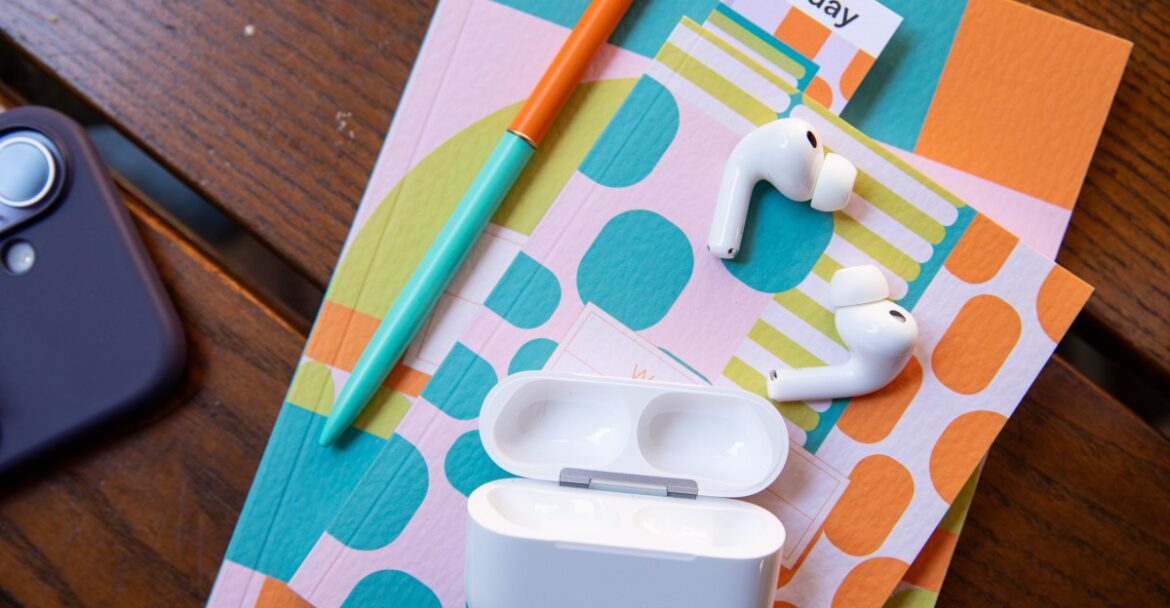
You can see the difference between the AirPods Pro 3 (top) versus the AirPods Pro 2.

And the other side.

The third-gen buds have a new shape to better fit ears.

Fit has always been one of the biggest complaints with AirPods, regardless of model. Whenever I come across AirPods haters, the usual reasons are either that the buds are too uncomfortable or they simply slip out. My spouse has bought multiple pairs over the years because the buds are always falling out of their ears. Nary a day goes by that I don’t find them crouching next to the bed or sofa, phone flashlight out, searching underneath for a missing AirPod. With these, they immediately declared, “They fit so much better!” and proceeded to pre-order their own pair. I’ve heard similar reactions from fellow reviewers who also had issues with the fit on prior AirPods Pro.

Still, that’s not a huge sample size, and everyone’s ear shape is unique. While I think the Pro 3 will fit more people, I still recommend trying a pair before committing if you’ve had issues in the past. But as someone who hasn’t, these fit me better too.

At Apple’s keynote last week, Apple executives kept saying these things had the “world’s best ANC” for wireless in-ear headphones. The claim is that the active noise cancellation in the third-gen buds is twice as good as the second gen, and four times better than the originals. The sound quality is also purportedly better due to a redesigned internal architecture that Apple says improves airflow for better bass.

Now, I’m not an audio engineer, but I did put the AirPods Pro 3’s ANC through a series of real-life tests alongside my personal pair of AirPods Pro 2. It’s pretty damn good.

The first test was a six-and-a-half hour flight from San Francisco to New York. Both pairs of buds performed well, but the third-gen were noticeably better. The dull hum of the plane was completely eliminated, though I could still hear announcements if I didn’t have audio playing. (That’s typical for any ANC headphones, however, especially earbuds.)

The case for the AirPods Pro 3 also has stronger Find My capabilities this year.

My second test was sitting in my kitchen while my spouse and in-laws were fixing our broken garbage disposal and running the laundry. Again, the second and third-gen buds were comparable, but the latter were notably better at dampening higher frequencies like voices and my cats yowling for kibble. If I put my tunes on, I couldn’t hear anything.

I also tested the active noise cancellation at a Bob Dylan and Willie Nelson concert against the Loop Experience 2 and EarPeace Music passive earplugs, which reduce noise by 17db and 20db respectively. The third-gen buds outperformed the Loop Experience 2, and were roughly on par with the Earpeace Music. I normally wouldn’t use AirPods in lieu of earplugs at a concert, but it’s nice to know that they’ll do in a pinch.

As for sound quality, the improvement is subtle but definitely there. I noticed it most while listening to the K-Pop Demon Hunters soundtrack. Multi-part vocal harmonies in songs like “Golden,” “Your Idol,” and “What It Sounds Like” are more audible, while the bass lines are punchier. Despite listening to this album on repeat since June with the AirPods Pro 2, I noticed new elements in the sound production, like faint bubble-popping effects in the catchy “Soda Pop.” I had a similar experience listening to old favorites. And while I still think spatial audio is gimmicky outside of a Vision Pro, I can appreciate that sound quality has been subtly improved on Dolby Atmos tracks as well. Ultimately, you’ll notice a richer overall listening experience regardless of whether you’re listening to music or watching an immersive movie.

Sensors: Dual beamforming microphones, inward-facing microphone, skin-detecting sensor, motion-detecting accelerometer, speech-detecting accelerometer, heart rate sensor, touch control.

Chips: H2 headphone chip, U2 chip in charging case

Dust and water resistance: IP57

Battery: Estimated 8 hours of listening time with ANC, 7.5 hours with Spatial Audio and Head tracking enabled. 6.5 hours with heart rate sensing during workouts. 10 hours in Transparency mode. 24 hours with the case.

Connectivity: Bluetooth 5.3

Calls sound “generically good,” according to a friend I called while walking along a windy highway full of bustling cars. They weren’t able to hear any of the wind or environmental noise, even though the ANC wasn’t able to wipe them out entirely for me.

ANC is power-intensive, but I was pleased to see the third-gen buds have improved battery life. I wore them with ANC enabled for five hours of my flight, plus a 10-minute wait at baggage claim and a 40-minute Uber ride home. I still had 27 percent battery left by the time I got home. Altogether, my usage roughly tracks with Apple’s eight-hour estimate for ANC listening time on a single charge.

Hands-free fitness tracking

Perhaps the biggest hardware update for the AirPods Pro 3 is the addition of a heart rate sensor, enabling fitness tracking without an Apple Watch. It’s not a huge surprise, given that Apple added heart rate sensors to the Powerbeats Pro 2 earlier this year. But the AirPods Pro do a lot more with the feature.

For starters, you can track your heart rate during 50 types of workouts directly from the native iOS Fitness app. On the Powerbeats, this was limited to a handful of partner apps at launch. This is great news for folks with wrist tattoos, which get in the way of smartwatch sensors, or those who’d rather not wear smart rings, chest straps, or smartwatches for sports like boxing or weight lifting. It’s also a boon for anyone who routinely forgets their Apple Watch while on walks.

You can choose to track workouts with the Apple Watch or with just the AirPods Pro 3.

Apple’s Fitness Plus app can display heart rate data from the AirPods Pro 3 — a strange omission from the Powerbeats at launch. Crucially, the AirPods can also act as a secondary heart rate data stream when used with the Apple Watch. Previously, apps always deferred to the Apple Watch over the Powerbeats. Now, Apple’s introduced an algorithm that will analyze which of the two heart rate data streams has a stronger signal in a given activity, and prefer that one. Some good news: Apple isn’t gatekeeping these improvements to the AirPods. It’s since announced these updates will also come to the Powerbeats in iOS 26.

I tried Pro 3-only tracking for two outdoor walks and found that the heart rate tracking was comparable to a chest strap, within roughly 5 to 10 beats per minute. Accuracy will heavily depend on a secure fit, but I never had issues getting readings, even when I got sweaty. Some more good news on that front: the buds now have IP57 sweat and water resistance. I wouldn’t dunk my head in a pool while wearing them, but they might stand a better chance of surviving the wash or a sudden downpour.

As part of Apple Intelligence, the AirPods Pro 3 (along with the Pro 2 and AirPods 4) will support live translations for a handful of languages. I’ve always wanted the Babel fish from Hitchhiker’s Guide to the Galaxy to be real, so I was stoked to try this out. Compared to phones or smartwatches, earbuds feel like a more natural choice for live translation tech.

Sorry to burst any bubbles. This live translation feature is no Babel fish, though I can see it being useful in a handful of scenarios.

The feature was impressive in a live demo Apple gave me where a Spanish speaker gave a short speech. I activated Live Translation via the iPhone’s Action Button and voilá. (You can also activate by pinching both AirPods’ stems). The speaker’s voice was dampened and after a short, intentional delay, Apple Intelligence crisply translated what was being said on-device. You and your conversation partner can either both use AirPods for translation, or if they don’t have a pair, you can also view a transcript of the translated conversation on your iPhone. And if it worked like this every single time, I’d cry tears of joy.

You can view a transcript of a conversation via the iPhone

You can also start a live translation session from the phone…

Or via touch controls. You just have to press the stems of each earbud.

But real-life conversations are a bit different. They’re not always calm. They’re full of ums and uhs, and I doubt there’s any child of immigrants who hasn’t heard an auntie rattle off at the speed of light. So I called up my cousin’s spouse, who is a fluent German speaker, to see how this feature would handle translation without guardrails. To both of our surprise, it actually worked quite well for conversational German. It was even able to accurately translate when he spoke in German slang in an Austrian accent — something he said might be hard for a native German speaker. (He likened it to hearing someone with a thick Scottish accent.) It only stumbled when he would occasionally switch back to English to comment on accuracy.

The feature isn’t limited to in-person conversations only, however. It works with any audio you’re hearing in person, meaning you should be able to use it for public announcements while traveling, video calls, or foreign-language media. To test this, I watched a scene from the German film Der Untergang featuring an epic meltdown from Hitler in the last days of his dictatorship. I chose this scene precisely because the actor speaks quickly and with emotion, changing thoughts mid-sentence, and there’s cross-talk from other characters. (And because I could compare the translation with the official subtitles.)

1/3You can get the gist even if it’s not quite right.

The translation feature performed admirably, but struggled to recognize character names or account for abrupt pauses in dialogue. Sometimes it identified the words correctly but used the wrong meaning for the context. For example, a line that Live Translation presented as “Steiner could not massage enough forces for an attack” is translated in the movie’s subtitles as “Steiner didn’t have enough force to attack.” A more literal translation would be “Steiner couldn’t amass enough forces for the attack.” There are multiple ways you can translate the word that became “massage,” but Live Translation picked the wrong one.

This isn’t an Apple limitation; I’ve seen it across all AI translation tech. But while live translation works well enough to convey broad meaning, it’s hard to say whether people will use this as intended. I’ve lived abroad and have a multilingual family. To me, using AirPods makes most sense in trying to translate announcements, museum tours where multilingual options aren’t available, or media that may not yet have subtitles. In face-to-face human interaction, most people are happy to gesture or point to a translation app on their phones. And in business meetings where the absolute correct meaning is crucial, it’s hard to beat seasoned interpreters. I’ll be curious to try this out during an upcoming trip to Italy, but I have the sense that doing so will also come with a healthy dose of anxiety and self-consciousness.

Now that I’ve used the AirPods Pro 3, I can’t go back.

Let me preface this by saying you shouldn’t run out and buy these if your AirPods Pro 2 are working perfectly fine. There’s no reason to throw out a good pair of earbuds. Ideally, I’d ask that everyone exercise restraint and only upgrade when their current AirPods finally crap out or are genuinely in need of replacement. (If you’re coming from the original AirPods Pro, you’ve got a much better case for upgrading.)

But I also know how gadget nerd brains work. If you’re going to ignore me, yes this is a worthy upgrade. I wrote ahead of last week’s event that Apple should lean into giving people what they want, and they’ve done that with the AirPods Pro 3. I have next to no complaints, and the only downside I can think of is perhaps the improved fit still won’t work for everyone. The price is the same, the new additions are smart, and most importantly, the sound quality and ANC are top-notch for earbuds.

I’m happy with my AirPods Pro 2, but I won’t lie. Now that I’ve experienced the AirPods Pro 3, I can’t go back. I’ll be ordering a pair for myself once I return this review unit.

Agree to continue: AirPods Pro 3

Every smart device now requires you to agree to a series of terms and conditions before you can use it — contracts that no one actually reads. It’s impossible for us to read and analyze every single one of these agreements. But we’re going to start counting exactly how many times you have to hit “agree” to use devices when we review them since these are agreements most people don’t read and definitely can’t negotiate.

Like any other Bluetooth earbuds, the AirPods Pro can technically be set up and used without you agreeing to anything in software. With the new heart rate tracking feature, however, you may optionally be asked to agree to third-party privacy policies and terms of service if you agree to share that data (i.e., Ladder, Runna, etc.)

Final tally is one mandatory agreement.

0 CommentsFollow topics and authors from this story to see more like this in your personalized homepage feed and to receive email updates.

  • Victoria SongClose

    Victoria Song

    Senior Reviewer, Wearable Tech

    Posts from this author will be added to your daily email digest and your homepage feed.

    PlusFollow

    See All by Victoria Song

  • AppleClose

    Apple

    Posts from this topic will be added to your daily email digest and your homepage feed.

    PlusFollow

    See All Apple

  • FitnessClose

    Fitness

    Posts from this topic will be added to your daily email digest and your homepage feed.

    PlusFollow

    See All Fitness

  • Fitness Tracker ReviewsClose

    Fitness Tracker Reviews

    Posts from this topic will be added to your daily email digest and your homepage feed.

    PlusFollow

    See All Fitness Tracker Reviews

  • GadgetsClose

    Gadgets

    Posts from this topic will be added to your daily email digest and your homepage feed.

    PlusFollow

    See All Gadgets

  • Headphone ReviewsClose

    Headphone Reviews

    Posts from this topic will be added to your daily email digest and your homepage feed.

    PlusFollow

    See All Headphone Reviews

  • ReviewsClose

    Reviews

    Posts from this topic will be added to your daily email digest and your homepage feed.

    PlusFollow

    See All Reviews

  • TechClose

    Tech

    Posts from this topic will be added to your daily email digest and your homepage feed.

    PlusFollow

    See All Tech

  • WearableClose

    Wearable

    Posts from this topic will be added to your daily email digest and your homepage feed.

    PlusFollow

    See All Wearable


Source link

September 15, 2025 0 comments
0 FacebookTwitterPinterestEmail
Lego Voyagers Review - Building A Relationship
Game Reviews

Lego Voyagers Review – Building A Relationship

by admin September 15, 2025


There are so many great co-op experiences to be had right now that my biggest issue isn’t finding something to play with my wife or kids, it’s finding enough time to play them all. But I’m glad I made the time for Lego Voyagers, because it’s the sort of game that is immediately, obviously special, and culminates in a beautiful final few minutes that made my kids and me care deeply for a simple pair of Lego bricks.

Lego Voyagers is a two-player co-op game, so there’s no solo mode, nor can you pair up with a bot partner. Played online or–even better–with two players sharing a couch, the game takes only about four hours to go through. But that’s time very well spent, I can tell you, after having played it with my daughter and son at different times.

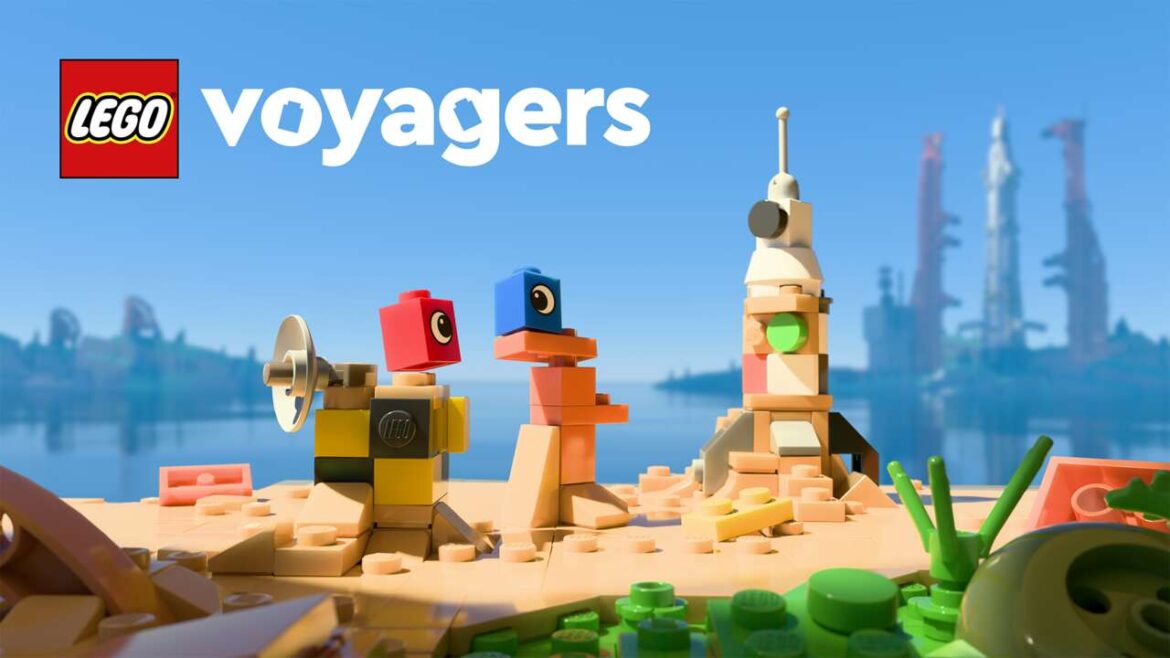
Lego Voyagers stars two minuscule Lego bricks. Both nameless, they’re each personified only by their single googly-eye sticker, as well as their different colors; one is blue, the other is red. The simple, wordless story is nonetheless affecting. As the pair live out their lives as neighbors and buddies atop a small island built of Lego bricks, a rocket in the distance can be seen taking off, awakening in them a passion for science and space travel. Heading off from home, the pair go on an adventure to explore this passion together.

Voyagers’ art direction recalls developer Light Brick Studio’s previous Lego game, Lego Builder’s Journey, with brick-based dioramas propped up like islands. Early sections are set in something like a nature trail, so autumnal Lego bricks decorate the world, as water rushes below and around the landmasses. Later in the story, the pair of brick buddies end up in more industrial spaces, giving the game an aesthetic overhaul but consistently looking gorgeous throughout, thanks to some fantastic lighting and the basic foundational art design that turns everything you can see and interact with into Lego bricks.

Voyagers is a puzzle-platformer at its heart, but it’s designed for players of most experience levels. Because it’s a co-op game, the puzzles usually require both players work together, but It feels built in such a way that virtually any two players could complete it, be it parent and child, siblings, best friends, or partners. Naturally, the puzzles tend to ask you to build together, too. Simple solutions early on, like building a Lego bridge to cross a gap, introduce the physics-based nature of the characters and world. Its basic controls consist of moving, jumping, and locking into any open Lego stud you can find.

Working together to build solutions to problems naturally fits the Lego aesthetic.

Sometimes this means picking up loose pieces, moving, spinning, and stacking them to make something that will help you progress, like plugging in a Lego battery to open a gate. Other times, you may scoot into a little Lego chair and operate contraptions like an industrial magnet, with one player carrying the other across an opening where they can then return the favor. The blue and red characters wobble around, traversing rocky trails and stumbling through forests as each player may or may not mash on the “sing” button, which allows them to call out to each other with noises that sound sort of like baby babble.

As you progress, the game reveals its keen eye for instructional play. For example, you may come to a landing with a rock wall too high to simply jump over, but several loose Lego bricks lie about. You and your partner know by then that you can easily build with any loose pieces you find all across the game, and when you do so in this case, you’ll see you’ve built something like a long stilt, which you can then move end over end up the rocky path, sort of like a stiff reverse Slinky, provided both players push their characters in the same direction.

Later in the game, you’ll need to learn how to do things like operate vehicles together, with one person steering while the other controls moving forward or backward. Lego Voyagers consistently builds on its playful mechanics, always asking players to collaborate, and always expressing Lego’s inherent best parts: creativity, spontaneity, and a sense of child-like silliness.

While the puzzles do expect a basic level of video game know-how–how to use a controller, for example–for the most part, the game’s language is one of relentless forgiveness and approachability, which I greatly appreciated. Few puzzles demand solutions built around strictly timing your actions, giving younger or less experienced players plenty of runway to perform their duties as half of the puzzle-solving duo. The game’s ever-present platforming elements–in which you may frequently fall off the world into the waters below–are so forgiving that you instantly respawn from where you fell off, even holding any loose, puzzle-solving bricks you may have lost in your fall. It’s a game that often challenges you but never punishes you, and playing it with my six-year-old especially made that design choice both impossible to miss and easy to adore.

Each puzzle we encountered did well in presenting the dilemma wordlessly. They reliably had the feeling of emptying a bag of Lego bricks onto a table, then building something you can already see in your mind. While most puzzles do have specific solutions you’re meant to use to progress, the finer details are often up to you. Maybe you need a makeshift staircase to climb a wall, but the precise shape of that staircase can vary, as players connect different bricks in different ways. It was especially joyous to watch my kids take the lead in moments like these. There are dozens of Lego games, but few quite capture that special feeling of building with your kids like Lego Voyagers does.

The only issue I had with Voyagers was how, on a small handful of occasions, it felt like we’d actually cheated the game somehow. This was usually because of how respawning after a fall works. If I’d made it to a platform and my co-op partner hadn’t yet, it was sometimes the case that they could fall off the world and respawn beside me instead of still needing to face the rest of the puzzle. It was a rare but odd case when this occurred, and though it could be seen as yet more forgiveness from the game’s world design, in these instances, it felt more like we’d lightly, though inadvertently, broken our way past a solution that would’ve been more satisfying to rightly solve.

The often peaceful vibes of Lego Voyagers are a wonderful change of pace compared to typical kid-friendly fare.

The tranquility of the world is something else I love about Voyagers, because it feels so unlike many family games and other experiences aimed at kids. As a parent, I’ve found I’m not always so enthusiastic for media that feels overly chaotic and loud. Lego Voyagers eschews that candy-coated energy and instead offers a game that is very laid-back, made complete with a soundtrack of slow, synthy rhythms that match the world’s dedication to simply hanging out with your friend or loved one. The game as a whole is less like a day at a theme park and more like a nature hike.

All of this dedication to meaningful time spent together and creative play spaces that let imaginations take over is made more powerful thanks to its unexpectedly moving story. There are no words, no narrator, no text-based exposition. Lego Voyagers tells you everything you need to know using its lovely music, the sneakily nuanced sing button that changes contextually as the story goes on in a few clever ways, and the simple premise at the start.

The two Lego pals seek adventure, and going on that adventure with them culminates in an ending that is as sweet as it is smart, repurposing some of the game’s core pieces in new ways that pack an emotional punch fit for players of any age. Much like building with Lego, it dismantles what was there to create something different, and those final few minutes, if they were sold in stores as a Lego set, would be flying off the shelves. It’s a beautiful game in so many ways, but most of all that beauty shines through in the would-be simple story of two friends on an adventure together, which easily became just as special for me and my loved ones.


Source link

September 15, 2025 0 comments
0 FacebookTwitterPinterestEmail
Lego Voyagers review - sticking together even when miles apart
Game Updates

Lego Voyagers review – sticking together even when miles apart

by admin September 15, 2025


A game so lovely it’s hard not to feel sad when it’s all over. A brief adventure that will leave a lasting impression.

It’s nice to have a friend. More than one if you’re lucky. My memories of childhood friends are predictably tied to the era: Sunny D, Apple Fruitang, MTV, bikes, and VHS tapes are all there, hanging around the back of my mind. Surprisingly, though, it’s stupidly long walks that I remember most fondly, although rather hazily. Like most kids before they had jobs (a paper round came some years later), we didn’t have much money, and what we did have we wanted to spend on sweets, so we’d often walk miles to avoid getting a bus – we even had a squeaky metal trolley we’d wheel about to carry all our stuff as we ventured to the distant pitch-and-put or tennis courts.

Lego Voyagers review

  • Publisher: Annapurna Interactive
  • Developer: Light Brick Studio
  • Platform: Played on PS5
  • Availability: Out now on PC, Xbox Series X|S, PS5, and Switch

Friendships are different as adults. There’s less time, more commitments, and unwanted organisation, and nary a single chewy sweet or gobstopper in sight (good news that gobstoppers mostly disappeared, to be honest – I have no idea how generations of children were allowed to wallop cricket balls into their mouths without anyone wondering if it was a bad idea). Good friends click into place at any time, though, as if you just saw each other yesterday even if it’s been “way too long”. Anyway, back to this review before I digress even further from the point. I played Lego Voyagers with my son, someone who still remembers what it’s like to not care about anything but the moment, and who sees the joy in heading out to do something, even if that thing hasn’t been neatly detailed in a group WhatsApp. He also hasn’t dealt with friendships drifting as they tend to do, daily pals turning into occasional hellos shared over huge distances.

Watch on YouTube

Lego Voyagers then, the sort-of-sequel to the Light Brick Studio’s Lego Builder’s Journey, is an entirely co-op adventure. Whereas Builder’s Journey asks you to build using Lego bricks to solve movement puzzles in a string of connected but singular dioramas, Voyagers offers up open levels to explore and characters (single red and blue blocks with an eye each, and an ability to shout out twee, nonsensical noises, which somehow makes them seem more alive than their simple shape should allow) who do the building themselves. It makes for a markedly different experience, that feels like more of an adventure with puzzles than a series of puzzles that take you through a story. It’s also one of the best depictions of friendship I’ve seen in a video game, handled with the most beautifully soft touch.

Character in the industry’s most traditional Lego games comes from an exuberant sense of fun and lampooning, the Lego versions of famous heroes and villains playing caricatures, often brilliantly, but more pantomime than West End. Lego Voyagers manages to convey character subtly, using music, sounds, and small movements rather than slapstick. One moment, which proves to be key in the second half of the game, caused my son to become close to rage, but if I were to explain it here it’d seem like nothing at all. Small things, and in this case, bricks, matter.

You do the actual placing of bricks, which gives you a stronger connection to the world than in most Lego games. | Image credit: Eurogamer/Light Brick Studio

Voyagers isn’t a difficult game, nor a long one, my son and I clocking just under four hours as we casually made our way to the finale. It heavily promotes working together, though, similar to how my wife might hold a door open while I push the buggy through. Neither task there is difficult (unless you’re dealing with an unusually obstinate door), but attempt to do both on your own and you’ll be reversing into a coffee shop pulling off moves usually reserved for a game of Twister (of course I’ve never played Twister, but I can imagine it!).

This is Lego Voyagers, two friends jumping and rolling through a Lego world, building blocks and activating contraptions in order to continue onwards. Sometimes you simply need to build up bricks to reach a high platform, occasionally you’ll be required to fix something by finding the right Lego bricks, from time to time there are some platforming sequences that rely on using a machine to aid you, there’s a train, a dump truck, and a rocket.

This looks like nothing, but it was the cause of multiple family humps. | Image credit: Eurogamer/Light Brick Studio

The rocket, parts of which appear on Red and Blue’s idyllic remote island home after a failed launch, is central to the pair’s voyage through the world – finding where it’s manufactured, fixing it up, and eventually much more. It’s the joining tissue in what often feels like a lazy afternoon hangout, a stress-free stroll. Sure, I admit to raising my voice when my son and I had different ideas of what “forward” meant while co-driving a vehicle, and my wife had to put headphones on when we took turns arguing over which of us had the more difficult job flying and landing a miniature space craft, but this is largely a game you move through rather than work through. There’s no peril, no sense of disaster, fear, or worry, just a bit of good natured squabbling. Nothing that a joke or two can’t fix.

Lego Voyagers accessibility options

None.

As we reached what I saw to be the start of the end of our adventure, I said to my son: “I don’t think you’re going to like what is happening here.” As this panned out, almost exactly as I predicted, I was right. He didn’t like it, but it felt right – the final moments about as perfect as I can imagine this story could be. As a short but sweet puzzle-adventure game, Lego Voyagers handles itself with an air of grace but no snootiness – a game so lovely it’s hard not to feel sad when it’s all over. Look deeper though, or simply from the privilege of age, and it’ll leave a more lasting impression on those of us who know what proper friendship feels like. Sometimes a little “hello” is all you need.

A copy of Lego Voyagers was provided for this review by Annapurna Interactive. A single copy of Lego Voyagers can be played co-op online (via the Friend’s Pass) or on the same console.

Love Eurogamer? Make us a Preferred Source on Google and catch more of our coverage in your feeds.


Source link

September 15, 2025 0 comments
0 FacebookTwitterPinterestEmail
  • 1
  • …
  • 13
  • 14
  • 15
  • 16
  • 17
  • …
  • 31

Categories

  • Crypto Trends (1,098)
  • Esports (800)
  • Game Reviews (772)
  • Game Updates (906)
  • GameFi Guides (1,058)
  • Gaming Gear (960)
  • NFT Gaming (1,079)
  • Product Reviews (960)

Recent Posts

  • This 5-Star Dell Laptop Bundle (64GB RAM, 2TB SSD) Sees 72% Cut, From Above MacBook Pricing to Practically a Steal
  • Blue Protocol: Star Resonance is finally out in the west and off to a strong start on Steam, but was the MMORPG worth the wait?
  • How to Unblock OpenAI’s Sora 2 If You’re Outside the US and Canada
  • Final Fantasy 7 Remake and Rebirth finally available as physical double pack on PS5
  • The 10 Most Valuable Cards

Recent Posts

  • This 5-Star Dell Laptop Bundle (64GB RAM, 2TB SSD) Sees 72% Cut, From Above MacBook Pricing to Practically a Steal

    October 10, 2025
  • Blue Protocol: Star Resonance is finally out in the west and off to a strong start on Steam, but was the MMORPG worth the wait?

    October 10, 2025
  • How to Unblock OpenAI’s Sora 2 If You’re Outside the US and Canada

    October 10, 2025
  • Final Fantasy 7 Remake and Rebirth finally available as physical double pack on PS5

    October 10, 2025
  • The 10 Most Valuable Cards

    October 10, 2025

Newsletter

About me

Welcome to Laughinghyena.io, your ultimate destination for the latest in blockchain gaming and gaming products. We’re passionate about the future of gaming, where decentralized technology empowers players to own, trade, and thrive in virtual worlds.

Recent Posts

  • This 5-Star Dell Laptop Bundle (64GB RAM, 2TB SSD) Sees 72% Cut, From Above MacBook Pricing to Practically a Steal

    October 10, 2025
  • Blue Protocol: Star Resonance is finally out in the west and off to a strong start on Steam, but was the MMORPG worth the wait?

    October 10, 2025

Newsletter

@2025 laughinghyena- All Right Reserved. Designed and Developed by Pro


Back To Top
Laughing Hyena
  • Home
  • Hyena Games
  • Esports
  • NFT Gaming
  • Crypto Trends
  • Game Reviews
  • Game Updates
  • GameFi Guides
  • Shop

Shopping Cart

Close

No products in the cart.

Close