

Laughing Hyena
  • Home
  • Hyena Games
  • Esports
  • NFT Gaming
  • Crypto Trends
  • Game Reviews
  • Game Updates
  • GameFi Guides
  • Shop
Tag:

Meta

DAAPrivacyRightIcon
Product Reviews

Meta Ray-Ban Display hands-on: Discreet and intuitive

by admin September 19, 2025


I’ve been testing smart glasses for almost a decade. And in that time, one of the questions I’ve been asked the most is “oh, but can you see anything in them?” For years, I had to explain that no, glasses like that don’t really exist yet.

That’s no longer the case. And while I’ve seen a bunch of glasses over the last year that have some kind of display, the Meta Ray-Ban Display glasses feel the closest to fulfilling what so many people envision when they hear the words “smart glasses.”

To be clear, they don’t offer the kind of immersive AR that’s possible with Meta’s Orion prototype. In fact Meta considers “display AI glasses” to be a totally separate category from AR. The display is only on one lens — the right — and its 20-degree field of view is much smaller than the 70 degrees on Orion. That may sound like a big compromise, but it doesn’t feel like one.

Karissa Bell for Engadget

The single display feels much more practical for a pair of glasses you’ll want to wear every day. It’s meant to be something you can glance at when you need it, not an always-on overlay. The smaller size also means that the display is much sharper, at 42 pixels per degree. This was especially noticeable when I walked outside with the glasses on; images on the display looked even sharper than in indoor light, thanks to automatic brightness features.

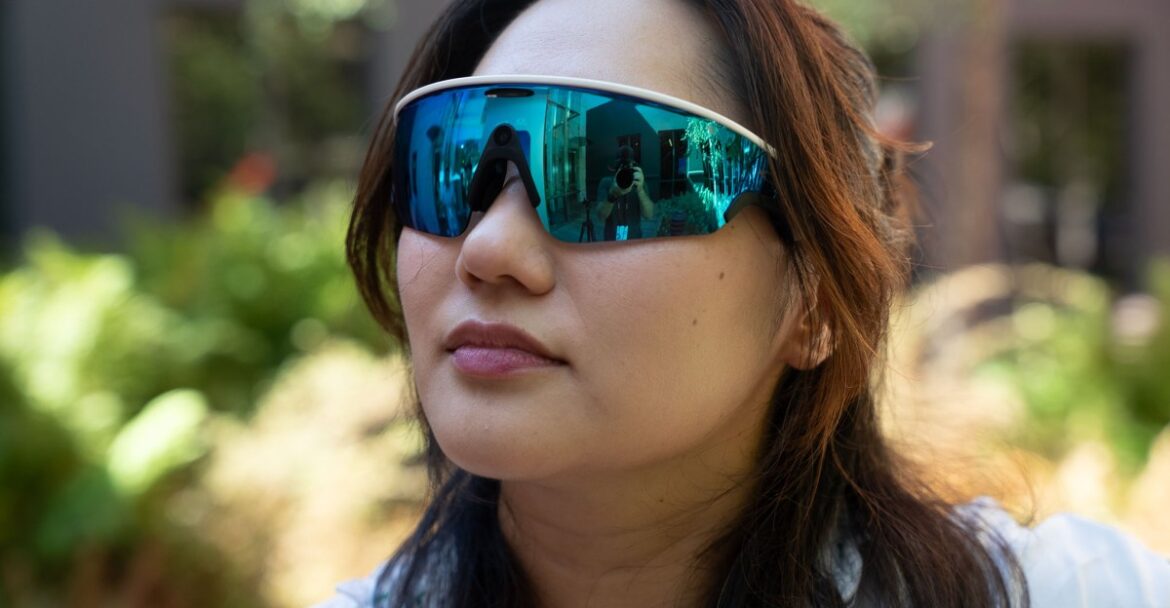
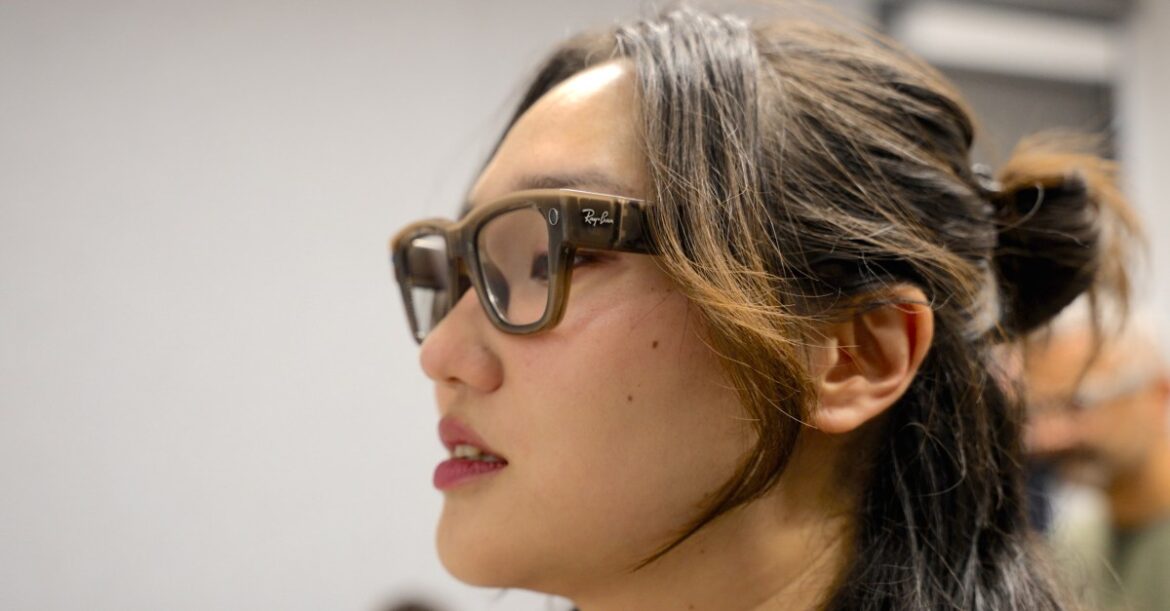
I also appreciated that you can’t see any light from the display when you’re looking at someone wearing the glasses. In fact the display is only barely noticeable at all when you at them up close.

Having a smaller display also means that the glasses are cheaper, at $799, and that they don’t look like the chunky AR glasses we’ve seen so many times. At 69 grams, they are a bit heavier and thicker than the second-gen Meta Ray-Bans, but not much. As someone who has tried on way too many pairs of thick black smart glasses, I’m glad Meta is offering these in a color besides black. All Wayfarer-style frames look wide on my face but the lighter “sand” color feels a lot more flattering.

The Meta Ray-Ban Display (left) and second-gen Ray-Ban Meta glasses (right.) The display glasses are a little thicker.

(Karissa Bell for Engadget)

The Meta Neural Band wristband that comes with the display glasses functions pretty much the same as the band I used on the Orion prototype. It uses sensors to detect the subtle muscle movements on your hand and wrist and can translate that into actions within the glasses’ interface.

It’s hard to describe, but the gestures for navigating the glasses interfaces work surprisingly well. I can see how it could take a little time to get used to the various gestures for navigating between apps, bringing up Meta AI, adjusting the volume and other actions, but they are all fairly intuitive. For example, you use your thumb to swipe along the the top of your index finger, sort of like a D-pad, to move up and down and side to side. And you can raise and lower the speaker volume by holding your thumb and index finger together and rotating your wrist right or left like it’s a volume knob.

It’s no secret that Meta’s ultimate goal for its smart glasses is to replace, or almost replace, your phone. That’s not possible yet, but having an actual display means you can look at your phone a whole lot less.

Karissa Bell for Engadget

The display can surface incoming texts, navigation with map previews (for walking directions), and info from your calendar. I was also able to take a video call from the glasses — unlike Mark Zuckerberg’s attempted live demo during his keynote — and it was way better than I expected. I could not only clearly see the person I was talking to and their surroundings, I could turn on my glasses’ camera and see a smaller version of the video from my side.

I also got a chance to try the Conversational Focus feature, which allows you to get live captions of the person you’re speaking with even in a loud environment that may be hard to hear. There was something very surreal about getting real-time subtitles to a conversation with a person standing directly in front of me. As someone who tries really hard to not look at screens when I’m speaking to people, it almost felt a little wrong. But I can also see how this would be incredibly helpful to people who have trouble hearing or processing conversations. It would also be great for translations, something Meta AI already does very well.

1 / 5

Meta Ray-Ban Display glasses.

You can just barely see the display from the front of the lenses.

I also appreciated that the wristband allows you to invoke Meta AI with a gesture so you don’t always have to say “Hey Meta.” It’s a small change, but I’ve always felt weird about talking to Meta AI in public. The display also addresses another one of my longtime gripes with the Ray-Ban Meta and Oakley glasses: framing a photo is really difficult. But with a display, you can see a preview of your shot, as well as the photo after the fact, so you no longer have to just snap a bunch and hope for the best.

I’ve only had about 30 minutes with the glasses, so I don’t really know how having a display could fit into my daily routine. But even after a short time with them, they really do feel like the beginning of the kind of smart glasses a lot of people have been waiting for.
Source link

September 19, 2025 0 comments
0 FacebookTwitterPinterestEmail
Oakley Meta Vanguard hands-on: what athletes actually want
Product Reviews

Oakley Meta Vanguard hands-on: what athletes actually want

by admin September 18, 2025


When the Oakley Meta HSTN arrived earlier this year, it wasn’t what I thought Oakley-branded smart glasses would be. Sure, they had Oakley’s famous PRIZM lenses, but where was the wraparound design? Where were the athlete-focused features like stronger water and sweat resistance? Confusingly, it felt like the HSTN glasses were just Ray-Ban Meta glasses by another name. But that’s because Meta had the real athlete-focused glasses in its back pocket. Today, the company unveiled the new $499 Oakley Meta Vanguard — and it has everything outdoorsy athletes could want and then some.

“When we started building HSTN, it was an easier process of developing because most of the things we wanted for low-impact sports, like skating, don’t require a lot of technology in the eyewear from a performance standpoint,” says Oakley global president Caio Amato. Conversely, Amato says, the Vanguards were envisiond as a “revolution” not just for elite sports stars, but weekend warriors and everyday athletes.

Jabroni mode unlocked.

Putting on the Vanguards, I felt myself morph into Coach Taylor from Friday Night Lights. They’re the quintessential wraparound Oakleys beloved by sports coaches, hardcore outdoors enthusiasts, and Patagonia-clad dads. At 66g, they’re slightly more hefty than the regular Ray-Ban Meta glasses, but still feel lightweight and secure enough for more intense activity. That’s partly because the Vanguards will ship with three swappable nosepads to ensure a good fit. The design has also been crafted with hats and cycling helmets in mind, which is why the control buttons are placed underneath the arms instead of above.

Switching the camera to the nosebridge was a huge technological challenge, says Oakley Global President Caio Amato. Photo: Colt Bradley / The Verge

Speaking of buttons, there’s also a new Action Button that acts as a shortcut for the various camera modes. Yes, you read that right: modes. The Vanguards have a 12MP, 122-degree camera placed smack-dab in the nose bridge, with a recording indicator light placed right above it. You can now record in 1080p with 30 frames per second for five minutes, 1080p at 60fps for three minutes, 3K at 30fps for three minutes, and 720p at 120fps in a new slo-mo mode. There’s also a new hyperlapse mode that lets you stitch together and compress in a sort of highlight reel. (Hyperlapse and slo-mo will come in a software update to all of Meta’s glasses later this fall.) There’s also adjustable stabilization, so you can customize based on the intensity of the activity you’re doing. Athletes can also program the glasses to start recording at certain milestones — like when they’re nearing a race’s finish line, for instance. It’s basically like putting a GoPro on your face without a silly little face-mount.

The camera, Amato says, was the biggest challenge in developing the Vanguards. The desire was to capture a first-person point of view, but “from an engineering and design standpoint, it change[d] everything completely from where Ray-Ban Meta were before.” For example, to get that first-person perspective, Amato says the camera required a much wider field of view, stronger stabilization, and 3K quality.

The Vanguards have also been tweaked to cater to outdoor performance. The lenses are swappable, and a low-light option will be available later this year. Amato says the different colors are optimized for certain activities. For example, if you’re into fishing, you may want the blue lenses as they neutralize blue hues more.

The speakers are 6db louder. That might not seem like much, but having pushed the volume, I assure you, they can get quite loud. Amato says that the speakers were tested on bicycles going up to 30mph with crowds present, as well as at road races, so that runners could have confidence their tunes wouldn’t be drowned out on race day. Unlike the regular Ray-Ban glasses, these also have an impressive IP67 water- and sweat-resistance rating. Meaning if you fall out of a kayak, you don’t have to worry about the glasses getting wrecked. Battery life also has an estimated max of nine hours, and six hours of continuous music playback — enough for most people to finish a marathon. With a case, you get a total of 36 hours and can also charge roughly 50 percent in 20 minutes.

Note the Meta AI glasses icon on the Garmin I’m wearing. Photo by Colt Bradley / The Verge

But the athlete-focused features don’t stop there. Meta is also partnering with Strava and Garmin. For the former, you can upload your footage straight to the platform. You’ll also be able to ask Meta’s AI about your historical Strava data. But perhaps what’s cooler is that the glasses can pair directly with certain Garmin watches. (I was told “most newer Garmins should work.”) You can see a Meta AI icon on the Garmin watch, and, mid-run, you can ask the glasses to give you a readout of your heart rate and other stats. Afterward, you can put an overlay with your workout’s key metrics on your video footage for sharing on social media. Garmin users can also program the glasses to automatically capture snippets at key moments — for example, each time you finish a mile.

“We wanted to have Garmin and Strava [as partners] because they’re leaders and because they have a community of sports people around them,” says Amato. “We really like the whole idea of this eyewear as enabling those sport communities to not only be their best version, but also to communicate and record better while capturing life.”

There’s more good news if you like heart rate zone training. There’s a new LED light above the right eye that turns red if you venture outside the target zone for a given workout. The LED light can also be configured to provide pacing alerts.

The glasses come in four colors and the lenses are swappable. Photo by Victoria Song / The Verge

I took the glasses for a brief spin on a treadmill run and used them to record regular and slo-mo video. It was simple and easy via the action button, but you can also just ask Meta’s AI to start recording. There was next to no latency when I asked the glasses to give me a readout on my heart rate. That’s not enough to deliver a complete verdict, but my first impression is that this is an impressive feature set that will appeal to all sorts of athletes. I was such a huge fan of the Bose Frames Tempo that I ran a whole half-marathon in them. I’ve felt a bit bereft since they were discontinued. However, those were simply audio glasses, and I still had to use my phone to capture moments from my race. The ability to condense sunglasses, headphones, and a camera into one piece of equipment is hugely appealing when you’re trying to manage a water vest, salt chews, energy goos, and sunscreen.

Amato says the response from elite athletes so far has been incredibly promising. The company had superstars like cyclist Mark Cavendish, NFL quarterback Patrick Mahomes, and Real Madrid’s Kylian Mbappé help develop and provide feedback on the device. According to Amato, the glasses left the usually opinionated Cavendish speechless over all the possibilities. Mahomes purportedly said that the Vanguards “were not eyewear anymore” but “something completely new.”

I’m no professional athlete, and we’ll have to put these to the test in the coming weeks. But if they can replace my Bose Tempo? I’m down to be the captain of Team Jabroni.

The Oakley Meta Vanguard glasses are available for preorder today and will ship October 21st.

0 CommentsFollow topics and authors from this story to see more like this in your personalized homepage feed and to receive email updates.

  • Victoria SongClose

    Victoria Song

    Senior Reviewer, Wearable Tech

    Posts from this author will be added to your daily email digest and your homepage feed.

    PlusFollow

    See All by Victoria Song

  • GadgetsClose

    Gadgets

    Posts from this topic will be added to your daily email digest and your homepage feed.

    PlusFollow

    See All Gadgets

  • Hands-onClose

    Hands-on

    Posts from this topic will be added to your daily email digest and your homepage feed.

    PlusFollow

    See All Hands-on

  • MetaClose

    Meta

    Posts from this topic will be added to your daily email digest and your homepage feed.

    PlusFollow

    See All Meta

  • ReviewsClose

    Reviews

    Posts from this topic will be added to your daily email digest and your homepage feed.

    PlusFollow

    See All Reviews

  • TechClose

    Tech

    Posts from this topic will be added to your daily email digest and your homepage feed.

    PlusFollow

    See All Tech


Source link

September 18, 2025 0 comments
0 FacebookTwitterPinterestEmail
DAAPrivacyRightIcon
Product Reviews

Meta Horizon TV is an entertainment hub for VR headsets

by admin September 18, 2025


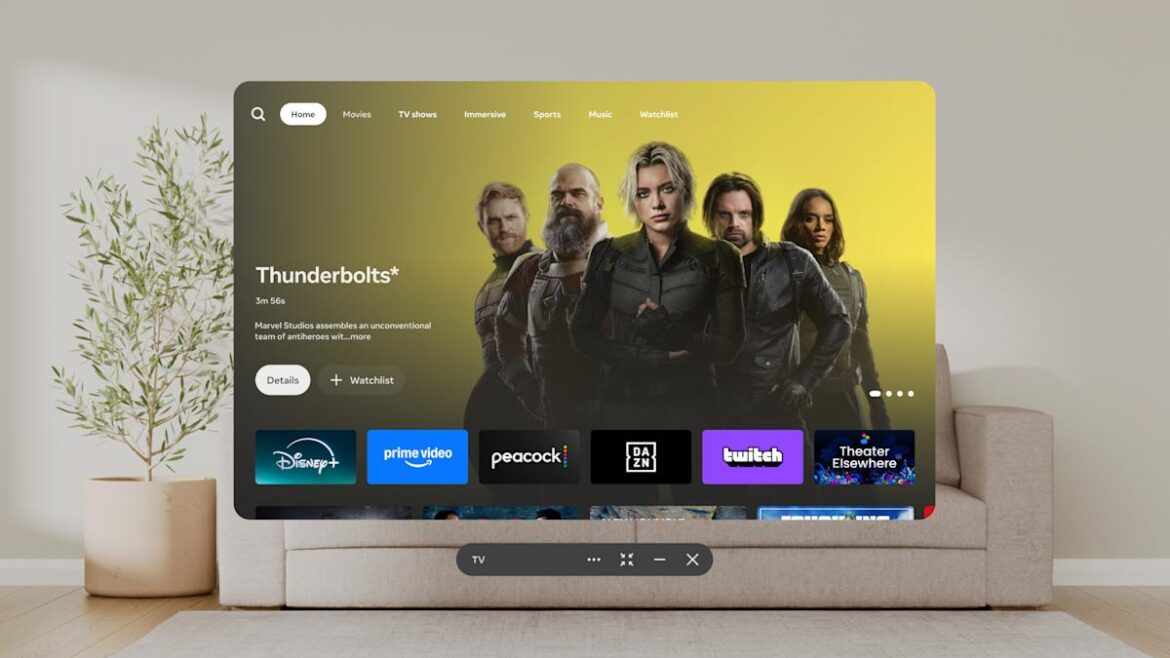
After revealing his company’s latest augmented reality and smart glasses at Meta Connect this year, Mark Zuckerberg has introduced a new entertainment hub for its Quest headsets called Horizon TV. Zuckerberg said Meta believes watching video content is going to be a huge category for both virtual reality headsets and glasses in the future. Meta has already teamed up with several major streaming services to provide shows and movies you can enjoy in VR. One of those partners is Disney+, which will give users access to the Marvel Cinematic Universe on their headsets, as well as to content from ESPN and Hulu.

Based on the interface Zuckerberg showed on the event, which had a lineup of streaming apps that will be available on the hub, Meta also teamed up with Prime Video, Spotify, Peacock and Twitch. That will allow you to watch shows, such as The Boys and Fallout on your virtual reality devices. Meta also partnered with Universal Pictures and iconic horror company Blumhouse, so that you can watch horror flicks like M3GAN and The Black Phone on your Quest “with immersive special effects you won’t find anywhere else.”

The Horizon TV hub supports Dolby Atmos for immersive sounds, with Dolby Vision arriving later this year for richer colors and crisper details. For a limited time, you’ll be able to watch an exclusive 3D clip of Avatar: Fire and Ash on Horizon TV, as well, as part of Meta’s partnership with James Cameron’s Lightstorm Vision.


Source link

September 18, 2025 0 comments
0 FacebookTwitterPinterestEmail
Meta Ray-Ban Display hands-on: the best smart glasses I’ve ever tried
Product Reviews

Meta Ray-Ban Display hands-on: the best smart glasses I’ve ever tried

by admin September 18, 2025


I want to preface this hands-on by saying that I’ve been a smart glasses skeptic for many years. In 2019, I even made a two-part mini documentary with a thesis that consumer smart glasses couldn’t happen without massive societal and technological shifts. Well, color me pink and let me find a shoe to eat. After getting a demo of the $799 Meta Ray-Ban Display, I’m convinced this is the closest we’ve ever gotten to what Google Glass promised over 10 years ago.

The glasses look just like a chunky pair of Ray-Bans. But put them on, pinch your middle finger twice, and a display will appear in front of your right eye, hovering in front of your vision. It’s not augmented reality overlaid on the real world so much as on-demand, all-purpose menu with a handful of apps. You can use it to see text messages, Instagram Reels, maps, or previews of your photos, letting you do all kinds of things without having to pull out your phone. In fact, since it pairs to your phone, it sort of functions like a pop-up extension of it.

The display shows apps in full color with a 600-by-600-pixel resolution and a 20-degree field of view. It has a whopping 5,000 nits of maximum brightness, yet only 2 percent light leakage, which means it’s nigh impossible for people around you to see that it’s there. Each pair of the Display glasses comes with transition lenses, and the brightness adjusts depending on ambient UV light. Since it’s monocular, the display only appears in the one lens, and while it can be a little distracting, it doesn’t fully obstruct your vision.

It was difficult for us to capture our own still photos of what the display looked like for me at the hands-on. This is a decent approximation. Image: Meta

My colleague Jay Peters was looking at me dead-on while I was reading a text message, and he couldn’t see a trace of it. I stepped outside into a sunny area, and while the display was hard to see at first, it came into clearer focus as the transition lenses took effect. (Though even 5,000 nits can’t compete with the sun if you stare directly at it. Side note: don’t stare directly at the sun.)

When you are looking at the screen, your conversation partner may not see what you’re looking at, and will be able to tell you’re a little distracted. Jay noticed this immediately in my demo, and after, we joked: forget phones at the dinner table — now you’ve got to worry if your spouse, date, or friend is secretly watching videos or texting while you’re telling them important news.

The glasses are bolder than the Ray-Ban Metas. The frames are thicker, the edges are more rounded, and the overall Wayfarer shape is more square. The nose bridge, I’m told, is designed to have a universal fit. As someone with a low nose bridge, I appreciated that it didn’t slip down my face. Also, good news if you have a wide face: there are now overextension hinges so the temple arms can bend slightly outward for a more comfortable fit. Battery life lasts around six hours with “mixed use,” and you get 30 hours total with the new collapsible charging case. And at 69 grams, it’s still relatively light.

I’m tracing letters into my leg to write a text message. You can hold your arm by your side to control the device with the Neural Band. Photo by Colt Bradley / The Verge

Another big new addition is the Meta Neural Band. We’ve seen this before with last year’s Orion prototype, but using it was eye-opening. The band utilizes something called electromyography to read the signals from your muscles so that you can control the display with gestures. It was a lot to take in at first, but I got the hang of it pretty quickly. And the coolest part? You don’t have to hold out your arm as with a headset like the Apple Vision Pro. You can just hold your hand at your side — behind your back, under a table, anywhere really — and perform all the gestures discreetly.

Pinching once with your index finger selects an item in the menu, while the same action with the middle finger acts as a back button. Pinching your middle finger twice summons and dismisses the display. You can also make a sideways fist and swipe your thumb left, right, up, and down to scroll through options. Pinching while rotating your hand will raise or lower the volume while listening to music, as well as zoom in when you’re taking photos.

Here are some examples of how you can’t see the display, but you can tell my attention is elsewhere.

Adding a display plus this wristband suddenly unlocks a range of hands-free capabilities. On the Ray-Ban Meta glasses, you have to pull up Instagram Live on your phone if you want to see what your photos or videos look like. With the Display glasses, you have a built-in preview window. My smart glasses photos will no longer be plagued by my bangs or my infernal tendency to tilt my head. You can also take video calls directly to your eyeballs in WhatsApp. You’ll be able to see whoever’s calling, and they’ll be able to see your point of view, too. I tried a video call with Jay. While it was incredibly cool to see his face floating in my vision, I couldn’t help feeling like a spy about to steal some corporate secrets in a high-stakes heist.

Messaging is another obvious plus. You can read, view photos and Instagram Reels, and reply to messages without ever having to take out your phone. (The Reels part is a little annoying; my friends send me TikToks.) And later this year, Meta is planning on introducing a handwriting feature where you can trace letters on any surface and discreetly reply to messages without having to dictate things aloud. I got to try it, and it worked shockingly well. There’s also predictive text, so you don’t even have to “write” that much.

Meta Ray-Ban Display and Neural Band specs

  • Display: 600 x 600 pixels with 20-degree field of view, 90Hz refresh rate (30Hz for content), and 30–5,000 nits of brightness
  • Battery life: 6 hours of mixed use for glasses, 18 hours for Neural Band. The glasses case holds 4 extra charges.
  • Lenses: Transition lenses that support prescriptions from -4.00 to +4.00
  • Camera: 12MP with 3x zoom; 3024 x 4032 pixel photo resolution with 1080p at 30fps for video
  • Weight: 69g
  • Water resistance: IPX4 for glasses, IPX7 for Neural Band
  • Storage: 32GB of storage, capable of storing up to 1,000 photos and 100 30-second videos.

A live caption demo was impressive. When you’re speaking to someone, the screen can display text or translations for live speech right in your line of sight. The wildest thing, however, is that thanks to the multidirectional microphone array, the glasses can tell who you’re looking at and will only show captions for that person. I got my demo while multiple people were speaking at once, and cross-talk was never an issue. When switching who I looked at, there was nearly zero latency in the captions catching up. The original Ray-Ban Metas were a game-changer for visually impaired people, and I suspect these glasses will be the same for people who are hard of hearing.

I’m excited by turn-by-turn walking directions. While my hometown of New York City has always had a grid system, I somehow always manage to get turned around. I hate looking down at my phone, trying to figure out where I’m going. With the Display glasses, I could look up directions to the nearest Jack in the Box and then orient myself on a map as I would on a phone. While I didn’t get to go to said hamburger joint, I was told you can dismiss the screen and still get turn-by-turn directions when you need them all while staying present in your surroundings.

You can’t see that I’m video calling my colleague Jay Peters, though you can see what I see on the laptop on the table behind me. Photo by Colt Bradley / The Verge

Meta’s Live AI features also get a boost. I used it to give myself a mini self-guided museum tour by taking a picture of an Andy Warhol Campbell’s soup can painting. Meta AI offered a short description, while the display showed info cards with further examples from the rest of that series of paintings. I also asked the AI to show me a chai latte recipe. It gave me step-by-step instructions, and then I hid the display and brought it back up again. The idea is you can review the steps, get cooking, and only review the next steps when needed. This seems useful as someone with many waterlogged cookbooks.

There haven’t been many consumer smart glasses, but I’ve tried everything from the original Google Glass and the enterprise edition to the defunct Focals by North. I have pairs of Rokid Glasses, XREAL glasses, and the Even Realities G1 that I’m currently testing. I’ve even received multiple demos of Google’s new prototype XR glasses. This is the first time I’ve ever felt like consumer smart glasses might really take off. Not just because Meta’s execution is excellent, but because I can see use cases I want in my daily life.

The glasses will come in two colors: black and sand, with matching neural wristbands and collapsible charging cases. Photo by Victoria Song / The Verge

Still, after the initial wonder and excitement tempered, I remembered my colleague Liz Lopatto’s recent column on how none of us truly has anonymity anymore. Surely these glasses will only exacerbate that. I thought about Meta CEO Mark Zuckerberg’s recent comments that people without AI smart glasses will be at a “significant cognitive disadvantage.” I winced at how a Border Patrol agent was spotted wearing a pair of Ray-Ban Metas during an immigration raid. Then I mulled the huge advances these glasses could pioneer in accessibility tech, enabling disabled people to live more independently. Are we perhaps rushing to open Pandora’s box without first thinking through what might break in the process? That question will linger in my mind until I get a pair for myself.

The Meta Ray-Ban Display glasses go on sale on September 30th for $799, and you’ll be able to try them for yourselves at Best Buy, LensCrafters, Ray-Ban Stores, and Verizon. They’re US-only to start, but Meta will expand sales to Canada, France, Italy, and the UK in early 2026.

0 CommentsFollow topics and authors from this story to see more like this in your personalized homepage feed and to receive email updates.

  • Victoria SongClose

    Victoria Song

    Senior Reviewer, Wearable Tech

    Posts from this author will be added to your daily email digest and your homepage feed.

    PlusFollow

    See All by Victoria Song

  • ARClose

    AR

    Posts from this topic will be added to your daily email digest and your homepage feed.

    PlusFollow

    See All AR

  • Featured VideosClose

    Featured Videos

    Posts from this topic will be added to your daily email digest and your homepage feed.

    PlusFollow

    See All Featured Videos

  • GadgetsClose

    Gadgets

    Posts from this topic will be added to your daily email digest and your homepage feed.

    PlusFollow

    See All Gadgets

  • Hands-onClose

    Hands-on

    Posts from this topic will be added to your daily email digest and your homepage feed.

    PlusFollow

    See All Hands-on

  • MetaClose

    Meta

    Posts from this topic will be added to your daily email digest and your homepage feed.

    PlusFollow

    See All Meta

  • ReviewsClose

    Reviews

    Posts from this topic will be added to your daily email digest and your homepage feed.

    PlusFollow

    See All Reviews

  • TechClose

    Tech

    Posts from this topic will be added to your daily email digest and your homepage feed.

    PlusFollow

    See All Tech

  • WearableClose

    Wearable

    Posts from this topic will be added to your daily email digest and your homepage feed.

    PlusFollow

    See All Wearable


Source link

September 18, 2025 0 comments
0 FacebookTwitterPinterestEmail
Meta Goes Even Harder Into Smart Glasses With 3 New Models
Gaming Gear

Meta Goes Even Harder Into Smart Glasses With 3 New Models

by admin September 18, 2025


It takes time to realize you don’t have to hold your hand out in front of you for these gestures to be recognized, but a surprisingly short amount of time to find yourself using them with very little second thought.

Of course talking to Meta AI remains a key way of interacting with the glasses, but Meta hopes that adding the visual elements will enhance the chatbot experience. For example, live speech captioning and language translation is still switched on by voice—but with Meta Ray-Ban Display, you can see the translations and captions appearing in real time on the glasses rather than on your phone’s screen. This is the same with commands like “Hey Meta, what am I looking at,” which can now offer more visually rich information about whatever the front-facing cameras are pointing at. Asking Meta to navigate to a local attraction results in the glasses displaying turn-by-turn directions directly on top of the real world as you walk.

For times when talking might be difficult, Meta also showed off a feature that tracks handwriting input as an alternative to voice commands. Aimed at quick messages, the user can “draw” letters with an outstretched finger on a flat service (or your leg), and the Neural Band will turn it into text. Though the feature was part of the demo we received, Meta says it won’t be available to users at launch, but will arrive soon. Who knows, maybe this will be the thing that helps save handwriting.

Meta has acknowledged some limitations with features at launch. For example, the built-in Spotify integration is only able to show what’s playing on your phone and give you basic playback controls, and Instagram is currently limited to just Reels and messages. Meta intends to broaden out the capabilities soon.

Also notable: The Orion prototype we saw last year required an external puck to power its most computing-intensive capabilities. But that prototype design provides a full range of augmented reality features. The AR feature set of this new Display model is more limited, so the puck isn’t needed. Also, this means the Display’s frames are slimmer. Meta does eventually plan to offer a full slate of wearable options to consumers: smart glasses, display glasses, and full AR glasses.

The Ray-Ban Displays will be available in either black or sand colors starting on September 30 for $799 and will initially only be available as in-store purchases in the US. Meta says you need to buy them in person because the wristband has to be fitted correctly to the wrist of your dominant hand. Also, the folks selling you the system will show you the hand gestures that control the glasses—though there will be a tutorial walkthrough when you first power on the glasses too.

Be ready to move quickly if you want them though. Meta says there are limited quantities available, and other countries won’t get them until early 2026.

Oakley Meta Vanguard

The Vanguard.

Photograph: Meta

Louder speakers are built into the arms.

Photograph: Meta

The ultrawide camera is right in the middle.

Photograph: Meta

Following on from the Oakley Meta HSTN glasses announced earlier this year, Meta’s newest Oakley collaboration evokes the timeless look of a pair of wrap-around Oakley Sphaera Glasses—but with a twist. That twist of course is a 12-megapixel ultrawide camera with a 122-degree field of view that’s positioned smack in the middle of the lens, right on the bridge of your nose. This is the optimum placement for recording POV action sports videos at up to 3K, as well as for capturing scenes in the glasses’ new slow-mo and hyperlapse modes.

The Vanguards are very much being marketed to sports enthusiasts—those who might be inclined to choose the Meta glasses over a GoPro, for instance. To that end, the Vanguards have an IP67 waterproof rating, the best waterproofing on any pair of Meta glasses. The speakers built into the arms of the frames are 6 decibels louder to make up for any loss of clarity caused by wind noise, and a new 5-mic array lets your commands be clearly heard even when an arctic gale is blasting you in the face while you careen down the slopes.


Source link

September 18, 2025 0 comments
0 FacebookTwitterPinterestEmail
Meta created its own super PAC to politically kneecap its AI rivals
Gaming Gear

Meta created its own super PAC to politically kneecap its AI rivals

by admin September 16, 2025


Mark Zuckerberg created a personal super PAC to kneecap his AI rivals

In late August, two pro-AI super PACs were announced on the same day, intent on shaping the upcoming midterm elections. One was a fairly traditional super PAC, announced via a splashy press release, with multiple major industry players planning to donate over $100 million to boost AI-friendly candidates across the country.

The other was far more unusual. Meta had quietly filed to create the Mobilizing Economic Transformation Across (Meta) California, a state-only super PAC that would allow Meta to spend its own money to run political ads on behalf of their AI interests — and only their interests.

After the Supreme Court’s 2010 decision in Citizens United loosened campaign finance restrictions, corporations and the super-wealthy have poured billions into super PACs: political action committees that can accept unlimited amounts of corporate money to spend on ads, advocacy, and voter turnout during elections. (The only requirement is that they cannot directly coordinate with candidates or campaigns, or directly donate to them.)

But while corporations and individual billionaires have donated to super PACs, campaign finance experts tell The Verge that to their knowledge, it is exceedingly rare for a company to create its own super PAC — especially a company controlled by one person.

Thanks to a unique corporate ownership structure that gives him complete control of Meta, Mark Zuckerberg has essentially created his own personal California super PAC, allowing him to spend Meta’s money on politically protecting his priorities in the heart of the tech industry — and, possibly, against the interests of his corporate rivals. Meta confirmed that the company plans to spend tens of millions of dollars as part of the initial investment and said that it would figure out who had ultimate decision-making power over candidates to back, and whether Meta’s own social media products were used to promote those candidates, once the super PAC was up and running.

“It’s essentially a way for [Zuckerberg] to spend the company’s money on his political choices, whereas at a company like Google, there’s not a single person who’s a majority shareholder who can dictate what the company does,” Rick Hasen, a UCLA law professor specializing in election law, told The Verge. “It’s interesting, because Zuckerberg could just spend his own personal money to do this. But instead, he’s doing it through the company.”

In a statement to The Verge, Meta’s VP of public policy, Brian Rice, said that Meta launched the super PAC in order to back “candidates regardless of party who recognize California’s vital role in AI development and embrace policies that will keep the state at the forefront of the global tech ecosystem.”

”As home to many of the world’s leading AI companies, California’s innovation economy has an outsized impact on America’s economic growth, job creation, and global competitiveness,” Rice said. “But Sacramento’s regulatory environment could stifle innovation, block AI progress, and put California’s technology leadership at risk.”

Certain aspects of the Meta super PAC are not unprecedented. In 2024, the crypto industry launched several super PACs to push anti-crypto elected officials out of office and replace them with allies. Nor is it unprecedented for an individual billionaire to fund a super PAC: in the same election Elon Musk spent over $235 million to boost Republican candidates via his own personal super PACs.

But Musk used his own personal funds for those super PACs, giving him the freedom to back his candidates without answering to shareholders. The crypto super PACs were coalitions, and all the participating companies would benefit as a whole industry.

Individual tech companies have entered the super PAC game occasionally. Earlier this year, Airbnb established one in New York City to influence the heated mayoral election. And Uber has several super PACs across the country, including California. But neither company was operating in a landscape so full of other potential competitors, and neither has remotely the same financial clout.

Leading the Future, the other AI super PAC, is running the crypto playbook. On launch day, LTF announced that it had already brought several AI heavy hitters on board — Andreessen Horowitz, Perplexity AI, Ron Conway, and Joe Lonsdale, to name a few — and planned to bring in more. They also planned to launch committees both on the state and federal level, leaving open the possibility that they could launch a California super PAC. (Leading the Future did not respond to a request asking if Meta had been invited to participate, or if they planned to file in California.)

But why, then, would Zuckerberg go it alone? “There’s nothing preventing this Meta super PAC from adding new partners,” Saurav Ghosh, the director of federal campaign finance reform at the Campaign Legal Center, told The Verge. “But I think what they would give up in that situation is the control that you have when [the super PAC] is entirely funded by one company.”

In other words, Meta’s first priority is not to convince the public to come to their side, since holding Big Tech accountable is often a bipartisan issue — especially during a time when Meta is being lambasted over reports of suppressing research on child online safety. Instead it’s about convincing politicians to vote Meta’s way, and for that matter, Zuckerberg’s way.

That means Meta’s strategy could be the same as that of the crypto super PACs, with one twist. Though they often disagreed on whom to back, the crypto PACs ultimately had the shared goal of ousting politicians threatening to crack down on the industry. But Meta could run attack ads against candidates that don’t support their interests — even if they’re pro-AI, but in a way that favors Meta’s competition.

“The threat of a super PAC is not that, Oh, Big Tech is going to be running pro-Facebook messaging in my race and a voter might come to me and say, ‘Now, why aren’t you standing up for Facebook?’ No, the threat is that a big tech company is going to give hundreds of millions of dollars to help your opponent win,” Sacha Haworth, executive director of the nonprofit Tech Oversight Project, told The Verge.

It makes sense for Meta to focus its fire specifically on California. Although the AI industry and lawmakers fully agree that there should be a nationwide law regulating the use of artificial intelligence, it’s highly unlikely that Congress will pass any comprehensive AI regulatory bill anytime soon. Their last attempt to vote on a major AI-related bill — a 10-year moratorium on states writing their own AI laws — died in the Senate, 99 to 1, during the passage of the One Big Beautiful Bill earlier this year.

California, meanwhile, has passed some of the strongest AI laws in the US and is now proposing what would be the most stringent standards in the country. SB 53, for instance, would compel AI companies to disclose and publicly adhere to their safety protocols; its critics claim that the regulations would stifle the industry’s growth and drive companies out of state.

In the absence of Congress, California’s proposed laws would effectively set the standards for the entire AI industry. The industry is largely based in California, and so are nearly 40 million residents those companies are competing to serve.

As such, the timing of Meta’s and LTF’s announcements was not lost on Sacramento’s lawmakers. Just as the California state legislature is wrapping up its yearly session — just before Gov. Gavin Newsom enters a 30-day decision period to sign or veto bills — they received an announcement that “there are two new AI super PACs focusing on California coming after them,” Haworth said. “It was designed for maximum intimidation.” The timing could be aimed at Newsom himself; there’s a governor’s race next year, after all, and the 2028 presidential election after that.

“Don’t forget, every politician, especially the governor of California — people have larger ambitions,” Haworth said. “What happens now will follow them. There are all kinds of implied threats here.”

Even before August, lobbying was ramping up in California. According to data from the state of California, Big Tech companies spent about $2.5 million on lobbying in the state during the first half of this year. For reference, in 2024, Google, Amazon, Waymo, Meta, and the Computer & Communications Industry Association were all among the top 100 lobbying expenditures in California. Those specific companies spent a combined $22.5 million for the whole year. Barring the fact we don’t have public third-quarter data available yet, there’s a good chance we’re likely to see tens of millions spent for the rest of 2025.

“They have oodles and oodles of lobbyists, and this is when they’re meeting with lawmakers multiple times a day — and all of this is happening at the same time members in California wake up in the morning and they see an announcement [about the super PAC],” Haworth said. “They’re trying to do at the ballot box what they can’t do legally. They’re going to try to buy off politicians.”

The fact that LTF and Meta are running two separate pressure campaigns, however, is telling.

“I just don’t think Meta was invited to the other AI party,” Haworth said, adding, “Look, you have Mark Zuckerberg trying to poach employees from every other AI company, from OpenAI especially, offering them packages in the hundreds of millions of dollars, and failing in a lot of cases.”

Dave Kasten, head of policy at Palisade Research, made a similar point — that at their core, people are people, and Zuckerberg may have ruffled too many feathers in his quest to poach top-tier research talent. “If I were listing hypotheses, that’s probably pretty high on my list of why this is happening,” he said.

On the other hand, Zuckerberg’s decision to fly solo, at least when it comes to protecting Meta’s own political interests, is not completely unprecedented. In 2022, during Big Tech’s fight against proposed bipartisan antitrust laws, Meta primarily funded its own tech industry advocacy group, the American Edge Project, to further its agenda. And more than 10 years ago, Zuckerberg spearheaded the launch of FWD.us, an immigration reform nonprofit, with tens of millions pooled from himself and others in the tech industry looking to champion white-collar tech talent.

“I think part of it might just be that, attitudinally, that’s how he rolls,” Kasten said, adding that Meta’s past posture on open-source AI may also set its strategy apart if it chooses to continue on that route — meaning Meta may want to advocate for things that uniquely benefit its own AI strategy.

And it might not stop there. Hasen, the UCLA election law professor, told The Verge that there was nothing preventing Zuckerberg from using the Meta super PAC on issues beyond supporting pro-AI candidates.

In California alone, Meta could weigh in on tech-related ballot initiatives, which allow citizens to pass laws with a majority vote without going through the legislative process. There is some precedent for industry influence: in 2020, Uber, DoorDash, Postmates, Instacart, and Lyft spent over $180 million to pass Proposition 22, which would let rideshare companies classify their drivers as “independent contractors” and not employees. However, Yes on 22 was a political alliance between several direct competitors donating to one campaign.

But Zuckerberg could also play a role in state elections with implications far beyond tech. In November, Californians will vote on whether to redraw California’s congressional map to add five more Democrat districts — a direct response to Texas Republicans redrawing their own map to gain a five-vote advantage in the House of Representatives. And next year, with Newsom ineligible to run for reelection due to term limits, Californians will have to vote for a new governor — a person that any tech corporation, Meta included, would love to directly influence.

“It doesn’t mean [Zuckerberg has] made the choice” to do that, Hasen added. “But since he controls the company, if [a super PAC] is something he didn’t want to do, I’m sure they wouldn’t be doing it.”

0 CommentsFollow topics and authors from this story to see more like this in your personalized homepage feed and to receive email updates.

  • Hayden FieldClose

    Hayden Field

    Posts from this author will be added to your daily email digest and your homepage feed.

    PlusFollow

    See All by Hayden Field

  • Tina NguyenClose

    Tina Nguyen

    Senior Reporter, Washington

    Posts from this author will be added to your daily email digest and your homepage feed.

    PlusFollow

    See All by Tina Nguyen

  • AIClose

    AI

    Posts from this topic will be added to your daily email digest and your homepage feed.

    PlusFollow

    See All AI

  • MetaClose

    Meta

    Posts from this topic will be added to your daily email digest and your homepage feed.

    PlusFollow

    See All Meta

  • PolicyClose

    Policy

    Posts from this topic will be added to your daily email digest and your homepage feed.

    PlusFollow

    See All Policy

  • ReportClose

    Report

    Posts from this topic will be added to your daily email digest and your homepage feed.

    PlusFollow

    See All Report

  • TechClose

    Tech

    Posts from this topic will be added to your daily email digest and your homepage feed.

    PlusFollow

    See All Tech


Source link

September 16, 2025 0 comments
0 FacebookTwitterPinterestEmail
DAAPrivacyRightIcon
Product Reviews

Video of ‘Meta Ray-Ban Display’ glasses surfaces ahead of Connect

by admin September 15, 2025


Meta’s smart glasses plans were already one of the worst kept secrets, as there have been more than a year of leaks and reports about its work to add a heads-up display to the product. Now, just days before their unveiling at Connect, a promotional video of the new frames seems to have leaked.

The video, reported and reposted by UploadVR, shows the new “Meta Ray-Ban Display” frames as well as a new model of camera-enabled Oakley sunglasses. The clip mainly features the new Ray-Ban glasses, and shows a pair of black frames with clear lenses that look similar to the company’s previous Wayfarer frames. 

Meta is adding two new pairs of glasses to its lineup.

(Screenshot)

The glasses also include a small display that’s able to show info like a map preview, chats with friends and information related to what you’re looking at. As reported, it also shows a dedicated wristband for the device. The video briefly shows someone swiping with their fingers in order to type out a reply to a message in a chat app. 

The clip also shows a new pair of Oakley frames that don’t have a display. The sunglasses seem to be based on the company’s wraparound Sphaera frames and show a camera in the center directly over the nosepiece. That would line up with prior reporting about the glasses that suggested Meta planned to market the glasses to cyclists and other athletes.

The latest Oakley Meta glasses will have a different camera placement.

(Screenshot)

A separate promotional video of the Sphaera sunglasses also cropped up on Monday. That video more clearly shows the placement of the camera in the center of the glasses, but doesn’t reveal what, if any, new features might be arriving with the device.

UploadVR reports that both videos briefly appeared on Meta’s official YouTube channel as unlisted clips but were later removed. We’ve reached out to the company for comment.In the meantime, you can read more about the company’s new smart glasses lineup and what to expect at Connect here. Engadget will be reporting live from the event beginning September 17.

Update, September 15, 2025, 2:56PM PT: Added info about a second video showing the Oakley sunglasses.


Source link

September 15, 2025 0 comments
0 FacebookTwitterPinterestEmail
broadcom
Gaming Gear

OpenAI is reported as Broadcom’s fourth XPU customer, joining Google, Meta and ByteDance in designing chips to reduce reliance on Nvidia

by admin September 11, 2025


  • OpenAI (probably) joins Google, Meta and ByteDance in Broadcom’s custom ASIC partnership
  • Broadcom secures $10 billion AI rack orders as Nvidia faces new rivals
  • Nvidia’s largest customers pursue in-house chips with Broadcom guiding the transition

As we’ve reported more than a new times in the past, the AI hardware market is changing, with some of Nvidia’s biggest customers looking for ways to cut costs and gain more control over their systems.

Rather than relying solely on Nvidia’s costly GPUs, companies are beginning to design their own ASICs tailored to their workloads.

Broadcom is one of the bigger players in this space, offering the expertise needed to turn those custom designs into production-ready chips and systems.


You may like

Reporting on Broadcom’s financial results for its third quarter, The Next Platform says the silicon supplier has now secured a fourth customer for its custom XPU program, adding to partnerships with Google, Meta, and ByteDance.

Industry reports and timing, suggest this newest client is OpenAI, which is developing its own inference processor known as Titan under the leadership of Richard Ho, a former Google TPU engineer.

Nvidia still dominates the market of course – by some way – with its Blackwell GB300 NVL72, but deploying such rackscale systems is expensive, and firms with massive AI models want hardware designed to better match their needs.

Custom ASICs are seen as a way to rein in costs while offering greater flexibility than an off-the-shelf GPU and Broadcom is well positioned to guide complex accelerator projects through design, production, and packaging.

Sign up to the TechRadar Pro newsletter to get all the top news, opinion, features and guidance your business needs to succeed!

On a call with Wall Street analysts, chief executive Hock Tan expanded on Broadcom’s unnamed fourth client (cough, OpenAI, cough), saying, “Now further to these three customers, as we had previously mentioned, we have been working with other prospects on their own AI accelerators.”

“Last quarter, one of these prospects released production orders to Broadcom, and we have accordingly characterized them as a qualified customer for XPUs and, in fact, have secured over $10 billion of orders of AI racks based on our XPUs,” Tan continued.

“And reflecting this, we now expect the outlook for our fiscal 2026 AI revenue to improve significantly from what we had indicated last quarter.”

That $10 billion figure refers to complete AI rack systems, not Broadcom’s share for the underlying chip design.

Revenue from those orders is scheduled to begin in the third quarter of fiscal 2026.

It’s clear that Nvidia’s biggest buyers are no longer content to depend solely on GPUs, and by investing in ASICs they are betting that custom hardware will bring efficiency and control. With its expertise, Broadcom is positioning itself as the company that can make those designs a reality.

You might also like


Source link

September 11, 2025 0 comments
0 FacebookTwitterPinterestEmail
DAAPrivacyRightIcon
Product Reviews

21 years later, Meta still hasn’t given up on the Facebook ‘poke’

by admin September 5, 2025


Meta currently has lots of priorities Mark Zuckerberg likely never would have imagined back in the early days of Facebook. The company has pivoted from social networking to the metaverse and, most recently, to AI. But somehow, one of its earliest — and most useless — features has not only survived but is apparently getting a revamp. I’m talking, of course, about the poke, which Meta is once again trying to revive. 

The company is making the storied feature easier to find by adding pokes back to user profiles in the Facebook app, according to a post it shared on Instagram. And you can track all poking-related activity between you and your friends at facebook.com/pokes. It even looks like there’s a Snapchat-streak like aspect where different emojis appear based on how many pokes have been exchanged. 

Just in case you weren’t on Facebook two decades ago, “poking” was something of a novelty in the early days of the social network. At the time, there weren’t that many features for interacting with your friends. You could leave comments on their profile and … you could “poke.” The feature never really did anything, but depending on who it came from it was considered something between creepy or flirty.  As Meta notes in its Instagram post, poking never really went away, but it was de-emphasized over the years and has been largely forgotten by users.

But the company has for some reason been trying to get poking to make a comeback for a while now. Meta said last year the feature was “having a moment” and that there had been a 13x spike in pokes after the company began surfacing the feature in the Facebook search bar. Now, it seems Meta is trying to build even more momentum for it, presumably for the current generation of younger Facebook users. 

Mark Zuckerberg said earlier this year he wants to bring back more “OG” Facebook features like… being able to find content posted by your actual friends. And it’s hard to get more “OG Facebook” than poking. Meta has also been on a years-long mission to win over “young adults,”  so it might see the jokey feature as a way to appeal to a generation used to taking their Snap streak extremely seriously. 


Source link

September 5, 2025 0 comments
0 FacebookTwitterPinterestEmail
Mark Zuckerberg announces Facebook renamed to Meta
Product Reviews

Meta to take ‘extra precautions’ to stop AI chatbots talking to kids about suicide, which makes you wonder what it’s been doing until now

by admin September 1, 2025


Content warning: This article includes discussion of suicide. If you or someone you know is having suicidal thoughts, help is available from the National Suicide Prevention Lifeline (US), Crisis Services Canada (CA), Samaritans (UK), Lifeline (AUS), and other hotlines.

Facebook parent company Meta has said it will introduce extra safety features to its AI LLMs, shortly after a leaked document prompted a US senator to launch an investigation into the company.

The internal Meta document, obtained by Reuters, is reportedly titled “GenAI: Content Risk Standards” and, among other things, showed that the company’s AIs were permitted to have “sensual” conversations with children.


Related articles

Republican Senator Josh Hawley called it “reprehensible and outrageous” and has launched an official probe into Meta’s AI policies. For its part, Meta told the BBC that “the examples and notes in question were and are erroneous and inconsistent with our policies, and have been removed.”

Now Meta says it will introduce more safeguards to its AI bots, which includes blocking them from talking to teen users about topics such as suicide, self-harm and eating disorders. Which raises an obvious question: what the hell have they been doing up to now? And is it still fine for Meta’s AI to discuss such things with adults?

“As we continue to refine our systems, we’re adding more guardrails as an extra precaution—including training our AIs not to engage with teens on these topics, but to guide them to expert resources, and limiting teen access to a select group of AI characters for now,” Meta spokesperson Stephanie Otway told TechCrunch.

(Image credit: via Getty Images/Yuichiro Chino)

The reference to AI characters is because Meta allows user-made characters, which are built atop its LLMs, across platforms such as Facebook and Instagram. Needless to say, certain of these bots are highly questionable, and another Reuters report found countless examples of sexualised celebrity bots, including one based on a 16 year-old film star, and that a Meta employee had created various AI Taylor Swift ‘parody’ accounts. Whether Meta can stem the tide remains to be seen, but Otway insists that teen users will no longer be able to access such chatbots.

Keep up to date with the most important stories and the best deals, as picked by the PC Gamer team.

“While further safety measures are welcome, robust safety testing should take place before products are put on the market—not retrospectively when harm has taken place,” Andy Burrows, head of suicide prevention charity the Molly Rose Foundation, told the BBC.

“Meta must act quickly and decisively to implement stronger safety measures for AI chatbots and [UK regulator] Ofcom should stand ready to investigate if these updates fail to keep children safe.”

The news comes shortly after a California couple sued ChatGPT-maker OpenAI over the suicide of their teenage son, alleging the chatbot encouraged him to take his own life.


Source link

September 1, 2025 0 comments
0 FacebookTwitterPinterestEmail
  • 1
  • 2
  • 3

Categories

  • Crypto Trends (1,098)
  • Esports (800)
  • Game Reviews (772)
  • Game Updates (906)
  • GameFi Guides (1,058)
  • Gaming Gear (960)
  • NFT Gaming (1,079)
  • Product Reviews (960)

Recent Posts

  • This 5-Star Dell Laptop Bundle (64GB RAM, 2TB SSD) Sees 72% Cut, From Above MacBook Pricing to Practically a Steal
  • Blue Protocol: Star Resonance is finally out in the west and off to a strong start on Steam, but was the MMORPG worth the wait?
  • How to Unblock OpenAI’s Sora 2 If You’re Outside the US and Canada
  • Final Fantasy 7 Remake and Rebirth finally available as physical double pack on PS5
  • The 10 Most Valuable Cards

Recent Posts

  • This 5-Star Dell Laptop Bundle (64GB RAM, 2TB SSD) Sees 72% Cut, From Above MacBook Pricing to Practically a Steal

    October 10, 2025
  • Blue Protocol: Star Resonance is finally out in the west and off to a strong start on Steam, but was the MMORPG worth the wait?

    October 10, 2025
  • How to Unblock OpenAI’s Sora 2 If You’re Outside the US and Canada

    October 10, 2025
  • Final Fantasy 7 Remake and Rebirth finally available as physical double pack on PS5

    October 10, 2025
  • The 10 Most Valuable Cards

    October 10, 2025

Newsletter

About me

Welcome to Laughinghyena.io, your ultimate destination for the latest in blockchain gaming and gaming products. We’re passionate about the future of gaming, where decentralized technology empowers players to own, trade, and thrive in virtual worlds.

Recent Posts

  • This 5-Star Dell Laptop Bundle (64GB RAM, 2TB SSD) Sees 72% Cut, From Above MacBook Pricing to Practically a Steal

    October 10, 2025
  • Blue Protocol: Star Resonance is finally out in the west and off to a strong start on Steam, but was the MMORPG worth the wait?

    October 10, 2025

Newsletter

@2025 laughinghyena- All Right Reserved. Designed and Developed by Pro


Back To Top
Laughing Hyena
  • Home
  • Hyena Games
  • Esports
  • NFT Gaming
  • Crypto Trends
  • Game Reviews
  • Game Updates
  • GameFi Guides
  • Shop

Shopping Cart

Close

No products in the cart.

Close