
Laughing Hyena
  • Home
  • Hyena Games
  • Esports
  • NFT Gaming
  • Crypto Trends
  • Game Reviews
  • Game Updates
  • GameFi Guides
  • Shop
Tag:

Ive

The Sims 4 shows off its getaway themed Adventure Awaits expansion in first gameplay trailer
Game Updates

The Sims 4’s Adventure Awaits expansion is exactly the kind of getaway I’ve been looking for

by admin October 3, 2025


In this, the year of unmitigated bullshit, a bit of a jolly holiday away from it all’s probably what most of us could do with. So consider it fortuitous timing, then, that The Sims 4’s latest expansion, Adventure Awaits, provides exactly that. Unfortunately, like holidays often do, it also comes with a bunch of screaming children. Boo.

The Sims 4: Adventure Awaits

Adventure Awaits is The Sims 4’s 20th Expansion Pack and includes pretty much everything you’d expect from these bumper-sized bits of marquee DLC, including a bumper-sized price tag. You’ve got a new world to explore in Gibbi Point, a new Park Worker career, new building bits, new skills and traits, plus new clothing options (this time leaning more toward the chunky and rugged, although you do get a couple of wetsuits thrown in). More broadly, though, its focus is split – with some thematic awkwardness – between expanded gameplay for child-age Sims and all that Getaway stuff.

To date, my sole experience of trying to raise a child involved them catching fire and turning into a ghost (in the Sims, obviously), so I haven’t spent much time putting Adventure Awaits’ kid-focused bits under the microscope. I can, though, tell you they include imaginary friends – and yes, evil ones are possible – new traits, new games, new modular playgrounds (which explains why you can barely move for slides and climbing frames in Gibbi Point), plus a Formative Moments system that influences their skills and specialties in later life. These can also be applied retroactively to your adult Sims, meaning you can turn them into, say, a Childhood Grief Survivor, making them more proficient at Undertaking and more resistant to Fear of Death; an Explorer Extraordinaire who’ll remain energised for longer, or a Danger Kid, who’s more resistant to food poisoning from spoiled food and can better endure extreme heat and cold. The list is long, and even as a brat-averse Sims player, I do like the sense of history it gives the grown-ups.

The Sims 4: Adventure Awaits gameplay trailer.Watch on YouTube

But that’s not why I was looking forward to Adventure Awaits. I’ve always liked the idea of whisking my Sims away to exotic climes for a well-earned break from the daily grind, but The Sims 4’s actual implementation of holidays has always felt a bit flat. You pack your family in a suitcase, jetset off for a welcome change of scene, and then almost immediately find yourself stuck in the same aimless cycle of pooping and eating until it’s time to go home. The fact some expansion worlds have a distinct focus – snowsports in Mt. Komorebi, for instance, and jungle exploration in Selvadorada – does mean trips away can be given a bit of local flavour, but they’ve never felt exactly like holidays before.

Adventure Awaits, though, introduces a new Getaway system that lets you create itineraries your Sim will merrily follow once they reach their chosen destination – so they too can now experience the kind of militant vacation scheduling that makes us all yearn for a holiday from the holiday we’re supposed to be enjoying. Essentially, you pick a lot destination, your length of stay, and an end-time, then start assembling a schedule of activities to be undertaken every four hours – so, say, some 12pm kayaking followed by a frantic 4pm WooHoo. Again the list of options is pretty all-encompassing, meaning it’s theoretically possible to create a Getaway to suit all tastes and one that feels right for your chosen destination.

Image credit: Eurogamer/EA

And so I packed the magnificently bearded Max Legroom off to Granite Falls national park, a map that’s always felt a bit dull and directionless. But with the scheduling system in play, he started his two day camping trip with a refreshing shower before improving his Natural Living skill then moving onto some energising watersports, a bit of butterfly collecting (Adventure Awaits introduces the new Entomology skill if you fancy incubating your own caterpillar), a spot of outdoor recreation – which can now include diving, kayaking, and archery for adults – then a cosy meal around the campfire before ending the day with some stargazing. Finally, my holiday felt like a real holiday! But of course aimless pooping and eating is still a valid option too.

There’s more to Getaways than that, though; it’s possible to give Sims specific roles, with each group following their own itinerary concurrently, and Getaways can be assigned up to five “rules” from a broad list. So Hardcode mode will cause your Sims’ needs to diminish more quickly – handy if you want to add a bit of realism to your survivalist pursuits, for instance – or you might want your Sims’ friendships to fade faster while vacationing together for true holiday authenticity. There’s even a No Strings Attached rule if you want what happens at a Getaway to stay at the Getaway. I’ve not played around with everything yet, but the system is flexible enough – particularly in conjunction with the new custom venues system – that it can be used to build anything where some sort of scheduled autononmy might be handy. You could set up a recurring spin class populated by instructors and fellow spinners, for instance, and I’m pretty sure one of EA’s included pre-sets is essentially a competitive sex party.

It all makes for a lot of new storytelling possibilities, but Adventure Awaits includes a bunch of other stuff I’ve enjoyed mucking around with too. The new Papercraft skill is surprisingly involved, for instance, letting your Sims craft everything from origami trinkets to “derpy” paper mache animals. And there’s a lengthy list of creations to unlock, meaning you’ll be able to make all sorts of cute stuff as gifts and decorations by the time you’re done.

Image credit: Eurogamer/EA

More than anything, though, I love the new Gibbi Point map, which has something of a New Zealand vibe. Over in Wonderwood Wilds, it’s all dense forests, spouting geysers, and crystalline lakes – making it the perfect home for Sims who like their air fresh and the landscape rugged. And the nearby Camp Gibbi Gibbi means things are looking good for a Friday the 13th teen massacre this Halloween. Crystal Valley, meanwhile, is Gibbi Point’s residential quarter, full of houses you might describe as cabin chic, and Jellyfish Junction is all about waterfront leisure, featuring quaint shops, an outdoor gym, an open air theatre, and more scattered along its picturesque wooden docks. And the water even glows at night!

Whether all this is enough to tempt £35 out of your pocket is obviously a matter of taste, but The Sims 4’s Adventure Awaits expansion – with its rugged outdoorsy vibes and flexible creativity tools (and, I guess, sex parties?) – feels like it’s aimed squarely at my specific areas of interest. Sure, it’s not exactly the same as shifting my arse and taking myself on holiday, but why shouldn’t Sims get to have a bit of fun every now and then too?


Source link

October 3, 2025 0 comments
0 FacebookTwitterPinterestEmail
Top Terror Teemo has been revealed for 2XKO, and he looks like the most disgusting zoner I've seen in years
Game Reviews

Top Terror Teemo has been revealed for 2XKO, and he looks like the most disgusting zoner I’ve seen in years

by admin September 30, 2025


Riot Games has released a gameplay trailer for Teemo, the 10th character coming to 2XKO. This trailer, which introduces the infamous Yordle Scout to the fighting game genre, presents him with a cute and jubilant aesthetic as well as an absolutely rancid moveset.

For those who don’t know, Teemo is a beloved League of Legends champion that was part of that game’s base roster all the way back in 2009. Known for his blow pipe and frustrating shenanigans, he’s been recreated in 2XKO with a lot of his trademark moves and more.

As you can see below, Teemo is coming with a new stage alongside the game’s Early Access launch on the 7th October. This stage in the release schedule for 2XKO will also mark the introduction of the game’s first season as well as the final content reset for the game, meaning anything earned is yours forever.

Check out the 2XKO Teemo trailer here!Watch on YouTube

This trailer shows a fighting game character designed by maniacs. Teemo has various projectiles, a brush you can teleport to, poison and flame effects, mushrooms he can throw out that stick on the screen and provide him ample cover. He can also delay his fall speed to bait out anti-air attacks from his opponent.

One of Teemo’s supers brings out a giant mushroom that bounces whimsily towards his opponent and while being projectile invulnerable, which is nasty work. Oh and he can turn himself invisible too for a short period of time, which is really just the cherry on top of a nightmarish monster of a character.

If all of this sounds negative you’re forgiven for thinking so, but the truth is that this is exactly what Teemo should be like when brought over to a fighting game. To live up to his character in League of Legends where he was first let loose on the world, he needs to strike that balance between cute and utterly infuriating. Anyways, it probably won’t be that hard to play against… Just block, bud.


Source link

September 30, 2025 0 comments
0 FacebookTwitterPinterestEmail
Nothing Headphone (1) review: Unlike anything else I've ever seen
Game Reviews

Nothing Headphone (1) review: Unlike anything else I’ve ever seen

by admin September 20, 2025


The Nothing Headphone (1) sees the trendy smartphone brand take a first stab at the extremely competitive wireless noise-cancelling headphone market. With their £244/$299 price tag, they sit right in the middle of a sector that’s long been dominated by Sony, Bose and others. We’ve also seen some other excellent options including the Cambridge Audio Melomania P100 attempt to break the trend, with varying levels of success.

Nothing has a bit of a reputation for doing things its own way, and the Headphone (1) is arguably the finest example of that. I’ve been testing them for the last couple of months to see if they impress.

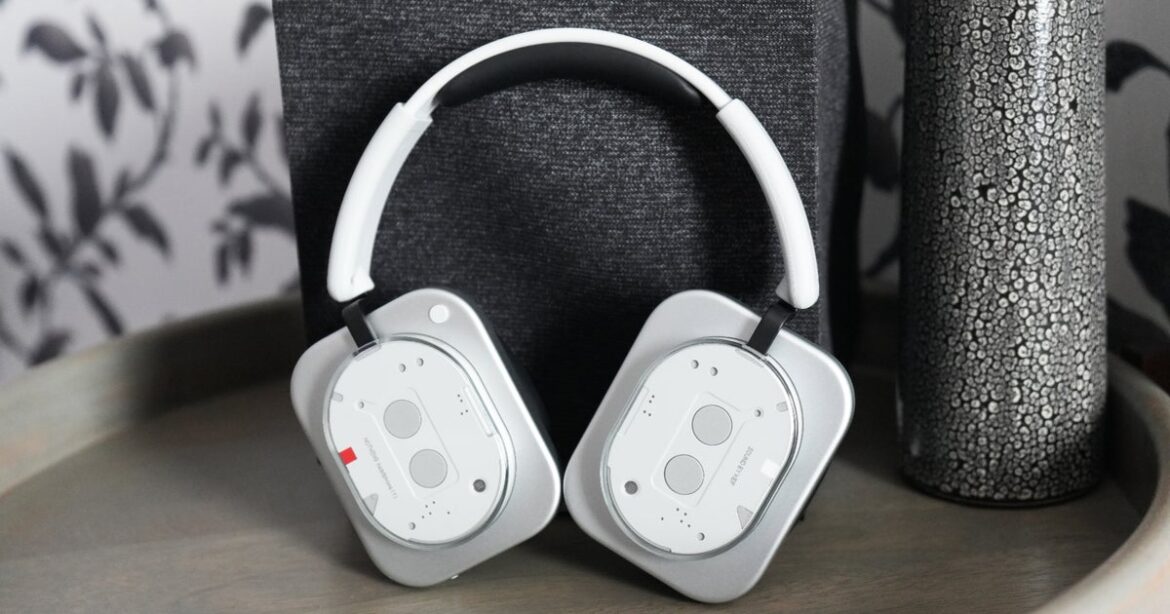
Right off the bat, I know that some folks haven’t been too fond of the way these cans look, but I’ll admit that I love them to pieces. It’s a lovely look, and is typical of Nothing’s clever blend of a modern yet industrial feel.

The build quality is strong too, with a pleasant blend of aluminium on the earcups, plus the large, domed plastic pieces on the earcups and some rubberised portions for good measure. I’ve never had a pair of headphones attract so much attention and so many questions from passers-by, not least when I was with a tech-focused crowd at Gamescom with them. If Nothing’s aim was to get people talking, then they definitely have.

The clamping force on the Nothing Headphone (1) is pleasant, with it being tight enough to secure a good fit and seal for the ANC but not too heavy to feel fatiguing for extended periods. The earcups here are deep enough and padded for comfort.

They do lie flat in their quite slender and minimalistic carry case, although I did worry about wearing them around my neck and flat for longer periods, as the corners of the earcups had a tendency to rub against each other.

There is a small annoyance I have with the fact that they lie flat in their case, though. The Headphone (1) actually sit in their case the wrong way – taking them out reveals the right of the headphones to be on the left, and vice versa, meaning you have to turn them around every time you wish to use them. Maybe I’m being a little nitpicky, but it seems like a simple thing to miss.

Another oddity is the position of the pairing button inside the right earcup, which just feels a tad finicky against the plethora of otherwise lovely tactile controls. The right earcup has a proper volume roller (although side to side), plus a rocker switch for skipping tracks or scruibbing through them if you hold down.

The outside of the right earcup has a button that’s customisable in the Nothing X app for things such as voice assistant triggering, cycling through ANC modes or enabling spatial audio. You can also map two functions to the button by having them set to a tap or a hold, respectively.

The Nothing X app is decent for the most part, offering typical means for adjusting ANC levels, fiddling with an EQ and spatial audio handling. The EQ offers both simple modes such as ‘More Bass’ or ‘Vocals’, or you can go into an 8-band custom EQ for more granular control. There are options for enhancing elements such as bass separately, plus you’ll finda low-latency gaming mode for mobile use, too.The spatial audio is based on head tracking, although it felt a little forced and synthetic with the music I listened to. I can see it working better for movies and for games, though. It’s a shame that the app doesn’t have the ear-tuning feature for a custom sound signature for your ears, as it does with Nothing’s in-ear models.

The Headphone (1) offers active noise cancellation, and for the most part, it deals with things such as voices and other ambient noise rather well. There are just some higher-pitched noises that can come through when you don’t have any music playing. I always use my old Bose NC700s as the benchmark for noise cancellation, as they envelop you in silence, which the Headphone (1) doesn’t necessarily do; the ANC is good, but not class-leading. I found the transparency mode to feel a tad synthetic in its approach to relaying noise around me, too.

Connectivity is handled with up-to-date Bluetooth 5.3, and these cans have a decent array of codecs supported. There are the usual suspects of SBC and AAC, plus the more advanced LDAC for wireless hi-res audio on supported devices. Pairing over Bluetooth to either my Samsung Galaxy S21 Ultra for some basic Spotify consumption or my FiiO M11S DAP for more critical listening was a doddle. The Headphone (1) can also connect via its bundled USB-C cable and to 3.5mm for wired use, too.

The Headphone (1) impresses with its strong battery life, too. Nothing rates these cans to last for up to 35 hours with ANC on, and up to 80 hours without. My testing was actually ahead of their claims, with general use putting their endurance with ANC on at around 40 hours – so a charge once every working week, which isn’t wholly unreasonable.

And now the important bit – audio. With the name of fellow British brand KEF on the side of the earcup, who helped with the tuning of the 40mm drivers inside, I had high hopes, even if KEF themselves is better known for its speakers than headphones. It has been said elsewhere that KEF’s involvement was purely for tuning’s sake, and all of the hardware and design work for these headphones is all Nothing’s own.

Out of the box, the Headphone (1) has a bit of a darker sound, with the low-end having plenty of extension and depth, as well as some prominence. It works especially well for my usual suite of rock testing tracks, such as Steven Wilson’s Meanwhile. I noticed there was a pleasant weight and depth to his gritty vocal, while the song’s strong bassline felt tight and had a good amount of power behind it.

If you want a little more oomph, you can also dial up the Bass Enhancement a couple of levels in the Nothing X app, which I did when listening to Daryl Hall & John Oates’ One on One, which added a tad more presence where required, but it didn’t fel too overbearing.

The Headphone (1) also excels with its width and accurate directionality that I found to work immensely well in live recordings, such as on a cut of Hotel Hobbies by Fish from a 1999 live album; there is a lot of ambient noise in the recording, be it crowd noise or applause, and the reverb on the song’s intro cymbal work,

In addition, the bongos in Earth, Wind & Fire’s September felt suitably far off to the right, where they should be, while for mobile gaming use, the prominent low end and lovely width helped immersion when playing some COD Mobile on the Honor Magic V5 or streaming some Forza Horizon 5 and such when barreling around Mexico.

I felt the mid-range to be pleasantly smooth and given enough room to breathe above the punchy low end, with a good feel to September Grass from James Taylor with his lovely vocal and warm acoustic guitar work. It’s an easy listen in this range.

The top end felt quite crisp, too, although there was a bit of a darker finish to the usually bright and vibrant percussion on the intro to Steely Dan’s Do It Again. In a similar vein, the cymbal hits in On The Other Side from The Strokes felt a tad pushed back in the mix against the song’s low-end and mid-range elements.

The Nothing Headphone (1) is a curious customer, as you might expect. Its design and feel is top-notch, offering something that’s far-removed from other headphones I’ve tested in and around its price point; they’re comfortable, stylish and look the business. For that price, I might have expected slightly better noise cancelling and a potentially more well-rounded sound, although if you’re a fan of punchy bass and a generally energetic default signature, then I’m sure you’ll like these. I know I’ve definitely enjoyed using them for the last few weeks, and if you can still pick them up at the discounted rate I spotted them at recently, then they’re well worth a go.


Source link

September 20, 2025 0 comments
0 FacebookTwitterPinterestEmail
Meta Ray-Ban Display hands-on: the best smart glasses I’ve ever tried
Product Reviews

Meta Ray-Ban Display hands-on: the best smart glasses I’ve ever tried

by admin September 18, 2025


I want to preface this hands-on by saying that I’ve been a smart glasses skeptic for many years. In 2019, I even made a two-part mini documentary with a thesis that consumer smart glasses couldn’t happen without massive societal and technological shifts. Well, color me pink and let me find a shoe to eat. After getting a demo of the $799 Meta Ray-Ban Display, I’m convinced this is the closest we’ve ever gotten to what Google Glass promised over 10 years ago.

The glasses look just like a chunky pair of Ray-Bans. But put them on, pinch your middle finger twice, and a display will appear in front of your right eye, hovering in front of your vision. It’s not augmented reality overlaid on the real world so much as on-demand, all-purpose menu with a handful of apps. You can use it to see text messages, Instagram Reels, maps, or previews of your photos, letting you do all kinds of things without having to pull out your phone. In fact, since it pairs to your phone, it sort of functions like a pop-up extension of it.

The display shows apps in full color with a 600-by-600-pixel resolution and a 20-degree field of view. It has a whopping 5,000 nits of maximum brightness, yet only 2 percent light leakage, which means it’s nigh impossible for people around you to see that it’s there. Each pair of the Display glasses comes with transition lenses, and the brightness adjusts depending on ambient UV light. Since it’s monocular, the display only appears in the one lens, and while it can be a little distracting, it doesn’t fully obstruct your vision.

It was difficult for us to capture our own still photos of what the display looked like for me at the hands-on. This is a decent approximation. Image: Meta

My colleague Jay Peters was looking at me dead-on while I was reading a text message, and he couldn’t see a trace of it. I stepped outside into a sunny area, and while the display was hard to see at first, it came into clearer focus as the transition lenses took effect. (Though even 5,000 nits can’t compete with the sun if you stare directly at it. Side note: don’t stare directly at the sun.)

When you are looking at the screen, your conversation partner may not see what you’re looking at, and will be able to tell you’re a little distracted. Jay noticed this immediately in my demo, and after, we joked: forget phones at the dinner table — now you’ve got to worry if your spouse, date, or friend is secretly watching videos or texting while you’re telling them important news.

The glasses are bolder than the Ray-Ban Metas. The frames are thicker, the edges are more rounded, and the overall Wayfarer shape is more square. The nose bridge, I’m told, is designed to have a universal fit. As someone with a low nose bridge, I appreciated that it didn’t slip down my face. Also, good news if you have a wide face: there are now overextension hinges so the temple arms can bend slightly outward for a more comfortable fit. Battery life lasts around six hours with “mixed use,” and you get 30 hours total with the new collapsible charging case. And at 69 grams, it’s still relatively light.

I’m tracing letters into my leg to write a text message. You can hold your arm by your side to control the device with the Neural Band. Photo by Colt Bradley / The Verge

Another big new addition is the Meta Neural Band. We’ve seen this before with last year’s Orion prototype, but using it was eye-opening. The band utilizes something called electromyography to read the signals from your muscles so that you can control the display with gestures. It was a lot to take in at first, but I got the hang of it pretty quickly. And the coolest part? You don’t have to hold out your arm as with a headset like the Apple Vision Pro. You can just hold your hand at your side — behind your back, under a table, anywhere really — and perform all the gestures discreetly.

Pinching once with your index finger selects an item in the menu, while the same action with the middle finger acts as a back button. Pinching your middle finger twice summons and dismisses the display. You can also make a sideways fist and swipe your thumb left, right, up, and down to scroll through options. Pinching while rotating your hand will raise or lower the volume while listening to music, as well as zoom in when you’re taking photos.

Here are some examples of how you can’t see the display, but you can tell my attention is elsewhere.

Adding a display plus this wristband suddenly unlocks a range of hands-free capabilities. On the Ray-Ban Meta glasses, you have to pull up Instagram Live on your phone if you want to see what your photos or videos look like. With the Display glasses, you have a built-in preview window. My smart glasses photos will no longer be plagued by my bangs or my infernal tendency to tilt my head. You can also take video calls directly to your eyeballs in WhatsApp. You’ll be able to see whoever’s calling, and they’ll be able to see your point of view, too. I tried a video call with Jay. While it was incredibly cool to see his face floating in my vision, I couldn’t help feeling like a spy about to steal some corporate secrets in a high-stakes heist.

Messaging is another obvious plus. You can read, view photos and Instagram Reels, and reply to messages without ever having to take out your phone. (The Reels part is a little annoying; my friends send me TikToks.) And later this year, Meta is planning on introducing a handwriting feature where you can trace letters on any surface and discreetly reply to messages without having to dictate things aloud. I got to try it, and it worked shockingly well. There’s also predictive text, so you don’t even have to “write” that much.

Meta Ray-Ban Display and Neural Band specs

  • Display: 600 x 600 pixels with 20-degree field of view, 90Hz refresh rate (30Hz for content), and 30–5,000 nits of brightness
  • Battery life: 6 hours of mixed use for glasses, 18 hours for Neural Band. The glasses case holds 4 extra charges.
  • Lenses: Transition lenses that support prescriptions from -4.00 to +4.00
  • Camera: 12MP with 3x zoom; 3024 x 4032 pixel photo resolution with 1080p at 30fps for video
  • Weight: 69g
  • Water resistance: IPX4 for glasses, IPX7 for Neural Band
  • Storage: 32GB of storage, capable of storing up to 1,000 photos and 100 30-second videos.

A live caption demo was impressive. When you’re speaking to someone, the screen can display text or translations for live speech right in your line of sight. The wildest thing, however, is that thanks to the multidirectional microphone array, the glasses can tell who you’re looking at and will only show captions for that person. I got my demo while multiple people were speaking at once, and cross-talk was never an issue. When switching who I looked at, there was nearly zero latency in the captions catching up. The original Ray-Ban Metas were a game-changer for visually impaired people, and I suspect these glasses will be the same for people who are hard of hearing.

I’m excited by turn-by-turn walking directions. While my hometown of New York City has always had a grid system, I somehow always manage to get turned around. I hate looking down at my phone, trying to figure out where I’m going. With the Display glasses, I could look up directions to the nearest Jack in the Box and then orient myself on a map as I would on a phone. While I didn’t get to go to said hamburger joint, I was told you can dismiss the screen and still get turn-by-turn directions when you need them all while staying present in your surroundings.

You can’t see that I’m video calling my colleague Jay Peters, though you can see what I see on the laptop on the table behind me. Photo by Colt Bradley / The Verge

Meta’s Live AI features also get a boost. I used it to give myself a mini self-guided museum tour by taking a picture of an Andy Warhol Campbell’s soup can painting. Meta AI offered a short description, while the display showed info cards with further examples from the rest of that series of paintings. I also asked the AI to show me a chai latte recipe. It gave me step-by-step instructions, and then I hid the display and brought it back up again. The idea is you can review the steps, get cooking, and only review the next steps when needed. This seems useful as someone with many waterlogged cookbooks.

There haven’t been many consumer smart glasses, but I’ve tried everything from the original Google Glass and the enterprise edition to the defunct Focals by North. I have pairs of Rokid Glasses, XREAL glasses, and the Even Realities G1 that I’m currently testing. I’ve even received multiple demos of Google’s new prototype XR glasses. This is the first time I’ve ever felt like consumer smart glasses might really take off. Not just because Meta’s execution is excellent, but because I can see use cases I want in my daily life.

The glasses will come in two colors: black and sand, with matching neural wristbands and collapsible charging cases. Photo by Victoria Song / The Verge

Still, after the initial wonder and excitement tempered, I remembered my colleague Liz Lopatto’s recent column on how none of us truly has anonymity anymore. Surely these glasses will only exacerbate that. I thought about Meta CEO Mark Zuckerberg’s recent comments that people without AI smart glasses will be at a “significant cognitive disadvantage.” I winced at how a Border Patrol agent was spotted wearing a pair of Ray-Ban Metas during an immigration raid. Then I mulled the huge advances these glasses could pioneer in accessibility tech, enabling disabled people to live more independently. Are we perhaps rushing to open Pandora’s box without first thinking through what might break in the process? That question will linger in my mind until I get a pair for myself.

The Meta Ray-Ban Display glasses go on sale on September 30th for $799, and you’ll be able to try them for yourselves at Best Buy, LensCrafters, Ray-Ban Stores, and Verizon. They’re US-only to start, but Meta will expand sales to Canada, France, Italy, and the UK in early 2026.

0 CommentsFollow topics and authors from this story to see more like this in your personalized homepage feed and to receive email updates.

  • Victoria SongClose

    Victoria Song

    Senior Reviewer, Wearable Tech

    Posts from this author will be added to your daily email digest and your homepage feed.

    PlusFollow

    See All by Victoria Song

  • ARClose

    AR

    Posts from this topic will be added to your daily email digest and your homepage feed.

    PlusFollow

    See All AR

  • Featured VideosClose

    Featured Videos

    Posts from this topic will be added to your daily email digest and your homepage feed.

    PlusFollow

    See All Featured Videos

  • GadgetsClose

    Gadgets

    Posts from this topic will be added to your daily email digest and your homepage feed.

    PlusFollow

    See All Gadgets

  • Hands-onClose

    Hands-on

    Posts from this topic will be added to your daily email digest and your homepage feed.

    PlusFollow

    See All Hands-on

  • MetaClose

    Meta

    Posts from this topic will be added to your daily email digest and your homepage feed.

    PlusFollow

    See All Meta

  • ReviewsClose

    Reviews

    Posts from this topic will be added to your daily email digest and your homepage feed.

    PlusFollow

    See All Reviews

  • TechClose

    Tech

    Posts from this topic will be added to your daily email digest and your homepage feed.

    PlusFollow

    See All Tech

  • WearableClose

    Wearable

    Posts from this topic will be added to your daily email digest and your homepage feed.

    PlusFollow

    See All Wearable


Source link

September 18, 2025 0 comments
0 FacebookTwitterPinterestEmail
Apple iPhone Air Review
Product Reviews

Apple iPhone Air review: the sexiest iPhone I’ve ever tested

by admin September 17, 2025


Why you can trust TechRadar


We spend hours testing every product or service we review, so you can be sure you’re buying the best. Find out more about how we test.

Apple iPhone Air: Two-Minute Review

The iPhone Air is, to a degree, exactly what we were expecting: Apple’s thinnest iPhone ever, measuring just 5.64mm. It feels light, balanced, and durable thanks to a grade 5 titanium frame and Ceramic Shield glass. In the hand it’s sleek and refined – I’ve been using my Sky Blue unit for a week now and it’s still turning heads.

The 6.5-inch Super Retina XDR OLED display is excellent: it’s an always-on display that supports ProMotion, HDR, and brightness up to 3,000 nits. It’s slightly bigger than the iPhone 17’s screen, which gives apps, text, and videos more room to breathe, and it looks great whether I’m scrolling TikTok, watching HDR movies, or just browsing outside on a sunny day.

iOS 26 feels tailor made for the Air, with its new Liquid Glass design that looks striking and complements the physical build. Messages now support custom backgrounds, typing indicators, and polls, while the Phone app and Visual Intelligence get useful upgrades. And while Siri’s full AI overhaul isn’t here yet, Apple Intelligence features are starting to appear.

The biggest trade-off comes with the camera setup: there’s just a single 48-megapixel lens on the rear of the phone. It produces sharp, natural-looking photos and impressive portraits, but you’ll miss the flexibility of a telephoto or ultrawide if you’re used to them. The selfie camera is excellent, though, with Apple’s Center Stage smarts for automatic wide and ultrawide framing, and Dual Capture is genuinely fun.

Performance from the A19 Pro is snappy and smooth, and it capably handled everything I threw at it, though the phone does get warm during fast charging or heavy gaming. Battery life is decent but not class-leading: enough for a workday, usually six to eight hours of use, with my best stretch hitting around 10 hours away from the charger. Power users may want to invest in the $99 / £99.00 / AU$159 MagSafe Battery Pack, which matches the phone’s slim profile and adds about 65% more life, but it’s an added cost.

The iPhone Air isn’t the best iPhone for photography or endurance, but as a design statement, it’s a gem. It feels like the most exciting iPhone Apple has released in years, and while it costs more than the iPhone 17 with fewer cameras and shorter battery life, it delivers value in other key areas.

Apple iPhone Air: Price and Availability

Apple unveiled the iPhone Air at its September 9, 2025, ‘Awe Dropping’ event alongside the iPhone 17, iPhone 17 Pro, iPhone 17 Pro Max, AirPods Pro 3, and three new Apple Watches. The Air, though, stands out with its entirely new design, and is a whole new category of iPhone.

Sign up for breaking news, reviews, opinion, top tech deals, and more.

It starts at $999 / £999 / AU$1,799 for 256GB of storage, or you can bump that up to 512GB for $1,199 / £1,199 / AU$2,199, or 1TB for $1,399 / £1,399 / AU$2,599. The iPhone Air is an eSIM-only device worldwide and comes in four colors: Sky Blue, Light Gold, Cloud White, and Space Black. I’ve been testing a 1TB iPhone Air in Sky Blue.

Apple will officially launch the iPhone Air on September 19, 2025, but it’s up for pre-order now from the company’s online store, authorized retailers, and carriers.

Apple iPhone Air: Specs

Swipe to scroll horizontallyHeader Cell – Column 0

iPhone Air

iPhone 17

iPhone 17 Pro

iPhone 17 Pro Max

Weight:

165g

177g

206g

233g

Display:

6.5-inch OLED

6.3-inch OLED

6.3-inch OLED

6.9-inch OLED

Resolution:

2736 x 1260

2622 x 1206

2622 x 1206

2868 x 1320

Refresh rate:

120Hz

120Hz

120Hz

120Hz

Peak brightness:

3,000 nits

3,000 nits

3,000 nits

3,000 nits

Chipset:

A19 Pro

A19

A19 Pro

A19 Pro

Rear cameras:

48MP wide (26mm, ƒ/1.6)

48MP wide (26mm, ƒ/1.6), 48MP ultra-wide (13 mm, ƒ/2.2)

48MP wide (24mm, ƒ/1.78), 48MP ultra-wide (13 mm, ƒ/2.2), 48MP telephoto (8x optical zoom)

48MP wide (24mm, ƒ/1.78), 48MP ultra-wide (13 mm, ƒ/2.2), 48MP telephoto (8x optical zoom)

Front camera:

18MP (ƒ/1.9)

18MP (ƒ/1.9)

18MP (ƒ/1.9)

18MP (ƒ/1.9)

Storage:

256GB, 512GB, 1TB

256GB, 512GB

256GB, 512GB, 1TB

256GB, 512GB, 1TB, 2TB

Colors:

Space Black, Cloud White, Light Gold, Sky Blue

Black, White, Mist Blue, Sage, Lavender

Silver, Cosmic Orange, Deep Blue

Silver, Cosmic Orange, Deep Blue

Apple iPhone Air: Design

(Image credit: Jacob Krol/Future)

  • The freshest look that Apple has delivered in years
  • Unbelievably thin and light
  • Feels great in the hand with proper ergonomics

If you were following the Apple rumor cycle, we were all expecting an ultra-thin iPhone to be released – one that would potentially go thinner than the iPhone 6 or 6 Plus, be more stunning than the iPhone X, and offer a truly refreshed look and feel for the iPhone. The launch event’s ‘Awe Dropping’ tagline set the bar high – and the iPhone Air cleared it with room to spare.

It’s not the first ultra-thin phone – the Galaxy S25 Edge measures in at 5.8 millimeters – but it still feels as stunning, sleek, and sexy in my hand right now after living with it for a week as it did during my brief hands-on session following the launch event. It feels as exciting as the iPhone X, in that it might give us the playbook for the modern iPhone going forward – or at least show us one half of the purportedly incoming foldable iPhone.

The photos released by Apple, and even those shot by me for this review, only do it partial justice. The iPhone Air is the best representation yet of Apple’s vision for an iPhone that’s just glass. It weighs in at just 5.82 ounces, or 165 grams, fully justifying the ‘Air’ moniker. Much like the iPhone 17 or even a Pro Max, it feels balanced – not too top-heavy, not too bottom-heavy. It’s Goldilocks ergonomics.

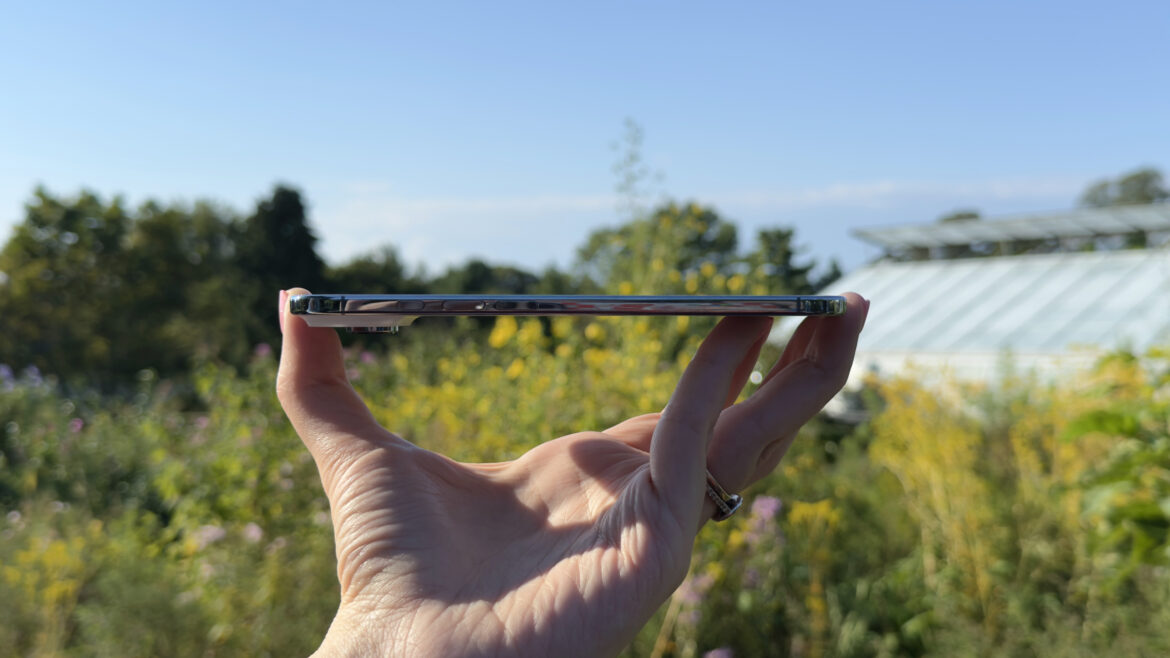
I don’t know if I’d quite call it awe-dropping, but the thinness is the part that gets people excited. At its thinnest, the iPhone Air is 5.64 millimeters, or 0.22 inches, and the ‘plateau’ (Apple’s new term for the camera bump) only juts out a bit more. I was instantly wowed, and over the course of a week (well, eight days now), I’ve really become accustomed to this look and feel for an iPhone.

(Image credit: Jacob Krol/Future)

While conducting some testing over the week, I showed it to my brother and sister-in-law, who were both visibly impressed when holding it. They asked about durability and were a little stunned at the overall feel. Then came the questions about battery life and the camera – both of which I’ll address below – and whether the USB-C port was thinner.

On that last point – it’s still a regular USB-C port, but to fit it in this frame and get it this small, Apple’s design team started by 3D-printing a custom one. And given how thin this phone had to be, Apple went back to grade five titanium for the shell and sides of the device. To further enhance the looks, it has a polished finish. My Sky Blue review handset is different from the MacBook Air and iPad Air colors of the same name – it’s a bit lighter and pastel-like. I really like it, and the Air also comes in Light Gold, Space Black, and Cloud White.

While the innermost layer of the iPhone Air sandwich is made of that strong titanium, which can bend slightly under pressure but is designed to spring back, it’s topped and bottomed with glass and glass ceramic; specifically Ceramic Shield 2 on the front and Ceramic Shield on the back. The rear, like the iPhone 17, is mostly frosted matte glass, while the top bump gets the glossy finish.

Apple says the Air is three times more scratch-resistant on the front – though I’ve still been careful sliding this in and out of my front or rear jeans pockets – and the back is four times more crack-resistant.

I actually did drop it on concrete paving stones, and the iPhone Air came out completely unscathed. My dog Rosie pulled me suddenly, I dropped the Air, and it hit the ground on the top-left corner and then landed screen-down, single camera-up. Not even a scratch. Rosie was off the hook.

That incident, along with our Editor at Large Lance Ulanoff’s bend test and his fumble with the iPhone Air, gives some credence to Apple’s durability promises. Apple says the iPhone Air is more durable than any model before this and on par with the rest of the 17 lineup. In a test behind closed doors at Apple Park, I saw an iPhone Air put through the wringer, receiving a simulated force of 130 pounds, and bending and then springing back with no visible stress marks left.

It also has the same IP68 rating for resistance to dust and water as the iPhone 17, 17 Pro, and 17 Pro Max – it survived a light drizzle shortly after I unboxed it at Apple Park. The weather’s been wet in my home state of Jersey, and the Air has shown no issues when being used in rain or surviving a dunk test.

Even given the extreme thinness here, you still get the usual buttons you’d expect on an iPhone. Camera Control (still not a button) has been redesigned to live on the right-hand side, and it’s slightly thinner but about the same length as on other iPhones. The power/sleep button sits slightly higher on this side, with the Action Button, volume up, and volume down on the left. The main mono speaker lives at the top with some microphones, and there are two other microphones either side of the USB-C port on the bottom.

This design does, as mentioned, only leave room for a single camera, and likely a smaller battery inside, but Apple has also dropped the SIM card slot worldwide and opted for eSIM to save some space.

The iPhone Air is stunning, attracts a lot of admiring glances, and feels like the biggest refresh in iPhone design we’ve seen in a while. Yes, it’s the same key parts, just compressed; but in use it feels like the perfect showcase for iOS 26. If you’re after Apple’s best design this year, I think it’s clearly the iPhone Air – but there’s a lot more to this iPhone than just looks.

Apple iPhone Air: Display

(Image credit: Jacob Krol/Future)

  • At 6.5 inches the front is virtually all screen
  • It’s on a par with the displays on the Pro and Pro Max

For $999 / £999 / AU$1,799 it would be a little mean of Apple not to include ProMotion or always-on functionality here, and the iPhone Air supports both. As a whole, the screen here is basically in line with those of the iPhone 17, 17 Pro, or 17 Pro Max.

The front of the iPhone Air is nearly all glass, except for a thin black bezel that turns into the sloped polished side. It’s a 6.5-inch Super Retina XDR OLED display with a resolution of 2376 x 1260, which works out to 460 pixels per inch. It tops out at 3,000 nits of brightness when needed, supports the Wide Color P3 gamut and HDR, and features an anti-reflective coating. It also has the same Dynamic Island as the rest of the iPhone 17 line.

In daily use, the display is really the main appeal here – on paper, it’s 0.2 inches bigger diagonally than the iPhone 17 or 17 Pro, but it feels a bit more expansive. It offers more lines of text, or a slightly expanded view when viewing a webpage. Games or movies feel a little more like an event, and it offers a broad canvas for iOS 26. Lay two of these phones side by side and I think you’d have some idea of what Apple is planning to bring us with its long-rumored folding iPhone – and it would look mightily impressive, but we’re not quite there yet. And it’s still smaller than the Pro Max.

Colors looked punchy and vibrant, text was inky black and crisp, and it was a great display for daily use. I found that it got bright enough to battle the bright sunshine of California, the late summer sunshine of New Jersey and New York, as well as bright artificial lighting. I liked scrolling TikTok and Instagram Reels, or watching a video on it, mainly thanks to the super-smooth ProMotion display.

And iOS 26, with its Liquid Glass makeover, looks fantastic here.

Apple iPhone Air: Software and Apple Intelligence

(Image credit: Jacob Krol/Future)

  • Liquid Glass runs well here and feels purpose-built for the design
  • iOS 26 brings with it some really smart features

I have a feeling that the design team at Apple knew the Air was on the roadmap when designing Liquid Glass.

iOS 26 is running on the iPhone Air out of the box, and as on any iPhone, announces itself with a ‘Hello’ on the first boot. You’ll get a sense of the new translucent, glass-like nature of the software pretty quickly. It’s mostly visible in how notifications refract over your wallpaper or up top, with whatever is behind the element. I especially like the way the bottom menu bars look with this, although legibility can be an issue at times, depending on what’s behind the element. You’ll also notice a difference if you use light mode or dark mode.

The redesign is only a portion of iOS 26, as Apple’s latest OS introduces a number of new features. I’m keen to put many of the new parts of Messages to the test with my friends and various group chats. With the latter, you’ll now get typing indicators, and you can set a custom background for any Message group or individual. This will, I have a feeling, be an especially tough test for legibility with the Liquid Glass components. You also have the option to add polls in group messages, which is a fun way to decide on activities or maybe pick a restaurant.

The Phone app is entirely new, though you can switch back, placing your favorites up top and below that is a combined list of outgoing and incoming calls, missed calls, and even voicemails. It can be a lot to process at first, but after months on the beta I’m more or less used to it, although I have switched back to the original setup occasionally, as the new one makes voicemails a little harder to track down. You can also use Live Translation during calls, which can be helpful for international travel, and I especially like the wait-on-hold feature.

Visual Intelligence, which is engaged with a long press of Camera Control, is a bit smarter here, and can now identify events to add to your calendar and integrate with apps that add support with the API. However, we’re still waiting on the full AI-powered Siri, and many of the new Apple Intelligence features aren’t front and center here.

You can check out our full guide to iOS 26 here, as there’s a lot more to dig into.

Apple iPhone Air: Camera

(Image credit: Jacob Krol/Future)

  • Single-lens 48MP Fusion camera on the rear
  • You can get some impressive shots, especially portraits
  • Front-facing camera is 18MP with Center Stage

This is where the compromises necessitated by the iPhone Air’s unfeasibly thin design begin: the iPhone Air only features a single, 48-megapixel Fusion camera on the back. It can shoot at 1x, a sensor crop in 2x, or a maximum digital 10x, but the quality falls off noticeably with the latter.

I’ll cut to the chase here – if you’re after the iPhone with the best cameras, or even just some variety for shooting, this is probably not it.

I was impressed with some of the shots I took, particularly the one taken from 36,000 feet out an airplane window in the gallery below – the Air captured a surprising amount of detail around the engine, wing, and even the clouds, and what appears to be a mountain in the distance. The night mode worked very well when capturing my Bernedoodle, the aforementioned Rosie, and I’m especially impressed with the Portrait mode here, and the work going on behind the scenes to deliver the right bokeh effect in the right spot.

Still, as someone who used a 16 Pro Max before this, I miss the telephoto camera, even if that wasn’t a Super Res Zoom like on a Galaxy or a Pixel; 2x isn’t a lot. The iPhone Air also doesn’t have an ultra-wide or a macro camera. If anything, it’s made me think about the types of shots I’d want to capture with a phone, and if an ultra-wide or zoom is a deal breaker for you, you’ll want to look at the 17 or the 17 Pro duo.

The 48MP Fusion camera here can capture photos at a full 48 megapixels or, by default, a 24-megapixel photo that saves space by combining a 12-megapixel shot and a 48-megapixel shot. It normally does a pretty good job of preserving colors and details, and is something that Apple’s been doing for several generations of iPhone.

The main lens here does an admirable job, and I’m quite happy with some of the images I got – particularly in portrait mode, with the camera keeping colors within a realistic range and not skewing warmer or cooler, as well as capturing plenty of the finer details.

In some cases, photos looked a bit washed out – for instance, landscapes on particularly sunny days, as when I took test shots at a botanical garden (although I was able to capture a sunflower quite nicely, other fauna, and even orange fish below a less-than-crystal-clear pond). Mostly, though, the camera can capture those more vibrant moments, such as a shot of Yankee Stadium or the sunset from a plane window.

Without a true telephoto or an ultrawide, you’re able to take more creative control to capture unique shots. You can see a full gallery of test images – standard photos at 1x or 2x, and some digital zoom ones, as well as Portraits at 1x or 2x – below.

(Image credit: Jacob Krol/Future)

A new feature that takes advantage of the 18-megapixel Center Stage camera on the front and the rear camera is Dual Capture. It’s not a brand-new idea, and essentially this lets you record with the front camera and rear camera at the same time, with stabilization applied. I think it’s a lot of fun, especially for sports events, where you could capture both the on-field action and the reaction of you and your friends, and I imagine it would be a blast at concerts – I could record myself belting out Born to Run along with the Boss – but also for parents with young children.

The 18-megapixel selfie camera uses a larger image sensor than on previous iPhones, and it’s actually super helpful. Essentially, it can automatically adjust a wide or ultra-wide view so you can easily fit everyone into your selfie or video, and with the tap of a button you can rotate between vertical and horizontal without needing to physically rotate your phone. It also delivers a serious, high-quality selfie.

I’ll include some video samples below – the 48MP camera isn’t a slouch here, and performs on a par with the standard iPhone 17. The end result is either up to 1080p HD at up to 60 frames per second, or 4K at up to 60fps.

Image 1 of 24

(Image credit: Jacob Krol/Future)(Image credit: Jacob Krol/Future)(Image credit: Jacob Krol/Future)(Image credit: Jacob Krol/Future)(Image credit: Jacob Krol/Future)(Image credit: Jacob Krol/Future)(Image credit: Jacob Krol/Future)(Image credit: Jacob Krol/Future)(Image credit: Jacob Krol/Future)(Image credit: Jacob Krol/Future)(Image credit: Jacob Krol/Future)(Image credit: Jacob Krol/Future)(Image credit: Jacob Krol/Future)(Image credit: Jacob Krol/Future)(Image credit: Jacob Krol/Future)(Image credit: Jacob Krol/Future)(Image credit: Jacob Krol/Future)(Image credit: Jacob Krol/Future)(Image credit: Jacob Krol/Future)(Image credit: Jacob Krol/Future)(Image credit: Jacob Krol/Future)(Image credit: Jacob Krol/Future)(Image credit: Jacob Krol/Future)(Image credit: Jacob Krol/Future)

Apple iPhone Air: Performance

(Image credit: Jacob Krol/Future)

  • The iPhone Air feels responsive and fast, even with more intense workflows
  • A19 Pro chip should keep it running smoothly for years
  • Can get warm on the camera bump with gaming and other more intensive tasks

Powering the iPhone Air is Apple’s A19 Pro chip, which is a step up from the iPhone 17’s A19, and a slightly less powerful version of the A19 Pro in the iPhone 17 Pro and 17 Pro Max, without the extra cooling technology. The A19 Pro here is a 6-core CPU with two performance and four efficiency cores, a 5-core GPU, and a 16-core Neural Engine.

It’s a good lick faster than the A18 Pro or A18 found in the iPhone 16 Pro Max or 16, especially with various elements of iOS 26 – including spatializing a wallpaper – and in everyday use. Compared to the standard iPhone 17, I’d say performance is about neck and neck. The A19 Pro is arguably being used here to help regulate performance temperature.

I did notice the iPhone Air heating up during the first few days while it was still indexing and charging – especially from 0% to about 50% – before cooling as it slowed near 80%. It also warms up when multitasking with demanding apps at times.

For example, if I’m on a call and launch a game like Asphalt 9, the area around the camera housing on the rear can get noticeably warm, though it cools quickly as performance regulates. The heat doesn’t spread below the Apple logo, and a case, like Apple’s Bumper or Clear option, helps keep it from your fingertips.

Keep in mind that basically all the components do live in the plateau – including the silicon – so it makes sense that the area does heat up. When it comes to non-gaming tasks, though, the iPhone Air handles everything well, and delivers strong performance while keeping cool. That was the case with my daily workflow consisting of calls – audio and FaceTime – as well as Mail, Gmail, Slack, Safari, Chrome, Edits, Capcut, the Camera, and other apps. Even with creating a Genmoji or using Image Playground or another facet of Apple intelligence, the iPhone Air didn’t get especially warm.

In terms of quantitative testing, the iPhone Air scored slightly higher than the iPhone 17 on GeekBench 6.5, at 3,723 on single-core and 9,665 on multi-core. That’s in line with smartphones at this price range, though, as we noted in our Galaxy S25 Edge review, that phone has a thermal solution for keeping things cool.

Apple iPhone Air: Battery

(Image credit: Jacob Krol/Future)

  • It can deliver all-day battery for some, but more likely will last a full workday
  • You’ll likely need to recharge it during the day
  • While costly, the MagSafe Battery is a sound investment

We can only guess at the iPhone Air’s battery size for now, as Apple doesn’t officially release those numbers. It’s clear, though, that the company has squeezed as large a cell as possible inside this ultra-slim smartphone.

Instead of capacity, Apple provides viewing estimates: up to 27 hours of downloaded video playback and 22 hours of streaming. With the $99 MagSafe Battery attached, those numbers rise to 40 and 35 hours, respectively – about a 65% boost.

In my experience, the iPhone Air generally lasts through a workday – six to eight hours depending on use. That’s behind the iPhone 17, 17 Pro, and 17 Pro Max, but it still meets Apple’s “all-day” standard. On one test, I took it off a charger at 7:30am and it lasted until 5:50pm, or 10 hours and 20 minutes. At best, I recorded six hours and 35 minutes of active screen time; on average, I got around four hours and 45 minutes.

During my first few fast charges, the top of the camera plateau and the area beneath it did get warm, mostly between 0% and 50%, before cooling down. This isn’t unusual for fast charging and reflects the component layout.

Power users will likely need to recharge by the time they get home. Apple’s slim MagSafe Battery nearly matches the Air’s profile, adding only a bit more thickness than the camera bump. It recharges intelligently throughout the day, manages heat well, and uses pocket detection to optimize charging times. Optional, yes – but it complements the iPhone Air experience nicely.

Apple iPhone Air: Should you buy?

Swipe to scroll horizontallyiPhone Air Score card

Attributes

Notes

Rating

Design

The iPhone Air is Apple’s most exciting refresh in years.

5 / 5

Display

The iPhone Air’s 6.5-inch Super Retina XDR OLED is punchy, sharp, and smooth with ProMotion and Always-On functionality.

5 / 5

Software

iOS 26 feels tailor-made for the iPhone Air.

4 / 5

Camera

The iPhone Air relies on a single 48MP lens that delivers sharp, natural photos and impressive portraits, but lacks the versatility found on other models.

4 / 5

Performance

The iPhone Air feels fast and smooth in daily use, though it can warm up under sustained heavy gaming.

4 / 5

Battery

The iPhone Air should last a workday, but heavy users will need to recharge.

4 / 5

Value

At $999, the iPhone Air feels like a new kind of Pro – trading camera and battery versatility for design.

4 / 5

Buy it if…

Don’t buy it if…

Apple iPhone Air: How I tested

I’ve been covering smartphones for years — including iPhones since the iPhone 8 lineup — and my first personal iPhone was the 3GS. For this review, I set up the iPhone Air in Sky Blue, moving my number over from an iPhone 16 Pro Max via eSIM and starting fresh.

Over more than a week of testing, I put the Air through everyday use: calls, streaming music, gaming, watching TV and movies, capturing photos, and running my usual suite of work apps. I measured performance using both real-world applications and benchmarks, such as GeekBench 6.5, paying close attention to how it handled multitasking and more demanding workloads. For battery life, I tracked how quickly it drained during different tasks and also ran a standardized assessment.

On the camera side, I pushed the single 48MP rear lens through its paces — testing 1x, 2x crop, Portrait, and Night modes, plus video recording up to 4K at 60fps. I also spent time with the new 18MP selfie camera, trying both portraits and group shots, and had fun with Dual Capture for video.

To get a clearer sense of how it stacks up, I compared the results directly with the iPhone 17, the iPhone 16 and 16 Plus, iPhone 16 Pro and 16 Pro Max, Google Pixel 10 and Pixel 10 Pro, and Samsung’s Galaxy S25 Ultra.

First reviewed September 2025.


Source link

September 17, 2025 0 comments
0 FacebookTwitterPinterestEmail
I’ve been using macOS Tahoe 26 since June and here are the eight best things about it
Product Reviews

I’ve been using macOS Tahoe 26 since June and here are the eight best things about it

by admin September 16, 2025


Apple’s new version of macOS, Tahoe 26, launches today for all compatible Macs. I’ve already shared many feelings about Liquid Glass in my look at the developer and public betas, and my opinion on the new, polarizing UI remains lukewarm. But after using Tahoe through the beta periods to full release, I can confidently say that there are some decent improvements to macOS worth diving further into.

The updated Spotlight: power user lite

PreviousNext

1/2A brief walkthrough of Spotlight’s UI behavior: using the keyboard shortcuts, using the arrow keys, and hovering over with the mouse to show the icons.

Command + Spacebar was always a helpful shortcut for calling up Spotlight and launching an app with just the keyboard. Now, you can do much more with it, and if you train up the muscle memory it could be one of the most helpful new features of macOS Tahoe. You can feel a little power user-y without being overwhelmed by a million controls and options found in third-party apps like Raycast.

When summoning Spotlight in Tahoe, you have easy access to applications, recent files, customizable / actionable shortcuts, and a clipboard history via just the keyboard (you can click stuff too, but bouncing between keyboard and mouse slows you down). In addition to jumping between those four functions with Command and numbers one through four, you can rotate between them one at a time with the arrow keys. This gives you a more helpful graphical guide, because it shows the four icons as you navigate instead of having to remember which number key corresponds to each function. Otherwise, the icons are hidden and require hovering your mouse over the Spotlight search bar to see them bubble out — all liquid-like. Cute animation, Apple, but it’d be better to not tuck away those icons.

Clipboard history is oh-so-handy

Clipboard history houses recently copied texts, screenshots, and files.

One of the new Spotlight functions is one of my favorite features of Tahoe. A clipboard history is incredibly useful for just about anyone. I’m sure we’ve all had moments where we copied text or a link and forgot to paste it before copying something else. Clipboard history helps with that by temporarily storing up to eight hours of copied text, files, and even screenshots (including screenshots ones didn’t save to a file). It makes those items easy to copy again and paste, and it also helps in situations where you have multiple fields to copy over in batches.

The only downside of a clipboard history are the slight security and privacy risks if you use a shared computer and accounts. It could reveal sensitive information or gossip to others in your household — that is, if you copied anything incriminating and they know how to access the clipboard history. (Apple maintains an eight-hour time limit on the clipboard history and doesn’t put copied passwords into it, but if it’s copied from plain text, then it’s fair game.)

A Phone app: convenient access to calls

Tahoe’s Phone app, complete with dialer.

I maintain that Tahoe’s full-blown Phone app is one of its more useful features, especially if you occasionally need to make a tedious call during your nine-to-five. Gotta call an insurance company, doctor’s office, customer service line, or bank that puts you in a tiresome queue? Call them while you work on other stuff. Doing it with your phone next to you on speaker accomplishes the same thing, but it also means keeping your phone and a plethora of other distractions near you. I’ve found that having it all baked into your computer is just a tiny bit more helpful at keeping me on-task through this multitasking speed bump.

The Messages app gets backgrounds and polls

PreviousNext

1/2Sending my friend a tough decision in a poll and setting the background to a pretty aurora.

Apple’s Messages app now offers customizable polls that you can survey your friends with and the ability to change the backgrounds of your conversations, the latter of which is commonly found on other chat apps. Apple’s preset backgrounds have a little animation flourish, which is fun, but they quickly settle into a static image. Most of the presets are just colorful abstractions or pretty scenes taken from the natural world, like clouds, water, and auroras, but you can also just set a custom photo or use Image Playground for something AI-generated (though it usually looks ugly).

Live Translations of calls and messages

1/4Live translations are tucked away in the dropdown menu of a call.

macOS Tahoe has a few ways it can do on-device live translations: it can translate text chats in the Messages app, display translated captions in FaceTime video calls, and translate a phone call live with both text transcriptions and an automated voice. At this time it only supports voice translations in English, French, German, Portuguese, and Spanish, while text translations include all of those plus Japanese, Korean, Italian, and simplified Chinese.

I tested the live translator in the Phone app during a call with my mom while she spoke Spanish, which is one of three languages she speaks (four, if you count proper Italian and her regional Italian dialect separately). It was serviceable, but it’d be tough to have a full conversation through it. Both participants have to get a feel for the cadence of the automated translator, ideally going a bit slowly and allowing gaps for it to speak around you in the other language. This isn’t as advanced as Google’s new translator on the Pixel 10 phones, where it deepfakes your voice with AI, but it’s a passable first attempt for Apple Intelligence. Just be aware that the usual hangups and stumbling around translating slang or any mid-sentence language switching are very present.

Safari’s whole new look

PreviousNext

1/2Safari is much more rounded and modern looking, with a top bar transparency.

The Safari redesign is one of the better infusions of Liquid Glass. The overall rounded-edge aesthetic is a fine change. And I dig how the top navigation bar color-matches sites you visit. But the color matching is very subtle, and most sites I visit just lead to it being black, white, or some level of off-white. I guess that’s an improvement over Safari’s previous default all-gray look? It might be more fun for you if sites you frequent have wider splashes of color that get picked up.

As for Safari’s new glassy transparency, it’s pretty neat. As you scroll down, the contents of a website tuck under the frosted top navigation bar, darkening and blurring until they go out of frame. It’s a subtle effect that’s easy to ignore, which is perhaps for the best so it doesn’t get too distracting.

The transparent Menu Bar: more wallpaper space

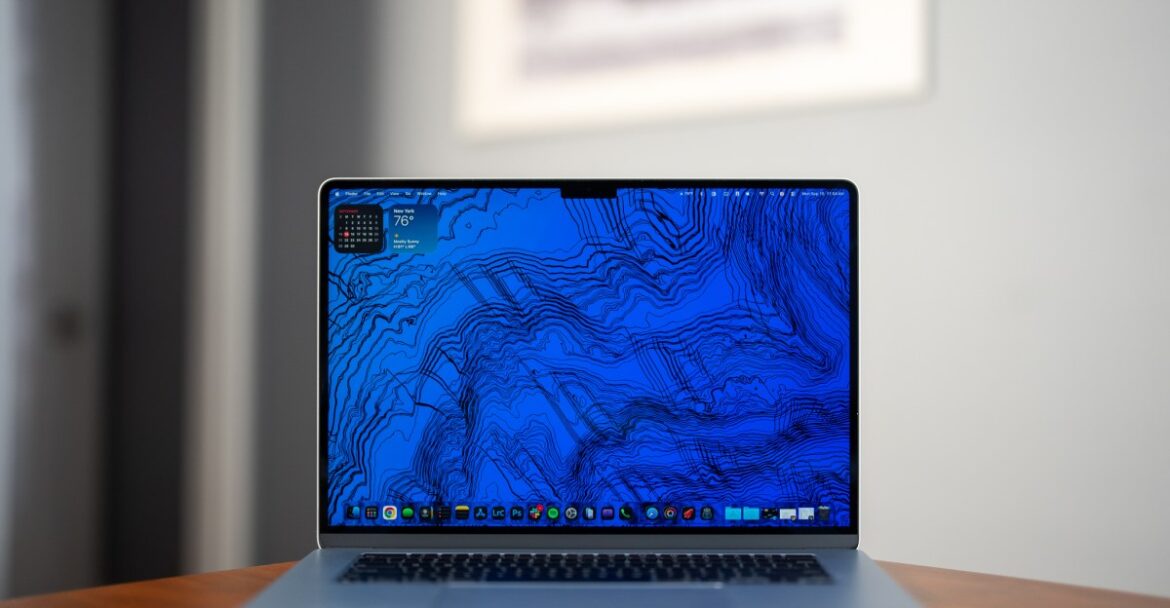
The Controls Gallery, with many toggles and buttons you can drag and drop to either the Command Center or Menu Bar. Note that I added enough stuff to the Menu Bar in this example to bump the temperature to the other side of the MacBook Air’s notch (which is invisible in screenshots).

I’ve come around on the new Menu Bar, though I’m glad anyone who dislikes its new transparent look can go back to filling it in with a background. It’s one of those things where, now that I’ve adjusted to it, I don’t want to go back.
But the best part of the new Menu Bar is how easy it is to add clickable buttons and drop-down menu shortcuts via the new Controls Gallery now. You’ve always been able to add lots of things to a Mac’s Menu Bar, but you now have one neat and orderly place to select them from. To add them, you click Edit Controls in the Command Center, which opens the Controls Gallery and allows you to drag and drop them in. It’s the same process as it is to add more toggles to Command Center, but the difference between the two is that I actually use the macOS Menu Bar — Command Center, not so much.

Fun and colorful folder customization

PreviousNext

1/2Colorful new folders.

I like the ability to change the actual color of folders, instead of just adding a colored dot next to their names. (Though, you can still do that if you prefer.) You’re limited to just seven folder colors, though, and can’t add your own. The new ability to add a helpful or silly emoji to the folder icon is also fun. Apple also allows you to choose from hundreds of minimal, monotone gray emojis to emblazen on a folder, but sadly you can’t search through them. The only way to keyword search for an emoji is to use a traditional, full-color emoji, which can kill the streamlined look.

The most meh parts of Tahoe

PreviousNext

1/2The new Games app.

  • Themes: I’m glad Apple is adding more appearance choices to macOS like it did the iPhone, but just like iOS’s themes, the look of dark, clear, or tinted icons are mixed at best. Some of the color tints make things ugly or unreadable. I hope this eventually gets better and more coherent on all of Apple’s platforms.
  • Live Activities: Tahoe automatically shows live, widget-like information straight from your iPhone on its Menu Bar and allows you to click right into an on-screen mirror of the app on your phone. It’s one of those features that could be very helpful (if you call lots of Ubers while working on your laptop) or that you might never actually see (if you don’t use an iPhone or none of your apps use Live Activities).
  • Games app: There’s no harm in having a game launcher and overlay tool in macOS, but much like gaming on a Mac, it’s not for hardcore players who play a wide variety of titles. The app is best equipped for games on Apple Arcade and the App Store. The Games app detects titles installed from my Steam library, but sometimes it fails to boot them or the overlay minimizes them for some reason. And while the overlay shows some helpful functions, like shortcuts to power settings, there’s no displayable framerate or performance metrics (not that I’m surprised Apple didn’t go this route). The Games app could be helpful for unifying your Steam and App Store games, but if you primarily buy your games on Steam, it’s mostly useless.

Tahoe’s long and windy trail

While Tahoe’s new look is likely to be polarizing, it has some decent new features. The update has been very stable for me, even from the early days of the developer beta (aside from the Games app acting weird — but, really, who cares). Though if you’re unsure how you’ll take to the glassy UI life or if your day-to-day work relies on a Mac, then it doesn’t hurt to wait a bit to update.

There will inevitably be updates that hammer out potential glitches or bugs, and I wouldn’t be surprised if Apple keeps cooking on Liquid Glass with some little visual tweaks as it did during the betas. But I guess it’s just a matter of time before we’re all glassified.

0 CommentsFollow topics and authors from this story to see more like this in your personalized homepage feed and to receive email updates.

  • Antonio G. Di Benedetto
  • AnalysisClose

    Analysis

    Posts from this topic will be added to your daily email digest and your homepage feed.

    PlusFollow

    See All Analysis

  • AppleClose

    Apple

    Posts from this topic will be added to your daily email digest and your homepage feed.

    PlusFollow

    See All Apple

  • Laptop ReviewsClose

    Laptop Reviews

    Posts from this topic will be added to your daily email digest and your homepage feed.

    PlusFollow

    See All Laptop Reviews

  • macOSClose

    macOS

    Posts from this topic will be added to your daily email digest and your homepage feed.

    PlusFollow

    See All macOS

  • ReportClose

    Report

    Posts from this topic will be added to your daily email digest and your homepage feed.

    PlusFollow

    See All Report

  • ReviewsClose

    Reviews

    Posts from this topic will be added to your daily email digest and your homepage feed.

    PlusFollow

    See All Reviews

  • TechClose

    Tech

    Posts from this topic will be added to your daily email digest and your homepage feed.

    PlusFollow

    See All Tech


Source link

September 16, 2025 0 comments
0 FacebookTwitterPinterestEmail
Hornet holds a hand up to her mask to help shade her eyes from a sunbeam in Hollow Knight: Silksong.
Gaming Gear

I just found out I’ve been using Silksong’s powerful Thread Storm ability wrong this entire time

by admin September 15, 2025


I’m making my way slowly to the end of Act One in Silksong, and one of my mainstays has been Thread Storm, a powerful AOE multihit ability that can be acquired fairly early on. But I’ve been a fool: despite using the attack in multiple boss fights, I actually haven’t been getting as much damage out of it as I could’ve. Thanks to a PSA video from Jason Mondal on YouTube, I only just learned how to use Thread Storm to its full potential.

Instead of pressing or holding right bumper on a controller once to activate the ability, you can rapidly mash the button to extend its duration without using more silk, giving you more damage per cast. The only downside is that this leaves you vulnerable to a counterattack for longer, but that’s kind of the basic tradeoff of Thread Storm already.

Hidden DAMAGE Buff with Thread Storm (Hollow Knight Silksong) – YouTube

Watch On

My preferred deployment is at a diagonal, up and slightly to the side of a boss to get them in the AOE while having a good chance of avoiding any attacks. Against enemies who can be staggered by Thread Storm, though, there’s practically no disadvantage to using its max duration⁠—this ability can be a huge help during any of those tricky wave fights.


Related articles

Where to find Thread Storm in Hollow Knight: Silksong

You can grab Thread Storm in the second half of Act One, in the Greymoor area. Instead of traveling west on the critical path to Bellhart, go east, past where Shakra is selling the map for the area, until the path dead ends at a building you can enter.

Inside, you’ll find a tough wave fight that, frustratingly, Thread Storm would be a great help for. Beating this encounter causes ladders of balloons to spawn outside: You can perform a downward attack in the air to pogo off of them, climbing to the top of the room and the entrance to a new area. The shrine with Thread Storm is at the end of a platforming section in this final room.

Image 1 of 4

(Image credit: Team Cherry)(Image credit: Team Cherry)(Image credit: Team Cherry)(Image credit: Team Cherry)

Keep up to date with the most important stories and the best deals, as picked by the PC Gamer team.


Source link

September 15, 2025 0 comments
0 FacebookTwitterPinterestEmail
Mae Martin kneels one knee on the ground in the middle of the woods
Product Reviews

Wayward is the new traumatic Netflix series you won’t be able to switch off, and I’ve lived to tell the tale

by admin September 12, 2025


Why you can trust TechRadar


We spend hours testing every product or service we review, so you can be sure you’re buying the best. Find out more about how we test.

Wayward is the title you need to keep your eyes on most of all when looking at the line-up of everything new on Netflix in September 2025. Brought to us by Feel Good creator and comic Mae Martin, they’ve even bagged Toni Collette for her most explosive horror role since Ari Aster’s Hereditary in 2022.

But this is just scratching the surface of why Wayward is so good. The new Netflix series tells the story of the small town of Tall Pines, Vermont, which is home to a school of delinquent teens that get shipped off to study under the watchful eye of Evelyn Wade (Collette). Leila (Alyvia Alyn Lind) and Abbie (Sydney Topliffe) are two teens caught up in the school’s mysteries, alongside cop Alex (Martin) and wife Laura (Sarah Gadon), who return to Laura’s home town to settle down before the birth of their new baby.

Their two points of view converge over the course of the eight-episode run, giving us a multi-dimensional look at what it means to be a brainwashed youth incarcerated against your will. The town’s decisions (and I won’t spoil what these are) aim to rebuild Tall Pines from the ground up, but instead break down and fracture every part of its infrastructure. Not that this seems to matter, though as Evelyn’s got her metaphorical hooks into almost everyone around her.

Between Alex, Abbie and Leila, it’s up to them to get to the bottom of what’s actually going on in Tall Pines. As a result, we’re taken on a journey that resembles something between Twin Peaks and Stranger Things, and boy, is the outcome satisfying.

Of course Netflix’s Wayward is brilliant, Mae Martin created it

Wayward | Official Trailer | Netflix – YouTube

Watch On

Viewers should have known Wayward would be an instant addition to their watchlist the minute it was clear the series was coming from Mae Martin. Feel Good is still regarded as one of the greatest comedy-dramas to come out of the last decade, and not just by me. Even though veering into sci-fi supernatural territory isn’t an expected direction for Martin, it almost doesn’t matter.

Why? Good TV comes from getting the basics right: we’re talking structure, characters, setting, as well as peaks and pits to hold the audiences attention. It’s Martin’s craft that’s always elevated anything they’ve been a part of, even though their character Alex could be seen as another extension of their own personality. But we’re rooting for Alex every step of the way, and that paves the way for some effortless LGBTQIA+ representation.

Instead of overtly stating that Martin’s character is a trans man, the ensemble use he/him pronouns without hesitation, and when they fumble it feels authentic, rather than clumsily wedging inclusion in to tick a diversity box. It’s incredibly refreshing and makes us buy into Alex’s personal experiences on a much deeper level. If you’re looking for someone more shouty about their sexuality, Leila is your girl, with her blossoming bisexuality proudly worn as only a naive teenager can.

Sign up for breaking news, reviews, opinion, top tech deals, and more.

Then there’s Toni Collette. As one of the most talented actors that seems to be continuously unappreciated (especially by the Academy Awards), I hope viewers will tune in merely to see her shine (though I already know they will). She raises the game of everything and everyone around her when she signs onto the project, and there’s no doubt that Wayward is what it is because of her. It’s Evelyn’s world and we’re just living in it, making even the most skin-crawling of scenes enjoyable.

Stick with Wayward after episode 1 – I promise the payoff is worth it

We even get a Toni Collette musical number in Wayward. (Image credit: Netflix)

For the most part, Wayward is well structured, holds its intrigue and has enough mystery wrapped in suspense to sustain us for the rest of the year. I’m a biased fan of anything to do with sketchy communes, strange towns and schools for dysfunctional children, but its subject matter is incredibly compelling even for the uninitiated. I should have felt as though I’d seen this play out 1000 times over (and better), but I came away from Wayward with a fresh perspective.

That said, there are a few minor downsides. With such a strange ensemble cast of characters in Tall Pines, not all of them get their backstories explained outright, particularly those relating to Laura’s past. Laura’s own journey has an ironic symbiosis with Evelyn’s and it would have been helpful to see more of how she actually functioned in her alma mater.

Looking back, episode 1 was the biggest stumbling block, and that’s not helpful when it’s the make-or-break point of a viewer deciding if they’ll stick or split to something else in Netflix’s expansive back catalog. It’s worth point out that all events that occur in Wayward are happening in 2003 rather than being split across different points in time, with it initially unclear how Abbie and Leila’s story will cross paths with Alex and Laura’s. It gets there pretty quickly after in episode 2, but the first 40 minutes require a bit of patience and push-through.

But these are small prices to pay for an ultimately satisfying and well-rounded eight-parter. Touching on themes of identity, motherhood, loss, community and trust, anybody who loves unpicking the crux of a story will be fed well-timed mouthfuls at every turn. There’s an interesting feeling of pride that comes with working out the subtext of something, and that’s a uniquely enjoyable experience in Wayward. Tall Pines has a lot of its own lore, both directly through the phases of the school, and hidden in plain sight among its residents.

If you want my advice: invest your time, trust nobody, and hope to God that you don’t get selected for The Leap.

You might also like

Today’s best Netflix deals


Source link

September 12, 2025 0 comments
0 FacebookTwitterPinterestEmail
A white gaming PC built using a Thermaltake PC case, Cooler Master fans, and an AMD CPU.
Product Reviews

I’ve taken a proper bargain of a case from Thermaltake and built a gorgeous white PC with it

by admin September 8, 2025


Our build process

Every month we build a gaming PC with the latest components and cases—it’s good to get stuck in and build something regularly in our opinion. If you’re looking for inspiration for your next build, or you’re new to the hobby, you can check out our picks below. You can easily make changes to these too, and in some cases, we hope you do. We’re building and testing every PC we highlight, and if we run into any issues, we’ll explain them here.

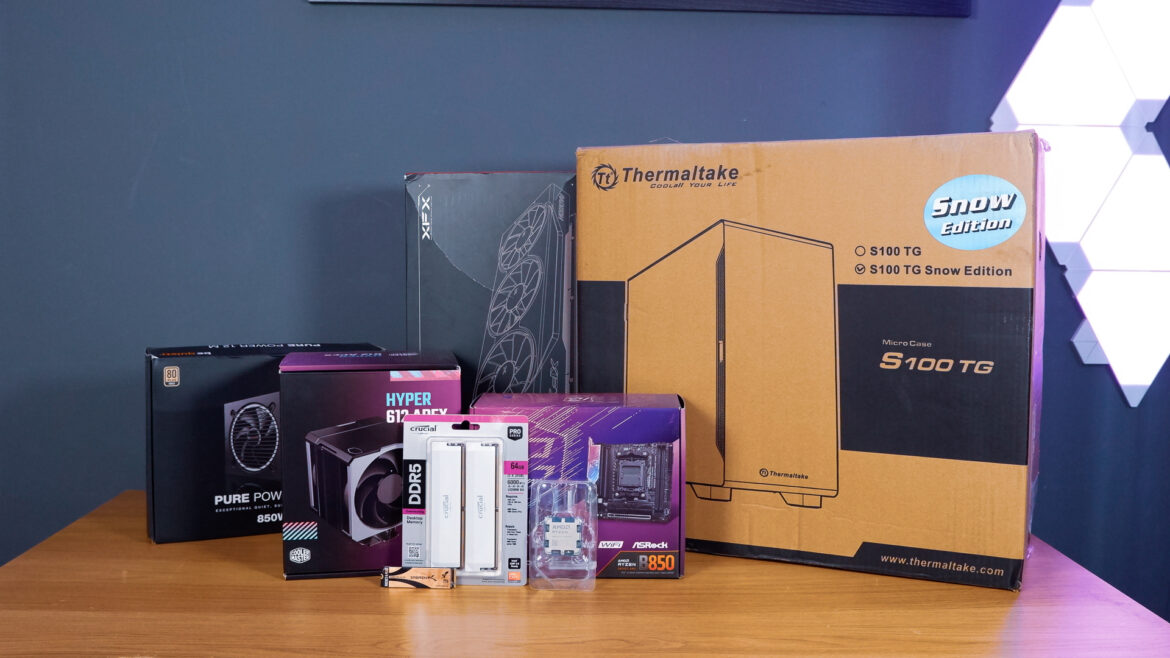
We’re back with another build. This time, a compact white gaming PC, powered by AMD’s top gaming CPU, the Ryzen 7 9800X3D, and a Gigabyte RTX 5070 Ti Eagle OC Ice SFF. I’ve tried to gain a few style points with the Cooler Master Hyper 612 Apex and Cooler Master Sickleflow Edge 360 fans—three fans combined into a single unit. That’s more of a time-saver than you’d think and makes for fewer cables.

All of which has been stuffed inside a surprising affordable chassis: Thermaltake’s S100 Tempered Glass Snow Edition. This budget case looks better than it should, considering its price tag, and altogether brings this white PC build together nicely.

Quick list

  • Case: Thermaltake S100 Tempered Glass Snow Edition – $73/£40
  • Motherboard: ASRock Phantom Gaming B850I Lightning WiFi – $210/£198
  • Graphics card: Gigabyte GeForce RTX 5070 Ti Eagle OC Ice SFF – $900/£610
  • CPU: AMD Ryzen 7 9800X3D – $472/£420
  • RAM: Crucial DDR5 Pro 64 GB – $228/£171
  • SSD: Solidigm P44 Pro 2 TB – $240/£187
  • Cooler: Cooler Master Hyper 612 Apex – $80/£55
  • PSU: Be Quiet! Pure Power 12 M 850 W – $130/£110
  • Fans: Cooler Master Sickleflow Edge 360 ARGB White Edition – $75/£53

Gallery

Image 1 of 18

(Image credit: Future)(Image credit: Future)(Image credit: Future)(Image credit: Future)(Image credit: Future)(Image credit: Future)(Image credit: Future)(Image credit: Future)(Image credit: Future)(Image credit: Future)(Image credit: Future)(Image credit: Future)(Image credit: Future)(Image credit: Future)(Image credit: Future)(Image credit: Future)(Image credit: Future)(Image credit: Future)

Parts list

Performance

We put every build through its paces, testing the latest games and putting the CPU under pressure to ensure stability.


Related articles

This PC is ‘Custom PC #10’ in the charts below.

Best PC build 2025

Our current recommendations

Keep up to date with the most important stories and the best deals, as picked by the PC Gamer team.


Source link

September 8, 2025 0 comments
0 FacebookTwitterPinterestEmail
Bosch ErgoMaster Series 6 blender
Product Reviews

I’ve used the Bosch ErgoMaster Series 6 for two weeks, and it’s already replaced my blender, food processor, and whisk

by admin August 31, 2025


Why you can trust TechRadar


We spend hours testing every product or service we review, so you can be sure you’re buying the best. Find out more about how we test.

Bosch ErgoMaster Series 6: one-minute review

The Bosch ErgoMaster Series 6 (sometimes known as the Serie 6) is an ergonomically designed stick blender, particularly well suited for users with limited hand mobility as a result of its curved body that sits comfortably in the hand, and trigger-style control.

The ErgoMaster has a 1,000W motor, and comes with a blending foot, a mini-chopper with two blades (one for general use, one for ice), a balloon whisk, and a 600ml mixing vessel. Attaching and removing accessories is easy, requiring no awkward twisting motions, and many of the components are dishwasher-safe for easy cleanup.

During my tests, the main blender foot produced silky-smooth sauce and soup in just a couple of minutes, while the mini-chopper attachment processed herbs, onions, garlic, cheese, and nuts quickly and evenly. The ErgoMaster’s instruction manual offers advice on quantities, how to prepare ingredients, and the length of time for which you should blend.

The balloon whisk worked especially well, whipping egg whites to stiff peaks even faster than my hand mixer (ideal for meringue and light sponge cakes).

Image 1 of 2

You can use the trigger control with your whole hand, which is much more comfortable than holding a small button with one finger(Image credit: Future)The blender has a premium construction with a stainless steel body(Image credit: Future)

The only attachment that didn’t meet my expectations was the mini-chopper’s ice blade, which took a lot longer than anticipated, and produced ice that was quite unevenly crushed.

The ErgoMaster has a premium build, sporting a stainless steel body and soft-touch handle for comfort, but I found that the metal heated up noticeably when I’d been using the blender for several minutes (when blending soup and sauces, for example). Fortunately, the grip itself never became hot, but it did take the appliance some time to cool down after use.

Overall, the ErgoMaster Series 6 is a super-versatile multifunction blender that’s particularly beneficial for those with hand mobility issues, although if you want to process ice regularly, you’d benefit from picking up a personal smoothie-maker as well.

Sign up for breaking news, reviews, opinion, top tech deals, and more.

Bosch ErgoMaster Series 6: price and availability

  • List price £99.99 (about $140 / AU$210)
  • Often available for less during sales events
  • Not widely sold outside Europe

The Bosch ErgoMaster Series 6 stick blender was released in 2023, and has a list price of £99.99 (about $140 / AU$210), although it’s often available for a discount, particularly during sales events such as Amazon Prime Day and Black Friday.

It’s available direct from Bosch, and from third-party retailers such as John Lewis and Amazon. You’ll find today’s best prices below. Note that the ErgoMaster Series 6 isn’t sold widely outside Europe.

Its price is pretty much standard for a high-end hand blender, and similar to the Ninja 2-in-1 Immersion Hand Blender and Mixer, for example. If you want something a little less expensive, the ErgoMaster Series 4 sports a plastic body rather than stainless steel, and is priced at £84.99 (about $110 / AU$180).

Today’s best Bosch Series 6 ErgoMaster deals

Bosch ErgoMaster Series 6: design

  • Comfortable to hold and easy to operate
  • Particularly good for people with restricted mobility or hand strength
  • Includes well-made mini-chopper and balloon whisk attachments

The Bosch ErgoMaster Series 6 is a solidly made stick blender that, as the name implies, is particularly comfortable to hold and use. The body of the blender, containing the motor, has a curved shape that sits better in the hand than a straight-sided cylinder, and rather than a button, the blender is activated by gently squeezing a large trigger-style control.

It’s a thoughtful design, and would be particularly good for anyone who doesn’t have full strength in their fingers, since the trigger doesn’t require much pressure and its operated using your whole hand, rather than just a single digit. The more firmly you hold the trigger, the faster the blender will mix.

The blender’s body is stainless steel, while the hand grip is made from a soft-touch plastic. The trigger button is ridged to prevent slipping.

The mini-chopper attachment is great for preparing onions and garlic (Image credit: Future)

The ErgoMaster Series 6 comes with a set of attachments for different ingredients: the standard blender for soups and sauces; a mini-chopper with two blades (one for ingredients such as cheese, nuts, and vegetables, and one for ice), and a whisk. To remove an attachment, hold down two large buttons on the handle (one on either side) and pull gently. To attach one, simply push it gently into place. There’s no need for awkward twisting movements that you might find uncomfortable if you have limited mobility in your hands.

You also get a tall mixing vessel with a capacity of two and a half cups, or 600ml, which is useful for blending or whisking wet ingredients such as cream or eggs. It’s a useful addition, and its shape makes it possible to whisk relatively small quantities that might be tricky to whip in a bowl without spillage.

The only downside is that this vessel isn’t totally cylindrical, which means it can be difficult to remove thick ingredients with a spatula. Ingredients tend to become stuck on the flat sides where the volume measurements are embossed. The tall vessel also has no pouring spout.

The balloon whisk attachment is excellent, although it can be tricky to scrape all your cream or meringue out of the mixing vessel when you’re done (Image credit: Future)

Not all of the blender’s components are dishwasher-safe, but the metal blending attachment, the whisk, the large vessel, the bowl of the mini-chopper, and the chopper’s two blades all are, which makes maintenance easy.

The blender is accompanied by a manual with diagrams explaining how to prepare different ingredients, and how long it will take to blend or chop a particular quantity. For example, a smoothie made using a 40:60 ratio of fruit to liquid should take 60-90 seconds to blend at full power in the tall mixing vessel.

Bosch ErgoMaster Series 6: performance

I started testing by preparing some ingredients for a pizza sauce (you can find the sauce recipe on Good Food) using the mini-chopper attachment and the cutting blade, and following the preparation instructions in the manual.

Herbs don’t need any special preparation, so I added my basil to the bowl and gave it a few pulses of around one second each. After around six pulses, the leaves were chopped into small, even fragments ideal for cooking (the manual suggests it could take up to 10 pulses).

Image 1 of 4

Fresh herbs were quickly and evenly chopped(Image credit: Future)Fresh herbs were quickly and evenly chopped(Image credit: Future)Herbs like basil don’t require any special preparation before chopping(Image credit: Future)Herbs like basil don’t require any special preparation before chopping(Image credit: Future)

The chopper also worked very well for preparing onion (roughly chopped into wedges first) and garlic (peeled, but added whole). I was impressed by how evenly and quickly the ErgoMaster prepared all of these ingredients. If you have a condition such as arthritis, for example, you might find fine knifework difficult and usually opt for pre-chopped ingredients. With this blender, you’ll be able to buy cheaper whole produce and prepare it easily yourself.

Once my pizza sauce had cooked down, I used the main blender foot to whizz it all to a smooth consistency. Exactly how long this takes will depend on the quantity and consistency of the ingredients, and the desired texture. I wanted my sauce as smooth as possible, and found that blending took about three minutes.

Image 1 of 3

Blending a large batch of pizza sauce to a smooth texture took about three minutes(Image credit: Future)Blending a large batch of pizza sauce to a smooth texture took about three minutes(Image credit: Future)Blending a large batch of pizza sauce to a smooth texture took about three minutes(Image credit: Future)

It wasn’t much faster than using my jug blender (which would be my usual choice; it too has a 1,000W motor, the same as the ErgoMaster), but then you don’t have to pour hot liquids, and there’s much less washing up afterwards. The only requirements are that you take the pan off the heat and ensure the end of the blending foot is submerged before you start the motor – and don’t immerse it beyond the “maximum” level.

I was surprised by just how quiet the blender foot was in use. It registered under 40dB, which is around the same as the hum of my fridge. It was louder when mixing harder ingredients, but still far less noisy than a jug blender.

I also used the ErgoMaster to prepare a roasted red pepper and sweet potato soup (the soup recipe is also from Good Food). Although the ingredients were tougher, the overall volume was lower, and the blending process took about the same time.

Image 1 of 2

The blender also made light work of a roasted vegetable soup(Image credit: Future)The blender also made light work of a roasted vegetable soup(Image credit: Future)

While blending the soup and sauce, I noticed that the body of the blender was heating up. The handle itself never became hot, but the metal part below was distinctly warm after the motor had been running for a few minutes, and it took quite a long time to cool back down afterwards.

The mini-chopper made light work of cheese, breaking it down into crumbs ideal for melting. It’s necessary to cut it into 1cm cubes first, but this is certainly easier on the hands than using a box grater, particularly for hard cheese such as parmesan. I used 100g of mature cheddar, and it was finely chopped in 20 seconds.

Our standard battery of blender tests here at TechRadar also includes nuts. I used 150g of shelled, toasted hazelnuts, which I was preparing to use in dukkah. The smaller the nuts, the longer you need to pulse the blender, and it took the maximum recommended 30 seconds to break them down; but there was none of the dust that’s usually created when I chop nuts using my Kenwood food processor. Another win for the ErgoMaster.

Image 1 of 2

It’s necessary to cut cheese into 1cm cubes before chopping(Image credit: Future)It’s necessary to cut cheese into 1cm cubes before chopping(Image credit: Future)

The only ingredient that the ErgoMaster really struggled with was ice. As per the instruction manual, I used the chopper’s ice attachment with 100g of ice, and pulsed for five seconds. When I released the trigger, the ice was barely touched. Chopping it to a usable texture took closer to a minute, and even then it was rather rough. If you want to chop ice regularly (particularly in large volumes), you’d be better served by a smoothie maker.

By contrast, the whisk attachment is superb, and performed even better than my Dualit hand mixer. I used the tall mixing vessel with the whisk, and it whipped two eggs to stiff peaks in 30 seconds. I used these to make a half-quantity of meringue (see the Lightest Ever Meringues recipe on Good Food) and they were ready to be baked within two minutes.

Image 1 of 2

Chopping ice took a lot longer than suggested in the manual, and the results were uneven(Image credit: Future)Chopping ice took a lot longer than suggested in the manual, and the results were uneven(Image credit: Future)

Overall, the Bosch ErgoMaster Series 6 is a great stick blender, particularly for those with mobility issues in their hands, and an excellent chopper and whisk. It’s a piece of cake to use, and could happily replace several small appliances in the typical kitchen. Just avoid ice, and you won’t be disappointed.

Should you buy the Bosch ErgoMaster Series 6 ?

Swipe to scroll horizontallyBosch Serie 6 ErgoMaster score card

Attribute

Notes

Score

Value

A premium blender with a price tag to match, but can often be found discounted. Not widely available outside Europe, though.

4.5/5

Design

Ergonomic, with comfortable grip and trigger operation. Excellent accessories, most of which are dishwasher-safe.

5/5

Performance

Purees, whisks, and chops almost all ingredients effortlessly. Just don’t bother with ice.

4.5/5

Buy it if

Don’t buy it if

How I tested the Bosch Serie 6 ErgoMaster

I used the Bosch ErgoMaster Series 6 in my kitchen for two weeks, during which time I prepared a selection of my favorite recipes that I’d normally prep using a jug blender to compare the results for speed, texture, and noise.

As with all our stick and jug blender reviews, I also tested the ErgoMaster’s performance with onions, cheese, nuts, and ice to see how quickly and evenly it could process these common ingredients. For more details, see how TechRadar tests, rates, and reviews products.

First reviewed August 2025.

Bosch Series 6 ErgoMaster Pressure Controlled 3-in-1 Hand Blender: Price Comparison


Source link

August 31, 2025 0 comments
0 FacebookTwitterPinterestEmail
  • 1
  • 2

Categories

  • Crypto Trends (1,098)
  • Esports (800)
  • Game Reviews (772)
  • Game Updates (906)
  • GameFi Guides (1,058)
  • Gaming Gear (960)
  • NFT Gaming (1,079)
  • Product Reviews (960)

Recent Posts

  • This 5-Star Dell Laptop Bundle (64GB RAM, 2TB SSD) Sees 72% Cut, From Above MacBook Pricing to Practically a Steal
  • Blue Protocol: Star Resonance is finally out in the west and off to a strong start on Steam, but was the MMORPG worth the wait?
  • How to Unblock OpenAI’s Sora 2 If You’re Outside the US and Canada
  • Final Fantasy 7 Remake and Rebirth finally available as physical double pack on PS5
  • The 10 Most Valuable Cards

Recent Posts

  • This 5-Star Dell Laptop Bundle (64GB RAM, 2TB SSD) Sees 72% Cut, From Above MacBook Pricing to Practically a Steal

    October 10, 2025
  • Blue Protocol: Star Resonance is finally out in the west and off to a strong start on Steam, but was the MMORPG worth the wait?

    October 10, 2025
  • How to Unblock OpenAI’s Sora 2 If You’re Outside the US and Canada

    October 10, 2025
  • Final Fantasy 7 Remake and Rebirth finally available as physical double pack on PS5

    October 10, 2025
  • The 10 Most Valuable Cards

    October 10, 2025

Newsletter

About me

Welcome to Laughinghyena.io, your ultimate destination for the latest in blockchain gaming and gaming products. We’re passionate about the future of gaming, where decentralized technology empowers players to own, trade, and thrive in virtual worlds.

Recent Posts

  • This 5-Star Dell Laptop Bundle (64GB RAM, 2TB SSD) Sees 72% Cut, From Above MacBook Pricing to Practically a Steal

    October 10, 2025
  • Blue Protocol: Star Resonance is finally out in the west and off to a strong start on Steam, but was the MMORPG worth the wait?

    October 10, 2025

Newsletter

@2025 laughinghyena- All Right Reserved. Designed and Developed by Pro


Back To Top
Laughing Hyena
  • Home
  • Hyena Games
  • Esports
  • NFT Gaming
  • Crypto Trends
  • Game Reviews
  • Game Updates
  • GameFi Guides
  • Shop

Shopping Cart

Close

No products in the cart.

Close