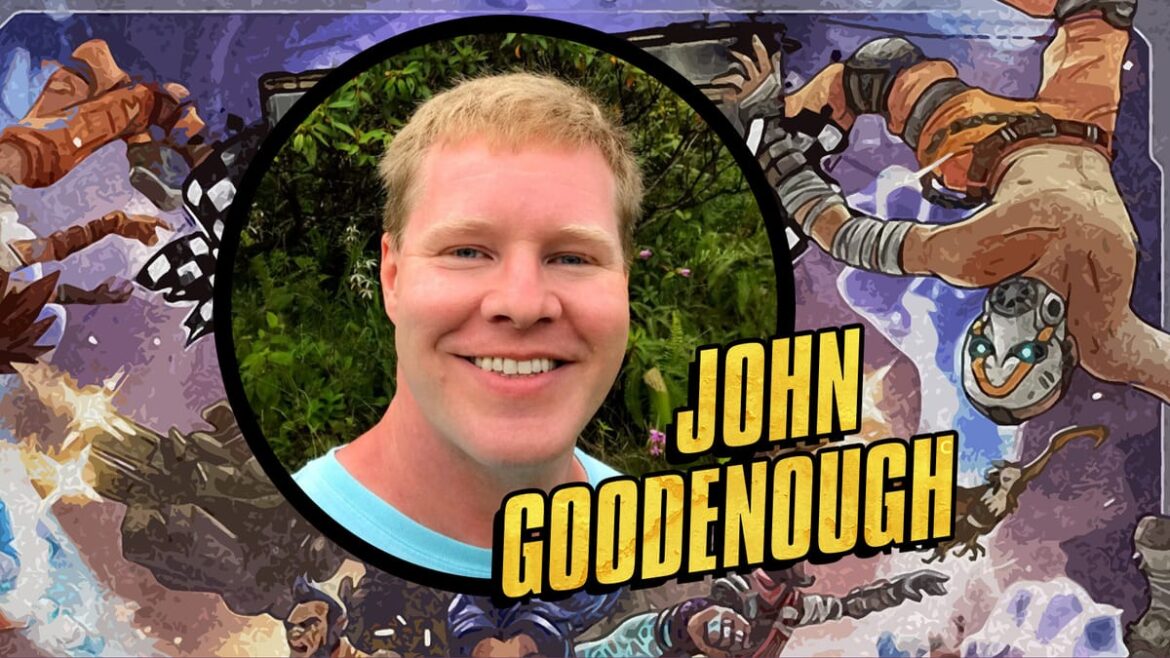
*Audio interview, edited for clarity and length*
A couple of weeks ago, Gaming Trend sat down with John Goodenough, Game Designer with Monster Fight Club, publisher and developer of Cyberpunk: Combat Zone and Borderlands: Mister Torgue’s Arena of Badassery. John’s journey didn’t begin there, however, and for over 20 years John has been the wearer of many hats, with his creative thumbprint on many, many games. John shared his journey from humble beginnings and talked about what he’s working on now.
Gaming Trend (GT)
So, John, you’ve been in the industry for like 20 plus years, right?
John
I think when I started getting a paycheck from my first game company, it was like 2000 or so, and I’ve worn a lot of hats. I’ve worked as an artist, as a developer, and as a designer. I actually got my start working in the warehouse [at Fantasy Flight Games]. It was one of those opportunities where I actually feel like I’ve been a part of just about every single step in the game design, creation, and marketing process. I even know what it’s like to hand assemble games and throw bits into a box and go to the shrink wrapper. It’s been a wild ride.
GT
We were checking out your equivalent game IMDB page on Board Game Geek, and my goodness, it has quite the list of credits for games. We’ve played many of them! Tide of Iron, Runebound, Talisman, Relic, and now Borderlands. For these games, did you design them and also do art? Were you moving around to wherever you were needed?
John
It was art first. I started off making illustrations for Rune Bound, and then continued when Fantasy Flight started getting into the CCGs. Because I was a local, I could go into the office and play test the game that I would then be working on illustrations for. I was maybe one of the few artists that they’ve ever had in the office that actually worked on the game and then played the game before they did art. It was an amazing process to me because I wanted to make sure that every illustration didn’t just look pretty but it also actually represented what was functioning in the game.
The thing that really piqued my interest for development was playtesting those games. I got to see the developer side of things because a lot of the projects and games that they were working on were primarily about world building. Fantasy Flight ultimately created worlds and created game engines for you to run around and play in. So that world building process is really what piqued my interest in getting into game design. I had designed Monopoly variants back in the day but I didn’t really have any ambition on being a game designer. I love games, and I love playing them, but I believed “you stick to the rules.” But that process of building a playground, a world for people to play in offered me more creative space to operate in than just illustrating cards or pages or card illustrations. As an artist, you really only get to take a couple of snapshots in a world being a game designer, but being able to wear this hat as a game designer gave me something to experiment with.
GT
Which artists’ work did you learn from and get inspired by?
John
John Howe has been the biggest inspiration. We got a chance to work together on The Lord of the Rings: Battlefields expansion and I tried my best not to be a gushing fanboy. The original graphic design for the boards were not delivering a cohesive aesthetic so he went above and beyond the call of duty to create art frames at the last minute. My admiration for his artistic vision was equally matched by his integrity and dedication. TSR legends like Easley, Elmore, and Parkinson unlocked amazing worlds to explore. This list goes on and on.
GT
What experience(s) help prepare you the most and become ok with coming up with new rules to games and being part of that design “behind-the-scenes” process?
John
Well, I think the best thing that prepared me for working on games was actually working in the warehouse. We played test games during the day, then took breaks and came back and chitchat. You got a pretty good insight into the behind the scenes. I think the biggest, most valuable lesson that I got out of that experience was watching the emotional journey. When people think of game design they think it’s very intellectual. People tend to think everything is happening in your head, but in reality, when you’re the creator, it’s a big emotional journey because you have to be passionate enough to work on it every day and carry it through.
It’s a hard job before you even get the game out there. Once you create the product and put it out in the world, you also have to learn how to step back and just let it be received. There are always gonna be people who love it, people who hate it, and people somewhere in between. These groups of fans are especially more prevalent on the Internet – it’s not 2000 anymore. The real truth is that, after you put a game out there, it’s not your game anymore; it’s not your baby now it’s theirs. You have to have a thick skin about response, too.
GT
What kind of emotional journeys have you had or seen?
John
One of the first big projects I was involved with was an “all hands on deck” game. It ended up being the whole company at Fantasy Flight putting all of their love, and resources into this game that was supposed to be “the next big thing.” Instead of the launch even coming close to their hopes and expectations, it completely flopped. It was one of the biggest flops and bombs that they’ve ever had. To watch that emotional journey of it all, the excitement of launch, the disappointment and the heartbreak with the reception, it was a lot. I was playtesting and getting insight to the development but I was far enough removed from the core group where I didn’t have as strong of an emotional attachment as the others. Witnessing all that happened was eye opening.
The one other lesson you learn too is that this is all a marathon. If you’re gonna last in this business, you can’t do anything as a sprint. You burn out your energy quickly like that so everything you do, every step you take within any project, has to be with the mindset of it’s a marathon. If you’re in it for the long haul, you have conserved some of that creative energy and passion that will carry you forward.
The one other lesson you learn too is that this is all a marathon. If you’re gonna last in this business, you can’t do anything as a sprint.
GT
When you’re working with intellectual properties and established fantasy worlds, like Warhammer, Borderlands, and World of Warcraft, and you’re doing world building developing, knowing passionate fans (on both ends) are there, how difficult of a dance is it for you to juggle that? The game has got to work mechanically, but then you also kind of have to have it be marketable and also something that fits within the established rules of whatever universe it is. How challenging is that from a design and art perspective?
John
Everything in design is all about balance. You also have to be a big enough fan and know the world and know the IP. However, being too big of a fan is a drawback, too, because if you try to make the game too realistic, and take the stance of “this is exactly how it works in the video games or books or movies,” then you end up starting to create things that only those super fans are going to enjoy and kind of turn all of the casual fans.
There is a lot of it that depends on the licensor. I have been extraordinarily lucky to work with many exceptional licensors, like Games Workshop and Blizzard. Every game company has its quirks, but when you’re working with the right licenser it makes all the difference in the world. When you have somebody that understands everything about the property, like they’re a walking encyclopedia on every single detail, it makes a big difference. Having people respect the rules and the board game design process makes a big difference, too. So everything has to be balanced and work for everything behind the scenes and also for the fans.
GT
So you have this juggling between the hardcore fans, the casual fans, the board gamers, the video gamers, the licensor, etc. etc. and you, as the designer and developer, have to act as like a translator, right? How do you gauge when something is working, or not?
John
It’s actually kind of a measuring stick that I use. When I get all excited and I design something that works just like the video game, or that’s just like the scene in the movie, that’s actually a red flag. It’s usually a symptom that you’re dialing in to that aspect too much. You want the game to feel like the moment or action you’re trying to create; you want to give the impression of the thing, not the actual thing itself. In many ways, being a designer is more like being an impressionistic painter. You’re not just creating these little micro moments of doing exactly the thing that happened in the movie or game; you’re giving the feeling of it. Ultimately, what you’re doing is you’re creating a whole series of those little micro interactions so that at the end of the game, people walk away with the feeling that they were a living character in that world.
GT
After all these years of Randy and I going to cons, we think our enjoyment comes from getting that impression, getting that ‘aha moment’ that occurs within the game, like “That was super cool!” You know, whatever happened, win or lose, we got a feeling from the game that leaves an impression. Do you get a similar ‘aha moment’ during that design process where you say to yourself “OK, this is going to work and this is going to be awesome”?
John
I’ve worked on a ton of expansions and so designing an expansion is quite different than designing a brand new game totally from scratch. I will say one of the more interesting processes was working with Rune Bound with Christian Peterson, the CEO. One of the very first things he’d want us to do is make the box art, so we would end up having the fully finished illustration pop to look at and for him to say “OK, go make the thing.” So I would print it out as a movie poster size, put it on the wall by my desk as a movie poster, and I would stare at this thing and imagine all these scenes happening in it as a movie. Then I would translate that into the mechanics and see how that would actually work in the game. These expansions I made were based off of a movie poster.
When you’re working with an intellectual property, like we’re working on Borderlands games at Monster Fight Club right now, it’s kind of the opposite because you go through the video games, go through the content, and get that impression. Merging everything in together to create its own identity is its own experience. There isn’t an ‘aha moment’ so much as there are small little ones along the way.
GT
With your journey thus far, how did you get involved with Monster Fight Club?
John
I worked at Fantasy Flight Games for a little over a decade. When I started there were like 10 people at the company and by the time I left it was close to 100. The company was growing rapidly, and it felt like the company was hitting the pinnacle of success. While the growth was good, I realize I’m more of a small town guy than a big city slicker. I like to work at smaller companies where everybody knows their name and it feels more cohesive with departments being down the hall, not down the street. If you’re working in a creative process, I just like that type of environment more. And so I moved on and wanted to work for a smaller company, like the good ol’ days. After FFG, I worked for Alderac Entertainment Group (AEG) for about 10 years until the company went through a restructuring.
Ten years in a creative position is a lot of work. There is a tremendous value in working at a company long enough to where you learn you know all the systems and processes people use, which gives you different perspectives on different ways of doing things. But moving every ten years into a different environment just kind of opens other doors and unlocks other potential. Being at AEG was more about production, and you really couldn’t design much in house like when I was at FFG. When you’re continuing production, all you’re doing is kind of giving a game a window dressing pushing it out the door to sales. So that is the nice thing about working at Monster Fight Club is I got to go back full time as a designer. There’s a buddy that I knew at AEG and so he brought me over. I guess I could mostly thank him for the gig!
GT
How tough was it for you to leave these positions, not knowing what was coming down the road for you or the companies?
John
Fantasy Flight was a bit of a tough call because I left right when they were starting to do Star Wars. And so when I left, people were like “Well, why? Why would you leave?” But it wasn’t just one thing. One of the big things that happened goes back to balance, and this was a balance between designing and sales. Every creative company needs the ratio of the creative people and the corporate business suits. It’s not that one is good and the other is bad, you just need a balance. The only time when it gets bad is when there is an upset to that balance. Too much business, and there is not much space for creative endeavors and the games go flat. But if all you have are creative people and you don’t have any business and people, you’re gonna be wondering if you’re gonna have a job tomorrow. So this is what I saw at FFG; the company hit a tipping point where the business side just took over and we’re running the show and the creatives didn’t really have any influence anymore. Not like when I started. So I do feel a bit lucky that I kind of saw the writing on the wall and left when I did.
I left while I still loved being there. That was the hardest part because it’s not just the place, it’s the people. Bearing in mind that all of this is coming from the perspective of me, the passionate creator guy, so I’m a little biased.
GT
So now that you’re back to world building within Borderlands, with things like the campaign and Raid bosses, how are you approaching this design with this whole balancing act?
John
The Combat Zone system is so simple and universal that just having such a good system and engine makes our jobs a million times easier. Super simple, super intuitive. It’s very easy to just kind of work out probabilities, you know, right in your head. Borderlands: Mr. Torgue’s Arena of Badassery is a cooperative game on a grid map with four Vault hunters running around fighting these waves of enemies and completing objectives. The Raid Boss fights are an interesting departure because you get to use the same system, but the new rules make the game feel radically different because you just have one big enemy on a map. So it simplifies things a lot. It makes setup really quick and easy; you can build the map with these two big tiles and just start playing. It gives you the feeling of an epic fight.
GT
Do you have a favorite Vault hunter that you tend to gravitate towards when you’re working on and testing these games?
John
Oh that’s like a “who’s in your favorite child” question, right? I mean, we’ve covered all of the Vault hunters and then we’ve taken some characters and turned them into Vault hunters. If I had to pick a favorite, I think it would be Zero. He might be the most fun to at least play test and design for because he’s such a min-maxing character. And game designers and players both love the min-maxing. Most characters do either range or melee, or sometimes mid, but only one. Zero gives you tons of options where he can do both. You just have to time it right, plan it and execute it perfectly, using exactly the right actions and get the right dice rolls, you can do these amazingly epic moves.
GT
Within the game design space, are you finding yourself playing the video game alongside it for inspiration? Are you mostly focused on just the board game? Is it both?
John
The expansions are a little mix of everything: you know a dash of Borderlands 1 there and then a scoop of Borderlands 3 there. The main reason why I do enjoy playing video games is mostly that it’s kind of a break. You spend all day crunching numbers, trying to get balance to work, and you just need to recharge, like that feeling of going into Gunzerker mode. Playing the games also helps to dial in the feeling and get inspiration. It’s almost like when people take a shower and they get this brilliant idea and it’s a shower. You know, there’s like ‘eureka’ moments where something just pops into your head.
GT
So while you’re blasting away at bandits and looting and shooting, that’s your shower thought moment.
John
Yeah! When you’re in the mindless explosions and just carnage. You can come up with some of the most creative ideas doing the mindless things. Like slaughtering bandits.
GT
That’s fantastic.
Do you find yourself recharging your creative batteries by playing other board games? Are there any go-to board games that you’ll always play, or recommend to aspiring designers to play?
John
Absolutely. I would say the best advice I could give to anybody wanting to design games is not only play a diversity of games, but play the games you hate. A lot of designers just play what they want, and you can get inspiration from that. However, actually playing the type of games that you don’t like gives you another language. Every language you learn just allows you to look at things differently and solve problems in different ways.
I had a really good buddy back in Minnesota, Richard, who had thousands of games. I mean literally like 5000 games in his house. They were on all of the shelves, walls, cabinets. I mean, he cleaned out his chimney after he ran out of room and was stuffing games in his chimney. It was a smorgasbord. Of course, like I said before, everyone has different tastes and eventually you’re going to find stuff that doesn’t resonate. It was one of those games that didn’t resonate that I played at his house that really kind of gave me inspiration. Playing it allowed me to articulate what I did like about other games better. When you create a contrast with a basis of comparison, it allows you to look at things with a sharper level of detail. There aren’t any games that I hate to play, but there are a lot I enjoy and a lot that I get inspiration from.
The best advice I could give to anybody wanting to design games is not only play a diversity of games, but play the games you hate…actually playing the type of games that you don’t like gives you another language. – John Goodenough
GT
Do you have a ‘gold standard’ for games? Regardless of the game mechanic, is there just one you’d recommend to anyone trying to get into game design?
John
I’m not saying this is the best game or the end-all, be-all of games, but if I had to think of an example of what makes the perfect game, the one that comes to mind is Carcassonne. It’s not even my favorite game, or the one I want to play every day all day, but it is close to what I would call a ‘perfect game.’ It balances out reward patterns, where you can get quick rewards by closing off roads or you can do long term investments by building up your farms. The castles are kind of in-between. It has this wonderful pattern of bouncing between short term investments versus long term investments in rewards and it’s super simple. All you can do is draw a tile, but your decision power comes from where it and your meeples, if any, are placed. It sounds like it would get boring so quickly and so why would you want to play that game more than once? The replay value is you’re putting tiles down and scoring on three different things that can occur in a nearly-unlimited arrangement. So the game is about the pattern of flow of having these little constant rewards, but also building up to the big, big reward at the end.
That is probably the game cause I played that a lot in real life, and then on apps, because it plays really quickly. I have probably played that more than any other game in existence.
GT
So did you play all 5000 games?
John
It was insane because I actually had a goal where I was like “there’s no way we’re gonna be able to play all these games, so I will try and play half of them.” In reality, we ended up playing several hundred games. This was during my research phase, too, where I said “I just wanna learn. Every game I play I wanna learn something new and play a different type of game that I experienced before.” So, I was learning about five games per session, which was like a drop in the bucket when you compared it to what was out there at the time in the early 2000s. Nowadays, there are 5000 new game releases every year!
GT
I mean, to learn five games in a session… that’s exhausting. When we try to learn one game now it takes like 90 minutes… and we’re not even playing it fully. What you’re talking about is that marathon-style approach to gaming.
John
I mean, I can’t do that anymore. It was mostly the passion about wanting to game design. Like back in those days, they didn’t have education around it. You just had to go out and play games and just learn by playing. Now, they actually have game design colleges and schools where they go into game theory. I think I was just in the right place at the right time. And was lucky enough to have a friend with practically an endless supply of games.
GT
Other than board games, what else resets the creativity? Do you like to surf? Hang out at the beach? Go hunting for treasure with a metal detector?
John
The dogs I have become the main focus of my life now. They just follow me home or kind of show up on my doorstep now. So I’m surrounded by dogs and there are more than a handful. But I love them. Another hobby is pinball, actually. It is one of those things where it’s all in the reflexes, and is quite different from video games and board games. Actually, from a designer point of view, pinball is close to board games, like Carcassonne, because it’s all about patterns. Once you hit the skill level where pinball isn’t so random anymore, it’s all about pattern development and that’s ultimately what Carcassonne. You play it, you learn it, and you master it. So once you ‘see the Matrix,’ you can predict the patterns and get into the flow. Whenever I get writers blocked or stuck on something, there is something about engaging in a game that has a really good flow of patterns that helps me. Whether it’s pinball, or Carcassonne, or Borderlands you can play it almost in a Zen-like state and just watch the patterns reveal themselves. I think it’s soothing to the brain and it just gets you into that designer mindset where you start coming up with ideas that you never would have thought of otherwise.
GT
You know, they say that if you stare at the waves for like 30 minutes, it can help reset that brain rhythm. Do you find yourself doing that out on the beach?
John
I mean that’s an amazing example, so. When I was a kid in Minnesota, I used to go out to the water – there was something really captivating about watching the waves roll in. Something about that is like a pattern. So now when I go to the beach, I do exactly that same thing. I just watch the pattern of the waves. There is something really wired into the ways that our brains work is we just love that pattern recognition. It’s very soothing and I think it quiets and resets the brain to the point where it can then start exploding with ideas and create connections and synapses in different ways.
GT
You’ve got all this stuff coming down the pipe and on your plate, like with the Borderlands: MTAOB 2 Kickstarter that’s coming up, so what conventions are planning on attending?
John
You know, I’ve had conventions kind of off my radar for so long, what with the mover and COVID and everything, but I’m really hoping next year that I’ll be able to hit at least some of the big ones, like GenCon and Origins. I don’t know exactly which ones, but GenCon is probably a do or die.
GT
John, it’s been an absolute pleasure chatting with you and getting to learn more about your background and creative process. It’s refreshing to hear there are some core elements to life and gaming that are just universal. Especially from an industry professional who’s made a career out of designing games and still loves what they do after all these years. You’re still running that marathon! Thank you so much for taking the time today to chat with us and share some of your stories and your insights.
John
Thank you! Looking forward to playing games with you guys soon!
Share this article
The link has been copied!
Affiliate Links