Laughing Hyena
  • Home
  • Hyena Games
  • Esports
  • NFT Gaming
  • Crypto Trends
  • Game Reviews
  • Game Updates
  • GameFi Guides
  • Shop
Tag:

Estate

Lenovo ThinkBook Plus Gen 6 Rollable
Product Reviews

Lenovo ThinkBook Plus Gen 6 Rollable review: Rolling in screen real estate

by admin September 8, 2025


Why you can trust Tom’s Hardware


Our expert reviewers spend hours testing and comparing products and services so you can choose the best for you. Find out more about how we test.

Typically, the best ultrabooks don’t rock the boat too much. They might have lighter designs than previous years or improve performance with new chips. But the Lenovo ThinkBook Plus Gen 6 Rollable is a unique device, with a rolling screen that turns a “short” 14-inch display into a very tall 16-inch diagonal experience.

It’s the type of device you would expect to see shown off at a trade show like CES (where it debuted) and then never seen again — except that for $3,299.99, you can actually own it.

It isn’t the most performance-focused computer for the money. You can buy powerful gaming laptops for the same price. But no other computer yet offers this functionality, even if there are a few first-generation hiccups. It’s surely the most interesting laptop I’ve used all year, if not longer.

  • Lenovo ThinkBook Plus Gen 6 Rollable at Lenovo USA for $3,299.99

Design of the Lenovo ThinkBook Plus Gen 6 Rollable

Out of the box, the ThinkBook looks like a pretty standard (if not dull) laptop, with a two-toned silver design. The screen has some odd bezels, wider on the sides than on the top and the bottom. The power button, which also features the fingerprint reader, is on the right side.

Image 1 of 4

(Image credit: Tom’s Hardware)(Image credit: Tom’s Hardware)(Image credit: Tom’s Hardware)(Image credit: Tom’s Hardware)

The aluminum deck is sturdy and features a backlit keyboard. The left side of the notebook features the laptop’s sole trio of ports: a pair of Thunderbolt 4/USB Type-C ports and a headphone jack. That’s not a lot of ports for any laptop, especially one seemingly meant for productivity, but I suppose something had to go in order to make room for the display.

The laptop is 11.95 x 9.08 x 0.78 inches and weighs 3.72 pounds, which is hefty for a 14-inch PC. But this laptop is also a 16-inch PC, thanks to its rollable display, which makes the ThinkBook far more interesting than it looks at first.

The system comes with a 65W GaN charger. It’s rare the charger gets a mention in our reviews, but it’s great to see the latest charger technology, including a removable USB Type-C cable, in a premium machine. Other laptop vendors should do this more often, and Lenovo should bring it to more of its own machines.

Display on the Lenovo ThinkBook Plus Gen 6 Rollable

With the ThinkBook’s screen rolled up, you get a 14-inch, 2000 x 1600 screen with a 5:4 aspect ratio. Unrolled, you get a far taller display, measuring 16.7 inches diagonally with a resolution of 2000 x 2350 and an 8:9 aspect ratio. The screen is a POLED (plastic OLED) display with a 120 Hz refresh rate.

Get Tom’s Hardware’s best news and in-depth reviews, straight to your inbox.

(Image credit: Tom’s Hardware)

To let the screen unroll, you push a button on the keyboard. And the first time you try it, it feels absolutely awesome. Unfolding a foldable the first time feels futuristic. Having a motor do it for you feels magical.

(Image credit: Tom’s Hardware)

The motor isn’t terribly loud, but it does take time to roll and unroll — about 9 seconds from button press to full extension or contraction. I’d like to see that cut in half, though I don’t know what that would do to durability. When Lenovo announced the laptop at CES, it claimed 30,000 hinge openings and closings and 20,000 screen rolls up and down. That’s a lot of rolls and openings, but it’s also a number you basically never have to think about with a traditional laptop design.

(Image credit: Tom’s Hardware)

The plastic OLED screen looks really nice, and performs pretty well, too. The screen measured 150% of DCI-P3 coverage by volume, and 211.7% of SRGB, easily surpassing the Yoga Book 9i Gen 10’s impressive dual panels. At 381.4 nits of brightness, however, it falls behind the Yoga Book and the MacBook Pro.

(Image credit: Tom’s Hardware)

The thing is, though, it’s not really great for multimedia. Even at 14-inches, the trailer for Superman had thick black bars on the top and bottom. Those increased to obscene amounts with the taller 16-inch screen unrolled.

What these aspect ratios do allow for is strong multitasking. Having the homepage of New York Magazine or Tom’s Hardware showed an almost overwhelming amount of text. But with the screen extended, I could use the top half for a Google Doc while using the bottom of the screen to keep an eye on Slack, or have the Tom’s Hardware’s morning meeting up at the top of the screen while still getting some work done on the bottom. And there are uses for tall displays; some coders love a desktop display turned vertical to show more text. This does that in a laptop.

I even used it to try playing Ikragua, an old bullet-hell game designed to be played vertically. Unfortunately, in much of my gaming, parts of the game were cut off despite the fact that it should have fit on the screen. This is no gaming device, simply because of that issue. Of course, it also doesn’t have dedicated graphics.

And for all its impressive unfurling, there are limitations to the screen. For one, it’s not a touchscreen, despite the many foldables that use similar technology, all featuring touch capabilities. I don’t feel that all clamshell laptops inherently need touchscreens, but there’s something about a screen this tall that feels like it invites it.

Additionally, the hinge only goes just past a 90-degree angle. This seemingly supports the display and rolling mechanism, ensuring it rolls and unrolls at ideal angles, but it feels quite limiting. It’s not good for lying back on the couch with the system in your lap. (The system also can tell if you have the angle below 90 degrees and won’t make adjustments.)

You have to be careful with the screen. If you attempt to shut the laptop with the 16-inch display unrolled, you’ll be greeted with a faint but annoying alarm until you open the system again.

You also can’t change the resolution or screen orientation in Windows 11 on this laptop. While I doubt many people would actually change it, it’s surprising to get a pop-up that says “The current model does not support resolution adjustment” as Windows reverts to the native resolution whether you tell it to or not. (You can still change scaling, though Lenovo warns it could cause problems with the ThinkBook Workspace app).

The other issue is that at certain angles, you can see where the screen bends to fit in the laptop. This isn’t terribly different from the way you can sometimes see the crease on foldable phones, but it doesn’t feel terribly premium.

Besides pushing the button on the keyboard, Lenovo has an opt-in feature that lets you use your hand and the time-of-flight sensor to raise and lower the screen. It sounds like a magic trick, but in practice it’s extremely finicky. You need your hand in the perfect spot, then the sensor needs to recognize your hand, and only then do you move it up or down. The keyboard button, on the other hand, is foolproof.

Lenovo ThinkBook Plus Gen 6 Specifications

Swipe to scroll horizontally

CPU

Intel Core Ultra 7 258V

Graphics

Intel Arc 140V GPU (integrated)

Memory

32GB LPDDR5x-8533, soldered

Storage

1 TB PCIe M.2 2242 SSD

Display

POLED (Plastic OLED), 120 Hz Rolled: 14-inch, 2000 x 1600, 5:4 Unrolled: 16.7-inch, 2000 x 2350, 8:9

Networking

Intel Wi-Fi 7 BE201, Bluetooth 5.4

Ports

2x Thunderbolt 4 over USB Type-C, 3.5 mm head jack

Camera

5MP, infrared, Time-of-Flight Sensor, e-shutter

Battery

66 WHr

Power Adapter

65 WHr GaN USB-C charger

Operating System

Windows 11 Pro

Dimensions (WxDxH)

11.95 x 9.08 x 0.78 inches (303.5 x 230.6 x 19.9 mm)

Weight

3.72 pounds (1.69 kg)

Price (as configured)

$3,299.99

Today’s best Lenovo ThinkBook Plus Gen 6 Rollable deals

Productivity Performance on the Lenovo ThinkBook Plus Gen 6 Rollable

There’s only one configuration of the ThinkBook Plus Gen 6 Rollable. The fancy screen is backed by an Intel Core Ultra 7 258V processor, 32GB of RAM and a 1TB SSD. If you’re buying this, it’s mostly for the display.

The bump to 32GB of RAM is nice, but otherwise the specs are all pretty similar to what you can get in cheaper ultraportables. This price can get you a big, gaming-ready GPUs. With this laptop, you’re getting ultrabook internals and an innovative screen, and you’ll have to live with integrated graphics.

Here, we’re comparing the ThinkBook Plus to Lenovo’s own Yoga Book 9i (Intel Core Ultra 7 255H), with dual screens that also lets you work tall, as well as the 14-inch MacBook Pro and HP OmniBook X Flip 14, both of which are more typical laptops with Apple’s M4 and AMD’s Ryzen AI 7 350, respectively, and cost far less.

Image 1 of 4

(Image credit: Tom’s Hardware)(Image credit: Tom’s Hardware)(Image credit: Tom’s Hardware)(Image credit: Tom’s Hardware)

On Geekbench 6, the Rollable earned a single-core score of 2,694 and a multi-core score of 10,847 – the lowest of the bunch, including Lenovo’s dual-screen foldable, which uses an H-series chip.

The Rollable copied 25GB of files at a rate of 1,075.92 MBps, just about in line with the Yoga Book, though the HP OmniBook was far faster.

It took the Rollable 7 minutes and 13 seconds to transcode a 4K video to 1080p, more than 2 minutes slower than the OmniBook (the M4 won here at 4:27).

We stress-tested the system using Cinebench 2024. The PC was largely stable, with scores settling in the high 490s, without signs of throttling. The CPU’s P-cores averaged 2.62 GHz during this test, while the E-cores measured 2.99 GHz.

Keyboard and Touchpad on the Lenovo ThinkBook Plus Gen 6 Rollable

The Rollable’s scallop-shaped keys are great to type on. While I’ve seen some snappier keys on some of Lenovo’s ThinkPad lineup, this keyboard was comfortable and balanced, letting me hit 110 words per minute on the monkeytype typing test with my standard 2% error rate.

(Image credit: Tom’s Hardware)

I have no complaints about the haptic touchpad — a computer with a rolling screen doesn’t need more moving parts. It’s responsive to gestures and to clicks.

Audio on the Lenovo ThinkBook Plus Gen 6 Rollable

Maybe it’s the extra bit of thickness the ThinkBook Plus Gen 6 needs to fit a screen, but it also allows for surprisingly powerful speakers in an ultrabook. As I worked, Linkin Park’s “Two Faced” screamed through my apartment with clear vocals, clashing drums, strong guitars, and even a hint of bass on the low end. You rarely find that on a business machine.

The song’s rapping and yelling were prioritized over sung vocals, but a quick change to the “balanced” mode in Dolby Access helped account for that, though it did lessen the bass.

Upgradeability of the Lenovo ThinkBook Plus Gen 6 Rollable

(Image credit: Tom’s Hardware)

Given the complexity of this device, I was shocked that there were any user-replaceable parts.

The base of the notebook is held on with eight Torx screws (a T5 bit fits just right). Removing them, I was able to pull the bottom off from a well-placed space near the chassis’ palm rest.

The inside of the system is packed around the surprisingly wide 66 WHr battery. That cell is removable, though Lenovo recommends disconnecting the Wi-Fi antenna before taking it out, as the cables go right around the top of it (and over the ones that connect the battery to the motherboard). The SSD is also user-replaceable if you want to add more storage. The RAM is soldered.

Be careful while working inside this system, though. You can see some of the springs and rails that power the motorized display. I’d hate to lose a screw in there.

Battery Life on the Lenovo ThinkBook Plus Gen 6 Rollable

An extra two inches of screen real estate (and the accompanying pixels) affects battery life. Rolled up to 14 inches, the ThinkBook ran for 9 hours and 28 minutes on our battery test, which includes web browsing, light WebGL testing, and video streaming with the screen set to 150 nits. With the screen unrolled out to 16 inches it ran for 8:43.

(Image credit: Tom’s Hardware)

Both are longer than the Lenovo Yoga Book 9i Gen 10, with two screens, and the HP OmniBook X Flip 14, a convertible with one display. Apple’s M4 and a mini-LED display, however, won out by far at 18 hours and 31 minutes.

Heat on the Lenovo ThinkBook Plus Gen 6 Rollable

To measure skin temperatures under load, we took heat readings while running our Cinebench 2024 stress test. The center of the keyboard measured 98 degrees Fahrenheit, while the touchpad was cooler at 92.3 F. The hottest point on the bottom of the notebook was near a vent at 113.5 F.

Internally, the CPU measured an average of 70.01 degrees Celsius during the same test.

Webcam on the Lenovo ThinkBook Plus Gen 6 Rollable

The webcam on the ThinkBook Plus Gen 6, despite having a 5MP lens, is just OK. In video calls, I saw some grainy artifacts despite the high-resolution image.

But the tall screen on the ThinkBook Plus Gen 6 Rollable adds a benefit: making it very easy to look at the camera. The angle changes slightly between 14 and 16-inch modes, but with the screen unrolled, you can look right at the camera.

The webcam features a shutter switch directly on top of the camera bump. I’d prefer a button on the keyboard, but this works fine.

Software and Warranty on the Lenovo ThinkBook Plus Gen 6 Rollable

Lenovo has several pieces of software designed specifically for the rollable, though I’ll be frank — I don’t think any of them are strictly necessary.

The big one is ThinkBook Workspace, which lets you add mini apps like your reminders, to-do-list, and calendar from your Microsoft account. The app also features a user guide, an awkward secondary virtual display, and access to Smart Copy, a clipboard manager. You can also pin your own apps to Workspace’s thick title bar. Personally, I preferred using Windows 11’s Snap Layouts to put apps where I wanted them on the screen. One of the first things I did with Workspace was prevent it from launching every single time I extended the screen (there’s an easy enough keyboard button for it).

ThinkBook Workspace has a ton of buried settings, many of them turned off by default. If you want a fun animation to play while you extend the screen (which I wouldn’t recommend, as it covers your work), or to try enabling the feature to raise the screen with your hand, you’ll have to dig.

There’s also Lenovo AI Now, a local AI app that lets you feed documents into your “personal knowledge base” to find or easily digest information without using the cloud. Lenovo requires an account for this app, which is a shame, since the point of it is that it uses local computing.

Just like Lenovo’s other devices, Vantage is on board for warranty information, easy access to your serial number, battery, and device settings, system updates, and an advertisement for McAfee Secure VPN.

There’s also Lenovo Smart Meeting, which makes adjustments to your camera, background, or replaces you with a temporary avatar if you have to leave a meeting. There’s also Smart Connect to add Lenovo or Motorola phones and tablets to your PC. Lenovo Now attempts to foist upsells and partner offers on you, and I think for a $3,300 laptop, you shouldn’t have to deal with that.

Lenovo sells the ThinkBook Plus Gen 6 with a one-year courier or carry-in warranty, which can be increased for a longer duration or to include more services for additional charges.

Bottom Line

When my colleagues and I see futuristic concepts at trade shows like CES, they tend to stay concepts. But Lenovo made the ThinkBook Plus Gen 6 Rollable real, and it’s by far the most interesting laptop I’ve reviewed in a long time.

(Image credit: Tom’s Hardware)

It’s a good enough performer for typical productivity tasks like writing, spreadsheets, video conferencing, and basic coding. But with the $3,299.99 price tag, you’re really paying for that rolling screen and all of the engineering behind it.

In truth, there’s nothing like it. Perhaps the closest options – the initial slate of foldable laptops that included the Lenovo ThinkPad X1 Fold 16 – are either no longer available or are several generations of chips behind. This device also offers a traditional laptop keyboard and touchpad, unlike the more powerful Yoga Book 9i with dual screens.

You could buy any number of traditional laptops with similar specs and add in one of the best portable monitors on top of it for a lot less money. But if you’re OK with more moving parts in your laptop and you want more screen when you need it, the ThinkBook Plus Gen 6 Rollable sure is easier to carry. If that’s worth the considerable extra expense (and extra weight) for you, then the ThinkBook Plus Gen 6 Rollable is worth considering.

Lenovo ThinkBook Plus Gen 6 Rollable: Price Comparison



Source link

September 8, 2025 0 comments
0 FacebookTwitterPinterestEmail
XRP
GameFi Guides

Is Real Estate About To Unlock XRP’s Next Sky-High Rally?

by admin September 7, 2025


Trusted Editorial content, reviewed by leading industry experts and seasoned editors. Ad Disclosure

The conversation around XRP and its price projections often centers on its role in global payments and the possibility of it replacing SWIFT as the backbone of international money transfers. However, recent trends in real-world asset tokenization have introduced a new perspective that shifts the focus on XRP from banking corridors to property markets. 

In a recent video shared on the social media platform X, crypto commentator Armando Pantoja argued that real estate could become the catalyst for XRP’s next major rally, even suggesting the XRP price could climb to $79 as blockchain adoption reshapes the housing sector.

Real Estate On The Blockchain

Tokenization of real-world assets on blockchain goes as far back as the 2021 bull market, but this trend is now really starting to take root due to institutional investors flocking into the industry in recent months. 

In his video, Pantoja highlighted several real-world examples to illustrate how blockchain is transforming the property market. For instance, in New Jersey, more than 370,000 property records are being moved onto the blockchain. This is a sign that government agencies are beginning to embrace this new technology. He also pointed to BlackRock’s efforts to tokenize $10 trillion in assets, calling it infrastructure rather than a passing Web3 trend.

Interestingly, the momentum is not limited to institutional players. An example of this is a case from Texas where a $235,000 home was fractionalized into tokens and sold to 38 investors, raising $246,000 in the process. Many of the participants had never used crypto before, yet they were able to set up digital wallets, buy in, and now receive weekly rent payments in USDC. 

XRPUSD currently trading at $2.83. Chart: TradingView

XRP’s Role In Tokenizing Real Estate Asset Market

Real estate is the largest asset class in the world, valued at trillions of dollars. According to Statista, the real estate market worldwide is expected to reach a value of $654.39 trillion by 2025. However, its infrastructure has long been plagued by inefficiency, high costs, and paperwork-heavy processes. 

Pantoja noted how XRP could play an important role in bringing liquidity and global accessibility to the sector. A prime example of this is in Dubai, where title deeds are already being recorded on the XRP Ledger. This offers a glimpse of how blockchain could make property ownership as easy to trade as stocks.

According to Pantoja, this shift is more than just technological hype. By 2030, real estate tokenization is projected to reach $16 trillion, and Ripple’s position as a trusted partner for regulators, banks, and governments may allow XRP to become the bridge asset that underpins this transformation.

If real estate markets begin to migrate to blockchain at scale, the demand for XRP as a settlement layer could rise dramatically, and we might see the XRP price rise to $79 and easily into $100 and beyond.

Featured image from Unsplash, chart from TradingView

Editorial Process for bitcoinist is centered on delivering thoroughly researched, accurate, and unbiased content. We uphold strict sourcing standards, and each page undergoes diligent review by our team of top technology experts and seasoned editors. This process ensures the integrity, relevance, and value of our content for our readers.


Source link

September 7, 2025 0 comments
0 FacebookTwitterPinterestEmail
Real Estate Speculators Are Swooping In to Buy Disaster-Hit Homes
Gaming Gear

Real Estate Speculators Are Swooping In to Buy Disaster-Hit Homes

by admin September 7, 2025


“Hi there Gina, hope you’re having a great day,” said another exactly two weeks later. “My name is Christine, I am a land buyer. I’m reaching out to see if you have any plans to sell the lot.” The text was signed by “Twin Acres.” Twin Acres is not a registered real estate broker. Grist’s attempt to text the number back went unanswered.

Sometimes, Miceli said, she answers the texts. “It depends on my mood. I think there’s been a time or two I’ve said, ‘Go to hell.’” She has no plans to leave. She’s raising her family in the home her husband’s grandparents bought, and she owns a local brewery.

Some theorists call this phenomenon “disaster gentrification,” when real estate investors flood a disaster zone to buy up damaged properties for cheap.

Samantha Montano, a professor of emergency management and author of the book Disasterology, spent years living and working in New Orleans after Hurricane Katrina and saw it happen with her own eyes. In areas like the Lower Ninth Ward, some people displaced by the storm didn’t have the resources to return. Speculators rushed in. Some landowners became instant millionaires, selling their properties to out-of-state developers hoping to rebuild and flip their property.

“The issue of gentrification in New Orleans was there from the beginning,” Montano said. “There were many groups who were warning about that, advocating for housing policy and other recovery policies to account for gentrification. [They] tried to prevent it.” Twenty years later, the demographics of New Orleans have shifted: Lower-income and Black residents have been displaced, and whiter, wealthier new residents took their place. “Certainly that is all very much intertwined in the recovery and in who had access to the resources to return and rebuild—and who didn’t,” she said.

In the wake of the Eaton Fire in Altadena, California, earlier this year, half of home purchases were by limited liability corporations, according to Dwell, the home design news site. That’s nearly double what they typically represent compared to individuals buying homes. Just six companies—among them Ocean Development Inc. and Black Lion Properties LLC—dominated those transactions in Altadena, spending millions of dollars to purchase destroyed properties in historically Black neighborhoods. It’s difficult to find out who these companies are: Often, they contact potential sellers through fake phone numbers or under names that aren’t necessarily attached to real corporations.

The value of disaster-struck land consistently bounces back fast, meaning that buyers can flip the land or homes—sometimes even without making repairs. As climate change fuels more frequent severe natural disasters across the United States, “disaster investors” seem set to make greater profits than ever—and communities like North St. Louis stand to bear the burden.

A for-sale sign in Altadena, California, in March, three months after wildfires swept through the area.Photograph: Juliana Yamada/Getty Images


Source link

September 7, 2025 0 comments
0 FacebookTwitterPinterestEmail
Bitcoin
Crypto Trends

Bitcoin Payments Now Accepted By Top UAE Developer For Real Estate

by admin September 4, 2025


Trusted Editorial content, reviewed by leading industry experts and seasoned editors. Ad Disclosure

RAK Properties, one of the UAE’s largest listed developers, has begun accepting cryptocurrency payments for its homes.

Buyers can now settle transactions using Bitcoin, Ethereum, and Tether. The initiative comes through a partnership with Hubpay, a regulated fintech company, which instantly converts digital assets into UAE dirhams before transferring them to the developer’s account.

Partnership Targets Global Investors

According to company executives, the move is aimed at attracting international buyers who are comfortable using digital assets.

RAK Properties is currently developing the Mina Al Arab waterfront community, with more than 800 units expected to be delivered by the end of the year.

Rahul Jogani, the firm’s chief financial officer, said the approach aligns with the company’s effort to appeal to “digitally and investment savvy” clients.

One of the UAE’s master-developers, RAK Properties, now allows overseas buyers to make purchases in Ras Al Kahimah using cryptocurrencies.
RAK Properties has struck a partnership with Hubpay, the ADGM-regulated fintech,to enable international clients to purchase property using… pic.twitter.com/WxMFD7JhJu

— Bazaar Times (@bazaartimes) September 1, 2025

Hubpay, licensed under Abu Dhabi Global Market, provides the infrastructure to ensure crypto payments are processed securely and that RAK Properties avoids the risk of holding volatile tokens on its books.

Market watchers have described the setup as a way to expand options for foreign buyers without exposing the company to added risk.

Image; RAK Properties

Profits On The Rise

The financials of the company seem to back its growth plans. Reports have revealed that RAK Properties recorded a net profit of AED 160 million during the first half of 2025, up by around 80% from the same period in the previous year.

Its capitalization stands at nearly AED 4.7 billion, or about $1.3 billion. Executives attribute the company’s growth to both robust demand in Ras Al Khaimah and its attempts to increase investor access.

BTCUSD trading at $111,216 on the 24-hour chart: TradingView

Bitcoin Adoption

Crypto adoption in UAE real estate is not new. Developers like DAMAC and Emaar have already introduced Bitcoin payment options, while Dubai’s land authority has worked with payment firms to process crypto-linked property deals.

RAK Properties’ decision adds Ras Al Khaimah to the list of emirates opening up to the practice.

RAK Properties’ entry into bitcoin transactions is being framed as part of Ras Al Khaimah’s Vision 2030 goals. By widening the pool of investors who can access property purchases, officials hope to draw more overseas buyers into the emirate’s housing market.

Featured image from Meta, chart from TradingView

Editorial Process for bitcoinist is centered on delivering thoroughly researched, accurate, and unbiased content. We uphold strict sourcing standards, and each page undergoes diligent review by our team of top technology experts and seasoned editors. This process ensures the integrity, relevance, and value of our content for our readers.


Source link

September 4, 2025 0 comments
0 FacebookTwitterPinterestEmail
Decrypt logo
GameFi Guides

Real Estate Firm’s Stock Spikes After Revealing First Publicly Traded Chainlink Treasury

by admin August 31, 2025


In brief

  • Caliber, a publicly traded real estate asset management firm, is starting a Chainlink treasury.
  • The firm will use cash reserves and existing access to capital to acquire LINK.
  • CWD shares jumped nearly 60% on Thursday as the price of LINK itself rose 2.5%.

Caliber, a publicly traded real estate asset management company, saw its stock price skyrocket Thursday after announcing that it has adopted a digital assets treasury strategy that will center on Chainlink (LINK).

The firm’s strategy was approved by its board of directors, allowing it to allocate a portion of its treasury to acquire LINK—the token that powers a Chainlink’s oracle network, which brings real-world data to blockchain apps. Caliber will use its balance sheet and existing access to capital to acquire LINK, though the firm has not shared how much it intends to acquire. 

“This strategy combines what Caliber already does best—raising and managing capital in private equity real estate funds—with one of the most promising financial technologies of our time,” Caliber CEO Chris Loeffler told Decrypt. 

“That technology, Chainlink, is directly applicable to our existing real estate business and it will help us to better automate our real estate value calculations (NAV automation), help better administer our funds, and it can help us potentially provide stronger liquidity options for our suite of private funds,” he added.


In addition to the digital asset treasury, the board of directors approved the creation of the Caliber Crypto Advisory Board—a group of crypto and blockchain experts that will help guide the firm’s digital asset treasury strategy. Loeffler told Decrypt that the board’s composition would be announced soon. 

Shares in Caliber (CWD) are up 59% since the opening bell on Thursday, now trading hands at $2.70. However, the stock has traded down nearly 4% in the last month and 78% in the last year.

As for why investors would choose CWD shares over buying LINK itself, Loeffler told Decrypt that “it’s a leverage play.” 

“We’re going to give them leverage through our consistent acquisition, through the staking process,” he said. “If they’re a big investor in Chainlink already and they want to take a position in Caliber to get sort of a levered play on that, that would be the way to think about it.” 

In the near future, it may not be eligible for trading on the Nasdaq, though. A filing with the SEC from Wednesday indicates that Caliber received a letter stating it was no longer in compliance with Nasdaq’s Stockholder Equity Requirement, and therefore has 45 days to provide a plan to Nasdaq which would satisfy that requirement. If it fails to do so, its stock could be delisted from the exchange. 

Chainlink (LINK) is up around 2.5% in the last 24 hours and more than 41% on the month.

On Thursday, the Department of Commerce announced it would team up with Chainlink’s decentralized oracle network to integrate macroeconomic data into the DeFi ecosystem.

Furthermore, the 13th largest crypto asset by market cap recently earned an ETF filing from Bitwise. Earlier this month, the team behind the network announced a new Chainlink Reserve funded via the network’s on-chain and off-chain revenues. 

Loeffler’s X account bio now notes that he’s a “new recruit to LINK Marines,” referencing a loose group of die-hard Chainlink investors that advocate for the asset across social media. He also celebrated Chainlink’s collaboration with the U.S. government for on-chain economic data.

“Couldn’t have timed it better, the federal government is a pretty good customer for Chainlink,” Loeffler posted on X.

Daily Debrief Newsletter

Start every day with the top news stories right now, plus original features, a podcast, videos and more.


Source link

August 31, 2025 0 comments
0 FacebookTwitterPinterestEmail
Aura Triple Aero 15.6 Pro Max
Gaming Gear

Aura Triple Aero 15.6 Pro Max portable monitor review: 43 inches of real estate spread across three displays

by admin August 20, 2025


Why you can trust Tom’s Hardware


Our expert reviewers spend hours testing and comparing products and services so you can choose the best for you. Find out more about how we test.

We’ve covered the best portable monitors here on Tom’s Hardware for a while, and it’s hard not to be impressed with the gains that’ve been made in a few short years regarding availability, quality, and pricing. We’ve seen an explosion in low-cost monitors, with many now available for under $100 (and even under $50). The overall build quality and image quality of currently available monitors are remarkable.

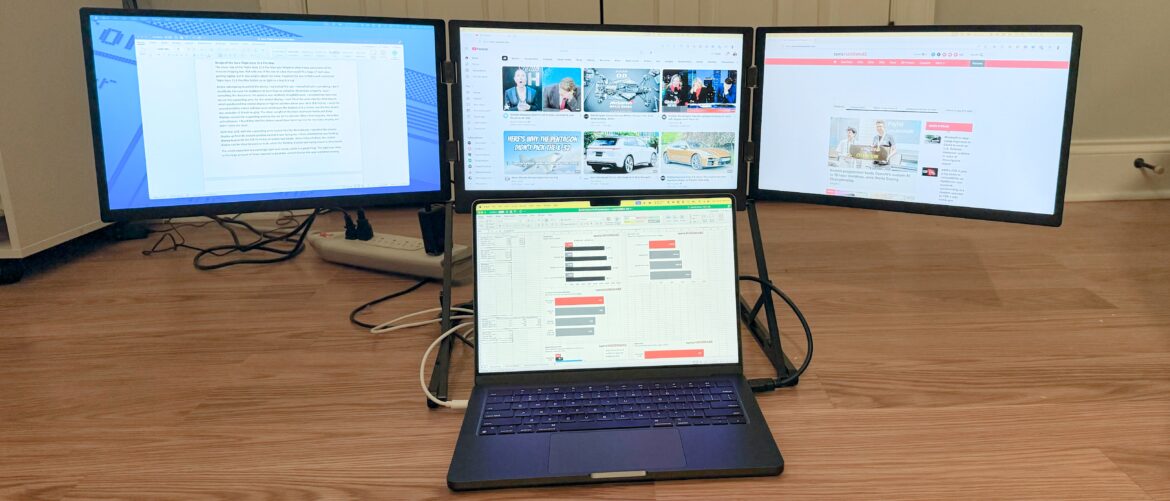
With so many products vying for your attention, it’s hard to stand out from the pack. However, the Aura is bringing out the big guns with its Triple Aero 15.6 Pro Max. We’ve reviewed several portable monitors that include “triple” in their name, but those products featured two external displays and counted your laptop’s internal display as panel number three. However, Aura includes three 15.6-inch 1080p panels, which unfurl to combine for 43 inches of total horizontal screen real estate.

It’s a lot to take in, and the Triple Aero 15.6 Pro Max is undoubtedly an impressive piece of kit that stands out in this space. However, its size and weight limit its effectiveness as a true portable monitor.

Design of the Aura Triple Aero 15.6 Pro Max

The immense size of the Triple Aero 15.6 Pro Max was evident from the moment I took possession of the shipping box. Not only was it the size of a box that would fit a large 17-inch gaming laptop, but it also weighs about the same. I opened the box to find a well-cushioned Triple Aero 15.6 Pro Max folded up as tight as a bug in a rug.

(Image credit: Tom’s Hardware)

Before attempting to unfold the device, I consulted the user manual (something I don’t often do, because I’m stubborn) to learn how to complete the process correctly. Upon consulting the document, the process was relatively straightforward. I unlocked two tabs that secure the supporting arms for the central display. I next lifted the side arms into the third detent on the bottom of the chassis rails, which positions the central display in the highest position above your desk (9.8 inches). I used the second (middle) indent without issue, putting the central display at 8.2 inches, but the first detent was unusable (3.9-inch height). The weight of the black aluminum frame and three displays caused the supporting arms to slip out of the first detent. When that happens, the entire unit collapses. However, I found that the first detent would have been too low for my tastes anyway, so I didn’t force the issue.

(Image credit: Tom’s Hardware)

With that said, with the supporting arms locked into the third detent, I swiveled the central display up from its stowed position so that it was facing me. I then unfolded the two flanking displays to provide the full 43 inches of screen real estate. When unfolded, the central display can be tilted forward or back, while the flanking displays can swing inward and outward.

The entire apparatus is surprisingly tight and sturdy, which is a welcome feature. The tightness refers to the large amount of force required to pivot the central display to your preferred viewing angle. The sturdiness is afforded by the all-metal construction, which contributed to the considerable weight of the Triple Aero 15.6 Pro Max (7 pounds). The only disappointment was the issue with the collapsing arm while using the first detent.

Get Tom’s Hardware’s best news and in-depth reviews, straight to your inbox.

Image 1 of 4

(Image credit: Tom’s Hardware)(Image credit: Tom’s Hardware)(Image credit: Tom’s Hardware)(Image credit: Tom’s Hardware)

With the Triple Aero 15.6 Pro Max in its fully workable position, I was able to observe its other intricacies. There are four physical buttons: power, up, down, and menu/exit. There are also three mini-HDMI ports, one USB-C port for video, and another USB-C port for powering the Triple Aero 15.6 Pro Max. A 65-watt power adapter with two USB-C and one USB-A port is included in the box, and the monitor supports 60-watt power pass-through. The Triple Aero 15.6 Pro Max also includes two 2-watt speakers.

Aura Triple Aero 15.6 Pro Max Specifications

Swipe to scroll horizontallyHeader Cell – Column 0

Aura Triple Aero 15.6 Pro Max

KYY X90D

KYY X90A

Limink LK14

Panel Type / Backlight

IPS / WLED

IPS / WLED

IPS / WLED

IPS / WLED

Number of Panels

3

2

2

2

Screen Size / Aspect Ratio

15.6 inches / 16:9

15.6 inches / 16:9

15.6 inches / 16:9

15.6 inches / 16:9

Max Resolution & Refresh Rate (Per Panel)

1920 x 1080 @ 60Hz

1920 x 1080 @ 60Hz

1920 x 1080 @ 60Hz

1920 x 1080 @ 60Hz

Max Brightness

350 nits

300 nits

300 nits

400 nits

Contrast

1,200:1

1,200:1

1,000:1

1,500:1

Ports

2x USB-C, 3x Mini-HDMI

2x USB-C

2x USB-C

2x USB-C

Dimensions

14.1 x 16.5 x 1.1 inches

11.9 x 17.3 x 3.74 inches

11.9 x 17.3 x 3.74 inches

13 x 7.83 x 1.4

Weight

7 pounds

3.2 pounds

3.2 pounds

3.3 pounds

Price

$599

$239

$179

$299

Connecting and Using the Aura Triple Aero 15.6 Pro Max

Before I connected the Triple Aero 15.6 Pro Max to my laptop, I once again consulted the included instruction manual to determine the required steps. At this point, I noticed that the company’s website is misspelled on both the front and back of the manual. The website is listed as aura-dislays.com instead of aura-displays.com. That’s a bit tacky, but getting the correct website pulled up in my browser wasn’t exactly rocket science.

The next issue I encountered was with the drivers necessary to get this three-panel monitor to function correctly. The manual pointed me to a link to Silicon Motion’s website to download drivers for the SM76x chipset. However, typing the URL into my browser gave me a 404 error. So, I instead typed “SM76x drivers” into my search bar, which took me right to the correct download page. Since I’m testing on an Apple MacBook Pro, I downloaded the appropriate software for macOS.

In this case, the software package installed Silicon Motion’s Instant View, allowing you to easily mirror or extend multiple displays on a Mac (or Windows) system. With Instant View installed, I next began plugging in the assortment of cables.

(Image credit: Tom’s Hardware)

I first used the included 65-watt wall adapter to run power to the USB-C input on the Triple Aero 15.6 Pro Max. I then ran a cable from the second USB-C port on the monitor to my MacBook Pro (M3 Pro). With this setup, only the left and central displays are activated. The right panel remained blank. So, I took the included mini-HDMI cable and plugged one end into the monitor and the other into my MacBook Pro. At that point, all three displays (four, including my MacBook Pro’s 14-inch panel) were alive.

When I first saw the overabundance of screens in front of me, I was initially overwhelmed, but quickly began my tests. The first step was to configure the displays in macOS settings to match their appearance in the real world. That meant my laptop’s internal display at the bottom, and the Triple Aero 15.6 Pro Max’s three displays positioned above. I then verified that all three displays were outputting at the specified 1920 x 1080 resolution at 60 Hz.

OSD on the Aura Triple Aero 15.6 Pro Max

The Triple Aero 15.6 Pro Max has a rather interesting on-screen display (OSD). Some multi-display portable monitors have no control buttons and no OSD, while others give you physical controls for each display panel (KYY X90D). However, the Triple Aero 15.6 Pro Max takes a different approach.

(Image credit: Tom’s Hardware)

The monitor uses a single set of OSD buttons that control all three panels. Pressing the menu button once presents the OSD to control the left panel. Press the menu again, and it switches to the middle panel. Pressing it again moves to the right panel. Not only does this arrangement provide individual control for each display panel, but it also saves on manufacturing costs by not requiring two additional sets of redundant buttons.

Image 1 of 4

(Image credit: Tom’s Hardware)(Image credit: Tom’s Hardware)(Image credit: Tom’s Hardware)(Image credit: Tom’s Hardware)

You have basic brightness, contrast, sharpness, and color controls here that you can configure per-monitor. You can also switch input sources, enable the low blue light filter, and adjust ECO modes. There’s nothing fancy about the OSD or the features it presents, but it’s wholly sufficient for the productivity-focused mission of the Triple Aero 15.6 Pro Max.

Aura Triple Aero 15.6 Pro Max Display Performance

The Aura Triple Aero 15.6 Pro Max has three displays, as its name suggests. Each one is identical, offering a 15.6-inch IPS panel with a 1920 x 1080 resolution and a 60 Hz refresh rate. While some portable monitors can run at up to 360 Hz, this is a productivity-focused monitor where 60 Hz is adequate. Each display panel is also covered with an anti-reflective coating to minimize glare.

Aura talks a big game with its claimed specifications, but our testing showed some discrepancies, at least regarding maximum brightness. Aura lists the Triple Aero 15.6 Pro Max as having a maximum brightness rating of 350 nits, but our light meter measured 244 nits with brightness set to 100 percent in the OSD, which represents a 30 percent shortfall. We ran the tests multiple times and tried every combination of available picture settings to rectify the brightness issue to no avail. That’s not a good start for a portable monitor that retails for $599.

(Image credit: Tom’s Hardware)

With that said, in my home environment, the brightness available with the Triple Aero 15.6 Pro Max is sufficient. I first tested the monitor downstairs in my living room, which has an overhead LED light in the ceiling fan, a couple of end table lamps, and natural light coming in from my back windows. The monitor was plenty bright in this scenario. I next moved the monitor to my home office, which is overly bright due to ten 75-watt (equivalent) LED lamps mounted on tracks. This is my typical work environment, and again, I had no complaints about the brightness.

Color performance put the Triple Aero 15.6 Pro Max near the top of the class for multi-screen portable monitors. The monitor covered 85.4% of the DCI-P3 color space and 120.6% of the sRGB color space. Those figures put it just slightly ahead of the dual-screen Limink LK14 and well ahead of the KYY K90A and K90D.

I used the Triple Aero 15.6 Pro Max for a wide variety of content, including web browsers (Microsoft Edge, Google Chrome, and Apple Safari), image editing apps (Pixelmator Pro), and productivity apps (Microsoft Word and Excel). I also spent a reasonable amount of time playing movies and TV shows on the panels, given that there’s plenty of screen real estate to go around when you’re dealing with four total displays (when counting my MacBook Pro’s internal display).

I rewatched a couple of second-season episodes of Star Wars: Andor and even watched the entirety of the classic action flick Predator on each of the three panels. The colors looked rich and accurate, as I peeked at the vibrant dresses and cloaks worn by the guests, including Mon Mothma, who danced with reckless abandon at her daughter’s wedding.

Likewise, Predator is a nearly 40-year-old movie that I enjoy watching repeatedly. I zeroed in particularly on the final battle sequence between Dutch and the Predator, which takes place at night. While the blacks didn’t look as deep as you’d find on a Mini LED or OLED panel, the Triple Aero 15.6 Pro Max performed admirably for an IPS panel during dark scenes. I watched every bone-breaking punch, with gushes of blood shooting from Dutch’s mouth as he got pummeled. I also enjoy the reds, purples, greens, and blues that appear on screen when we get the Predator’s infrared thermal vision viewpoint as he gains the upper hand.

Although it’s easy to overlook when the displays take center stage with the Triple Aero 15.6 Pro Max, it also has two 2-watt speakers. As is the case with most speakers on portable monitors, they’re good enough for playing back OS sounds or taking the occasional Google Meet/Teams/Zoom call, but they are subpar for music and movie playback. Bass is non-existent, and the overall sound output is relatively muted despite the massive footprint of the Triple Aero 15.6 Pro Max.

Bottom Line

The Aura Triple Aero 15.6 Pro Max is an impressive piece of hardware. It’s by far the largest “portable” monitor I’ve tested, given its 43-inch wingspan. That’s to be expected, as it’s also the first triple-monitor setup that has graced our labs, as we typically see dual-panel units.

The Triple Aero 15.6 Pro Max impressed with its aluminum construction, colorful panels, and a variety of ports to accommodate various laptop configurations. However, its size and weight will make many think twice about transporting this device regularly for travel purposes. While it is manageable to carry to different meeting rooms in your office, carrying this 7-pound portable monitor in addition to your laptop on a work trip is quite a burden.

There are also some performance issues, such as the shortfalls in the stated maximum brightness and what we measured in the real world. And there’s an actual physical issue with attempting to use the Triple Aero 15.6 Pro Max in its lowest height position (it doesn’t work).

With a price tag of $599, we expect near-perfection from a portable monitor, but the Triple Aero 15.6 Pro Max falls a bit short due to its flaws. However, if you absolutely must have a triple-panel option that can be stowed when not in use, it’s worth considering if you can stomach the lofty price tag. If three additional monitors is overkill for you, consider the Limink LK14 at $299 or the KYY X90D at $239.


Source link

August 20, 2025 0 comments
0 FacebookTwitterPinterestEmail

Categories

  • Crypto Trends (1,098)
  • Esports (800)
  • Game Reviews (772)
  • Game Updates (906)
  • GameFi Guides (1,058)
  • Gaming Gear (960)
  • NFT Gaming (1,079)
  • Product Reviews (960)

Recent Posts

  • This 5-Star Dell Laptop Bundle (64GB RAM, 2TB SSD) Sees 72% Cut, From Above MacBook Pricing to Practically a Steal
  • Blue Protocol: Star Resonance is finally out in the west and off to a strong start on Steam, but was the MMORPG worth the wait?
  • How to Unblock OpenAI’s Sora 2 If You’re Outside the US and Canada
  • Final Fantasy 7 Remake and Rebirth finally available as physical double pack on PS5
  • The 10 Most Valuable Cards

Recent Posts

  • This 5-Star Dell Laptop Bundle (64GB RAM, 2TB SSD) Sees 72% Cut, From Above MacBook Pricing to Practically a Steal

    October 10, 2025
  • Blue Protocol: Star Resonance is finally out in the west and off to a strong start on Steam, but was the MMORPG worth the wait?

    October 10, 2025
  • How to Unblock OpenAI’s Sora 2 If You’re Outside the US and Canada

    October 10, 2025
  • Final Fantasy 7 Remake and Rebirth finally available as physical double pack on PS5

    October 10, 2025
  • The 10 Most Valuable Cards

    October 10, 2025

Newsletter

About me

Welcome to Laughinghyena.io, your ultimate destination for the latest in blockchain gaming and gaming products. We’re passionate about the future of gaming, where decentralized technology empowers players to own, trade, and thrive in virtual worlds.

Recent Posts

  • This 5-Star Dell Laptop Bundle (64GB RAM, 2TB SSD) Sees 72% Cut, From Above MacBook Pricing to Practically a Steal

    October 10, 2025
  • Blue Protocol: Star Resonance is finally out in the west and off to a strong start on Steam, but was the MMORPG worth the wait?

    October 10, 2025

Newsletter

@2025 laughinghyena- All Right Reserved. Designed and Developed by Pro


Back To Top
Laughing Hyena
  • Home
  • Hyena Games
  • Esports
  • NFT Gaming
  • Crypto Trends
  • Game Reviews
  • Game Updates
  • GameFi Guides
  • Shop

Shopping Cart

Close

No products in the cart.

Close