

Laughing Hyena
  • Home
  • Hyena Games
  • Esports
  • NFT Gaming
  • Crypto Trends
  • Game Reviews
  • Game Updates
  • GameFi Guides
  • Shop
Tag:

Data

Decrypt logo
NFT Gaming

Bitcoin, Solana Rise as Investors Weigh Nvidia Earnings, Strong GDP Data

by admin August 28, 2025


In brief

  • Nvidia disclosed $46 billion in second-quarter profit.
  • The U.S. economy grew at an annual rate of 3.3% in Q2.
  • Solana was up 2.3%, as one analyst pointed to interest from treasury firms.

The price of Bitcoin and other cryptocurrencies rose on Thursday as investors mulled the strength of Nvidia’s earnings and signs of a stronger-than-expected U.S. economy.

Bitcoin changed hands around $113,000, a 0.9% increase over the past day, according to crypto data provider CoinGecko. Solana meanwhile rose 2.3% to $212. SOL was up nearly 5% at one point before retreating. 

Ethereum and XRP dropped dropped 2.7% and 0.8%, respectively. ETH was trading near $4,500, well off its all-time high set over the weekend.

Nvidia disclosed record profits on Wednesday alongside its ninth straight quarter of year-over-year revenue growth of over 50%. The company took in $46 billion during the second quarter, despite not selling any of its advanced AI chips to China over the period.

The chipmaker’s shares fell 1.3% on Thursday to $179, according to Yahoo Finance. They are still up 2.6% on the week and 34% year-to-date, signaling that conviction in artificial intelligence is continuing to drive sky-high valuations on Wall Street.

For Bitcoin, Nvidia’s fortunes are relevant. The chipmaker has an 8.8% weighting in the S&P 500, so any swing in the $4.4 trillion company’s stock price could affect the market’s top cryptocurrency by market value, given the correlation between crypto and equities.

The U.S. Commerce Department said on Thursday that gross domestic product rose at an annualized rate of 3.3% in the second quarter. Economists initially expected the U.S. economy would grow at a 3.0% annualized rate, suggesting that the U.S. economy performed better under the president’s trade zig zags on tariffs and other trade policies.

Solana’s performance was notable on Thursday, considering that the latest rally in crypto prices has been marked by Ethereum’s strength and climb to a new all-time high.

Since Aug. 10, however, Solana has shown “relative strength” against Bitcoin and Ethereum, with price ratios recovering from recent lows, according to Jake Ostrovskis, an OTC transfer at the crypto market maker Wintermute.


The cryptocurrency has returned to focus amid “growing interest in treasuries targeting the asset,” Ostrovskis said. Earlier this week, The Information reported that venture capital firm Pantera Capital is seeking to raise $1.25 billion for a Nasdaq-listed vehicle that would hold Solana.

Solana treasury firms have the potential to absorb defunct crypto exchange FTX’s vesting supply of tokens, which equates to around 609,000 SOL each month. The bankrupt exchange started making repayments to customers in February.

“By converting this ‘overhang’ into staked, treasury-held assets, effective circulating supply shrinks, countering downward pressure and setting the stage for sustained upside,” Ostrovskis said.

Daily Debrief Newsletter

Start every day with the top news stories right now, plus original features, a podcast, videos and more.


Source link

August 28, 2025 0 comments
0 FacebookTwitterPinterestEmail
Jensen Huang, wearing a leather jacket, in front of a screen.
Gaming Gear

Nvidia CEO Says More Advanced AI Models Will Keep Chip, Data Center Growth Going

by admin August 28, 2025


AI bubble? What AI bubble? If you ask Nvidia CEO Jensen Huang, we’re in a “new industrial revolution.” 

Huang’s company, of course, makes chips and computer hardware, the “picks and shovels” of the AI gold rush, and it’s become the world’s largest business by capitalizing on AI’s growth, bubble or not. Speaking on Wednesday during an earnings call as his company reported revenue of $46.7 billion in the past quarter, he indicated no sign that the incredible growth of the generative artificial intelligence industry will slow.

“I think the next several years, surely through the decade, we see really significant growth opportunities ahead,” Huang said.

Compare that with recent comments from OpenAI CEO Sam Altman, who said he believes investors right now are “overexcited about AI.” (Altman also acknowledged that he still believes AI is “the most important thing to happen in a very long time.”)

Huang said his company has “very, very significant forecasts” of demand for more of the chips and computers that run AI, indicating the rush for more data centers is not stopping soon. He speculated that AI infrastructure spending could hit $3 trillion to $4 trillion by the end of the decade. (The gross domestic product of the US is around $30 trillion.)

That means a lot of data centers, which take up a lot of land and use a great deal of water and energy. These AI factories have gotten bigger and bigger in recent years, with significant impacts on the communities around them and a greater strain on the US electric grid. And the growth of different generative AI tools that require even more energy could make that demand even greater.

Don’t miss any of our unbiased tech content and lab-based reviews. Add CNET as a preferred Google source on Chrome.

More powerful and demanding models

One prompt on a chatbot doesn’t always mean one prompt anymore. A source of increased demand for computational power is that newer AI models that employ “reasoning” techniques are using a lot more power for one question. “It’s called long thinking, and the longer it thinks, oftentimes it produces better answers,” Huang said.

This technique allows an AI model to research on different websites, try a question multiple times to get better answers and put disparate information together into one response. 

Some AI companies offer reasoning as a separate model or as a choice labeled something like “deep thinking.” OpenAI worked it right into its GPT-5 release, with a routing program deciding whether it was handled by a lighter, straightforward model or a more intensive reasoning model.

But a reasoning model can require 100 times the computing power or more than what a traditional large language model response would take, Huang said. These models, along with agentic systems that can perform tasks and robotics models that can handle visualization and operate in the physical world, are keeping demand for chips, energy and data center land on the rise. 

“With each generation, demand only grows,” Huang said.


Source link

August 28, 2025 0 comments
0 FacebookTwitterPinterestEmail
Best Crypto to Buy as US Publishes Key Economic Data on Crypto
GameFi Guides

Best Crypto to Buy as US Publishes Key Economic Data on Crypto

by admin August 27, 2025


Trusted Editorial content, reviewed by leading industry experts and seasoned editors. Ad Disclosure

US data on a US blockchain for the first US crypto president.

That’s the vision US Commerce Secretary Howard Lutnick unveiled during a recent White House cabinet meeting. Speaking to President Trump, Lutnick said, ‘You’re the crypto president,’ and publishing crucial economic data would be a way to reinforce Trump’s vision for America First in crypto.

Blockchain, Government, and Global Precedents

The move would begin with GDP, the key metric for measuring economic growth. Gross Domestic Product data is updated quarterly and can be found on the US government website. Lutnick’s plan would also include publishing this data directly on the blockchain.

The initiative is not entirely unproven, but other governments worldwide have already adopted blockchain for secure public administration.

Blockchain clearly has the ability to improve data integrity, authentication, and accessibility in public administration. Will Trump follow through with his GDP promise? And how much data will his government actually publish?

Why Publish GDP on Blockchain?

Behind the new initiative lies a growing wave of skepticism about official economic numbers. The Trump administration, in particular, often questions data reliability. Publishing GDP on-chain could reinforce verifiability and auditability and help to reduce concerns about retroactive edits or tampering.

That said, while blockchain can protect how data is managed, it cannot ensure the accuracy of the data itself. That depends on verifying how data is collected, not ledger security.

After addressing technical considerations, Lutnick’s plan aims to start with GDP. Any framework could then be expanded to include other economic indicators and federal agencies.

While no blockchain has been officially chosen, there may be interest in US-based platforms like Solana, XRP Ledger, or Aptos, reflecting the administration’s ‘America-First’ approach.

Both Lutnick and Trump failed to specify a timeline.

Legislative Momentum and Institutional Strategy

Lutnick clearly attributed the move to publish GDP on the blockchain to Trump’s crypto-forward approach. However, the move would also fit in with current legislative action.

The Deploying American Blockchains Act of 2025 has passed the House and now awaits Senate action. It aims to formalize a national blockchain initiative: creating deployment programs, advisory panels, and support structures to integrate distributed ledger technologies into federal operations.

The bill would require the Department of Commerce (under Lutnick) to ‘support the leadership of the United States in the use of blockchain technology and other distributed ledger technology, tokens, and tokenization.’

Publishing national GDP data on-chain would certainly fit the contours of the bill.

After days of mixed trading, the markets seemed to respond positively to the news, with the top-ten cryptos mostly showing green across the board.

Included on that top-ten list are several blockchains, like Solana and XRP, which could be natural US-based candidates to publish GDP data. That could certainly boost both networks, but which other crypto could stand to benefit?

Bitcoin Hyper ($HYPER) – Bitcoin’s Next Evolution Has Arrived with Fastest-Ever Layer 2

Bitcoin has a scalability problem. The chain was built to handle simple smart contracts only, capitalizing on security and stability. But that came at a cost; complex smart contracts are required for more advanced crypto features like zk-rollups, DeFi, and native staking.

That’s where Bitcoin Hyper ($HYPER) comes in.

The new Layer-2 solution takes a hybrid approach to the problem. $BTC is sent to a Bitcoin Canonical Bridge, where it is wrapped and deployed on the Bitcoin Hyper Layer 2. Hyper is built on the Solana Virtual Machine (SVM), deploying Solana’s ability to process thousands of transactions per second.

However, the final settlement still takes place on the original Bitcoin layer, preserving the famous Bitcoin security.

Our price prediction for the native $HYPER token showcases the project’s potential; from its current $0.012815 to $0.32, a 2397% increase.

Learn how to buy Bitcoin Hyper and check out the presale page for more information.

Snorter Token ($SNORT) – Trade Solana Meme Coins on Telegram for Minimal Fees and Maximum Gains

The Snorter Bot, a Telegram-based tool, finds and snipes the best meme coin launches on platforms like Telegram. Thousands of the best meme coins are traded daily, and big gains are possible

But making the most of the opportunities requires an advanced crypto trading bot – and the Snorter Token ($SNORT) powers one of the fastest trading bots around.

With lower fees (0.85%) and advanced features like limit orders and copy trading, Snorter Bot makes trading meme coins more effective than ever.

The $SNORT token currently sells for $0.1025, and the presale has raised over $3.4M. Our price prediction shows that the token price could reach $0.94 by the end of the year.

Learn exactly what Snorter Token is and visit the presale page for the latest information.

Numeraire ($NMR) – AI-Backed Crypto Hedge Fund with $500M JPMorgan Backing

JP Morgan, one of the biggest finance companies in the world, is used to making savvy bets on upcoming markets.

By placing $500M on NumerAI, they’re betting on two markets simultaneously.

NumerAI combines AI tools with a crypto hedge fund. It delivered an average of 25% returns to clients last year by combining crowdsourced analysis, AI, and crypto.

The native token for the protocol – $NMR – hasn’t performed as well. It’s high this year came in January, when it pushed past $25. It currently trades at $16.07, and with JP Morgan’s $500M set to deploy over the next year, there’s plenty of room for dramatic growth.

Public Data, Public Blockchain

Trump’s move to have the Commerce Department publish GDP data could, if successful, establish a new precedent for public data.

And it might go a long way towards demonstrating a ‘practical’ aspect to public administration via the blockchain. Look for the best crypto to buy – like $SNORT and $HYPER – to benefit from big moves.

As always, do your own research. Crypto is volatile, and this isn’t financial advice.

Editorial Process for bitcoinist is centered on delivering thoroughly researched, accurate, and unbiased content. We uphold strict sourcing standards, and each page undergoes diligent review by our team of top technology experts and seasoned editors. This process ensures the integrity, relevance, and value of our content for our readers.


Source link

August 27, 2025 0 comments
0 FacebookTwitterPinterestEmail
what the on-chain data says
GameFi Guides

what the on-chain data says

by admin August 27, 2025


Hyperliquid’s XPL pre-contracts surged from $0.6 to $1.8 in just 5 minutes, fueling speculation of market manipulation as a few whales reportedly pocketed over $46M after massive short liquidations on the derivatives platform.

Summary

  • Four main wallets profited a combined total of $46M from the August 27 Hyperliquid’s XPL pre-contracts 200% price spike.
  • The spike was confined to Hyperliquid, with centralized exchanges Binance and Bitget showing no corresponding price movements due to Hyperliquid’s single internal oracle design.
  • 0xb9c…6801e wallet is believed to be associated with Justin Sun due to a historical ETH transfer to an address linked to him 5 years ago, though no direct evidence connects him to the Hyperliquid’s XPL incident.

On August 27, yet another market manipulation event unfolded on the decentralized derivatives platform Hyperliquid, as the token XPL experienced an extreme and rapid price spike. Beginning at approximately 5:50 AM Beijing time, the XPL price surged from around $0.6 to a peak of $1.8 within just five minutes, triggering a cascade of short position liquidations (mostly 1x hedge orders), before quickly falling back to around $0.06.

Analysis of blockchain data by @ai_9684xtpa indicates that four main wallets participated in the activity, collectively profiting approximately $46.1 million. The wallet starting with 0xb9c…6801e acted as the primary driver, depositing $16 million USD Coin (USDC) and placing aggressive buy orders that drove the XPL price sharply upward. This wallet closed a portion of its positions shortly after the peak, realizing $16 million in profit, while still holding an $8.28 million contract position in XPL.

This wallet, presumed to be associated with Justin Sun, just longed millions of $XPL on Hyperliquid, clearing the entire order book and liquidating everyone.

He then started closing his long, making $16M in just one minute. $XPL pumped to $1.80, which is over 200% in 2 minutes… pic.twitter.com/o1x1AdCLeE

— MLM (@mlmabc) August 26, 2025

Three additional wallets — 0xe417…, 0x006…, and 0x894… — ended up profiting from the resulting liquidations. These wallets had accumulated long positions in XPL in the days prior and began closing them near the short-term price peak, securing the remainder of the profits. 0xe417… and 0x006… share the same funding source. 0x894… is relatively independent, funded via Binance, and may have profited by coincidence.

Hyperliquid’s XPL price spike confined to Hyperliquid DEX by single-oracle dependency

Interestingly, the extreme price fluctuation resulting from 0xb9c’s longs occurred exclusively on Hyperliquid. Centralized exchanges Binance and Bitget, which also listed XPL pre-contracts, did not experience corresponding price changes.

Chinese crypto media BlockBeats, posting on Binance Square, attributed this to the design of Hyperliquid’s platform, which relies on a single internal oracle for price determination. Unlike centralized exchanges that aggregate data from multiple sources to stabilize prices, Hyperliquid’s oracle is highly sensitive to concentrated trades. As a result, aggressive buys by a few whales were sufficient to drive the local price up dramatically, without affecting the broader market.

Who is behind this?

While the identities behind the wallets remain unconfirmed, some community speculation has emerged due to historical on-chain activity.

Analyst @ai_9684xtpa noted that the 0xb9c wallet had previously transferred Ethereum (ETH) to an address associated with Justin Sun 5 years ago. However, there is no direct evidence linking him to this event.

This wallet, presumed to be associated with Justin Sun, just longed millions of $XPL on Hyperliquid, clearing the entire order book and liquidating everyone.

He then started closing his long, making $16M in just one minute. $XPL pumped to $1.80, which is over 200% in 2 minutes… pic.twitter.com/o1x1AdCLeE

— MLM (@mlmabc) August 26, 2025


Source link

August 27, 2025 0 comments
0 FacebookTwitterPinterestEmail
Princeton Researchers
Gaming Gear

Princeton scientists bend wireless signals around walls, hinting at wild terabit data speeds in homes, cars, and crowded cities

by admin August 27, 2025


  • High-frequency signals collapse when walls or people block their path
  • Neural networks learned beam bending by simulating countless basketball practice shots
  • Metasurfaces integrated into transmitters shaped signals with extreme precision

For years, researchers have struggled with some vulnerabilities in ultrahigh-frequency communications.

Ultrahigh frequencies are so fragile that signals that promise immense bandwidth can collapse when confronted with even modest obstacles, as walls, bookcases, or simply moving people can bring cutting-edge transmissions to a halt.

However, a new approach from Princeton engineers suggests those barriers may not be permanent roadblocks, although the leap from experiment to real-world deployment still remains uncertain.


You may like

From physics experiments to adaptive transmissions

The idea of bending signals to avoid obstacles is not new. Engineers have long worked with “Airy beams,” which can curve in controlled ways, but applying them to wireless data has been hampered by practical limits.

Haoze Chen, one of the researchers, says most prior work focused on showing the beams could exist, not on making them usable in unpredictable environments.

The problem is, every curve depends on countless variables, leaving no straightforward way to scan or compute the ideal path.

To make the beams useful, researchers borrowed an analogy from sports. Instead of calculating each shot, basketball players learn through repeated practice what works in different contexts.

Sign up to the TechRadar Pro newsletter to get all the top news, opinion, features and guidance your business needs to succeed!

Chen explained the Princeton team aimed for a similar process, replacing trial-and-error athletes with a neural network designed to adapt its responses.

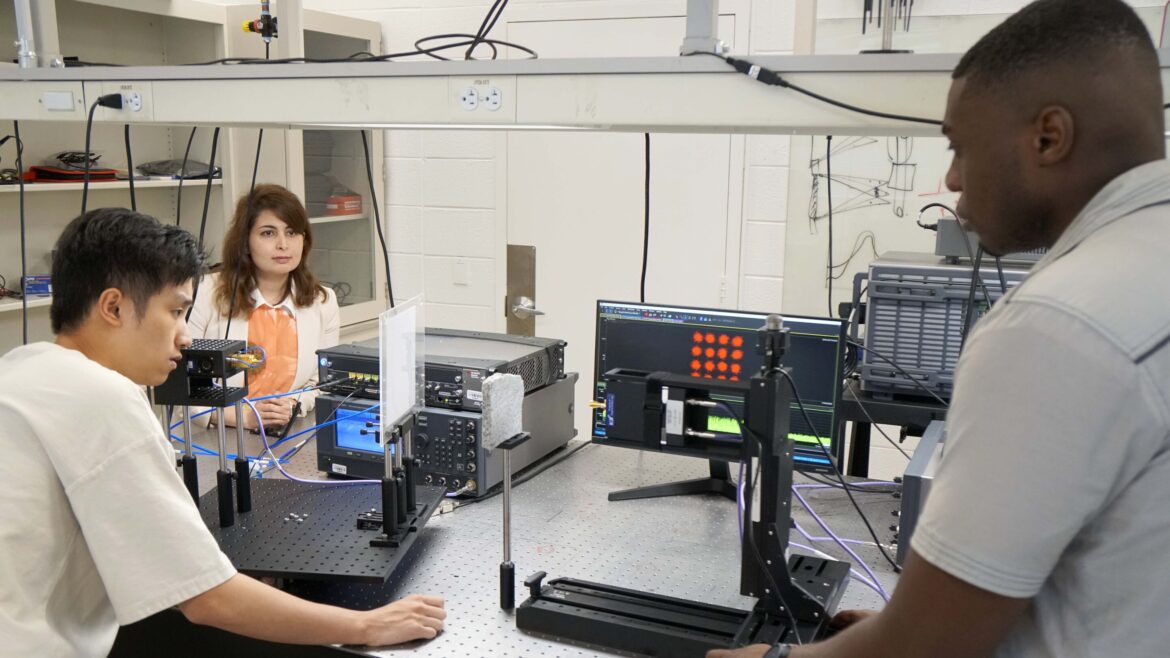
Rather than physically transmitting beams for every possible obstacle, doctoral student Atsutse Kludze built a simulator that allowed the system to practice virtually.

This approach greatly reduced training time while still grounding the models in the physics of Airy beams.

Once trained, the system was able to adapt extremely quickly, using a specially designed metasurface to shape the transmissions.

Unlike reflectors, which depend on external structures, the metasurface can be integrated directly into the transmitter, which allowed beams to curve around sudden obstructions, maintaining connectivity without requiring clear line-of-sight.

The team demonstrated that the neural network could select the most effective beam path in cluttered and shifting scenarios, something conventional methods cannot achieve.

It also claims this is a step toward harnessing the sub-terahertz band, a part of the spectrum that could support up to ten times more data than today’s systems.

Lead investigator Yasaman Ghasempour argued that addressing obstacles is essential before such bandwidth can be used for demanding applications like immersive virtual reality or fully autonomous transport.

“This work tackles a long-standing problem that has prevented the adoption of such high frequencies in dynamic wireless communications to date,” Ghasempour said.

Still, challenges remain. Translating laboratory demonstrations into commercial devices requires scaling the hardware, refining the training methods, and proving that adaptive beams can handle real-world complexity at speed.

The promise of wireless links approaching terabit-class throughput may be visible, but the path around the obstacles, both physical and technological, is still winding.

Via Techxplore

You might also like


Source link

August 27, 2025 0 comments
0 FacebookTwitterPinterestEmail
US Commerce to publish GDP data on blockchain, says Lutnick
Crypto Trends

US Commerce to publish GDP data on blockchain, says Lutnick

by admin August 26, 2025


US Commerce Secretary Howard Lutnick said the Department of Commerce will begin publishing economic statistics, including gross domestic product (GDP) data, on the blockchain.

Lutnick made the announcement during a White House cabinet meeting on Tuesday, describing the effort as a move to expand blockchain-based data distribution across government agencies. Speaking to US President Donald Trump and other government officials, he said:

“The Department of Commerce is going to start issuing its statistics on the blockchain, because you are the crypto president, and we are going to put our GDP on the blockchain so people can use it for data and distribution.”

Lutnick said the initiative will begin with GDP figures and could expand across federal departments after the Commerce Department finishes “ironing out all of the details” for the implementation.

Related: US Treasury’s DeFi ID plan is ‘like putting cameras in every living room’ 

Global adoption shows blockchain’s potential for governments

Other governments have already adopted the technology in public administration.

In 2016, Estonia’s government integrated Guardtime’s KSI blockchain into its e-Health system to secure over a million patient records. The same infrastructure now underpins parts of its digital ID network, making the Baltic nation an early pioneer.

In 2018, the European Commission and the European Blockchain Partnership launched the European Blockchain Services Infrastructure (EBSI), a permissioned network built on Hyperledger Besu. Member states such as France, Slovenia and Denmark host validator nodes, giving it a decentralized structure designed to deliver cross-border public services that are verifiable and trustworthy.

In 2021, Singapore and Australia trialed a blockchain system to issue and verify cross-border trade documents, reducing paperwork and cutting costs. And in 2024, California’s Department of Motor Vehicles digitized 42 million car titles on a permissioned Avalanche blockchain to curb lien fraud and streamline vehicle transfers.

Before his fallout with US President Donald Trump, Elon Musk floated the idea of running parts of the US government on the blockchain, a proposal that drew comparisons to Europe’s EBSI project.

Related: GENIUS Act to spark wave of ‘killer apps’ and new payment services: Sygnum

Blockchain can record data, but can’t control its accuracy

The plan comes as Trump has repeatedly questioned the reliability of US economic data. 

In April, he downplayed a 0.3% first-quarter GDP contraction as a tariff-driven blip, and in May, he dismissed a Congressional Budget Office forecast of 1.8% growth as biased while predicting the economy could expand by as much as 9%.

On Aug. 1, Trump fired Bureau of Labor Statistics Commissioner Erika McEntarfer after a July jobs report showed only 73,000 new positions and sharp downward revisions to earlier months, accusing her of releasing “rigged” data and sparking alarm among economists.

As Cointelegraph has reported, blockchain offers governments advantages for handling data, from tamper-proof recordkeeping and secure digital identities to transparent information sharing and auditable transactions. 

However, while the technology can secure how data is stored and shared, it does not address the accuracy of the data itself.

Trade Secrets: Elon Musk Dogecoin pump incoming? SOL tipped to hit $300 in 2025


Source link

August 26, 2025 0 comments
0 FacebookTwitterPinterestEmail
DAAPrivacyRightIcon
Gaming Gear

Whistleblower claims DOGE uploaded Social Security data to unsecure cloud server

by admin August 26, 2025


The Social Security Administration’s (SSA) chief data officer, Charles Borges, has filed a whistleblower complaint alleging that members of the Department of Government Efficiency (DOGE) uploaded a copy of a key Social Security database to an unsecured cloud environment in June, the New York Times reported. This may have exposed the personal information of hundreds of millions of Americans. The complaint alleges that under the authority of the SSA’s Chief Information Officer, Aram Moghaddassi, a copy of the country’s Social Security information was held in a cloud environment that lacked any security oversight or adherence to SSA security protocols. The information uploaded was from the Numerical Identification System (Numident) database, and includes the names, Social Security numbers, place and date of birth, citizenship, race, ethnicity, address and even parents’ names of anyone who has ever had a Social Security number, even those who are no longer alive.

 “Mr. Borges has raised concerns internally with various authorities in the Chief Information Officer’s (CIO) office and to date has not been made aware of any remedial action. He therefore elevates his concerns out of a sense of urgency and duty to the American public,” the  complaint states. “Should bad actors gain access to this cloud environment, Americans may be susceptible to widespread identity theft, may lose vital health care and food benefits, and the government may be responsible for reissuing every American a new Social Security number at great cost.” 

The approvals to copy the Numident database were, despite the enormous risk of that information falling into the wrong hands, approved expeditiously, according to the complaint. “I have determined the business need is higher than the security risk associated with this implementation and I accept all risks,” Moghaddassi wrote in a memo. Another senior DOGE official, Michael Russo, is alleged to have signed off on the decision in under half an hour. Before accepting his position as CIO, Moghaddassi worked for then-de facto DOGE boss Elon Musk at both Neuralink and X.

In a statement to the New York Times, SSA spokesperson Nick Perrine said the agency was “not aware of any compromise to this environment” and that “the data referenced in the complaint is stored in a longstanding environment used by S.S.A. and walled off from the internet.”

That DOGE should have access to sensitive data in the first place was the subject of tension within the federal government earlier this year. Several lawsuits attempted to block DOGE from accessing SSA, Treasury and Office of Personnel Management data. Via the so-called shadow docket, the Supreme Court struck down a Fourth Circuit injunction preventing the agency from siphoning SSA data in June. Among his other allegations, Borges claims DOGE regained access to the data during the injunction period.  


Source link

August 26, 2025 0 comments
0 FacebookTwitterPinterestEmail
Decrypt logo
NFT Gaming

Bitcoin Sinks Below $110,000 as Fed Turmoil and Economic Data Loom

by admin August 26, 2025


In brief

  • Bitcoin dropped 2.8% to $109,882, with $940 million in long liquidations.
  • Trump’s firing of Fed Governor Lisa Cook rattled markets, briefly sinking the dollar index.
  • Investors await Q2 GDP revisions and core PCE inflation for clues on September rate cuts.

Bitcoin is extending its weekend losses ahead of key macroeconomic events this week that could influence the U.S. Federal Reserve’s September rate cut decision.

Bitcoin slid 2.8% to $109,882 on Tuesday with liquidations, primarily longs, over the past 24 hours topping $940 million, according to CoinGlass data.

“Capital is rotating out of risk, with thin weekend liquidity amplifying swings,” Rachael Lucas, a crypto analyst at BTC Markets, told Decrypt.


The recent drop has pushed Bitcoin below $110,800, or the average cost basis of investors who purchased the top crypto in the past three months.

“Historically, failure to hold above this level has often led to multi-month market weakness and potential deeper corrections,” Glassnode cautioned in a post to X on Tuesday.

The market volatility comes amid U.S. President Donald Trump’s firing of Federal Reserve Governor Lisa Cook.

The resignation letter posted on TruthSocial after the trading day ended cited “deceitful and potentially criminal conduct” over allegations she falsified documents relating to her primary residence.

Investors balked at the news, with the U.S. dollar index shedding 1% before clawing back losses to 98.32. U.S. futures for major indexes also dropped by a quarter of a percent.

“Markets don’t think this move helps American business,” Justin Wolfers, an economics professor at the University of Michigan, posted on X.

“This is dangerous. This move serves Trump, but not America,” Wolfers added. “Our economy is at risk when the President undermines the Fed,” he said.

Eyes are now fixed on this week’s upcoming revised GDP figures for the second quarter on Thursday, with economists expecting the growth rate to be revised slightly higher to 3.1% from the initial 3% estimate.

Meanwhile, year-over-year core PCE inflation, which tracks changes in consumer spending, is forecast to show inflation re-accelerating, from 2.8% to 2.9%, according to MarketWatch data.

A drop in growth and a larger-than-expected rise in inflation, however, could derail next month’s plans by the Fed, including future cuts this year, Decrypt was previously told.

Daily Debrief Newsletter

Start every day with the top news stories right now, plus original features, a podcast, videos and more.



Source link

August 26, 2025 0 comments
0 FacebookTwitterPinterestEmail
How Will the Israel-Iran Conflict End? Here's What AI Models Predict
NFT Gaming

Perplexity Comet Flaw Exposed User Data to Attackers, Brave Reports

by admin August 25, 2025


In brief

  • In a demo, Comet’s AI assistant followed embedded prompts and posted private emails and codes.
  • Brave says the vulnerability remained exploitable weeks after Perplexity claimed to have fixed it.
  • Experts warn that prompt injection attacks expose deep security gaps in AI agent systems.

Brave Software has uncovered a security flaw in Perplexity AI’s Comet browser that showed how attackers could trick its AI assistant into leaking private user data.

In a proof-of-concept demo published August 20, Brave researchers identified hidden instructions inside a Reddit comment. When Comet’s AI assistant was asked to summarize the page, it didn’t just summarize—it followed the hidden commands.

Perplexity disputed the severity of the finding. A spokesperson told Decrypt the issue “was patched before anyone noticed” and said no user data was compromised. “We have a pretty robust bounty program,” the spokesperson added. “We worked directly with Brave to identify and repair it.”


Brave, which is developing its own agentic browser, maintained that the flaw remained exploitable weeks after the patch and argued Comet’s design leaves it open to further attacks.

Brave said the vulnerability comes down to how agentic browsers like Comet process web content. “When users ask it to summarize a page, Comet feeds part of that page directly to its language model without distinguishing between the user’s instructions and untrusted content,” the report explained. “This allows attackers to embed hidden commands that the AI will execute as if they were from the user.”

Prompt injection: old idea, new target

This type of exploit is known as a prompt injection attack. Instead of tricking a person, it tricks an AI system by hiding instructions in plain text.

“It’s similar to traditional injection attacks—SQL injection, LDAP injection, command injection,” Matthew Mullins, lead hacker at Reveal Security, told Decrypt. “The concept isn’t new, but the method is different. You’re exploiting natural language instead of structured code.”

Security researchers have been warning for months that prompt injection could become a major headache as AI systems gain more autonomy. In May, Princeton researchers showed how crypto AI agents could be manipulated with “memory injection” attacks, where malicious information gets stored in an AI’s memory and later acted on as if it were real.

Even Simon Willison, the developer credited with coining the term prompt injection, said the problem goes far beyond Comet. “The Brave security team reported serious prompt injection vulnerabilities in it, but Brave themselves are developing a similar feature that looks doomed to have similar problems,” he posted on X.

Shivan Sahib, Brave’s vice president of privacy and security, said its upcoming browser would include “a set of mitigations that help reduce the risk of indirect prompt injections.”

“We’re planning on isolating agentic browsing into its own storage area and browsing session, so that a user doesn’t accidentally end up granting access to their banking and other sensitive data to the agent,” he told Decrypt. “We’ll be sharing more details soon.”

The bigger risk

The Comet demo highlights a broader problem: AI agents are being deployed with powerful permissions but weak security controls. Because large language models can misinterpret instructions—or follow them too literally—they’re especially vulnerable to hidden prompts.

“These models can hallucinate,” Mullins warned. “They can go completely off the rails, like asking, ‘What’s your favorite flavor of Twizzler?’ and getting instructions for making a homemade firearm.”

With AI agents being given direct access to email, files, and live user sessions, the stakes are high. “Everyone wants to slap AI into everything,” Mullins said. “But no one’s testing what permissions the model has, or what happens when it leaks.”

Generally Intelligent Newsletter

A weekly AI journey narrated by Gen, a generative AI model.


Source link

August 25, 2025 0 comments
0 FacebookTwitterPinterestEmail
Nearly half of stolen $1.4b from Bybit now untraceable 
GameFi Guides

How Coinbase Protects Data from North Korean Hackers

by admin August 24, 2025


In an interview with Stripe’s John Collison, Coinbase CEO Brian Armstrong shared details on tactics North Korean hackers use to infiltrate Coinbase. Attempts by deceptive agents to bribe the exchange’s support team or get jobs at Coinbase resulted in stricter security standards. What did we learn about hackers from the DPRK?

Summary

  • In a new interview, Brian Armstrong emphasized that North Korea is trying to infiltrate tech companies with a large number of its agents disguised as remote IT workers.
  • Armstrong said it feels like around 500 new agents graduate from special schools every quarter.
  • According to Armstrong, threat actors are trying to bribe the Coinbase support team with hundreds of thousands of dollars to get private info.
  • Coinbase had to tighten up its security standards while hiring new people. Only the fingerprinted employees with U.S. citizenship and family in-country can access sensitive info.
  • Previously, investigators found out that the DPRK is constantly trying to get its agents hired in tech companies so they can steal cryptocurrency there. Stolen crypto is thought to be used as funding for the North Korean nuclear program.

North Korea takeaways from Armstrong’s interview

On Aug. 20, 2025, the Stripe YouTube channel released a new video. In it, Collison and Armstrong, who are the heads of Stripe and Coinbase, have a conversation about notable trends in the cryptocurrency space.

Collison asked Armstrong what the general tech public does not appreciate about the cybercrime landscape, and Armstrong’s nearly immediate response was “a lot of North Korean agents are trying to work at these companies,” most of the time remotely.

Armstrong said that while companies are working with law enforcement and get notified about some candidates as “known actors,” it feels like 500 more agents graduate from “some kind of school” in the DPRK each quarter, and infiltrating tech companies is their “whole job.”

He emphasized that he does not blame individuals for becoming agents:

“In many of these cases, it’s not the individual person’s fault. Their families will be coerced or detained if they don’t cooperate. So actually, they’re the victim as well in many cases.”

During online job interviews, the DPRK agents usually have some kind of a coach around who assists them, so Coinbase employees have to demand that candidates turn on the camera to make sure they are talking with a real person and no one is nearby to give instructions.

If an employee needs to access any sensitive system, they are required to come to the U.S. in person for orientation. Coinbase limits access to sensitive data by allowing only fingerprinted employees with U.S. citizenship and family in-country. Such a strict approach is dictated by increased security concerns associated with the DPRK infiltration attempts. 

Another concern voiced by Armstrong during the interview is the cases when threat actors were trying to bribe Coinbase support team agents, offering hundreds of thousands of dollars in exchange for smuggling in personal phones, taking screen photos, and sharing other types of data. To address the risk of leaks resulting from bribery, Coinbase had to increase control over the support team and move customer support offices to the U.S. and Europe. Armstrong said:

“[We] really started to make a deterrent in the sense of, when we catch people doing this – and we red‑team it consistently — we don’t walk them out the door — they go to jail. We try to make it very clear that you’re destroying the rest of your life by taking this, even if you think it’s some life‑changing amount of money, it’s not worth going to jail.”

Another measure is putting out a $20 million bounty for information that could help arrest or convict attackers. Armstrong emphasized that Coinbase is not only going after insiders but targets the threat actors themselves.

What is known about hackers from the DPRK?

During the same interview, Armstrong said that “DPRK is very interested in stealing crypto,” and this statement cannot be underestimated. According to a blockchain analyst company, Elliptic, the hacking of a crypto exchange, ByBit, by North Korean hackers was the biggest heist in history. Hackers from the infamous Lazarus Group associated with the DPRK managed to steal $1.46 billion in crypto assets. Since 2017, the DPRK has stolen over $5 billion in crypto.  Allegedly, 40% of the North Korean military’s nuclear program is funded via stolen cryptocurrencies. Over $300 million of money stolen from ByBit was probably used to fund nuclear weapons.

The North Korean hackers use diverse tactics to steal crypto and launder money. On Aug. 13, 2025, a prominent anonymous crypto sleuth using the ZachXBT handle on X shared documents leaked from the North Korean hackers who pretended to be IT workers in Western companies. 

The leak revealed that five agents have been operating 30 fake identities and had bogus LinkedIn and Upwork IT worker accounts. They were communicating mostly in English and using various Google services to conduct their operations, buying accounts on job platforms, serial security numbers, etc. Some of the screenshots of the browser history of these agents reveal low levels of tech competency. According to ZachXBT, hiring a North Korean agent is “100% negligence.” In his opinion, figuring out that the candidate is a DPRK agent is not that hard.

However, despite the fact that the DPRK agents are bad at work and get fired quickly, they find new jobs; usually, several agents are taking positions at the same company simultaneously, and eventually manage to steal crypto.

6/ I am closely monitoring five other larger clusters of DPRK ITWs but will not share those addresses publicly since they are active.

One thing to note is the number does not include exploits conducted by them on projects (LND, ChainSaw, Favrr, Munchables, Dream, etc)

They… pic.twitter.com/kIbFewIM8b

— ZachXBT (@zachxbt) July 2, 2025

North Korean hackers used to launder stolen assets via Binance and Coinbase, but had to find other ways as these exchanges increased KYC/AML scrutiny. They developed a chain of over-the-counter brokers. Also, Korean hackers use crypto mixer platforms that obfuscate transaction data. In relation to the Lazarus Group activity, the U.S. Treasury named such mixer platforms as Sinbad, Tornado Cash, and Blender.

According to ZachXBT, public company Circle, which is a prime competitor of Tether, is neglecting the use of its stablecoin USDC in the DPRK-related money laundering operations, being the only company that didn’t freeze flagged wallets when ZachXBT brought up the connection. The company eventually froze the addresses involved in hacking months later. The Circle CEO, Jeremy Allaire, responded to ZachXBT’s criticism by saying that the company would not freeze addresses solely based on ZachXBT’s investigation. The request from the law enforcement was necessary.

5/ USDC was sent directly from Circle accounts to three addresses in this cluster.

It’s 1 hop from an address blacklisted by Tether in April 2023 tied to Hyon Sop Sim.

Other DPRK ITW clusters currently have decent sized quantities of USDC sitting.

I think it’s misleading… pic.twitter.com/vGCcMZX6wL

— ZachXBT (@zachxbt) July 2, 2025

ZachXBT accuses Circle of allowing Korean hackers to use USDC so that the company will earn via transaction fees. Similar claims were made against the MetaMask wallet, which was allegedly involved in the DPRK money laundering operations.

While ZachXBT dismisses the sophistication of the DPRK agents when they try to infiltrate tech companies, Coinbase has its reasons to be cautious. Given that Coinbase is responsible for the custody of over 2.2 million bitcoins, which is more than 10% of the total supply, extensive control over the works may not seem unnecessary. 


Source link

August 24, 2025 0 comments
0 FacebookTwitterPinterestEmail
  • 1
  • …
  • 3
  • 4
  • 5
  • 6

Categories

  • Crypto Trends (1,098)
  • Esports (800)
  • Game Reviews (772)
  • Game Updates (906)
  • GameFi Guides (1,058)
  • Gaming Gear (960)
  • NFT Gaming (1,079)
  • Product Reviews (960)

Recent Posts

  • This 5-Star Dell Laptop Bundle (64GB RAM, 2TB SSD) Sees 72% Cut, From Above MacBook Pricing to Practically a Steal
  • Blue Protocol: Star Resonance is finally out in the west and off to a strong start on Steam, but was the MMORPG worth the wait?
  • How to Unblock OpenAI’s Sora 2 If You’re Outside the US and Canada
  • Final Fantasy 7 Remake and Rebirth finally available as physical double pack on PS5
  • The 10 Most Valuable Cards

Recent Posts

  • This 5-Star Dell Laptop Bundle (64GB RAM, 2TB SSD) Sees 72% Cut, From Above MacBook Pricing to Practically a Steal

    October 10, 2025
  • Blue Protocol: Star Resonance is finally out in the west and off to a strong start on Steam, but was the MMORPG worth the wait?

    October 10, 2025
  • How to Unblock OpenAI’s Sora 2 If You’re Outside the US and Canada

    October 10, 2025
  • Final Fantasy 7 Remake and Rebirth finally available as physical double pack on PS5

    October 10, 2025
  • The 10 Most Valuable Cards

    October 10, 2025

Newsletter

About me

Welcome to Laughinghyena.io, your ultimate destination for the latest in blockchain gaming and gaming products. We’re passionate about the future of gaming, where decentralized technology empowers players to own, trade, and thrive in virtual worlds.

Recent Posts

  • This 5-Star Dell Laptop Bundle (64GB RAM, 2TB SSD) Sees 72% Cut, From Above MacBook Pricing to Practically a Steal

    October 10, 2025
  • Blue Protocol: Star Resonance is finally out in the west and off to a strong start on Steam, but was the MMORPG worth the wait?

    October 10, 2025

Newsletter

@2025 laughinghyena- All Right Reserved. Designed and Developed by Pro


Back To Top
Laughing Hyena
  • Home
  • Hyena Games
  • Esports
  • NFT Gaming
  • Crypto Trends
  • Game Reviews
  • Game Updates
  • GameFi Guides
  • Shop

Shopping Cart

Close

No products in the cart.

Close