
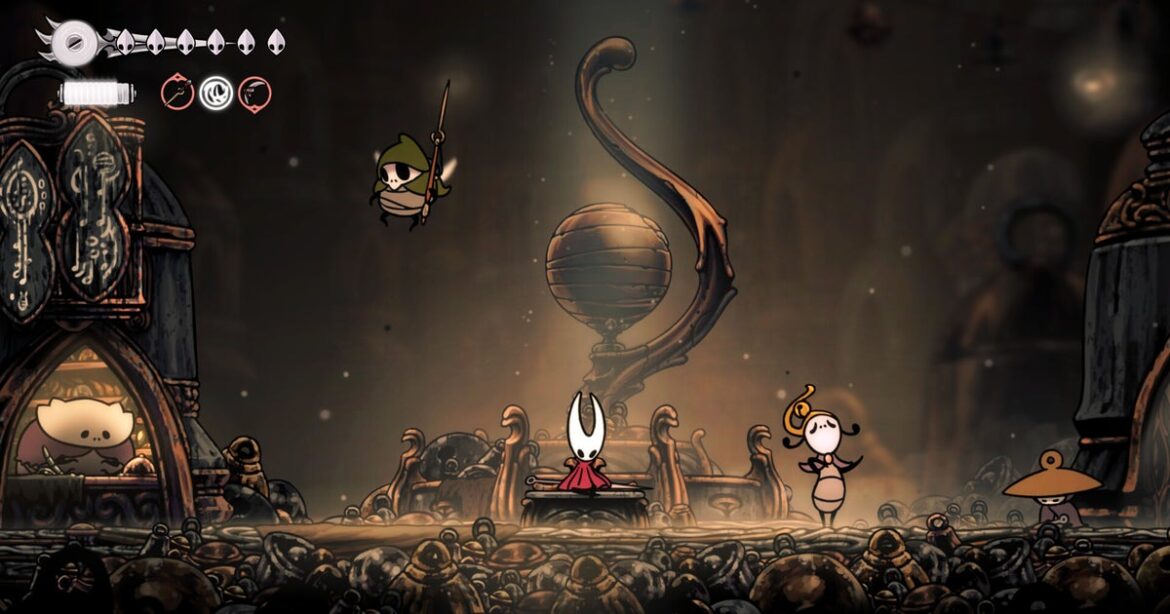
At the end of August, fans of Hollow Knight were stunned to discover that its long-awaited sequel would drop in a matter of weeks.
After a long wait, Team Cherry released Hollow Knight: Silksong on September 4, 2025 to so much fanfare that it broke digital storefronts globally.
The game surpassed half a million concurrent players on Steam a day after its release, and sold over three million copies in three days on the platform, according to Alinea Analytics.
No review codes were sent out ahead of release, hence impressions coming in slowly. But all in all, it’s safe to say that Silksong has quickly become one of 2025’s biggest titles, currently sitting at a score of 92 on Metacritic for the PC version.
But how are critics faring in the fantastical (and unforgiving) world of Pharloom?
Playing as Hornet
Players were first introduced to Silksong’s protagonist Hornet in the original Hollow Knight, in which she was a recurring boss.
For PC Gamer’s Tyler Colp, who rated the game 90 out of 100, “the thrill of playing as Hornet is what really anchors Silksong as a brilliant action game above all else.”
Having access to a boss’s powerful skillset was the key appeal.
“[Silksong] improved on every core issue I ever had with Hollow Knight, then continued to improve on every issue I didn’t know I had”
Monica Phillips, Dualshockers
“When I wasn’t being clobbered, it felt like the table had turned,” Colp wrote. “Silksong sets the bar for mastery so high that you can only reach it for short bursts, but it’s a carrot worth chasing when pulling it off is so unbelievably satisfying.”
VGC’s Ashley Schofield, rating the game 3 out of 5, was particularly amazed by the “graceful movement” and “gorgeous motion” Hornet has in Silksong.
“Every input flows cleanly into one another,” Schofield wrote. “The joy of movement only heightens with the gradual unlocks of her dash, float, and wall jump abilities, giving a sense of freedom and precision to maneuvering around Pharloom.”
DualShockers’ Monica Phillips, who scored Silksong 9 out of 10, commended the improvements to Hornet’s moveset and the game’s overall gameplay.
“Silksong essentially has the same base gameplay as Hollow Knight, but it takes every mechanic and component that stems from that base and reworks, improves, and reimplements it in a way I’ve seen few sequels try to do before,” Phillips noted. “It feels like it improved on every core issue I ever had with Hollow Knight, then continued to improve on every issue I didn’t know I had.”
Increased difficulty
The difficulty of the sequel has been increased to match with Hornet’s more powerful combat abilities, but Rock Paper Shotgun’s James Archer felt the way Team Cherry implements this “is a bit blunt” – noting how enemies have a larger pool of health and bosses hit twice as hard.
But Dualshockers’ Phillips reveled in Silksong’s increased difficulty.
“As the game progresses, you’ll likely notice that it tends to kick your ass far quicker and harder than the original did,” they noted. “The message is clear: Learn the mechanics, master the dance, or die.”
“It’s typically a test of skill, knowledge, and patience. Every fight feels like a dance with death where you’re learning the steps on the spot, and the feeling is incredible. Mastering a boss’ pattern, getting a reward, and ending up feeling satisfied because of the struggle is a constant here.”
However, VGC’s Schofield found that while some bosses “feel like fair challenges of mechanical skill and memorisation”, Team Cherry’s “insistence” on increasing “player suffering” in Silksong tests the patience of players rather than their skills.
Image credit: Team Cherry
“Very few of the combat challenges are short frenetic engagements; instead, they’re drawn-out battles of attrition due to the incredibly high health of bosses and elite enemies alike,” she wrote. “There’s nothing inherently wrong with designing a game to make the player suffer, but there has to be more engaging approaches than empty time-wasting and pace-damaging sadism.”
Schofield complained that the extreme difficulty is “rarely interesting or rewarding,” and instead fills the player with a “tired, hollow relief that it’s over.”
PC Gamer’s Colp, however, found entertainment in the difficulty. “The diabolical commitment to knocking you on your ass in a world where everyone’s been knocked on their ass is what impresses me most about Silksong,” he said. “Not even a game as punishing as Elden Ring outright refuses to loosen its grip around your neck.”
While he felt the difficulty had purpose when he was able to step back and appreciate “how creative [its] boss fights can be,” he was aware that Silksong “doesn’t always get the balance between effort and reward right.”
“You’re not guaranteed to get anything after defeating a boss,” Colp noted. “For the first half, you’ll be lucky to find a bench to rest on that isn’t trying to kill you or take your money.”
Respawn points and runbacks
In Silksong, benches are spawn points that allow players to change Hornet’s combat equipment as well as to recover health. When she is defeated in combat, she will return to the last bench she sat on.
For most critics, the placement of these benches became a detriment due to how far apart they are placed between combat encounters.
Archer said he can see the point of these “runbacks” as a way of “penalising your carelessness” and to add “tension of having to fight or parkour your way back.”
“Except this tension thing doesn’t work because you can just dash over and under every non-boss enemy, and losing to a boss themselves already carries the punishment of not allowing you to play the game any further. In other words, they’re boring busywork, a fact that modern Souls and Soulslikes have increasingly got wise to.”
If it weren’t for the runbacks, Phillips said she’d have given Silksong a perfect score.
“There are tons of challenges that are incredibly designed, then there’s runbacks from benches that take several minutes of incredibly repetitive gameplay, enemies that can grab you and chink your entire health bar in seconds. It’s unforgiving, and while I adore that, it gets to a limit.”
For Schofield, worrying about respawn points and Hornet’s health makes “exploration feel [more] terrifying than exciting” – and not in a good way.
“Your brain [ends up] firmly grasping onto the memory of how long ago the last bench was rather than wondering what new discovery could lie past the next secretly breakable wall – a feeling entirely antithetical of the Metroidvania genre.”
Schofield also said that the fear of losing rosaries (the game’s currency) encourages players to fast travel to vendors, which “breaks the flow of exploration.”
“Grinding for currency and worrying about a stingy economy feels alien to the adventurous spirit of a Metroidvania, and is another example of Soulslike genre norms poisoning what could have been a freeing cycle of exploration.”
The beauty of Pharloom
Exploration was a major highlight among critics. Rock Paper Shotgun’s Archer reveled in getting “lost on purpose” in Pharloom, and described Silksong’s worldbuilding as an example “of how well Team Cherry can effectively beckon you to danger.”
“Almost every tunnel or silo is littered with offshoots and ledges, just begging for a quick look, which often turns into a long look, which might turn into two hours poking around a completely different area that you may never have discovered if you didn’t take that one turn.”
“There’s always something […] lingering in the background that draws your eye, and those details always kept me hungry for more”
Tyler Colp, PC Gamer
As Colp traversed Pharloom, he appreciated how “every shortcut and secret area contextualised the horrors you face in the bigger, sadder picture.”
“There’s always something just out of view or lingering in the background that draws your eye, and those details always kept me hungry for more,” he wrote. “By the end of the game, I couldn’t tell what was more exciting: the fact I somehow dug my way into an entire zone I hadn’t explored yet or the questions that new place raised about what’s really going on with Pharloom’s biggest mysteries.”
Silksong’s symbiotic pairing of worldbuilding and explorations also lends to its narrative, striking “that perfect balance between a forefront narrative and complex lore,” as noted by Phillips.
“You can go through this game and barely know what’s going on, [but] if you dig a little deeper, interact with the world, and read through the flavour text on enemy logs, you’ll find there’s an entire world crafted under your feet […] it’s a level of excellence you don’t see from indie games – hell, video games in general.”
Overall consensus
While most critics were sceptical of the difficulty spike in Silksong, some found it hard not to reframe it as a positive aspect of the game in some ways.
“I want to give Silksong a thrashing,” Archer wrote. “I want to verbally repay unto it every cruel death, every pernickety jumping puzzle, every time-thieving runback it’s inflicted on me […] But I can’t. For every moment of frustration, there are five of relief, of joy, of beauty, even.”
Colp had a similar experience with Silksong overall. “I may be bruised and sore from the experience, but I’m happy to say that it does, in fact, pay off.
“Silksong is too good to let the brutal difficulty hold it back, or to hold me back from seeing all of it – even if I wish there were at least some options to tone down the nastiest of punishments.”
He continued: “Silksong will beat you, burn you, rub your face in the dirt, and then dazzle you with another piece of a haunted clockwork world, confident the sight will elicit a bloody, jagged-tooth grin.”
“Silksong is more of what was good about Hollow Knight, but it failed to avoid some very clear pitfalls in design on its long path to release”
Ashley Schofield, VGC
Schofield, however, was critical of Team Cherry’s approach to merging two genres – Metroidvania and Soulslike – together for Silksong.
“[These genres] are fundamentally at odds with each other, with the necessary staples of each actively damaging the other half to end up with a lesser whole – Silksong ends up with a playable identity crisis.”
She concluded: “The beauty of its art and design and the precise, joyful feel of its movement are inarguable wonders, but the tiring and demotivating nature of its sadistic approach to challenge ripples throughout the entire experience of exploration and combat.
“Silksong is more of what was good about Hollow Knight, but it failed to avoid some very clear pitfalls in design on its long path to release.”