Laughing Hyena
  • Home
  • Hyena Games
  • Esports
  • NFT Gaming
  • Crypto Trends
  • Game Reviews
  • Game Updates
  • GameFi Guides
  • Shop
Tag:

case

A white gaming PC built using a Thermaltake PC case, Cooler Master fans, and an AMD CPU.
Product Reviews

I’ve taken a proper bargain of a case from Thermaltake and built a gorgeous white PC with it

by admin September 8, 2025


Our build process

Every month we build a gaming PC with the latest components and cases—it’s good to get stuck in and build something regularly in our opinion. If you’re looking for inspiration for your next build, or you’re new to the hobby, you can check out our picks below. You can easily make changes to these too, and in some cases, we hope you do. We’re building and testing every PC we highlight, and if we run into any issues, we’ll explain them here.

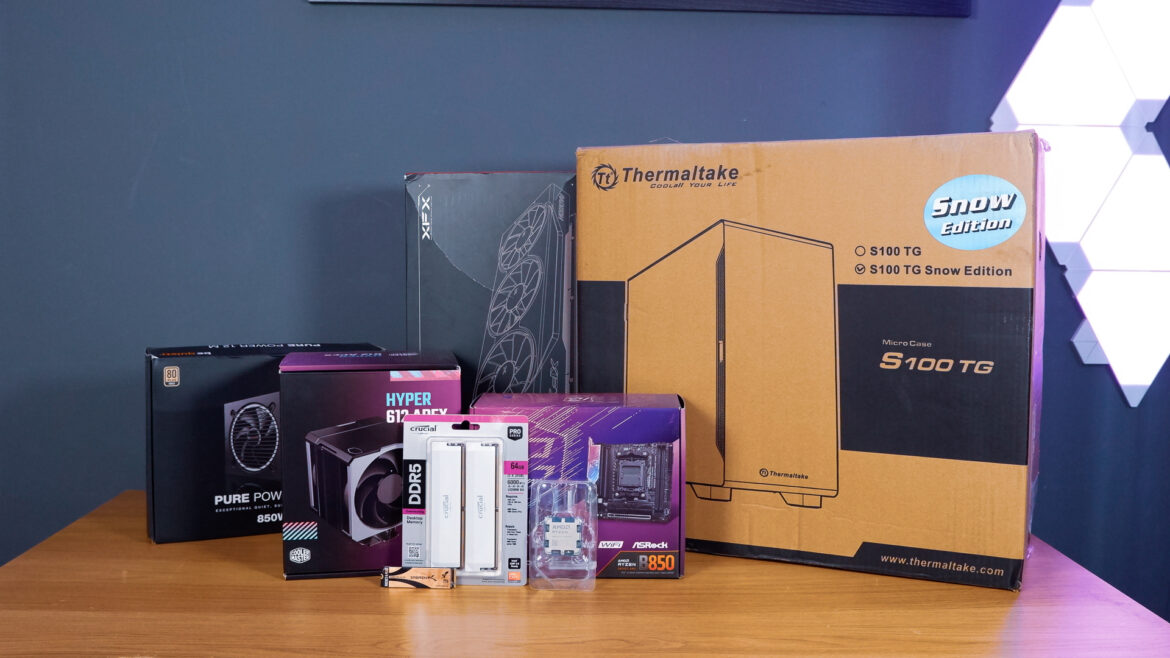
We’re back with another build. This time, a compact white gaming PC, powered by AMD’s top gaming CPU, the Ryzen 7 9800X3D, and a Gigabyte RTX 5070 Ti Eagle OC Ice SFF. I’ve tried to gain a few style points with the Cooler Master Hyper 612 Apex and Cooler Master Sickleflow Edge 360 fans—three fans combined into a single unit. That’s more of a time-saver than you’d think and makes for fewer cables.

All of which has been stuffed inside a surprising affordable chassis: Thermaltake’s S100 Tempered Glass Snow Edition. This budget case looks better than it should, considering its price tag, and altogether brings this white PC build together nicely.

Quick list

  • Case: Thermaltake S100 Tempered Glass Snow Edition – $73/£40
  • Motherboard: ASRock Phantom Gaming B850I Lightning WiFi – $210/£198
  • Graphics card: Gigabyte GeForce RTX 5070 Ti Eagle OC Ice SFF – $900/£610
  • CPU: AMD Ryzen 7 9800X3D – $472/£420
  • RAM: Crucial DDR5 Pro 64 GB – $228/£171
  • SSD: Solidigm P44 Pro 2 TB – $240/£187
  • Cooler: Cooler Master Hyper 612 Apex – $80/£55
  • PSU: Be Quiet! Pure Power 12 M 850 W – $130/£110
  • Fans: Cooler Master Sickleflow Edge 360 ARGB White Edition – $75/£53

Gallery

Image 1 of 18

(Image credit: Future)(Image credit: Future)(Image credit: Future)(Image credit: Future)(Image credit: Future)(Image credit: Future)(Image credit: Future)(Image credit: Future)(Image credit: Future)(Image credit: Future)(Image credit: Future)(Image credit: Future)(Image credit: Future)(Image credit: Future)(Image credit: Future)(Image credit: Future)(Image credit: Future)(Image credit: Future)

Parts list

Performance

We put every build through its paces, testing the latest games and putting the CPU under pressure to ensure stability.


Related articles

This PC is ‘Custom PC #10’ in the charts below.

Best PC build 2025

Our current recommendations

Keep up to date with the most important stories and the best deals, as picked by the PC Gamer team.


Source link

September 8, 2025 0 comments
0 FacebookTwitterPinterestEmail
Can Inaccessibility Make A Game Better? This Game Makes A Strong Case For It
Game Updates

Can Inaccessibility Make A Game Better? This Game Makes A Strong Case For It

by admin September 8, 2025


How does one properly deal with grief? The grief of recollecting beautiful memories, knowing they can never return. The grief of watching the life you built for yourself drastically slip away. The grief of seeing a loved one lose themselves to dementia. I’ve lived these moments. The pain of watching my grandfather, the kindest and gentlest man in my life, lose his entire personality and identity to dementia. The worst part is arguably watching the disease progress, seeing him lose more and more every year. Yet, throughout these powerful and intense moments of grief, love shines through in every scenario. This is the excellence of And Roger, a visual novel that swept me away with its brilliant gameplay and masterful storytelling, and for the first time in my life, made me reconsider how I critique inaccessibility.

Spoilers for And Roger to follow.

Developed by TearyHand Studio, And Roger follows a couple as the wife, Sofia, progressively loses herself to dementia. The hour-long game, composed of three chapters, recounts moments throughout Sofia’s life, particularly those associated with her husband, Roger. Players see the evolution of the couple’s life together, performing varying quick-time events to progress the story. Yet, with each loving and tender core memory, the shadows of Sofia’s disability continuously lurk.

But I’m not here to explore the emotional depth of one of the most powerful games I’ve ever played. Rather, I want to explore something that continually struck me as I completed each minigame: how a lack of accessibility, ultimately leading me to struggle, made the story much more impactful. The power of this short experience was so great that it made me reflect on my own beliefs and journalistic practices as both a disability reporter and disabled gamer. How I view accessibility will forever be changed because of this game.

Love and quick time events

And Roger begins with Sofia as a small child, struggling to wake herself. She tells herself she’s exhausted and dizzy–that her body feels abnormally heavy. The music during this sequence is haunting and made me feel uneasy, as if I were about to enter a horror game. Instead, I found myself thrown into the game’s first QTE, which required me to rapidly press a white button to sit Sofia up. Like Sofia, I struggled immensely to click the button on the screen. With every slip, she would fall back into her bed, forcing me to start over. And after completing the task, I felt drained, barely able to move my hand across the mouse. My stamina mirrored hers, yet this was only the beginning; as she slowly forced herself into the bathroom, we were confronted by another minigame: brushing her teeth.

After finishing that sequence, players are introduced to a strange man that Sofia mistakes for her father. He appears friendly, instructing her to go about her day and eat breakfast. The interactions are tense, with one minigame consisting of the strange man feeding Sofia, much to her objection. The uneasiness builds, with the stranger asking Sofia to take some medication to feel better.

Sofia sleepily brushes her teeth in And Roger.

As a scared child, she resists. And the QTE expertly reflects her struggles to fight. Again, by rapidly pressing a button, players are meant to push the man’s hand away. The event itself was impossible to complete without outside assistance. Like Sofia, I felt powerless, completely unable to budge the extended hand until someone else was able to take control. After the event, I felt considerably weaker, but I continued to play, leading Sofia out of the apartment and into a bakery where she collapses at the sight and smells of a presumably safe space.

The bakery remains a key setting, both in terms of QTEs and core memories. Chapter Two begins with Sofia entering the bakery to purchase baked goods; There she meets Roger, and the connection is immediate. The ensuing dates consist of QTEs ranging from moving dials to choose a hairstyle, to tracing heart monitor lines as the two talk. It’s a beautiful way to explore their blooming relationship, and the games expertly reflect the tenderness and fragility of new love.

Through these sections, Chapter Two beautifully demonstrates the importance of love and finding joy. Yet the struggles of dementia are ever present, and one QTE abruptly and forcibly brought me back into Sofia’s current world.

Food is integral to the relationship between Sofia and Roger. Their romance began at the bakery, and numerous QTEs–from chopping vegetables to shifting dials to purchase bread–reflect this special bond. In one scene, players are required to spin a button around a pot, stirring the soup inside. If the button falls outside of the ring, the meter to complete the objective progressively depletes. On numerous occasions, my strength and stamina levels would fail to keep up with continuously spinning a button. After approximately 10 minutes and several breaks, I finished the task, once again leaving me physically exhausted. And after finishing and eating the meal, Sofia mimicked my energy levels, dropping the pot of soup on the floor.

Inaccessibility as a tool

I’ve been professionally critiquing accessibility in games for six years. My reviews always focus on what is or isn’t included, and how the lack of appropriate options or designs make games unplayable. With And Roger, I found myself conflicted with my own ethics and morals as a disability reporter. As someone who regularly pushes back on the belief that accessibility can ruin artistic vision, I struggled coming to terms with the fact that, in this instance, inaccessibility had made the game so much more profound.

Sofia says she feels like she forgot something in a still for And Roger.

Players are meant to feel Sofia’s struggles as she navigates her world. We’re meant to feel her exhaustion, frustration, and animosity toward people and activities that once brought so much light into her life. And for me, someone with a physical disability, struggling to perform and finish certain QTEs only enhanced my connection with her. Do I recommend more games adopt this practice of forgoing accessibility? Absolutely not. But for this specific work of art, the emotional journey was vastly improved because I struggled to play.

And Roger wants players to appreciate the everyday moments in life, cherishing them on the chance they’re one day outside of your control. Yet in addition to a greater appreciation for life, I also have a newfound appreciation for games and the unique way my disability interacts with them. Inaccessibility is so innately tied to the disabled experience. And Roger showed me that there is often beauty in moments of frustration.


Source link

September 8, 2025 0 comments
0 FacebookTwitterPinterestEmail
Decrypt logo
GameFi Guides

XRP Army ‘Made a Difference’ in SEC Case Against Ripple, Says Lawyer

by admin September 7, 2025


In brief

  • Lawyer John Deaton believes that the group known as the XRP Army made a difference in the SEC’s case against Ripple.
  • In 2023, a judge issued a split ruling that XRP sales via public exchanges did not violate securities laws. The legal saga came to a close this August as all appeals were dropped.
  • Deaton said that thousands of affidavits were submitted to the court, and were cited as a reason the judge gave a ruling partially in favor of Ripple.

Lawyer and XRP legal advocate John Deaton claims that the XRP Army—a group of online supporters that continued to back the cryptocurrency during its lows—played a role in Ripple successfully concluding its legal battle with the U.S. Securities and Exchange Commission.

In an X post, Deaton cited the thousands of affidavits that self-proclaimed XRP Army members wrote and submitted to the court as a reason that Ripple secured a partial win against the regulator in its battle over the security status of XRP. An affidavit is a written statement that can be used as evidence in court.

The SEC and Ripple were embroiled in a legal dispute for nearly half a decade, after Ripple and two of its executives were sued in 2020 for the alleged offering of unregistered securities by selling XRP. 

No credible person can argue that the XRP Army didn’t make a difference in the Ripple case. If they do they’re either ignorant to the facts and truth or intentionally lying. We have conclusive evidence that we made a difference. There were over 2K exhibits filed in the case. In… https://t.co/WK2MfOb6wS

— John E Deaton (@JohnEDeaton1) September 3, 2025

In October 2023, federal district judge Analisa Torres issued a split ruling, stating that XRP sales to institutional investors violated securities laws, but sales on public exchanges did not. The ruling was hailed across the crypto industry as a victory for Ripple, despite it leaving the company liable for its institutional sales.

“No credible person can argue that the XRP Army didn’t make a difference in the Ripple case,” Deaton wrote on X. “If they do, they’re either ignorant to the facts and truth or intentionally lying.”

“[Judge Torres] ruled XRP itself is NOT a security while citing XRP holder affidavits,” Deaton wrote on X. “Had she not cited those things, people could legitimately debate whether our efforts made a real difference. But the proof is in the decision itself.”


The XRP Army is a militant supporters group that formed as a response to the SEC’s case against Ripple. The legal dispute unified XRP investors, with thousands of affidavits being written to the court by Army members, according to Deaton. 

“I submitted six affidavits that were used in the lawsuit because I was solely paid in XRP as an income, spent my XRP on goods and services, bills, etc,” XRP Army member James Rule told Decrypt. “Thousands came together, and the end result was a huge win for the industry.”

Deaton—who unsuccessfully challenged Elizabeth Warren for her Senate seat last year—also filed an amicus brief in support of Ripple’s legal position. An amicus brief is a legal document supplied to a court from a party that isn’t directly involved in the case.

Pseudonymous XRP Army member CryptoinsightUK further told Decrypt that some community members told the judge that they used XRP without even being aware of Ripple.

“You can’t buy something relying on an entity with the expectation of profit if you don’t even know the entity exists,” they said.

The legal battle between Ripple and the regulator continued to bubble until just last month as the SEC appealed the 2023 ruling, which was followed by a cross-appeal by Ripple. Both sides ultimately dropped their respective appeals just last month, as XRP Army members celebrated the result.

“We emerged from this battle bigger and stronger together,” pseudonymous XRP Army member MackAttackXRP told Decrypt, reacting to the news. “And we’ve known for years that we were on the right side of history.”

Daily Debrief Newsletter

Start every day with the top news stories right now, plus original features, a podcast, videos and more.


Source link

September 7, 2025 0 comments
0 FacebookTwitterPinterestEmail
Ethereum's Vitalik Buterin Names One Major Stablecoin Use Case to Watch
GameFi Guides

Ethereum’s Vitalik Buterin Names One Major Stablecoin Use Case to Watch

by admin September 6, 2025


Vitalik Buterin, Ethereum (ETH) cofounder, has shared his thoughts about stablecoins as an asset class in the cryptocurrency space. Buterin dropped his insights in reaction to a post highlighting Codex, a stablecoin built on the Ethereum blockchain.

Vitalik Buterin tags stablecoins key driver of crypto utility

According to Buterin, cheap stablecoin transactions remain one of the key real-world value drivers of the crypto industry. He is implying that stablecoins have utility in cross-border remittances and payments, which makes them pivotal in the adoption of crypto.

You Might Also Like

Notably, new users in the crypto space require stablecoins to purchase different cryptocurrencies like Ethereum, Bitcoin, XRP and others. This arguably makes them a vital link in the crypto adoption chain compared to NFTs or meme coins, for instance.

Cheap stablecoin transactions continue to be one of the most important sources of large-scale value that crypto provides today.

Excited to see @codex_pbc joining the arena as an L2 and thinking explicitly about synergy between itself and ethereum L1 from day one. https://t.co/BuCyZZqYgh

— vitalik.eth (@VitalikButerin) September 5, 2025

Buterin expressed excitement at how Codex has distinguished itself among other layer 2s and is exclusively for stablecoins.

“Excited to see @codex_pbc joining the arena as an L2 and thinking explicitly about synergy between itself and Ethereum L1 from day one,” he wrote.

The Ethereum cofounder is highlighting the fact that Codex, rather than compete with Ethereum, has decided to align and create a mutually beneficial ecosystem. With this development, it could help Ethereum maintain dominance in global crypto finance.

This could support Ethereum in staying ahead of Tron and other competitors in the stablecoin market as it seeks to make payments cheaper worldwide.

Stablecoin’s $1.2 trillion market projection

You Might Also Like

Vitalik Buterin’s post is gaining traction, with one user agreeing that while “cheap” remains the primary requirement, there is also a need to guarantee privacy.  He noted that once these two requirements are in place, mass adoption is inevitable.

Interestingly, the stablecoin market is rapidly expanding, and Coinbase has projected it could hit $1.2 trillion by 2028. The exchange believes that the growth will progress gradually and be supported by friendly policies over time.


Source link

September 6, 2025 0 comments
0 FacebookTwitterPinterestEmail
Face,detection,and,recognition,of,citizens,people,,ai,collect,and
Gaming Gear

Elon Musk, AI Startups, and The Case of The Allegedly Missing Trade Secrets

by admin September 5, 2025


A second lawsuit filed by an artificial intelligence company alleging a former employee stole trade secrets has been filed in California, just days after Elon Musk’s xAI alleged it had recently experienced corporate espionage.

In this case, Scale AI, a leading AI data-labeling firm, sued competitor Mercor Inc. in federal court Wednesday, accusing the startup and a former employee of misappropriating trade secrets to win new business.

Scale is valued at approximately $29 billion following a massive $15 billion Meta investment.

The allegations

The lawsuit, filed in the U.S. District Court for the Northern District of California, targets Eugene Ling, Scale’s former head of engagement management, and his new employer, Mercor.

The case is Scale AI Inc. v. Mercor.io Corporation, 25-cv-07402.

In its court filing, Scale alleges Ling downloaded over 100 confidential documents, including proprietary customer strategy materials and product information, to a personal Google Drive while still employed at the company and after meeting with Mercor’s CEO.

According to the complaint, Ling then contacted one of Scale’s top clients, referred to as “Customer A,” on behalf of Mercor while still at Scale, even arranging calls to pitch Mercor’s services. The lawsuit claims this effort was an attempt to steal business worth “millions of dollars.”

Attempts to reach Ling’s attorney were unsuccessful. But on his social media, Ling posted that he “never used” any of the Scale files and is “still waiting for guidance on how to resolve this.”

“I just wanted to say that there truly was no nefarious intent here,” he wrote. “I’m really sorry to my new team at Mercor for having to deal with this.”

Mercor’s response

Mercor co-founder Surya Midha denied any misuse of Scale’s intellectual property, stating that while several former Scale employees have joined Mercor, the two firms operate under “intentionally different” strategies. He added that Mercor is investigating the matter and had offered to have Ling delete any documents in his possession.

“While Mercor has hired many people who departed Scale, we have no interest in any of Scale’s trade secrets and in fact are intentionally running our business in a different way,” Midha said in a statement.

“Eugene informed us that he had old documents in a personal Google Drive, which we have never accessed and are now investigating,” it reads. “We reached out to Scale six days ago offering to have Eugene destroy the files or reach a different resolution, and we are now awaiting their response.”

Scale, in turn, argues that ordering Ling to destroy the files would eliminate crucial evidence. The company is seeking damages, legal fees, an injunction barring Mercor from using the stolen material, and the return of all misappropriated documents.

Scale’s legal move is another speed bump for a turbulent period for the company, which has recently experienced Meta’s massive investment, the hiring of Scale’s CEO Alexandr Wang by Meta, and a 14% workforce reduction.

Cutthroat competition comes to the courts

The case is a glimpse into the fiercely competitive nature of the AI sector, where intellectual property—particularly data strategy and customer relationships—is the key to market dominance. The situation mirrors another recent trade secret lawsuit, when Elon Musk’s xAI sued a former engineer for allegedly stealing confidential information on his way to a rival.

In that case, Musk’s company is alleging Zhihao “Zack” Li stole confidential files tied to the development of Grok, the company’s chatbot, before departing for rival OpenAI.

The complaint, filed in California state court, accuses Li, who joined xAI last year as an engineer, of copying proprietary materials in July 2025 shortly after agreeing to take a job at OpenAI. Court filings say Li also sold $7 million worth of vested xAI stock ahead of his departure.

According to the lawsuit, Li admitted during an internal meeting on Aug. 14 that he had taken sensitive documents, though xAI alleges he attempted to “cover his tracks” by deleting files. Forensic checks later uncovered additional materials still stored on his devices, the company alleges.

Musk’s startup argues that the stolen information could allow OpenAI to enhance ChatGPT with what it describes as xAI’s “more innovative AI and imaginative features.”

That case is xAI Corp v. Xuechen Li, U.S. District Court, Northern District of California, No. 3:25-cv-07292-RFL

What are the broader implications?

For investors and the AI industry in general, the lawsuit highlights two key risks.

Firstly, the theft of highly complex and coveted intellectual property, or even the appearance of it, can rapidly alter competitive positioning in a market where trust and proprietary data are currency. Secondly, it signals that AI startups may increasingly turn to legal avenues to enforce boundaries and protect their turf.

As AI becomes a part of so much of the technology we see and use all the time, the companies that make it are going to become even more fiercely protective of their products and brands. The value of proprietary data and client relationships makes legal protection, and the precedents set through lawsuits like this, the next frontier for companies looking to safeguard their tools and reputations.

“Scale has become the industry leader on the strength of our ideas, innovation, and execution,” Joe Osborne, a spokesperson for Scale, said in a statement. “We won’t allow anyone to take unlawful shortcuts at the expense of our business.”


Source link

September 5, 2025 0 comments
0 FacebookTwitterPinterestEmail
John Deaton claims XRP army helped win Ripple case
GameFi Guides

John Deaton claims XRP army helped win Ripple case

by admin September 4, 2025


John Deaton, the lawyer deeply involved in the Ripple case against the SEC, shares new insights into the case.

Summary

  • John Deaton shared new details from Ripple’s battle with the SEC
  • He argued about the difference that the volunteers in the XRP community made
  • Ripple’s VP Deborah McCrimmon admitted that volunteers saved the company millions

The XRP community may have made a significant difference in the Securities and Exchange Commission lawsuit against Ripple. On Wednesday, Sept. 3, John Deaton, a lawyer who became a voice for XRP holders during the case, revealed just how impactful the community was.

“No credible person can argue that the XRP Army didn’t make a difference in the Ripple case. If they do they’re either ignorant to the facts and truth or intentionally lying,” John Deaton said.

Deaton stated that there was “conclusive evidence” of the community’s impact, both during the trial and in the ruling. Specifically, the judge cited his amicus brief and affidavits from several XRP holders in her ruling that XRP was not a security when traded on secondary markets.

No credible person can argue that the XRP Army didn’t make a difference in the Ripple case. If they do they’re either ignorant to the facts and truth or intentionally lying. We have conclusive evidence that we made a difference. There were over 2K exhibits filed in the case. In… https://t.co/WK2MfOb6wS

— John E Deaton (@JohnEDeaton1) September 3, 2025

The proof, according to Deaton, was in the decision itself, and it shows that any individual can make an impact, no matter how small.

Ripple VP confirms the role of the XRP army

Deaton’s comments were echoed by Deborah McCrimmon, Ripple’s vice president and deputy general counsel. In a Sept. 2 interview on the Penta Podcast, she revealed that members of the XRP community actively contributed valuable work to the case. This volunteer work saved Ripple “millions” in legal fees, she explained.

“We didn’t ask them to, but once they saw this defense in our in our answer, people started finding this. I could have paid lawyers thousands of dollars, literally thousands of dollars, to do that and yet they were finding it and posting it on Twitter, and that was tremendously helpful for me.”


Source link

September 4, 2025 0 comments
0 FacebookTwitterPinterestEmail
DAAPrivacyRightIcon
Gaming Gear

Google doesn’t have to sell Chrome, judge in monopoly case rules

by admin September 3, 2025


Google will not have to divest its Chrome browser but will have to change some of its business practices, a federal judge has ruled. The ruling comes more than a year after the same judge ruled that Google had acted illegally to maintain a monopoly in internet search.

Following the ruling last year, the Department of Justice had proposed that Google should be forced to sell Chrome. But in a 230-page decision, Judge Amit Mehta said the government had “overreached” in its request. “Google will not be required to divest Chrome; nor will the court include a contingent divestiture of the Android operating system in the final judgment,” Mehta wrote. “Plaintiffs overreached in seeking forced divesture of these key assets, which Google did not use to effect any illegal restraints.”

Google will, however, no longer be permitted to strike exclusive deals around the distribution of search, Google Assistant, Gemini or Chrome, Mehta ruled. For example, Google can’t require device makers to pre-load its apps in order to get access to the Play Store. It also can’t condition revenue-sharing arrangements on the placement of its apps. But Google will be able to continue to pay partners — like Apple — for pre-loading search and other apps into their products. Mehta said that ending these arrangements could cause “downstream harms to distribution partners, related markets, and consumers.”

Mehta also ruled that Google will need to share some of its search data with competitors going forward. “Making data available to competitors would narrow the scale gap created by Google’s exclusive distribution agreements and, in turn, the quality gap that followed,” he wrote. The company is not required to hand over data related to its ads.

Mehta’s ruling is largely a win for the search giant, which had argued that divesting Chrome or Android “would harm Americans and America’s global technology leadership.” In a statement Tuesday, Google said it had “concerns” about some aspects of the ruling.

“Today’s decision recognizes how much the industry has changed through the advent of AI, which is giving people so many more ways to find information,” the company said. “Now the Court has imposed limits on how we distribute Google services, and will require us to share Search data with rivals. We have concerns about how these requirements will impact our users and their privacy, and we’re reviewing the decision closely.”

The company previously indicated it plans to appeal Mehta’s original decision, but said in June it would wait for a final decision in the case.

Update, September 2, 2025, 4:28PM PT: This post has been updated to add a statement from Google on the ruling.


Source link

September 3, 2025 0 comments
0 FacebookTwitterPinterestEmail
Cred Llc Leaders Sentenced In Federal Crypto Fraud Case
GameFi Guides

Cred LLC Leaders Sentenced in Federal Crypto Fraud Case

by admin August 31, 2025


Two former executives of San Francisco-based crypto lender Cred LLC have been indicted in relation to the company’s November 2020 collapse. Daniel Schat and Joseph Podulka were collectively sentenced to 88 months in prison for the wire fraud conspiracy.  

As per the U.S. Attorney’s Office, Northern District of California’s press release, Daniel Schatt, the company’s Co-Founder and CEO, was sentenced on Friday to 52 months in federal prison, while Joseph Podulka, the Chief Financial Officer, received 36 months. The two, along with former Chief Capital Officer James Alexander, were charged last year.

Schatt and Podulka were accused of conspiring to present an incomplete and misleading, positive portrayal of Cred’s business while failing to disclose information about Cred’s business challenges and risks. U.S. Attorney Craig Missakian said the executives’ scheme seriously harmed Cred’s customers and warned that fraud targeting crypto investors will not be tolerated.

The Conspiracy and Impact

Cred allowed customers to deposit cryptocurrency to earn interest and also offered loans using crypto as collateral. However, the business model relied heavily on two risky arrangements.

Prosecutors explained that Cred secretly relied on a Chinese company, linked to one of its co-founders, to generate interest. This company used customer funds to make short-term, high-interest loans to gamers in China. At the same time, Cred used a third-party hedging firm to protect against crypto market fluctuations. 

When the COVID-19 pandemic hit in March 2020 and Bitcoin prices dropped, both arrangements failed. The hedging partner forced Cred to liquidate its positions, and the Chinese company said it could not repay tens of millions of dollars. Cred’s finances collapsed, but instead of warning customers, Schatt and Podulka assured the public the company was “operating normally.”

In November 2020, Cred filed for bankruptcy. More than 6,000 customers and investors 

filed claims of around $140 million in losses, which prosecutors said would now be worth over $1 billion given current crypto prices. Authorities said the executives misled investors and customers in an attempt to cover up the company’s failure.

Along with prison sentences, Schatt and Podulka each received three years of supervised release and were fined $25,000. A separate hearing in October 2025 will determine how much restitution they must repay.

The defendants will start their prison sentences on October 28, 2025, and a restitution hearing is scheduled for October 7, 2025.

Also Read: Unicoin Counters SEC Fraud Lawsuit, Seeks Dismissal in NY Court


Source link

August 31, 2025 0 comments
0 FacebookTwitterPinterestEmail
Life Term For 14 In India Over Bitcoin Extortion &Amp; Kidnapping Case
GameFi Guides

Life Term for 14 In India Over Bitcoin Extortion & Kidnapping Case

by admin August 30, 2025


Ahmedabad City Sessions Court has convicted 14 accused, including former BJP MLA Nalin Kotadiya and senior Gujarat police officers, in the 2018 Bitcoin extortion case. They were sentenced to life imprisonment under relevant sections of the IPC and the Prevention of Corruption Act.

According to a report by The New India Express, the case started in 2018 with the kidnapping of Shailesh Bhatt, a builder and Bitcoin trader from Surat. Reportedly, a group of police officers in official government cars took him from a gas station to a farmhouse. The accused took 200 Bitcoins, worth about ₹12 crore at the time, and asked for ₹32 crore in ransom. Bhatt also reported that someone posing as an agent from India’s Central Bureau of Investigation (CBI) tricked him into meeting.

The investigation also revealed that Bhatt had previously stolen ₹150 crore worth of Bitcoin from a Surat man named Dhawal Mawani. When the perpetrators found this out, they, including Kotadiya, planned to steal from Bhatt. 

The investigation initially started after Bhatt filed an official complaint with the Indian Criminal Investigation Department (CID). As the CID’s probe went on, they detained 10 police officials, including Amreli SP Jagdish Patel, Amreli LCB PI Anant Patel, and Ketan Patel, a lawyer from Surat. Their questioning quickly pointed towards Jagdish Patel and Kotadiya. Later, a non-bailable warrant was also issued for Kotadiya’s arrest while he went into hiding. 

The case got even bigger when a real CBI Inspector, Sunil Nair, got involved. Nair is said to have asked Bhatt for a bribe and then threatened to start a false probe into him if he failed to pay him. 

After Shailesh Bhatt’s explosive complaint, CID got to work and arrested everyone involved in the extortion. The trial took place at the ACB Special Court of the City Civil and the Sessions Court in Ahmedabad, where the state brought in an incredible 172 witnesses against them.

The defense, on the other hand, could only call one witness. Even though 92 witnesses said they were hostile, the court judged the evidence and reasons good enough to convict the accused.

In this case, while justice has been served, globally a surge in crypto-related crimes, specifically those involving extortion and kidnapping, can be seen. In February, the Spanish police had arrested 3 British citizens for kidnapping a UK cryptocurrency trader in Marbella and demanding a £25,000 ransom. 

Also Read: How Social Engineering Fooled a Millionaire Out of $1.2M in Crypto


Source link

August 30, 2025 0 comments
0 FacebookTwitterPinterestEmail
Decrypt logo
NFT Gaming

Unicoin Will Move to Dismiss SEC Fraud Case, Says CEO

by admin August 27, 2025


In brief

  • The SEC has accused Unicoin and its executives of misleading investors and inflating deals.
  • CEO Alex Konanykhin says the charges are politically motivated “fabrications” meant to block Unicoin’s public listing.
  • Legal experts warn the SEC’s case looks like a classic securities fraud complaint, giving Unicoin a steep battle in court.

Crypto firm Unicoin will today file a motion to dismiss a lawsuit brought against it by the U.S. Securities and Exchange Commission (SEC), the company told Decrypt.

The SEC sued Unicoin and three of its top executives in May, accusing them of misleading investors and raising more than $100 million through false claims about its crypto offerings and company stock while attempting to cloak themselves in a veneer of regulation.

In its forthcoming filing, Unicoin will argue the case should be thrown out because the complaint distorts its record and ignores key disclosures. The company insists it has “embraced a strategy of transparency, compliance, and responsible innovation from the start,” highlighting that it voluntarily registered securities, published audited financial statements and limited participation to accredited investors.

Its CEO Alex Konanykhin has portrayed the SEC’s lawsuit as political theater, blaming “henchmen” from former SEC Chair Gary Gensler’s enforcement team.

“In the high point of his war on crypto, Gensler saw the Unicoin logo highly visible in Manhattan,” Konanykhin told Decrypt, referring to an ad campaign by Unicoin. “Our NYSE listing would mean a humiliating defeat of his anti-crypto crusade.”

He said that Gensler ordered his enforcers to preclude it from happening. In May of 2024, the SEC sent a “barrage” of subpoenas to our investors, brokers, lawyers, auditors, bankers and vendors, “deliberately disrupting important relationships,” he added.

“Just like during the both preceding investigations, the SEC investigators found no violation in our work,” the Unicoin CEO said, referring to two other clashes the company had with the SEC. “We were cutting no corners, complying with all rules and had top-level securities lawyers, compliance consultants and auditors. So, they crudely fabricated false charges.”

Among their allegations, regulators say Unicoin overstated the value of real estate acquisitions in Argentina, Antigua, Thailand and the Bahamas which were supposed to back their token, and in some cases announced deals that had not yet closed.

Unicoin’s motion to dismiss pushes back on this, saying the agency is conflating contractual commitments with completed transfers of title and insists that every deal was backed by binding agreements. “The SEC conflates deal value with property value,” the company said, adding that it measured purchases in the value of Unicoin tokens swapped for land.

In 2023, for example, the company said it had signed an agreement worth $335 million to purchase a Thai luxury resort. It added in a press release that it would pay 140% of the property’s appraised value in Unicoins.

Konanykhin told Decrypt that Unicoin was unable to take ownership of these properties as its intention was to transfer funds following its initial coin offering, which has been delayed due to the SEC action.

The agency also claims Unicoin misrepresented the company’s financial position while advertising and selling so-called “Unicoin Rights Certificates” and that Konanykhin himself improperly sold nearly 38 million of them to investors who were barred from participating.

The company said its marketing materials always paired optimism with explicit warnings about risk and argued the SEC was cherry-picking snippets to portray ordinary projections as fraudulent misstatements. “The SEC treats routine financial projection and optimism as fraud, while overlooking that Unicoin coupled every aspirational claim with sober warnings,” the motion states.

Konanykhin said he had not sold the certificates to unaccredited investors but that he had asked about the possibility around the same time, leading the SEC to assume he had done so. He has vowed to fight the lawsuit, and claims the SEC’s actions have cost its 8,000 investors billions in lost value and blocked the success of Unicoin.

“If we went public a year ago, I’m sure the stock market would give us a healthy premium,” he said, adding he estimated the company would now be worth $25 billion. “Instead, we are forced to literally fight for our survival.”

No guarantee for Unicoin

Legal experts suggest the company faces a tough road.

Katherine Reilly, a partner in Pryor Cashman’s White Collar and Regulatory Enforcement Group and a former federal prosecutor, told Decrypt that the SEC’s complaint reflects a more traditional securities fraud case than some of the other crypto cases it has dropped in the past few months.

“It talks a lot about really traditional misrepresentations that Unicoin executives are alleged to have made,” she said. “For example, the SEC lays out claims that executives overstated financing and runway, and represented that their coin was backed by real property and assets that didn’t go through.”

Although the Trump-era SEC has pulled back from a number of recent cases against major crypto players, Reilly said this one may be different. “I think this is a strong example of the type of enforcement action the SEC still plans to pursue. There’s clearly an effort by Unicoin to align itself with the new administration’s allyship with the crypto industry and its emphasis on American entrepreneurialism,” she said.

“But I don’t think that’s likely to mean much in front of a judge in the Southern District of New York.”

Decrypt reached out to but did not immediately receive a response from the SEC.

Daily Debrief Newsletter

Start every day with the top news stories right now, plus original features, a podcast, videos and more.


Source link

August 27, 2025 0 comments
0 FacebookTwitterPinterestEmail
  • 1
  • 2
  • 3
  • 4

Categories

  • Crypto Trends (1,098)
  • Esports (800)
  • Game Reviews (772)
  • Game Updates (906)
  • GameFi Guides (1,058)
  • Gaming Gear (960)
  • NFT Gaming (1,079)
  • Product Reviews (960)

Recent Posts

  • This 5-Star Dell Laptop Bundle (64GB RAM, 2TB SSD) Sees 72% Cut, From Above MacBook Pricing to Practically a Steal
  • Blue Protocol: Star Resonance is finally out in the west and off to a strong start on Steam, but was the MMORPG worth the wait?
  • How to Unblock OpenAI’s Sora 2 If You’re Outside the US and Canada
  • Final Fantasy 7 Remake and Rebirth finally available as physical double pack on PS5
  • The 10 Most Valuable Cards

Recent Posts

  • This 5-Star Dell Laptop Bundle (64GB RAM, 2TB SSD) Sees 72% Cut, From Above MacBook Pricing to Practically a Steal

    October 10, 2025
  • Blue Protocol: Star Resonance is finally out in the west and off to a strong start on Steam, but was the MMORPG worth the wait?

    October 10, 2025
  • How to Unblock OpenAI’s Sora 2 If You’re Outside the US and Canada

    October 10, 2025
  • Final Fantasy 7 Remake and Rebirth finally available as physical double pack on PS5

    October 10, 2025
  • The 10 Most Valuable Cards

    October 10, 2025

Newsletter

About me

Welcome to Laughinghyena.io, your ultimate destination for the latest in blockchain gaming and gaming products. We’re passionate about the future of gaming, where decentralized technology empowers players to own, trade, and thrive in virtual worlds.

Recent Posts

  • This 5-Star Dell Laptop Bundle (64GB RAM, 2TB SSD) Sees 72% Cut, From Above MacBook Pricing to Practically a Steal

    October 10, 2025
  • Blue Protocol: Star Resonance is finally out in the west and off to a strong start on Steam, but was the MMORPG worth the wait?

    October 10, 2025

Newsletter

@2025 laughinghyena- All Right Reserved. Designed and Developed by Pro


Back To Top
Laughing Hyena
  • Home
  • Hyena Games
  • Esports
  • NFT Gaming
  • Crypto Trends
  • Game Reviews
  • Game Updates
  • GameFi Guides
  • Shop

Shopping Cart

Close

No products in the cart.

Close