

Laughing Hyena
  • Home
  • Hyena Games
  • Esports
  • NFT Gaming
  • Crypto Trends
  • Game Reviews
  • Game Updates
  • GameFi Guides
  • Shop
Author

admin

admin

Zane, from Borderlands 4, pinches his fingertips expressively as he tries to communicate something so someone off screen.
Gaming Gear

Borderlands 4 dev clears up the difference between Skill Damage and Action Skill damage, and I feel like a combat log is in order so I didn’t have to find this out on a Reddit thread

by admin September 30, 2025


Borderlands 4 has a ton of possible builds to choose from—it’s one of the strengths I highlighted in my Borderlands 4 review—but I do have one teensy-tiny complaint, and it’s that I would like some of the tooltips to be a smidge more straightforward about what is what.

This feeling has returned full-force after seeing a developer kindly explaining the difference between Skill Damage and Action Skill damage on the game’s subreddit (thanks, TheGamer), which probably isn’t the place you should have to go for this sort of clarification.

Turns out, it’s a rectangles/squares situation. Except this is Borderlands, so lead character designer Nicholas Thurston uses guns and shotguns as the metaphor: “Skill Damage and Action Skill Damage is like Gun Damage and Shotgun Damage. All Skills are skills, but only some are Action Skills. Same as all Guns are Guns, but only some are Shotguns.” Simple, then.


Related articles

Thurston then explains that Skill Damage impacts basically everything involving the word “Skill”, including passive skills and traits and, you guessed it, Action Skills. However, Action Skill damage only boosts whatever’s on the Action Skill itself.

Other modifiers, like Melee Damage and Minion Damage, can apply to an Action Skill if it also does those things. For example: “Amon’s ‘Onslaughter’ does Melee Damage with his fist, this would get Skill Damage, Action Skill Damage, and Melee Damage … Forgedrones (as an example) only benefit from Skill Damage, as they come from Passive Skills, as well as Melee Damage.”

In a separate comment, Thurston also explains that there’s no real difference between “status chance” and “status application chance”, and that all instances of the former should be the latter: “if something doesn’t, that’s a goof on our part that we’ll need to investigate and correct.”

And hey, props to Thurston for coming in and clearing some of this up, but it does beg the question whether or not the series needs a little more transparency on just how everything works.

Keep up to date with the most important stories and the best deals, as picked by the PC Gamer team.

Most ARPGs, a genre which Borderlands shares most of its DNA with, have combat logs that let you mouse over your damage and get a peek at the math going on underneath the hood, allowing you to test whether all those floating modifiers are actually being fed into the machine properly.

And while BL4 does have training dummies, not having any proper mouseovers for its various tooltips—or a way to check on your damage after the fact—does hamper the otherwise stellar buildcraft somewhat. I probably shouldn’t be having to do napkin math to figure out why a non-legendary gun is causing Total Existence Failure.



Source link

September 30, 2025 0 comments
0 FacebookTwitterPinterestEmail
Former TT Games head takes on Peter Pan
Esports

Former TT Games head takes on Peter Pan

by admin September 30, 2025


Back in 2020, UK games industry veteran Tom Stone stepped down from his position as managing director at the Lego games maker TT Games.

Having spent almost 18 years at the helm of the studio – and before that, working at Lego Interactive, Electronic Arts, and Giant Interactive (which merged with Traveller’s Tales to form TT Games) – he departed to do something new.

To start with, this took the form of becoming the chair of FuturLab (the maker of Powerwash Simulator) and acting as managing director for the venture capital firm Juno Capital Partners.

Tom Stone, Second Star Games

Then, in Christmas 2024, Stone had a conversation with The Blair Partnership and Great Ormond Street Hospital. The former is a media agency that manages franchises such as Harry Potter; it had been appointed by the latter to develop the Peter Pan and Neverland IP in the video games space.

Back in 1929, author JM Barrie granted the rights to Peter Pan to Great Ormond Street. Although the IP is now in the public domain, the hospital receives royalties from its commercial use.

Thus, Second Star Games was born. The name itself, for those who know, is a telltale sign of what IP the studio is working on. In the Disney animated movie, Peter gives Wendy the directions to Neverland with the famous line: “Second star to the right and straight on ’til morning.”

Let’s go round again

The venture is staffed by some of Stone’s former colleagues from TT Games, including lead game designer Andrew Holt, art director Nicola Daly and head of engineering Chris Stanforth. The last piece of the puzzle was funding: Stone is putting some of his own money into the venture, but the majority of the investment has come from Grahame Chilton, who helped fund 2005’s Lego Star Wars: The Video Game. The company is still weighing up whether to partner with a publisher or go it alone.

“We could have made fewer games slightly better”

Tom Stone, Second Star Games

While Second Star Games definitely has an element of bringing the band back together, Stone wants to do things slightly differently this time.

“I think we’re going to take a breath and look up occasionally,” he says. “When we were making the Lego games, it was intense. It was blood, sweat and tears. I loved every single moment of it, but upon reflection, we could have made fewer games slightly better and sold probably the same number of units that we sold.”

Though TT Games saw wild success with its series of Lego games, there were some at the studio who were unhappy with its culture. An investigation by Polygon in 2022 painted a picture of a workforce under relentless pressure and crunch, at least on Lego Star Wars: The Skywalker Saga. To his credit, Stone is reported to have held meetings to find out how staff felt and tried to rectify the situation before he departed the company.

“It was a pretty tough 15, 16, 17 years we had at TT. We were on a mission. We were focused. We achieved incredible things,” Stone says.

“Everything in life is a trade; people worked incredibly hard and the games were phenomenally successful. I don’t think everyone complained that it was a tough culture. As happens, there were a number of people who justifiably and rightly said it was a tough environment; their voices were louder than the people who were saying they enjoyed working there and loved making Lego games. Their voices weren’t heard so much.”

Concept art for Second Star’s Peter Pan game | Image credit: Second Star Games

Despite his earlier reflection that he wants his new studio to make fewer games slightly better, Stone says that in order to do extraordinary things, developers must be open to tough and challenging work.

“We’re currently a team of 18 full-time employees. Everyone’s the same. We’re all in this boat together. Everyone knows each other. We don’t want an HR department. Everyone is there to support one another in building this game together,” Stone says.

“It’s going to be tough and challenging because we’re setting ourselves incredibly high goals. We had a meeting last week in the studio, where we agreed on a particular design feature, which is going to be very, very challenging to achieve.

“If we are not going to do stuff like that, what’s the point of doing it? If we aren’t going to break through and make this game truly memorable, then why bother? Everyone is on board. Everyone knows we are going to set ourselves some really, really high bar challenges, and everyone wants to do it.”

A changed world

At last official count back in 2019, the Lego games made by TT had sold north of 200 million copies (Stone reckons now it’s closer to 380 or 390 million). There’s no denying that the franchise has been hugely successful. But Stone and co are mindful of the fact that the games industry has changed wildly since 2005, especially when it comes to younger audiences.

More concept art depicting Neverland | Image credit: Second Star Games

“We want to do something really special. We’re aware that we’re launching into an entirely different market now. In 2005, there was no Roblox, no Minecraft, no Rocket League, no Fortnite,” he says.

“We know that the age group we are aiming at – five through 13 years old – is engaged in one of those games. Obviously, it’s going to be a challenge to have them look up and turn their head and say: ‘There’s a game over there I’d really love to play,’ because they are so engaged in those other games.

“Back in 2005, we were releasing into a physical goods, console-led market, but with no backdrop of people being absorbed by other games that they are playing. Now that’s different. That’s the key change. The other major change is discoverability – there are so many games being released. Unless you have an IP, it’s quite hard for people to discover your game.”

Working on licensed IP has also changed a great deal in the last 20 years. Companies appear to be more relaxed than they were in the past when it comes to their intellectual property and are more open to video games in general.

“Licensors now realise the power of video games and that we can actually enhance and grow and build the intellectual property by making an amazing game,” Stone explains.

“The magic of Lego added to any one of the franchises that we made helped give that other franchise a slight lift. It’s a symbiotic relationship, right? As Harry Potter gave Lego a lift, Lego gave Harry Potter a lift. It just expressed it in new, different, and interesting ways.

“Consumers who love those intellectual properties are always ready for a new treatment and a new way of looking at Harry, a new way of looking at Lord of the Rings, whatever the franchise might be.”

Thoroughbred stable

Across its history, TT Games worked on everything from Star Wars to The Lord of the Rings to Marvel and DC properties. Stone has similar aims for Second Star; he wants the studio to have a range of intellectual properties in its repertoire.

Neverland concept art | Image credit: Second Star Games

“The first is Neverland and the adventures of Peter Pan. Once we announced the studio, we actually had quite a lot of inbound interest, asking whether we’d be interested in working on this IP or that piece of IP. Obviously, we will be selective and thoughtful. We have to be mindful that we can’t do it all at the same time, but the goal is to build out a stable of expertise in this young gamer space.

“I imagine 100 years ago, the family would gather around the fire and share stories. They would have that shared moment of family community. What I’m imagining now is the family gathering around a screen in co-op mode, playing a game together, watching it being played and Peter Pan is that magnet.

“Peter Pan is the fire that everyone is watching, while they all gather around the television together. The vision is to build a stable, bring the thoroughbreds in, and have everyone playing together around a screen.”

He concludes: “When we introduced co-op play into the first Lego Star Wars game, it made such a difference. It was such a breakthrough moment; people were able to play together in a social cooperative way. We are going to build on that.”


Source link

September 30, 2025 0 comments
0 FacebookTwitterPinterestEmail
XRP price
GameFi Guides

Spot XRP, Dogecoin ETF Approval Odds Hit 100%: Bloomberg Expert

by admin September 30, 2025


Trusted Editorial content, reviewed by leading industry experts and seasoned editors. Ad Disclosure

Bloomberg Intelligence senior ETF analyst Eric Balchunas says the odds of spot ETFs for XRP and Dogecoin winning US approval are now 100%, arguing that last week’s rule change to adopt generic listing standards has rendered the old approval clock irrelevant and left only registration statements awaiting a final sign-off from the SEC’s Division of Corporation Finance.

“Honestly the odds are really 100% now. Generic listing standards make the 19b-4s and their ‘clock’ meaningless. That just leaves the S-1s waiting for formal green light from Corp Finance,” he wrote, adding that applicants for Solana ETFs have already filed another round of amendments, a sign the process is in its final stages. “The baby could come any day. Be ready.”

Balchunas’ call follows a flurry of developments triggered by the SEC’s September 18 approval of “generic listing standards” at NYSE Arca, Nasdaq and Cboe. That decision allows exchanges to list certain commodity-based ETPs—including crypto spot products that meet the criteria—without submitting a separate rule change under Exchange Act Section 19(b).

In effect, the long, deadline-driven 19b-4 process that governed coin-by-coin approvals is no longer required for qualifying products; instead, the remaining gating item is the effectiveness of an issuer’s S-1 registration. The agency framed the change as bringing commodity ETPs onto a more streamlined path, while Commissioner Hester Peirce emphasized that, once an ETP fits the standard, an exchange can list it without prior 19(b) approval.

What This Means For Spot XRP And Dogecoin ETFs

The near-term catalyst for XRP and DOGE specifically emerged from reporting by Eleanor Terrett, who said the SEC has asked issuers of proposed spot ETFs for Litecoin, XRP, Solana, Cardano and Dogecoin to withdraw their pending 19b-4 filings because those forms are no longer needed in the “post-GLS” regime.

“SCOOP: The SEC has asked issuers of LTC, XRP, SOL, ADA, and DOGE ETFs to withdraw their 19b-4 filings following the approval of the generic listing standards, which replace the need for those filings. Am told withdrawals could start happening as soon as this week,” Terrett posted.

She later added, “More context for those asking whether withdrawal is a bad thing: the short answer is no… when the SEC approved the generic listing standards two weeks ago, it eliminated the need for exchanges to file 19b-4 forms to list individual token ETFs, simplifying and speeding up the process.”

Balchunas endorsed that interpretation, calling Terrett’s report a “nice scoop” and noting that analysts had anticipated this shift once generic standards were finalized. “This was something we thought could happen. It makes sense as you don’t need 19b-4s in the post-GLS world. Just not sure how the launch schedule will work yet,” he wrote, suggesting timing is now primarily an issuer and Corp Fin coordination question rather than a statutory countdown.

Evidence that S-1s are indeed the remaining lever is visible on EDGAR. In recent days multiple Solana spot ETF applicants, including VanEck and 21Shares, submitted fresh S-1/A amendments—VanEck’s docket shows an “Amendment No. 4” filed late last week, while 21Shares likewise posted Amendment No. 4—consistent with the end-game polishing typical before effectiveness. While those updates are for Solana, the same filing pathway would apply to any spot XRP or DOGE product under the new standards.

However, none of this guarantees immediate launches or provides a definitive timetable. The operative question now is not whether the SEC can approve such funds under its own rules—it can—but when Corp Fin will declare the S-1s effective and how exchanges and issuers will choreograph first-day listings under the new regime.

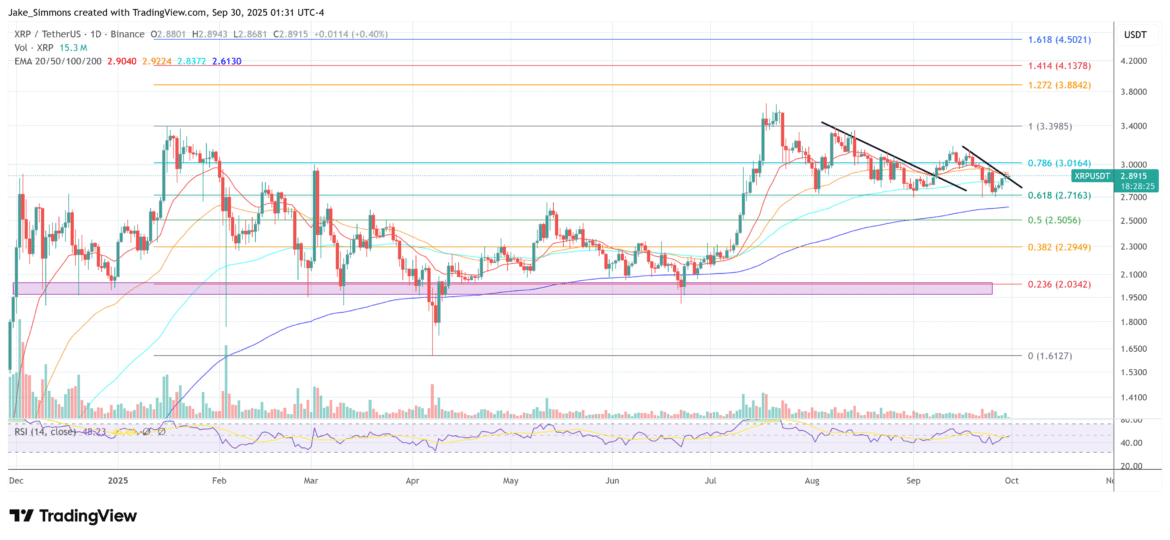
At press time, XRP traded at $2.89.

XRP eyes breakout, 1-day chart | Source: XRPUSDT on TradingView.com

Featured image created with DALL.E, chart from TradingView.com

Editorial Process for bitcoinist is centered on delivering thoroughly researched, accurate, and unbiased content. We uphold strict sourcing standards, and each page undergoes diligent review by our team of top technology experts and seasoned editors. This process ensures the integrity, relevance, and value of our content for our readers.


Source link

September 30, 2025 0 comments
0 FacebookTwitterPinterestEmail
Main
Game Updates

The Very Finest Cosplay Fits From New York’s Anime NYC

by admin September 30, 2025


Anime NYC is an annual New York-based event to celebrate all things anime and related Japanese pop culture. It purports to be the largest anime convention on the East Coast, with over one-hundred-thousand people showing up for the four-day event. And with its association with Crunchyroll, has become an important fixture in the Western anime calendar. As such, it brings in an impressive list of celebrity guests, and of course some incredibly fine cosplay. As ever, Mineralblu were in attendance for Kotaku, snapping the best fits for your eyeballs’ pleasure.

2025’s event saw some very big names from the world of Japanese culture. A-1 Pictures president Akira Shimizu and Blue Eye Samurai director Jane Wu were there, along with voice actors Abby Trott, Zeno Robinson and Kpop Demon Hunters‘ May Hong, among many others. But we’re here to celebrate the cosplayers, the people who put months into sewing and crafting extraordinary outfits to celebrate their favorite anime and video games. The results, as ever, are fantastic.

Check back soon for a video of the event, but in the meantime, click on for some of the most impressive costumes.


Source link

September 30, 2025 0 comments
0 FacebookTwitterPinterestEmail
Amazon’s AI assistant is smarter, but still struggles.
Product Reviews

Amazon’s AI assistant is smarter, but still struggles.

by admin September 30, 2025


This week, Amazon will launch new Echo hardware designed to supercharge Alexa Plus, the AI-powered upgrade to its voice assistant. I’ve been using Alexa Plus for the last few months as part of its Early Access program, and while the new assistant is off to a promising start, it’s still clearly a work in progress.

To fix Alexa, Amazon had to break it apart and rebuild it. The result is a hybrid smart home assistant, personal assistant, and Amazon’s answer to ChatGPT. Right now, in its Beta phase, this new Alexa isn’t doing any of those things as well as I’d hoped.

This is most obvious in the smart home. Controlling my lights, locks, and robot vacuum with natural language rather than precise phrases is a huge improvement, as is not having to say “Alexa” repeatedly and being able to interrupt, um and er, and change my mind mid-thought. But we are still far from the dream of the ambient home that runs on a Star Trek–style “Computer.”

Today, running on what feels like underpowered hardware and with surface-level integrations into my smart home, Alexa Plus often leaves me frustrated. There’s power under that hood, but it feels largely inaccessible. The assistant desperately needs something to make it more compelling — and better hardware could be the answer.

Alexa Plus should make the smart home smarter

Generative AI is supposed to be a watershed moment for the smart home. By cutting through the complexity of programming your home and removing the frustrations of clunky commands, LLMs should make the smart home more accessible. And in many ways, Alexa Plus delivers.

I can now say, “Alexa, dim the lights in here, adjust the thermostat down a few degrees, lock the front door, and turn the upstairs lights off. Oh, and remind me to take the trash out in the morning,” and it all happens. This kind of easy, hands-free convenience is exactly what the smart home has promised for years.

The old Echo Show UI (left), compared to the new Alexa Plus UI, which offers more control and a more intuitive interface. Photo by Jennifer Pattison Tuohy / The Verge and Photo by Chris Welch / The Verge

Managing my devices is also simpler. Instead of scrolling through thumbnail clips in the Ring app, I can ask an Echo Show 21 when the cat was last on the porch and instantly see a full-screen video. The updated UI on the Show 15 and 21 is a big improvement, with larger widgets, customizable layouts, and easier access to smart home controls.

Recently, Alexa and I chatted about the best ways to use my smart home gadgets to their full potential. It suggested possible routines, built the automations, tweaked them based on my feedback, and tested them — all in minutes, with no fiddling in the (still clunky) Alexa app. It even helped me set up a new air purifier and folded it into one of those routines.

But there are issues. Alexa Plus is noticeably slower, with some requests taking up to 15 seconds for a response. While turning on lights or adjusting a thermostat is fast enough (I assume due to using local connections over Matter), waiting for over 10 seconds for the weather or a song to play is tiresome.

Some basic features that used to work reliably now don’t or require new phrasing every time. My struggles to control my Alexa-enabled coffee machine persist, and I can’t get Alexa to consistently turn on my bathroom fan for a set period of time.

The Echo Show 21 can display live feeds from up to four Ring cameras, as well as pull up specific events using voice commands. Photo by Jennifer Pattison Tuohy / The Verge

I used to say, “Turn on the bathroom fan for 15 minutes,” and it did it. Now, Alexa Plus tells me it has to create a routine to do that, and then doesn’t run that routine. Or it says, “Sure,” turns the fan on, but never turns it off. I’ve tried this a dozen times and haven’t had a consistent response yet.

One surreal moment: after weeks of Alexa Plus’ new voice, the old Alexa suddenly surfaced when the system hit a snag. “Sorry, something went wrong,” it said in that stiff, familiar tone. For a second, I wondered — is the old Alexa still in there, trying to get out?

Building the old on top of the new

The old Alexa — the deterministic model built on rigid command-and-control rules — is essentially gone. According to Panos Panay, head of Amazon’s devices and service division, whom I spoke with in February, Alexa Plus runs on an entirely new architecture. One that, based on my testing, feels much more powerful than the old Alexa, but also less reliable.

That’s the paradox of LLMs: they’re excellent at parsing human language, but they’re not designed for consistency. Ask ChatGPT the same question twice, and you’ll get different answers. The unpredictability of LLMs, known as nondeterminism, is a poor fit for smart home control, where reliability and repeatability are crucial. It’s great when you’re brainstorming, but frustrating when you just want your morning coffee.

Amazon’s workaround has been to use its LLM models as a kind of translator. It interprets what you say, then hands off the request to deterministic systems — APIs, device controllers, or local Matter connections.

The unpredictability of LLMs is a poor fit for smart home control, where reliability and repeatability are crucial.

I’ve found this works most of the time, but if the LLM translates a request incorrectly or there’s a gap in the API, it appears that handoff can fail. I assume that’s why my bathroom fan sometimes turns on as requested and why Alexa sometimes insists on creating a routine but then forgets to finish the job.

This is the problem every company with a voice assistant in the smart home is dealing with — merging the old and predictable with the new and exciting. LLMs aren’t designed to be predictable, and what you want when controlling your home is predictability.

Panay says they’ve worked hard to bring predictability to Alexa Plus and to ensure it won’t hallucinate in your smart home. While the former still needs work, so far my smart home has been hallucination-free. There have been no bizarre behaviors such as unlocking doors or cranking up the heat unbidden, or doing something different from what was requested.

However, this tightly controlled structure has resulted in an Alexa Plus that is not the paradigm shift I was hoping for. Of course, it’s still early days, but the promise of LLMs is that they will unlock the potential of technology within our homes — and that hasn’t happened yet.

Alexa Plus hasn’t changed anything for me; it’s just made my smart home (mostly) easier to manage. It still feels like pieces and parts, not a cohesive whole being run by an intelligent machine.

Hardware could hold the key

Many of my frustrations with Alexa Plus are connected to the hardware, and changes here could make a big difference.

The current Show devices are the flagship Alexa Plus interfaces, specifically the Show 21 and 15. But the interplay between voice and screen is still lacking; the hardware remains voice-first.

For example, I’ll ask Alexa to show me the recipe I was just using, and instead, it will read out the directions. With hardware that synchronizes voice and visuals seamlessly, Alexa Plus would be very compelling. (Also, the Shows are the worst Echo devices at hearing commands, and Amazon really needs to fix that.)

Andy Jassy has promised us “beautiful” new hardware for Alexa. As the first products fully designed under Panos Panay, who told me he believes in screens, we have some idea of what’s coming. But ultimately, it will be about how well the hardware and software work together. The devices revealed this week will be Alexa Plus’s moment to prove it’s more than just potential.

Photos by Jennifer Pattison Tuohy / The Verge

Follow topics and authors from this story to see more like this in your personalized homepage feed and to receive email updates.

  • Jennifer Pattison TuohyClose

    Jennifer Pattison Tuohy

    Senior Reviewer, Smart Home

    Posts from this author will be added to your daily email digest and your homepage feed.

    PlusFollow

    See All by Jennifer Pattison Tuohy

  • AmazonClose

    Amazon

    Posts from this topic will be added to your daily email digest and your homepage feed.

    PlusFollow

    See All Amazon

  • Amazon AlexaClose

    Amazon Alexa

    Posts from this topic will be added to your daily email digest and your homepage feed.

    PlusFollow

    See All Amazon Alexa

  • AnalysisClose

    Analysis

    Posts from this topic will be added to your daily email digest and your homepage feed.

    PlusFollow

    See All Analysis

  • ReportClose

    Report

    Posts from this topic will be added to your daily email digest and your homepage feed.

    PlusFollow

    See All Report

  • ReviewsClose

    Reviews

    Posts from this topic will be added to your daily email digest and your homepage feed.

    PlusFollow

    See All Reviews

  • Smart Home ReviewsClose

    Smart Home Reviews

    Posts from this topic will be added to your daily email digest and your homepage feed.

    PlusFollow

    See All Smart Home Reviews

  • TechClose

    Tech

    Posts from this topic will be added to your daily email digest and your homepage feed.

    PlusFollow

    See All Tech


Source link

September 30, 2025 0 comments
0 FacebookTwitterPinterestEmail
EA private acquisition deal expected to go smoothly, says report, as "what regulator is going to say no to the president's son-in-law?"
Game Reviews

EA private acquisition deal expected to go smoothly, says report, as “what regulator is going to say no to the president’s son-in-law?”

by admin September 30, 2025


The $55bn private acquisition of EA is expected to run smoothly, the Financial Times has reported, due to the influence of Jared Kushner and Saudi Arabia on The White House.

The acquisition announced yesterday will see a group of investors comprising Saudi Arabia’s Public Investment Fund, and investment firms Silver Lake and Affinity Partners, acquiring EA, the publisher known for its sports games, BioWare’s RPGs, The Sims, and many more.

Though the acquisition won’t be completed until Q1 FY27, a report from The FT suggests it won’t face much opposition.

That’s due to Saudi Arabia being considered a key ally to the US, as well as the involvement of President Trump’s son-in-law Kushner, CEO of Affinity Partners.

“Kushner has a personal relationship and he has deep ties in Saudi Arabia. He is very comfortable operating in the Middle East. It created a basis of trust,” a person briefed on the talks told the FT.

Another source stated: “We are in a regulatory environment that is welcoming of [Saudi Arabia]. We are not in what was the previous regime.”

“What regulator is going to say no to the president’s son-in-law?” stated another source close to the inner workings of the Trump administration.

The involvment of Saudi Arabia’s PIF is controversial, due to the country’s ruler Prince Mohammed bin Salman chairing the fund. He’s been blamed by the CIA for the assassination of Washington Post journalist Jamal Khashoggi, and has upheld the country’s notoriously poor human rights record.

While the last big video game acquisition – Microsoft’s acquisition of Activision Blizzard – was met with opposition, it seems this latest deal for EA will be less contested.

Eurogamer has contacted the US Federal Trade Commission for comment on EA’s private acquisition.

In a further report from the FT, it’s suggested the deal is a huge bet that AI can significantly cut EA’s operating costs.

The $55bn buyout is backed by $36bn in equity and $20bn in JPMorgan debt, which EA will need to cover. AI will therefore be a key factor in cutting costs, according to sources involved in the transaction.

Last year, EA CEO Andrew Wilson stated AI is “the very core of our business” at the company’s Investor Day 2024. “For years we have talked about our games delivering experiences that are always new and different,” he said. “We predict that with generative AI we will truly be able to fulfil this promise for billions of people for billions and billions of hours.”

One area of AI innovation for the company is efficiency, which Wilson described as not just about cost saving but “doing what we do today faster, cheaper, and at a higher quality”.

With the growing reputation of AI tools being used across the games industry, no doubt this presentation proved influential in the eventual acquisition by private investors.

In a statement to employees yesterday, Wilson stated EA’s “values and our commitment to players and fans around the world remain unchanged”. However, the deal has sparked fear among fans for the future of EA’s most queer-friendly franchises, including The Sims, Mass Effect, and Apex Legends, due to the involvement of Saudi Arabia.


Source link

September 30, 2025 0 comments
0 FacebookTwitterPinterestEmail
Decrypt logo
NFT Gaming

Wisconsin Bill Seeks to Exempt Crypto Activities From Money Transmitter Laws

by admin September 30, 2025


In brief

  • Wisconsin’s Assembly Bill 471, introduced Monday, would exempt crypto users from licensing when accepting payments, using self-hosted wallets, running nodes, developing software, and staking.
  • The bill would prohibit state agencies and local governments from restricting these fundamental blockchain activities.
  • The move follows Wisconsin’s $300 million Bitcoin ETF liquidation in Q1 2025 and Democrats’ bills targeting crypto kiosk fraud.

Wisconsin lawmakers introduced legislation Monday that would shield crypto users and businesses from state licensing requirements, just months after the state dumped its entire $300 million Bitcoin ETF stake.

Assembly Bill 471, a moderate bipartisan measure with nine sponsors, would exempt individuals and businesses from money transmitter licensing when accepting cryptocurrency payments, using self-hosted wallets, running blockchain nodes, developing software, or participating in staking operations.

The bill was referred to the Committee on Financial Institutions, where it now awaits review. The legislation explicitly bars state agencies and political subdivisions from prohibiting or restricting these activities.


The measure would create exemptions for anyone “operating a node or a series of nodes on a blockchain,” “effectuating the exchange of one digital asset for another digital asset if there is no exchange of digital assets for legal tender,” “developing software on a blockchain,” or engaged in “digital asset mining or staking,” according to the bill text.

Under the legislation, state agencies and local governments wouldn’t be able to “prohibit, restrict, or otherwise impair” residents from accepting digital assets as payment or taking custody of crypto “using a self-hosted wallet or hardware wallet.”

“If this bill passes, it’ll help attract more crypto-native businesses to Wisconsin—think DEXs, staking providers, and other fully on-chain platforms,” Ruchir Gupta, co-founder of Gyld Finance, told Decrypt. “Just as importantly, it sets a useful precedent for other states by showing what regulatory clarity can look like.”

Gupta cautioned the legislation wouldn’t fundamentally transform crypto operations since “most providers operate across multiple states and will still be subject to FinCEN registration and compliance.”

He noted the bill “doesn’t really impact banks and payment processors,” since on- and off-ramps continue to operate under existing money transmitter licenses.

Wisconsin and crypto

In May, SEC filings revealed that the State of Wisconsin Investment Board quietly liquidated its entire $300 million stake in BlackRock’s iShares Bitcoin Trust during Q1 2025, just ahead of tariff-driven market turmoil that sent Bitcoin below $75,000.

In August, the state’s Democratic lawmakers introduced twin bills requiring money transmitter licenses for crypto kiosks, citing a 99% surge in fraud complaints that cost victims nearly $247 million in 2024.

Daily Debrief Newsletter

Start every day with the top news stories right now, plus original features, a podcast, videos and more.


Source link

September 30, 2025 0 comments
0 FacebookTwitterPinterestEmail
Decrypt logo
Crypto Trends

SEC, CFTC Pledge Closer Cooperation, ‘Harmonization’ on Crypto and Market Oversight

by admin September 30, 2025


In brief

  • The SEC and CFTC leadership have called for “harmonization” after years of overlap and conflict.
  • The push comes amid rapid changes in U.S. crypto policy under the Trump administration.
  • Officials stressed cooperation, not consolidation, as the crypto industry pushes for clarity.

The U.S. Securities and Exchange Commission (SEC) and the Commodity Futures Trading Commission (CFTC) said Monday they will work more closely together, beginning with crypto markets, in an effort to reduce duplication and regulatory conflict.

The pledge came after a joint regulatory roundtable in Washington, D.C., and marks what leaders described as a turning point for American financial oversight.

“For too long, the SEC and CFTC have operated in parallel lanes, too often in conflict with one another, leaving the American public to bear the costs of duplication, delay, and uncertainty. That era is behind us,” SEC Chair Paul Atkins said in prepared remarks. “We are charting a new course, one that will solidify America’s position as the world’s financial leader.”

Alex Urbelis, general counsel and chief information security officer at Ethereum Name Service told Decrypt the lack of clarity and duelling rulebooks had stalled blockchain innovation in the US for many years now, but cautioned that achieving greater harmonisation between the two regulators wouldn’t necessarily be easy.

“Collaboration between market regulators is an excellent sound bite for crypto, but requires real work and likely the will of Congress to remove statutory overlaps,” Urbelis said, adding that, “The balance of investor protection and promoting innovation isn’t easy, and will always be a game of push and pull despite the best regulatory intentions.”

Crypto policy shifts

The announcement follows a shift in Washington’s posture toward crypto markets over the past year, with the return of the Trump administration pushing regulators to ease restrictions on digital assets.

Since early 2025, the SEC and CFTC have floated proposals to expand market trading hours to a 24/7 schedule, introduce regulatory exemptions for decentralized finance projects, and allow spot crypto assets to trade directly on U.S. exchanges. At the same time, the SEC has dismissed multiple enforcement actions against crypto firms, including Kraken, Cumberland and ConsenSys, signaling a broader pivot away from the aggressive crackdown that defined the Gensler era.

SEC Commissioner Mark Uyeda additionally emphasized the need for clearer lines of oversight as markets evolve. “Innovation rarely respects jurisdictional lines and often does not fit neatly into the statutory distinctions between ‘securities’ and ‘commodities’ written decades ago,” he said.


“Today, we have an opportunity to avoid the mistakes of the past and instead, together, build a regulatory architecture that evolves with our markets — not against them.”

The SEC has previously pledged to implement an “innovation exemption” for certain digital assets by year’s end as part of “Project Crypto,” an SEC initiative to lower regulatory burdens.

CFTC Acting Chair Caroline Pham echoed the call for collaboration, while pushing back on criticism of her agency’s work. “In recent years, the dynamic between our agencies could be described as one of competition rather than collaboration. That is not what this Administration wants. It is not what we want,” she said. “The CFTC is alive and well, and there needs to be no more FUD about what’s happening on the other side of town.”

Meanwhile, the CFTC under Pham has  increased its pace of enforcement and rulemaking actions, which she highlighted as proof the commission remains fully engaged.

Daily Debrief Newsletter

Start every day with the top news stories right now, plus original features, a podcast, videos and more.


Source link

September 30, 2025 0 comments
0 FacebookTwitterPinterestEmail
Caldera area of Kepler in Destiny 2
Esports

How to get Tier 5 gear in Destiny 2

by admin September 30, 2025


One of the biggest changes made to Destiny 2 in The Edge of Fate expansion is the introduction of loot tiers. Weapons and armor come in five tiers, with higher tiers providing better stats, and Tier 5 even having unique cosmetic treatment.

Similar to Adept weapons and Artifice armor prior to the expansion, Tier 5 is the ultimate goal in this grind. However, while getting Adepts and Artifice gear was fairly straightforward, getting Tier 5 gear is an extremely long-term commitment.

Here’s everything you need to know about how to get higher-tier gear in Destiny 2.

How to get Tier 5 weapons and armor in Destiny 2

Getting higher-tier gear in Destiny 2 is tied directly to the Power grind, except for the Desert Perpetual raid. The higher your Power level, the better the loot. Tier 5 drops appear closer to 400 Power, which is a substantial grind you won’t be able to achieve overnight.

To get Tier 5 drops consistently, you need to be closer to 500 Power, but there are a few things you can do to get additional higher-tier drops throughout leveling.

Play activities in the Portal

Look out for Bonus Drops in the Portal. Screenshot by Dot Esports

As you increase your Power, the reward packages in the Portal will get better. Play activities with enough modifiers to get you to the A rank reward package, and eventually, you’ll start getting higher-tier gear. Some of the fastest activities to grind are Caldera and K1 Logistics Solo Ops, but you can also target activities with Bonus Drops.

You may also get occasional Prime drops as a completion reward. Those are rare drops of a higher tier and Power than your usual loot. Tier 5 gear will first appear in the Portal at 400+ Power as Prime drops. As you climb higher, you’ll be able to get Tier 5 drops from your main Reward Package.

Complete Conquests

There are eight total Tier 5 drops. Screenshot by Dot Esports

Conquests replaced Grandmaster Nightfalls in The Edge of Fate. You can still play on Grandmaster difficulty in the Portal, but the Conqueror title can now only be progressed via Conquests. There are 12 Conquests across three difficulties (Expert, Master, Grandmaster, and Ultimate), and you can find them in the Seasonal Hub.

Depending on the difficulty, you can get Tier 3, Tier 4, and Tier 5 rewards with a significant Power boost by completing the respective Conquest. The main downside is that Conquests are a one-time activity. Unlike Grandmaster Nightfalls, you can only complete each Conquest once per season.

avant-garde:

All Conquests have the Avant-Garde modifier, which means you must use new or featured gear (gear with a teal icon) in your loadout.

Complete weekly campaign missions

Two drops per week. Screenshot by Dot Esports

Every week, you can complete two The Edge of Fate campaign missions on either Fabled or Mythic difficulty for bonus loot. The first weekly completion of each mission awards a Tier 3 drop on Fabled difficulty and a Tier 4 drop on Mythic, which you can increase by purchasing upgrades.

To get Tier 5 drops from these missions, reach 350 Power and get the Kepler Tier Upgrade: +1 from Altar of Relativity. With the upgrade, completing a weekly mission for the first time each week on Mythic difficulty guarantees a Tier 5 drop.

Before heading into the weekly mission, attune to the gear piece you want at the Altar of Relativity on Kepler. The last thing you need is a machine gun when you’re missing a better pair of leg armor for your new build.

Purchase upgrades on Kepler

In case you want high-tier Kepler gear. Screenshot by Dot Esports

At the Altar of Relativity, you can purchase the aforementioned upgrades that improve destination loot. Reaching 350 Power unlocks the Kepler Tier Upgrade: +1, and then reaching 450 Power unlocks the Kepler Tier Upgrade: +2. These upgrades increase the Tier of all Kepler rewards, including world drops, weekly mission rewards, and The Sieve activity rewards.

Play Desert Perpetual raid with Feats

Either grind or be really good at the game. Screenshot by Dot Esports

The Desert Perpetual raid is the only exception when it comes to grinding Power for Tier 5 gear. There’s a chance to get a Tier 5 drop for completing a raid encounter, but to increase it, you need to add Feats (raid-specific modifiers) when starting your run, with five Feats guaranteeing Tier 5 loot. There are also two weekly challenges that guarantee a Tier 5 drop when completing them with three or more Feats.

Tier 5 gear benefits in Destiny 2

Tier 5 armor is more important than Tier 5 weapons. Screenshot by Dot Esports

Higher Tier gear comes with slightly improved stats and, in the case of Tier 5 weapons, also with a unique cosmetic treatment. While Tier 5 gear is better stat-wise, don’t be pressured into farming it, as the difference isn’t nearly as decisive as you might think.

Weapons

Here are the Tier benefits for weapons (higher Tiers include all the previous benefits):

  • Tier 1: Base weapon.
  • Tier 2: Enhanced perks in the third and fourth columns.
  • Tier 3: Two perks in the third and fourth columns.
  • Tier 4: Enhanced mods, magazine, and barrel.
  • Tier 5: Three perks in the third and fourth columns. A unique ornament and kill effect.

Regardless of the tier, the most important aspect of any weapon is its perks. A Tier 3 god roll is always better than a Tier 5 with mediocre perks, especially since you will be able to upgrade the weapon tiers in Renegades.

Armor

Here are the tier benefits for armor:

  • Tier 1: 52-57 stat points.
  • Tier 2: 58-63 stat points.
  • Tier 3: 64-69 stat points.
  • Tier 4: 70-75 stat points, 11 Energy.
  • Tier 5: 75 stat points, stat tuning.

On the other hand, having Tier 5 armor allows you to maximize stats on any given build. Apart from guaranteeing maximum stat points, a Tier 5 armor piece also comes with a tuning socket. Tuning allows you to increase a pre-determined stat by five points at the cost of another stat of your choice.

Generally, aim to get high stat Tier 4 pieces (73+), as those come with 11 Energy rather than 10, allowing you to squeeze more mods. The stats for tuning sockets on Tier 5 pieces are random, and while you can farm for them to maximize loadouts, it’s a whole new time commitment that’s not really worth it.

Dot Esports is supported by our audience. When you purchase through links on our site, we may earn a small affiliate commission. Learn more about our Affiliate Policy


Source link

September 30, 2025 0 comments
0 FacebookTwitterPinterestEmail
Decrypt logo
GameFi Guides

Indonesian University Rolls Out On-chain Records At No Cost to Students

by admin September 30, 2025


In brief

  • Indonesia’s Universitas Gadjah Mada will pilot verifiable digital credentials, beginning with English proficiency courses.
  • Students receive digital wallets preloaded with tokens for paying tuition and course fees, with no added costs.
  • The pilot rollout will cover 60,000 students and run alongside a separate AI lab initiative.

Universitas Gadjah Mada (UGM), one of Indonesia’s oldest and largest public research universities, announced Tuesday that it will begin storing student course records on-chain by adopting Space and Time, a decentralized database platform.

Students who complete courses will have their records written directly to the Space and Time network, creating an immutable credential they can share with employers or other schools.

The education framework is intended to help provide “expanded, modernized education access to the unbanked” and give students “a way to prove their educational achievements to any institution or employer in the world,” Scott Dykstra, co-founder and CTO of Space and Time, told Decrypt.

By onboarding students on-chain, Space and Time is hoping its database platform could help students overcome “intermediaries or traditional financial infrastructure” and “come out the other side with a traceable, verifiable record of what they’ve accomplished,” Dykstra said.

UGM‘s rollout for its estimated 60,000 students begins with English proficiency courses as the initial use case for on-chain credentialing, with planned expansions to other courses. The university also announced a new on-campus AI lab using Dreamspace, a tool built on Space and Time, which will provide courses on building and deploying AI applications.

The initiative was introduced following a partnership between Indomobil Group, one of Indonesia’s largest automotive conglomerates, and the Space and Time Foundation, which now oversees the decentralized database network originally developed by MakeInfinite Labs.

Space and Time’s custom chain pulls data from multiple blockchains and distributes it across a validator network, where each query is backed by cryptographic proofs, allowing applications to verify results without relying on a single data source.


Verifiable education

Speaking with Decrypt on Tuesday during the week leading to TOKEN2049 Singapore, a representative for the Space and Time Foundation explained the education program’s components.

The first centers on verifiable education. By placing course completions and diplomas on-chain, students avoid fragmented records across institutions and instead create a single, immutable record that employers or universities beyond the local can confirm.

The second component involves financial access through SXT, the native digital asset of Space and Time. Each student will receive a wallet preloaded with tokens to pay tuition and course fees directly, in a system the company says is designed to reach those without traditional bank accounts. Space and Time confirmed with Decrypt there will be no costs to students.

Still, some scholars caution that the promise of blockchain-based use cases in education comes with risks.

A 2025 ASEAN report on higher education mobility noted that digital credentials can support cross-border recognition of qualifications, but warned that gaps in digital readiness could worsen inequities for students and institutions with fewer resources.

Daily Debrief Newsletter

Start every day with the top news stories right now, plus original features, a podcast, videos and more.


Source link

September 30, 2025 0 comments
0 FacebookTwitterPinterestEmail
  • 1
  • …
  • 78
  • 79
  • 80
  • 81
  • 82
  • …
  • 764

Categories

  • Crypto Trends (1,098)
  • Esports (800)
  • Game Reviews (772)
  • Game Updates (906)
  • GameFi Guides (1,058)
  • Gaming Gear (960)
  • NFT Gaming (1,079)
  • Product Reviews (960)

Recent Posts

  • This 5-Star Dell Laptop Bundle (64GB RAM, 2TB SSD) Sees 72% Cut, From Above MacBook Pricing to Practically a Steal
  • Blue Protocol: Star Resonance is finally out in the west and off to a strong start on Steam, but was the MMORPG worth the wait?
  • How to Unblock OpenAI’s Sora 2 If You’re Outside the US and Canada
  • Final Fantasy 7 Remake and Rebirth finally available as physical double pack on PS5
  • The 10 Most Valuable Cards

Recent Posts

  • This 5-Star Dell Laptop Bundle (64GB RAM, 2TB SSD) Sees 72% Cut, From Above MacBook Pricing to Practically a Steal

    October 10, 2025
  • Blue Protocol: Star Resonance is finally out in the west and off to a strong start on Steam, but was the MMORPG worth the wait?

    October 10, 2025
  • How to Unblock OpenAI’s Sora 2 If You’re Outside the US and Canada

    October 10, 2025
  • Final Fantasy 7 Remake and Rebirth finally available as physical double pack on PS5

    October 10, 2025
  • The 10 Most Valuable Cards

    October 10, 2025

Newsletter

About me

Welcome to Laughinghyena.io, your ultimate destination for the latest in blockchain gaming and gaming products. We’re passionate about the future of gaming, where decentralized technology empowers players to own, trade, and thrive in virtual worlds.

Recent Posts

  • This 5-Star Dell Laptop Bundle (64GB RAM, 2TB SSD) Sees 72% Cut, From Above MacBook Pricing to Practically a Steal

    October 10, 2025
  • Blue Protocol: Star Resonance is finally out in the west and off to a strong start on Steam, but was the MMORPG worth the wait?

    October 10, 2025

Newsletter

@2025 laughinghyena- All Right Reserved. Designed and Developed by Pro


Back To Top
Laughing Hyena
  • Home
  • Hyena Games
  • Esports
  • NFT Gaming
  • Crypto Trends
  • Game Reviews
  • Game Updates
  • GameFi Guides
  • Shop

Shopping Cart

Close

No products in the cart.

Close