Laughing Hyena
  • Home
  • Hyena Games
  • Esports
  • NFT Gaming
  • Crypto Trends
  • Game Reviews
  • Game Updates
  • GameFi Guides
  • Shop
Author

admin

admin

Exchange Review August
NFT Gaming

CIFR Prices $1.1B Upsized Convertible Note Offering

by admin September 27, 2025


Cipher Mining (CIFR) priced a $1.08B private offering of a 0.00% convertible senior notes due 2031, upsized from $800M initially.

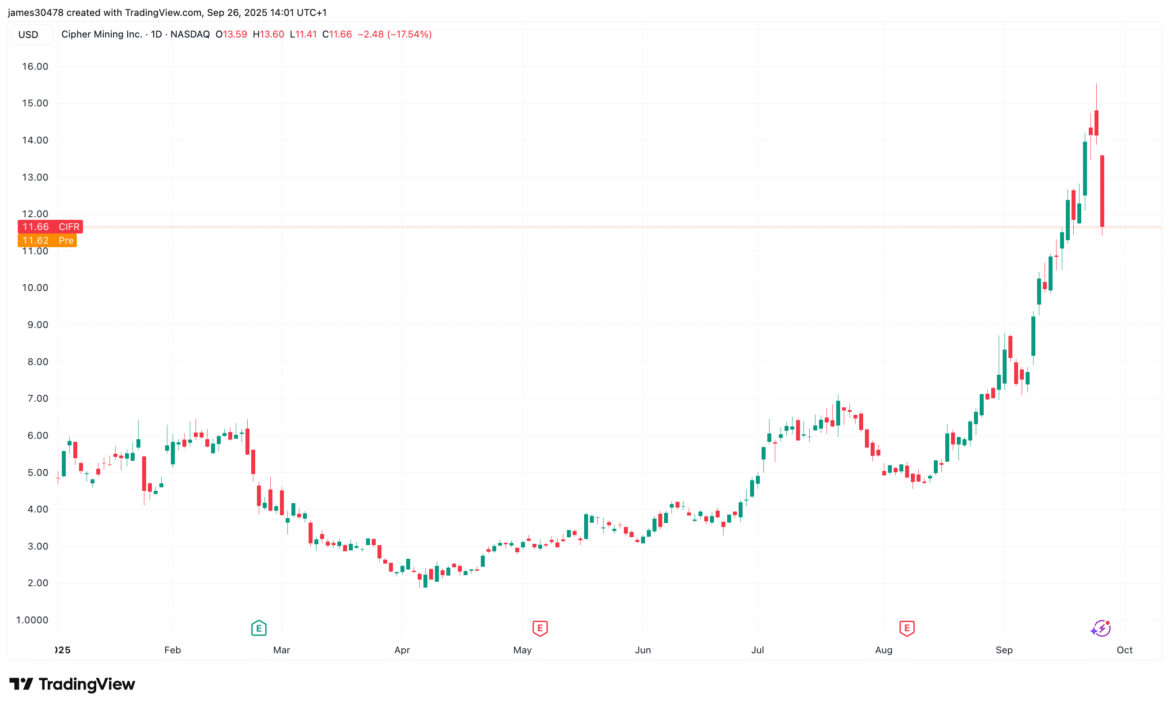
The notes, senior unsecured obligations, are convertible at an initial price of $16.03 per share, a 37.5% premium to Thursday’s $11.66 close. Investors may require repurchase in 2029 at par, while Cipher can redeem starting in 2028 if shares trade 30% above the conversion price.

Net proceeds of $1.08B will fund capped call transactions, the Barber Lake data center buildout, and expansion of its 2.4 GW high-performance computing pipeline.

The financing comes as Cipher yesterday secured a $3B AI hosting deal with Google and Fluidstack.

CIFR shares fell as much as 17% on Thursday and are. down a further 1% in premarket trading at $11.55.

The decline in the stock price Thursday was likely driven by delta hedging activity from banks involved in the convertible note deal, which often pressures shares in the short term as counterparties manage their exposure. Similar price action has occurred following past convertible note offerings at Strategy and Semler Scientific.


Source link

September 27, 2025 0 comments
0 FacebookTwitterPinterestEmail
Slips to 6-Week Low at $20, But Potential Trend Shift Emerges
Crypto Trends

Slips to 6-Week Low at $20, But Potential Trend Shift Emerges

by admin September 27, 2025


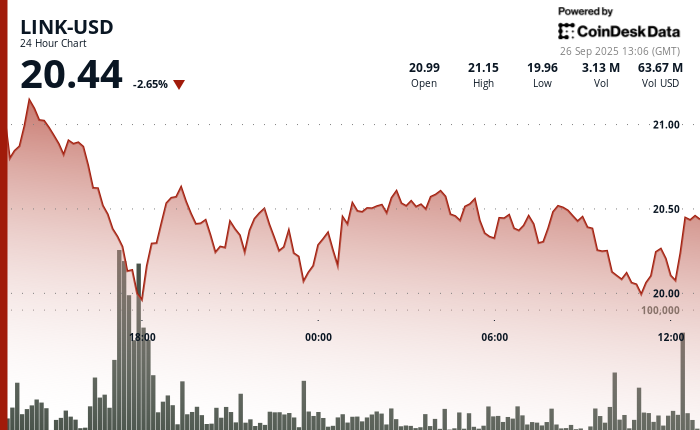
Native token of oracle network LINK$21.04 has sunk to its weakest price since early August, giving up past weeks’ gains amid broader crypto market weakness.

LINK dipped briefly below $20 multiple times overnight from Thursday to Friday, declining around 4% over the past 24 hours and down nearly 28% from the August highs.

The move happened despite consistent buying activity. On Thursday, wealth management firm Caliber (CWD) bought another $4 million in LINK tokens as part of its digital asset treasury strategy. With the latest purchase, the firm brought total LINK holdings to $10 million, according to the press release.

The Chainlink Reserve, a facility that purchases tokens using revenue from protocol integrations and services, taking supply off from the open market, also bought on Thursday nearly 47,903 LINK, worth just shy of $1 million at current prices. The initiative has purchased over 370,000 tokens ($7.5 million) since its August launch.

Despite the bearish trend, LINK is showing signs of snapping its downtrend with buyers’ defending the $20 price level, CoinDesk Research’s technical analysis model suggested. However, bulls have to push through the subsequent resistance cluster around $20.57 for a more persistent trend shift.

  • Price Movement: LINK retreated 5% from $21.16 to $19.95 before rebounding to $20.26, showcasing substantial intraday fluctuation with firm support at the $20.00 psychological barrier.
  • Macroeconomic Influences: Broad-based cryptocurrency volatility mirrored wider risk-aversion sentiment as bitcoin fell below $109,000 and major altcoins tumbled.
  • Microeconomic Components: Outstanding trading volume exceeding 5 million units during the selloff suggested institutional participation, while the following recovery on continuous buying interest indicates robust underlying appetite for LINK tokens.
  • Volume Assessment: Outstanding volume of 5,031,849 units during decline created firm support at $19.95 threshold.
  • Support Zones: Essential support region identified between $19.95-$20.00 with multiple successful validations.
  • Resistance Objectives: Subsequent resistance cluster positioned near $20.57 with intermediate resistance at $20.30-$20.35.
  • Momentum Signals: Bullish measured move formation indicates sustained upward momentum capacity.


Source link

September 27, 2025 0 comments
0 FacebookTwitterPinterestEmail
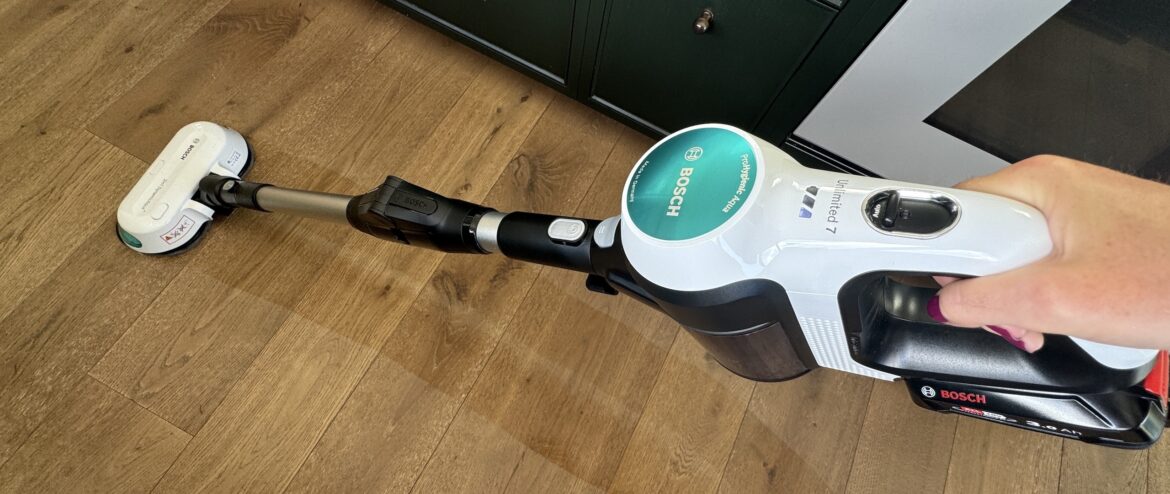
Bosch Unlimited 7 Aqua vacuum testing mop function on wood floors
Gaming Gear

Bosch Unlimited 7 Aqua review: a 2-in-1 vacuum-mop that’s great for freshening up floors

by admin September 27, 2025


Why you can trust TechRadar


We spend hours testing every product or service we review, so you can be sure you’re buying the best. Find out more about how we test.

Bosch Unlimited 7 Aqua: two-minute review

The Bosch Unlimited 7 Aqua is marketed as a hybrid hero: part cordless vacuum, part mop, all in one sleek stick. It sits alongside the regular Unlimited 7, which is a standard cordless vacuum, but the Aqua version comes with two floorheads: a powered vacuum head, and a mopping head with suction. As such, it’s a direct rival to Dyson V15s Submarine, but with a lighter feel and a friendlier price. However, after using it for nearly three weeks, I found it wasn’t quite up there with the best wet and dry vacuums on the market.

On test, I found this vacuum light and nimble, with a properly practical design. There’s a long, flexible nozzle attachment for getting behind radiators, and the main vacuum wand can be released to bend forwards to 90 degrees too, enabling me to skim under sofas, kickboards and low tables without crouching or dragging furniture around.

However, it’s not well suited to strenuous cleaning. With the vacuum head attached, suction was strong enough for everyday crumbs, dog hair and dust bunnies, but not on a par with the best cordless vacuums on the wider market – it struggled to get fine dust out of carpet and wasn’t great on edges, either. The mop head did a decent job of freshening up hard floors, but tended to smear spillages around rather than mopping them up. Plus, the gap between the two rotating pads meant several passes were required for complete coverage. Both the dustbin and water reservoir are quite small, which means frequent emptying and refilling.

Still, if you live in a smaller home, perhaps with mostly hard floors, and are just looking for an all-in-one solution for everyday use, the Bosch Unlimited 7 Aqua is well worth a look. You’ll still need to dig out the mop for more thorough cleans, but this stick vacuum will help keep things fresh in the meantime. Read on for my full Bosch Unlimited 7 Aqua review.

It comes with plenty of accessories and spares (Image credit: Future)

Bosch Unlimited 7 Aqua review: price & availability

  • List price: £499.99 / AU$699
  • Launch date: January 2024 (AU), April 2024 (UK)
  • Available: UK and Australia

In the UK, the Unlimited 7 Aqua officially launched in April 2024, and it’s already seen some decent discounts. The list price is £499.99, but at the time of writing I spotted it on offer for £379.99 with free delivery (which actually makes it cheaper than the base Unlimited 7). Considering the Aqua version comes with a handy mop head as well as the standard vacuum attachment, it feels like a no-brainer if you’ve got hard floors.

Over in Australia, the Unlimited 7 Aqua arrived in January 2024 with a price tag of $699. That puts it neatly in line with the rest of the Unlimited 7 range, which varies between AU$549 and AU$749 depending on which bundle you go for (extra batteries, pet brushes, that sort of thing).

I haven’t spotted any consistent discounts yet, so it’s probably safest to assume it’ll be sold close to full price for now. Sadly, Bosch doesn’t sell its vacuums in the US, so the Unlimited 7 Aqua won’t be making its way across the pond as far as we know.

Sign up for breaking news, reviews, opinion, top tech deals, and more.

As for where it sits in the market, the Aqua is at the lower end of the premium sector in both territories. But given the solid build quality, the option to mop and vacuum in one go, and Bosch’s reputation for durability, I’d say it’s pitched fairly.

  • Value for money score: 4 out of 5

Bosch Unlimited 7 Aqua specs

Swipe to scroll horizontally

Weight:

6.4 lbs / 2.9 kg

Dimensions (H x W x D):

51.6 x 9.9 x 53in / 131 x 25.2 x 134.5cm

Floorhead width:

9.8 in / 25cm

Filter:

HEPA

Bin capacity:

0.3L

Battery:

18v 3.0 Ah

Max runtime:

40 mins

Charge time:

5 hours

Bosch Unlimited 7 Aqua review: design

  • 2-in-1 vacuum and vac-mop, with separate heads for each
  • Slim, lightweight, yet solid build
  • Flexible wand and bendy hose get into hard-to-reach places

In the box, the Bosch Unlimited 7 Aqua comes with everything you’d expect, and more. You get two floorheads (a powered floorhead for vacuuming and the Aqua mop/vac head), a bendable hose, charging cable, battery pack, docking station, a 2-in-1 furniture brush, both short and long, bendy crevice nozzles, plus four textured pads for the mop.

It’s a generous bundle that meant I could get stuck in straight away without feeling short-changed on accessories. You can also store a couple of the nozzles on the wall-mounted docking holster once you’ve decided where it’s going to live.

The floor head has a motorized brush with soft and hard bristles and LED headlights (Image credit: Future)

The vacuum itself is slimline and lightweight and, crucially, it doesn’t feel top-heavy in the hand the way some stick vacs can. All the attachments click into place with satisfying smoothness, and the release buttons are ergonomically positioned, so swapping heads mid-clean never felt fiddly.

If I were to compare it to a car, the build quality was giving VW energy: solid, reliable, and clearly engineered to last, even if it doesn’t have the glossy, showy looks of a Merc or Beemer.

Switching to handheld mode is very easy (Image credit: Future)

Controls are nice and simple. A single slider toggles between Eco, Turbo and Auto, and I mostly left it parked on Auto. Battery life is shown by three LEDs that switch off one by one as the charge drops. It’s functional, but a bit vague info-wise compared to a modern digital display.

Getting deep under furniture is a breeze (Image credit: Future)

The flexible hose was one of my favorite design touches. It bends like an elbow joint, letting me sweep under sofas and kickboards without crouching. I also made good use of the bendy crevice nozzle, which snaked neatly behind radiators and into tight spots.

The roller floorhead mixes stiff and soft brushes, though I couldn’t see an obvious way to pop the roller out for detangling hair without a screwdriver, which felt slightly old-school.

A small water tank feeds the mop floorhead (Image credit: Future)

The mop head, on the other hand, is refreshingly straightforward: a lozenge shape with two spinning pads that attach via Velcro. Fill the small tank with water (and a splash of floor cleaner if you like), press a button to dampen the pads, click it back into place, and you’re ready to mop. All in all, the Unlimited 7 Aqua’s design is practical, flexible and reassuringly well built. It’s not especially flashy, but it’s smart where it counts.

Bosch Unlimited 7 Aqua review: performance

  • Strong suction and flexible cleaning
  • Mop tends to swish dirt around
  • Small bin and tank need frequent stops

Since the Bosch Unlimited 7 Aqua is a game of two parts, I’ll start by covering the general stuff like ease of use, noisiness and maintenance, then focus on mop-ability.

Maneuvering the Bosch Unlimited 7 Aqua is effortless. Regardless of which floorhead is attached, it glides smoothly across every surface, getting tight to edges and right into the corners with ease, and barely needing any force, thanks to the powered floorhead.

On test, I especially loved the flexible main tube, which I could unlatch and bend to reach right under sofas and low furniture without having to twist my own body like a contortionist. It’s also very lightweight, even for a stick vacuum, so I could lift it up onto the sofas and upholstered ottoman, staircase runner etc.if I was feeling lazy, or switch to handheld vacuum mode if I wanted a bit more precision.

The long bendy nozzle tool is super handy for getting into awkward places (Image credit: Future)

The array of nozzles make the fiddlier tasks easy, too. The crevice tool and furniture brush work exactly as expected, but my fave is the bendy long crevice nozzle, which managed to get into all the nooks and crannies of my fancy (but impossible to clean) radiators and also provided good reach for ceiling cobwebs and curtain rails.

This cordless is so light, I often didn’t bother switching to handheld (Image credit: Future)

While the mop head has a vacuum function, it’s really only designed to clear the way for mopping. For carpets and dirty hard flooring, you’ll need to employ the excellent motorized floorhead.

I loved that it has decent LEDs on the front to illuminate every crumb, and the anti-tangle roller had no truck with my daughters’ long tresses. In terms of noisiness, which I recorded using an app, in Eco mode it was fairly quiet at around 68 dB(A), so I could easily hold a conversation while cleaning. Turbo definitely ramped things up, hitting about 80 dB(A) and sounding punchier, but I used this mode sparingly to save juice so it was never really an issue.

The suction on this thing is way punchier than I expected. Even in Eco mode it guzzled up crumbs, pet hair and muddy paw/boot prints without breaking a sweat. Auto mode was the real star though – I could hear it cranking things up the second I hit a rug, then chilling out again on hard floors.

The red button slides down to drag the bin contents out (Image credit: Future)

The vacuum dustbin was annoyingly small and needed emptying far more regularly than my cordless Miele – this wouldn’t be ideal if you have plenty of pets. On the plus side, it was very easy to empty, and the filter has an easy-clean function whereby you turn the red wheel in the top and the dust pours out. No washing filters under the tap and waiting for them to dry before you can vacuum again.

Mopping

To set the scene, my floors are mostly hard surfaces (engineered wood, porcelain, laminate) and they do not get an easy ride. With two kids, two dogs (including a mischievous puppy), an escapee budgie who thinks he rules the roost, and ponies that seem determined to send half the Devonshire countryside indoors on our boots and clothing, my mop and bucket get a lot of action throughout the week.

With that in mind, it’s fair to say the mop pads on the Bosch Unlimited 7 Aqua had their work cut out. They work by taking clean water from the reservoir to dampen the pads, then spinning fairly quickly as you push along, vacuuming at the same time. The mop head has a button you can press with your foot to charge the mop heads with water.

Press the raised button with your foot to charge the mop heads with water (Image credit: Future)

I found the mop pads spread the water and cleaning solution fairly evenly, except for the dry channel created by the gap between the two, which meant I did need to do multiple passes for full coverage. They definitely did some good, judging by the grubby pads afterwards – which were pretty grim, in a satisfying way.

If I’m honest, it often felt like the mops were pushing the dirt around rather than properly lifting it away. In short, when life got really filthy (pretty much every other day), I still needed to follow up with an old-fashioned mop to tackle the worst of it.

That’s the issue with this style of mop: although the pads are fed with clean water, the dirty stuff stays on them until the end of the cleaning session, when you can remove them and rinse them out or pop them into the washing machine.

In contrast, roller-based wet cleaners like the Dyson WashG1 have a scraper that siphons off dirty water as the mop pad rolls around. That kind of setup does require a separate dirty water tank, though.

The rotating mop pads sit on Velcro and can be removed and washed in the washing machine (Image credit: Future)

That said, for everyday upkeep the Unlimited 7 Aqua was still a handy pal to have around. It gave our hard floors a nice little refresh, and I loved how quick and fuss-free it was compared with lugging out the mop and bucket.

For me, this is the machine to grab for a speedy once-over before guests arrive, i.e. when I want to pretend we don’t spend our days knee-deep in horse muck. But after a muddy hack through the fields or a puppy-induced disaster, the good old faithful mop was called back into action.

Cleaning tests

To really see what this machine was made of, I put the Bosch Unlimited 7 Aqua through a series of at-home tests that aim to replicate the kind of messes real families deal with daily. Here’s how it did.

Test 1: Fine dust
I started with a teabag’s worth of dry tea scattered on both hard floor and carpet. On hard floor, it was flawless – everything vanished in a single pass on Eco, without any effort. On carpet, though, it wasn’t quite as slick. Eco took several passes and still left bits behind until I cranked it up to Turbo, which eventually got the job done.

Image 1 of 2

Tea on hard floor(Image credit: Future)Tea on carpet(Image credit: Future)

Test 2: Larger debris
Next up, 30g of oats scattered across the floor to mimic larger dirt particles. On hard floor it aced the challenge, sucking them up in one smooth pass without shoving them around like a mini snow plough. On carpet, they bounced about a bit at first, but a second pass on Eco cleared the lot.

Image 1 of 2

Oats on hard floor(Image credit: Future)Oats on carpet(Image credit: Future)

Test 3: Edges
I lined oats along the skirting boards to see how close it could clean without swapping to a nozzle and was not terribly impressed. It needed multiple passes and still left a few stragglers that I had to tidy up with the crevice tool.

The edge cleaning test left a fair few stragglers (Image credit: Future)

Test 4: Mop
This was the big one. I spilt milk on dark laminate and set the Aqua mop head to work. At first glance it looked promising… until I stopped and lifted it, at which point milk dribbled back out. Worse, when the floor dried, there was a faint white film where it hadn’t been properly cleaned.

A second test on my engineered timber floor seemed better at first, but a swipe with a wet wipe revealed plenty of dirt was still lingering. Safe to say, I won’t be relying on it for puppy accidents again anytime soon.

Image 1 of 2

I didn’t cry over spilt milk…(Image credit: Future)…until it poured right back onto the floor(Image credit: Future)

Overall, the tests showed that the Bosch Unlimited 7 Aqua is a strong performer on hard floors, handling both fine dust and larger debris with ease in Eco mode. Carpets were more of a challenge. It could cope, but often needed multiple passes or a boost to Turbo to get a thorough clean.

Edge cleaning wasn’t its strongest suit, and the mop function looked good at first glance but ultimately made me sad, leaving behind residue and proving unreliable for all but the quickest spruce-up.

  • Performance score: 3 out of 5

Bosch Unlimited 7 Aqua review: battery

  • Around 30 mins with the powered floorhead for vacuuming
  • Mopping eats battery quicker, around 10–15 mins on Auto
  • Turbo gobbles up the juice – about 9 mins max

Battery life on the Bosch Unlimited 7 Aqua isn’t mind-blowing, but it’s not a total washout either. In Eco mode, I squeezed out a respectable 41 minutes when using the smaller accessories, though the powered floorhead brought that down to about half an hour (28 minutes, if we’re being precise). Flick it into Turbo and the battery evaporates faster than my kids’ snacks after school – you’ll get around nine minutes before it keels over.

Mopping is another level of thirsty: with the Aqua head on Auto mode, I only managed 10–15 minutes before the lights started blinking. That said, I rarely needed Turbo when mopping, so it wasn’t a huge issue.

Charging is where Bosch redeems itself. Yes, it takes a yawnsome five hours if you plug it directly into the vacuum, but if you shell out for a fast charger base (not included as standard), that falls to just one hour, which feels far more realistic for a busy household. The battery is part of Bosch’s 18V Power For All Alliance, so I could technically pop it into a hedge trimmer or drill, which is pretty handy.

Overall, the runtime won’t blow you away, but I never ran out mid-clean in Auto mode. If you’ve got a bigger place or serious messes, a spare battery is your golden ticket.

  • Battery life score: 3 out of 5

Should you buy the Bosch Unlimited 7 Aqua?

Swipe to scroll horizontally

Attribute

Notes

Rating

Value for money

Not dirt cheap, but you’re getting a vacuum and a mop in one, plus Bosch’s solid build. Deals make it even sweeter.

4/5

Design

Slim, light and packed with clever touches like the bendy wand. Feels sturdy and well thought-out, but not flashy.

4/5

Performance

Great suction on hard floors, less convincing on carpets and edges, and the mop turned out to be disappointing.

3/5

Battery

Enough juice for a decent clean, although Turbo and mop modes drain battery fast. Bosch’s fast charger (not included) is a lifesaver.

3/5

Buy it if…

Don’t buy it if…

How I tested the Bosch Unlimited 7 Aqua

I spent nearly three weeks living with the Bosch Unlimited 7 Aqua, putting it through its paces in the chaos of my pet-filled four-bed family home in the country. To keep things fair, I ran TechRadar’s set tests, sprinkling fine tea leaves, scattering handfuls of oats, dragging it along skirting boards, and even pouring milk on my dark laminate to challenge the mop.

Day-to-day, I also used it for real-world chores: sucking up endless dog hair, chasing crumbs under the kitchen table, and tackling the fallout from pony gear being trailed through the hallway. The bendy wand and flexible crevice nozzle got a workout behind radiators and under sofas, while Auto mode proved handy for flitting between hard floors and rugs without me fiddling with settings.

I even gave the mop head a fair chance, though I quickly learned its limitations and gave up using it on Dotty the puppy’s many, many toilet-training fails. I generally found it quick, light and easy to use, even if it couldn’t quite conquer the messiest moments.

Read more about how we test vacuum cleaners.

First reviewed September 2025


Source link

September 27, 2025 0 comments
0 FacebookTwitterPinterestEmail
Niki Head and Chiara Santevecchi to discuss AI at GamesIndustry.biz HR Summit 2025
Esports

Niki Head and Chiara Santevecchi to discuss AI at GamesIndustry.biz HR Summit 2025

by admin September 27, 2025


Niki Head, people and development director at Stellar Entertainment Software, and Chiara Santevecchi, the founder and CEO of Teem Camp, will be taking part in a panel about AI at the upcoming GamesIndustry.biz HR Summit.

In a session entitled “Culture in the age of AI”, Head and Santevecchi will examine how AI is reshaping work culture, as well as discussing approaches for introducing AI tools to employees and how these tools can be leveraged.

Head, who has worked at the Guildford-based Stellar Entertainment since 2021, says that her latest passion is “learning about the opportunities and challenges that AI and emerging technologies bring to the world of work.”

Santevecchi, meanwhile, says that her work at the team-building provider Teem Camp combines “behavioural science and AI with the fun of team play, creating experiences that go beyond ‘team building’ to deliver lasting impact on trust, communication, and well-being at work.”

Head and Santevecchi join a line-up that includes Sarah Brewster, founder of the people and culture consultancy Fresh Seed, as well as Skillfull’s Gina Jackson and Amiqus business manager Liz Prince. Sega Europe’s chief people officer Nicky Ormrod will also be joined by Simon Court and Dan Bobby of Value Partnership to talk about how they put the business back on a positive growth trajectory.

The GamesIndustry.biz HR Summit 2025 takes place next Thursday (October 2) at The Royal Institution in London.

Tickets for the event (which includes entry to the Best Places to Work Awards) can be found here.

The winners of the Best Places to Work Awards will be announced during the HR Summit. The finalists for the awards were revealed last week.


Source link

September 27, 2025 0 comments
0 FacebookTwitterPinterestEmail
DeFi
GameFi Guides

DeFi Community On Alert Following Hypervault’s $3.6 Million Suspected Rug Pull

by admin September 27, 2025


Trusted Editorial content, reviewed by leading industry experts and seasoned editors. Ad Disclosure

Decentralized finance (DeFi) protocol HyperVault is suspected to have executed a “rug pull,” as on-chain analytics account PeckShield noted an abnormal outflow of funds from the protocol, worth close to $3.6 million. 

DeFi Protocol HyperVault Pulls The Rug

According to an X post by on-chain analytics account PeckShield, Hyperliquid-based DeFi protocol HyperVault appears to have pulled a quick one on its users, defrauding them of funds worth almost $3.6 million.

PeckShield noted that the stolen funds were bridged from Hyperliquid to Ethereum, swapped into ETH, and then 752 ETH were deposited into Tornado Cash. For the uninitiated, Tornado Cash is a popular crypto mixer that is typically used by hackers to erase their on-chain trail.

Notably, UPUMP tokens worth $191,494, USDC worth $107,358, WHYPE worth $1.55 million, and several other tokens were stolen from HyperVault. PeckShield noted that HyperVault have also deactivated all their socials – including the X handle – virtually confirming the rug pull.

To explain, a rug pull is a type of crypto scam where developers suddenly abandon a project and drain its funds, leaving investors with worthless tokens. It’s common in DeFi and NFT spaces, where anonymity and lack of regulation make quick exits easier.

HyperVault offered “unmanaged” auto-compounding vaults, strategy adapters, and keeper-bot harvests. These features helped users route their digital assets to lending, looping, and concentrated liquidity venues on HyperEVM.

Another X user HypingBull, commented, saying that they had been warning about HyperVault since September 4. In an X post, the user stated that the protocol’s developers lied to them about audits, adding:

I have just reached Pashov (blockchain audit firm) on Telegram, asking if Hypervaut is doing an audit via them. The answer was: “First time I hear the project with this name”. WTF? This is super suspicious. I am withdrawing all the funds from the protocol until the team clarifies what’s going on.

Unfortunately, users continued to deposit funds into the DeFi protocol, lured by the protocol’s promised 90% APR yields on HYPE tokens. However, the extraordinarily high-yield promises at the time did not raise the alarm among users.

That said, the HYPE token appears to be minimally impacted by this suspected rug pull, as it is trading at $42.89 at the time of writing, up 2.8% on the day. However, the token is down almost 25% over the past week.

Crypto Still The Wild West?

While the total crypto market cap now hovers over $3.8 trillion, the safety of users continues to be a major factor hindering the industry from mainstream adoption. For example, crypto phishing attacks recorded a significant surge in August 2025, impacting as many as 15,230 victims, resulting in a loss of $12 million in user funds.

Similarly, the THORChain Founder lost $1.35 million earlier this month after a deepfake Zoom and Telegram scam. At press time, Bitcoin (BTC) trades at $109,488, down 1.6% in the past 24 hours.

Bitcoin trades at $109,488 on the daily chart | Source: BTCUSDT on TradingView.com

Featured image from Unsplash.com, chart from TradingView.com

Editorial Process for bitcoinist is centered on delivering thoroughly researched, accurate, and unbiased content. We uphold strict sourcing standards, and each page undergoes diligent review by our team of top technology experts and seasoned editors. This process ensures the integrity, relevance, and value of our content for our readers.


Source link

September 27, 2025 0 comments
0 FacebookTwitterPinterestEmail
Xbox ROG Ally Prices Revealed, Pre-Orders Now Live
Game Updates

Xbox ROG Ally Prices Revealed, Pre-Orders Now Live

by admin September 27, 2025


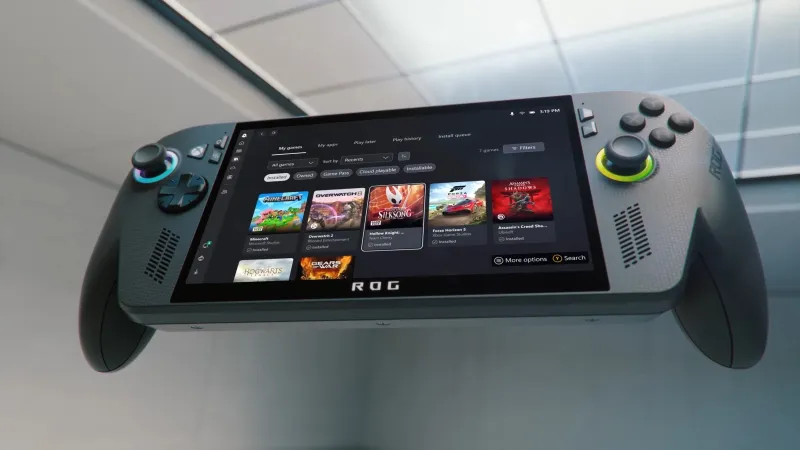
Microsoft and Asus have revealed the price points for their two models of the handheld PC, the Xbox ROG Ally. And, unsurprisingly, they’re not cheap.

The Xbox ROG Ally was revealed in June during the Xbox Game Showcase and is an Xbox-branded model of Asus’ Steam Deck competitor, the ROG Ally. The device’s primary selling point is its ability to run Xbox games and apps natively, including those from Game Pass, allowing players to access their Xbox software library on the go. Powered by Windows 11, the Xbox ROG Ally can also run other platforms such as Steam, Battle.net, and GOG.


Launching on October 16, pre-orders are now live in 38 countries for the two models: The ROG Ally and the more powerful ROG Ally X. Here’s what they cost:

Xbox ROG Ally X (1TB): $999.99

Xbox ROG Ally (512GB): $599.99

Click image to enlarge

These premium prices were to be expected (especially since the standard ROG Allies are generally quite expensive), but the sticker price may sting from potential Xbox converts still reeling from Microsoft’s recent announcement of a second price increase to its Xbox Series consoles starting next week. Xbox and Asus likely knew it would have to bite the bullet as well, as they seemingly withheld revealing the price for as long as possible while eying the economy to determine the appropriate pricing. It will be interesting to see how many players will be willing to shell out that kind of money for an ROG Ally, given the rising prices of video game hardware across the board going into the holiday season. 

If you’re looking to buy an Xbox ROG Ally but can’t decide between the two models, you can read more about the specs of each version here. Do you plan on buying an Xbox ROG Ally? Let us know in the comments.


Source link

September 27, 2025 0 comments
0 FacebookTwitterPinterestEmail
Our Favorite Wi-Fi Router Is $20 Off
Product Reviews

Our Favorite Wi-Fi Router Is $20 Off

by admin September 27, 2025


Are you constantly resetting your dated router, or feeling like your streaming isn’t as snappy as it used to be? You might consider upgrading your router, and our favorite Wi-Fi router, the Asus RT-BE58U, is currently marked down by $20 on Amazon. For just $130, you could upgrade your whole house to Wi-Fi 7, and get all the benefits that come with it.

Photograph: Simon Hill

Importantly, the Asus RT-BE58U support Wi-Fi 7, the latest and greatest in in-home wireless internet. If you want to learn more about the benefits of the new standard, make sure to check out our full explainer that breaks down all of the technical details. The practical benefits are speeds up to four times faster than Wi-Fi 6, lower latency, and better handling for more connections to the router. While these devices were expensive at launch, as prices have come down and device support has risen, they’ve become worth the extra price.

The Asus mobile app gives you a surprising amount of control over your Wi-Fi settings without having to dig into the even more detailed admin panel. With excellent feature support, you can configure your network-wide VPN, or create separate networks for smart home devices and guests. If you want added security or parental controls, Asus offers those with no additional monthly fee.

We were impressed with the RT-BE58U’s range right out of the box, with our reviewer Simon Hill saying it covered his two-story, 1,600-square-foot home without any extra help, although he noted that sometimes devices would switch to the slower 2.4-GHz band at the edges of the range. If you think you’ll need extra coverage for your larger-than-average house, you can use Asus’ AiMesh feature to easily add extra routers or range extenders to your setup.

Of course, it still has all the wired connections you’d expect from a modern router, with three gigabit LAN ports, 2.5- and 1-gigabit WAN ports, one of which is also a LAN port, and USB WAN for 4G LTE and 5G mobile tethering. As long as you don’t have an expansive home, the Asus RT-BE58U should cover almost all of it with fast, reliable internet, and it’s easy to set up and configure to your needs, but you can always check out our full roundup of the best Wi-Fi routers if you aren’t sure.


Source link

September 27, 2025 0 comments
0 FacebookTwitterPinterestEmail
ROG Xbox Ally vs. Steam Deck
Game Reviews

ROG Xbox Ally vs. Steam Deck

by admin September 27, 2025


The ROG Xbox Ally finally has a price tag, which is $600 for the base, and $999 for the “X” variant, giving us the chance to properly pit it against competitors and determine which one is worth your hard-earned, inflated bucks.

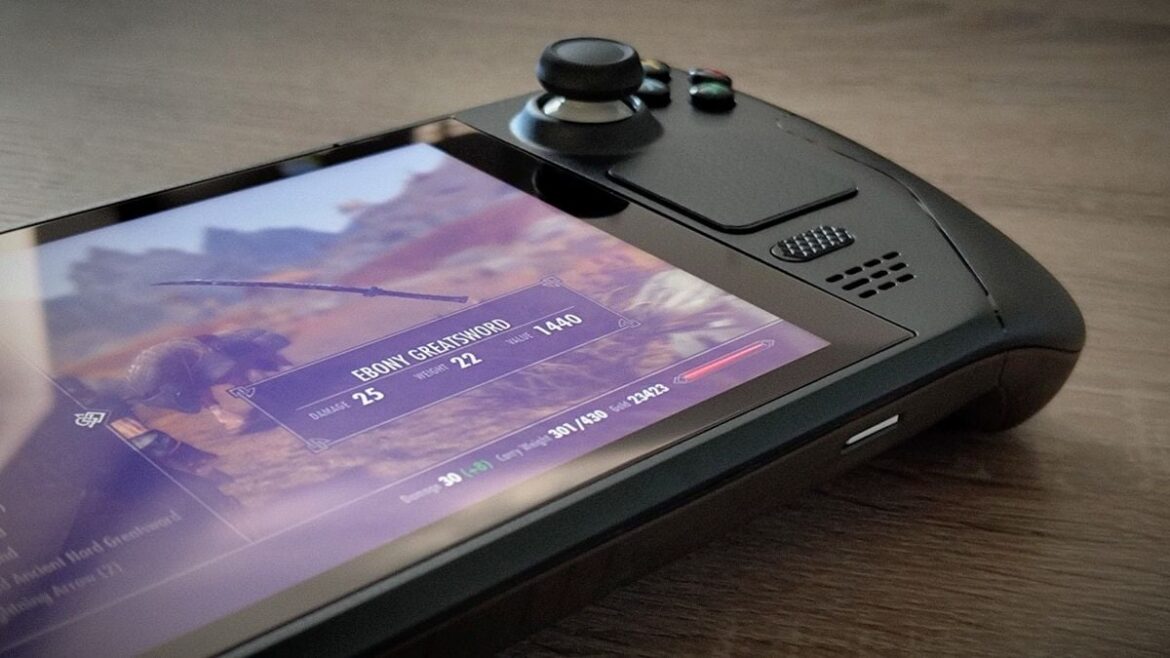
The Steam Deck is the leading PC handheld at the moment, being Valve’s massively successful hardware product after a series of trials and errors, though its cheap price comes at the cost of performance.

So, being the hottest two PC handheld consoles at the moment, we’ve decided to compare them directly, both on hardware, software, potential, and, naturally, their price-to-performance ratios.

Should you buy the Steam Deck or the ROG Xbox Ally?

Firstly, we will have to take a good, hard look at each of the handhelds’ components and see how well games run on them. We will use PC equivalents to gauge the performance, as well as dedicated Steam Deck and ROG Ally benchmarks for this segment. Secondly, we’ll analyze their operating systems, game libraries, and what you could get running on them, even if not by default.

Lastly, we’ll compare prices, how they reflect the above, and whether or not you should dish out the dosh for any of these handheld systems.

The components and performance

The following table contains each of the devices’ components, which are the most important bits of any given machine.

ROG Xbox Ally ($599)ROG Xbox Ally X ($999)Steam Deck OLED 512GB ($549)GPU: Integrated “Van Gogh” RDNA 2 GPUGPU: Integrated “Strix Point” RDNA 3.5 GPUGPU: Integrated RDNA 2 GPUAPU: AMD Ryzen Z2 A – 4 cores, 8 threads, up to 3.8GHzAPU: AMD Ryzen AI Z2 Extreme – 8 cores, 16 threads, up to 5GHzAPU: 6nm AMD ZEN 2 APURAM: 16GB LPDDR5X-6400RAM: 24GB LPDDR5X-8000RAM: 16GB LPDDR5-6400Storage: 512GB SSD with micro-SD card slotStorage: 1TB SSD with micro-SD card slotStorage: 512GB NVMe SSD with high-speed micro-SD card slotOS: Windows 11 Home (exclusive “Xbox” variant)OS: Windows 11 Home (exclusive “Xbox” variant)OS: SteamOS (Linux-based)Screen: 1080p 7″ IPS 120HzScreen: 1080p 7″ IPS 120HzScreen: 1280×800 7.4″ HDR OLED 90Hz

The base ROG Xbox Ally is strikingly similar to the Steam Deck OLED 512GB. I chose this one in particular since it fit the price range well and is internally the most competitive for the sake of this comparison, which doesn’t remove the fact that a $320 Steam Deck LCD exists, but it’s generally weaker with a worse screen, APU, GPU, and other internals.

Both the base ROG Xbox Ally and the Steam Deck OLED carry 16GB of specialized DDR5 RAM, the former having the somewhat more performant LPDDR5X variant. Both carry an AMD APU with RDNA 2-based graphics, though Valve does not go into the specifics of its CPU and GPU models. The ROG Xbox Ally features the Zen 4-based Ryzen Z2, whereas the Steam DECK is stuck with an older architecture, carrying a Zen 2-based APU instead.

This makes the ROG Xbox Ally fresher, newer, and likely more performant in modern titles, given that support for this architecture is likely to continue for the foreseeable future.

When it comes to the screen, the ROG has a standard 1080p resolution and a 7-inch screen size, with a 120Hz refresh rate that should make any gaming experience very smooth and HD due to the high pixel density on such a small screen.

Steam Deck, on the other hand, has a low 1280×800 resolution, which does help with performance but looks nowhere near as good. It does have an HDR-capable OLED screen, which is as good as it gets, but the 90Hz refresh rate also won’t feel as smooth as what the ROG offers.

But the one handheld that stands out the most here is the ROG Xbox Ally X, the thousand-dollar option that has all the bells and whistles of a modern PC machine. With a great APU, a newer RDNA 3.5-based GPU, and 24 gigs of RAM, the Ally X edges out both of the other consoles by a wide margin.

These high-powered internals will reflect on battery life, which is bound to drain much quicker on both the ROG Xbox handhelds, while the Steam Deck should cruise smoothly at low temperatures and a lower power draw.

In most games, both the ROG Xbox Ally variants will probably win over the Steam Deck OLED, but I wouldn’t bet on the first one doing so all the time. It’s 50 bucks more expensive and has much newer components, but shouldn’t have a dramatically bigger performance, given both it and the Steam Deck have an RDNA 2 GPU integrated.

We’ll have to wait for a full release to see benchmark numbers, but I feel like it’s safe to say that the ROG Xbox Ally is the clear winner in the performance category, since it’s literally years ahead in its APU architecture and other internals.

Operating systems, game libraries, and potential

The Ally is big, bulky, and beautiful. Image via Asus

Both ROG Xbox Ally variants run a homebrew Xbox OS based on the Windows 11 Home edition. This OS eliminates many features of the desktop Windows experience to improve battery life, reduce background processes, and overall help the handheld achieve better performance. This OS fork is currently exclusive to the ROG Xbox Ally but is going to be released to the wider public at some point in the future.

Steam Deck OLED runs Valve’s Arch Linux fork, SteamOS, which is a custom-built operating system tailor-made for gaming, especially on Steam itself. Valve develops and maintains the OS and manually certifies games for the Steam Deck, which now largely feature a “Steam Deck” graphics setting within their options menu. Based on Arch Linux, it draws next to no power, has minimal background processes, and is almost the perfect way to game without being bogged down by your OS.

However, there are pros and cons to the SteamOS, precisely because it is based on Linux. Windows 11 is the default OS for most home computing devices nowadays, and installing any app, Steam included, onto it is pretty straightforward. To expand your domain beyond Linux, you’d have to install Windows on the Steam Deck on your own, which isn’t guaranteed to work well out of the box, requiring further tinkering to be done correctly.

Meanwhile, the ROG Xbox Ally can and will run any Windows app, and you can do with the system whatever you please, with a dedicated button taking you to the regular Windows desktop in an instant.

The Steam Deck is also pretty much bound to Steam, with Game Pass only available via streaming, which drains battery life and has tremendous input lag and quality issues. The ROG Xbox Ally has the Xbox app, so natively running Game Pass is no biggie, and likely even intended.

What’s more, the ROG Xbox Ally can run Steam and Steam games, though without Steam Deck verification, which shouldn’t be an issue, especially for Xbox Ally X users who will be able to run most games at satisfying performance with upscaling.

Thus, the Xbox Ally gives you the best of both worlds, trading in custom-made stuff for extra freedom and power.

Price, worth, and conclusion

Steam Deck remains competitive at this price range, especially with its $320 cheapest option, which, though weaker, is the deal of the century. Image by Destructoid

The ROG Xbox Ally is a $599 machine, its big brother a $999 option, while the Steam Deck OLED sits at $549. All three are capable machines that’d offer you a tremendous amount of customization, freedom, and on-the-go gaming, no matter the genre. However, being so close in price, and with similar if not better internals, the base ROG Xbox Ally is an enticing offer over the Steam Deck OLED, while the Ally X remains out of reach as way too expensive.

Though it will offer a lot more than the base version in terms of raw performance, the screen remains the same, and so do many other things, which are not worth the extra $400 in my opinion.

If you are a fan of Valve and how they’ve been handling (pun intended) the Steam Deck, its SteamOS (which can also be installed on the Ally), and the store all of this is named after, then sticking to your guns won’t hurt you all too much.

After all, the Steam Deck is a capable machine, has Valve itself verifying games’ performance on it, and an OS that’s as fast as they come.

Is it worth $549? Probably, but compared to the ROG Xbox Ally, it should reduce its price to $499 due to its more aged components. That should put it ahead of the Xbox Ally as the better option, but right now, with these prices, I would choose the base ROG Xbox Ally personally, since you can do whatever you want with the thing, including installing SteamOS and doing as Valve does.

Like our content? Set Destructoid as a Preferred Source on Google in just one step to ensure you see us more frequently in your Google searches!

Destructoid is supported by our audience. When you purchase through links on our site, we may earn a small affiliate commission. Learn more about our Affiliate Policy


Source link

September 27, 2025 0 comments
0 FacebookTwitterPinterestEmail
$154 Million XRP Short Appears on Hyperliquid, Here's Worst Scenario
NFT Gaming

$154 Million XRP Short Appears on Hyperliquid, Here’s Worst Scenario

by admin September 27, 2025


A high-risk play has appeared on Hyperliquid after a trader known for large bets returned with $4.2 million USDC. This was put to work straight away. The account went into leveraged shorts, targeting both Bitcoin and XRP, drawing most attention to the latter.

According to Lookonchain, the trader put together a short position worth 2.78 million XRP — that is about $7.5 million in margin, but they went for 20x leverage, which means the total notional exposure ended up being more than $154 million. 

The average entry was around $2.71 per token, just as XRP tested the lower end of its recent trading range.

What’s liquidation price?

The liquidation data makes it pretty obvious where the danger zone is. If XRP goes up to $3.06, the position will have to close, which could wipe out millions in collateral. 

The size of this bet is made even bigger by the background: XRP has been all over the place since it hit $3.70 in August, dropping to $2.70 in September but still way up from earlier in the year. With liquidation only 13% away from spot, there is not much margin for error.

The same wallet is also shorting 1,366 BTC with 40x leverage, but it is XRP where the squeeze potential looks brutal. If it goes beyond $3, it will be a total disaster. Thus, traders all over the market are keeping an eye on this high-risk player to see if they can make it through or if they will end up in the liquidation headlines.


Source link

September 27, 2025 0 comments
0 FacebookTwitterPinterestEmail
crypto
Crypto Trends

South Korean Actress Sentenced For $3-M Crypto Scam

by admin September 27, 2025


Trusted Editorial content, reviewed by leading industry experts and seasoned editors. Ad Disclosure

South Korean actress Hwang Jung-eum was handed a suspended prison term on Thursday after a court found she took company money and used most of it to buy cryptocurrency. According to the Jeju District Court, the total amount involved was about ₩4.34 billion — roughly $3.1 million — and the case has stirred sharp public reaction and industry fallout.

Court Hands Suspended Sentence

Based on reports, the court sentenced Hwang to two years in prison, but the sentence was suspended for four years, meaning she will not go to jail unless she breaks the terms of probation.

Prosecutors had asked for a three-year prison term. The court applied the Act on the Aggravated Punishment of Specific Economic Crimes in reaching its verdict.

Judges said factors such as full repayment and Hwang’s lack of a prior criminal record weighed in favor of leniency.

The Charges And How The Crypto Moved

Reports have disclosed that the alleged embezzlement took place across 13 separate transactions in 2022. About ₩4.2 billion of the money was used to buy crypto, while smaller sums covered property taxes and local levies through credit card payments.

According to charging documents, the withdrawals were recorded as provisional payments or advances and were later routed from the agency’s accounts into accounts controlled by Hwang.

Total crypto market cap currently at $3.69 trillion. Chart: TradingView

Crypto: Repayments And Admissions

Before the verdict, Hwang repaid the full amount, according to media reports and statements from her agency. Two large repayments were made on May 30, 2024 and June 5, 2024, reportedly funded by selling personal assets.

Hwang publicly apologized in court and in statements, calling the moves a misjudgment and accepting responsibility for her actions. Her agency has said that, as of mid-June 2025, all financial obligations between the actress and the company were settled.

Industry Response And Repercussions

Broadcasters reacted quickly. Based on reports, some networks edited Hwang out of programs, and a number of brand deals were paused or canceled.

The damage is both legal and reputational. While the court noted that the agency operated as a one-person company and that outside victims were limited, advertisers and networks tend to move fast when a high-profile legal case emerges.

Broader Questions About Celebrity Finances

Legal observers say the case highlights growing scrutiny of how entertainers handle company funds and crypto investments. South Korea has been tightening rules and oversight around virtual assets, and this verdict could signal stricter enforcement in the future.

Featured image from Unsplash, chart from TradingView

Editorial Process for bitcoinist is centered on delivering thoroughly researched, accurate, and unbiased content. We uphold strict sourcing standards, and each page undergoes diligent review by our team of top technology experts and seasoned editors. This process ensures the integrity, relevance, and value of our content for our readers.


Source link

September 27, 2025 0 comments
0 FacebookTwitterPinterestEmail
  • 1
  • …
  • 129
  • 130
  • 131
  • 132
  • 133
  • …
  • 764

Categories

  • Crypto Trends (1,098)
  • Esports (800)
  • Game Reviews (772)
  • Game Updates (906)
  • GameFi Guides (1,058)
  • Gaming Gear (960)
  • NFT Gaming (1,079)
  • Product Reviews (960)

Recent Posts

  • This 5-Star Dell Laptop Bundle (64GB RAM, 2TB SSD) Sees 72% Cut, From Above MacBook Pricing to Practically a Steal
  • Blue Protocol: Star Resonance is finally out in the west and off to a strong start on Steam, but was the MMORPG worth the wait?
  • How to Unblock OpenAI’s Sora 2 If You’re Outside the US and Canada
  • Final Fantasy 7 Remake and Rebirth finally available as physical double pack on PS5
  • The 10 Most Valuable Cards

Recent Posts

  • This 5-Star Dell Laptop Bundle (64GB RAM, 2TB SSD) Sees 72% Cut, From Above MacBook Pricing to Practically a Steal

    October 10, 2025
  • Blue Protocol: Star Resonance is finally out in the west and off to a strong start on Steam, but was the MMORPG worth the wait?

    October 10, 2025
  • How to Unblock OpenAI’s Sora 2 If You’re Outside the US and Canada

    October 10, 2025
  • Final Fantasy 7 Remake and Rebirth finally available as physical double pack on PS5

    October 10, 2025
  • The 10 Most Valuable Cards

    October 10, 2025

Newsletter

About me

Welcome to Laughinghyena.io, your ultimate destination for the latest in blockchain gaming and gaming products. We’re passionate about the future of gaming, where decentralized technology empowers players to own, trade, and thrive in virtual worlds.

Recent Posts

  • This 5-Star Dell Laptop Bundle (64GB RAM, 2TB SSD) Sees 72% Cut, From Above MacBook Pricing to Practically a Steal

    October 10, 2025
  • Blue Protocol: Star Resonance is finally out in the west and off to a strong start on Steam, but was the MMORPG worth the wait?

    October 10, 2025

Newsletter

@2025 laughinghyena- All Right Reserved. Designed and Developed by Pro


Back To Top
Laughing Hyena
  • Home
  • Hyena Games
  • Esports
  • NFT Gaming
  • Crypto Trends
  • Game Reviews
  • Game Updates
  • GameFi Guides
  • Shop

Shopping Cart

Close

No products in the cart.

Close